 SOUNDTRACK: RHEOSTATICS-The Whale Music Concert, 1992 [Sets 1 and 2] (2005).
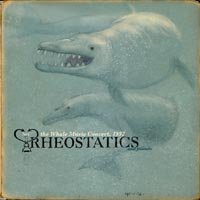 This is the second Rheostatics live CD that’s available from Zunior. Whale Music is a simply stellar album, and this concert focuses primarily on that disc, although there are a couple older tracks (and the then-new “Michael Jackson”) as well. The big surprise about this concert is that they consider it a night of 1,000 stars: there are a ton of guests in this show (the majority of whom are even more obscure than the Rheostatics, I believe–the only two that I knew of before hand were Kevin Hearn and Andy Stochansky (who drummed with Ani Difranco for a while). But guests like Tannis Slimmon, Doug Feaver, Tim Mech, Kevin Gould, Richard Burgman, Mitch Perkins and The Bird Sisters (and if you like Canadian music, the link for The Bird Sisters is to a cool blog called Raised on Canadian Radio: 1 Song per Day by 1 Uniquely Canadian Artist) add to the party atmosphere.
Anyhow, sometimes guests can really heighten a show. And that’s the case for some of this show. Of course, anyone who has read my criticisms of rap knows that I feel that too many guests spoil a good thing. None of these guests are “too much” here, but it does seem odd that there are so many!
The first set of this concert is awesome (the whole show was recorded to DAT and although there are a few weird drop outs, the set sounds great). It’s like a greatest hits of early Rheos songs; the band sounds tight and they really respond to the audience. “Rock Death America” is blistering, “Green Sprouts” is a fun little treat and “Palomar” and “King of the Past” sound fantastic. It’s also funny to me how many great songs Tim Vesely is responsible for. And they all seem to be featured here.
Set 2 is a little different. It feels looser, a bit sillier, and is filled with much more Dave Clarke. I’ve always known that Clarke was the goofball of the band. He’s the chatty one when they’re onstage–he is full of goofy banter and he introduces most of the guests. While it’s true that the Rheos aren’t entirely serious, I find Clarke’s goofiness to be a little off-putting. And by the end of Set 2, he sees to have taken over the show. He’s an excellent drummer, no doubt, but he hams it up on “Full Moon Over Russia” and I think he rather ruins “Queer” (one of my favorite songs) with his , yes, bad, singing. And on “When Winter Comes,” the bridge is so beautiful, that his rantings in the verses are just too much for it. Having said that, while I like the sentiment of “Guns” (although it is oversimplistic), the drum solo bit is quite cool.
The other thing that I kind of dislike in Set 2 is that the songs are really extended, but not in a good way. I mean, “Queer” is 9 minutes, but it’s a lot of Dave Clarke and Kevin Hearn’ keyboard silliness. And “Record Body Count” seems really slowed down or something. However, the band closes strong with a great version of “The Wreck of the Edmund Fitzgerald” and what sounds like an amazing version of “Horses” (the beginning of “Horses” is cut off, which is a shame).
So overall, despite some flaws, this is a really good live release. And since, it’s only $8.88, it’s totally a bargain. Plus, there’s some great artwork by Martin Tielli as well.
[READ: August-September 2011] Tree of Codes
I first heard of this book through the Five Dials news feed (and there’s an excerpt of the book in Five Dials Issue 20 which you can see here). Anyhow, I read about it and decided I wanted a copy for myself. It’s not cheap, but you can just look at it to see how complicated it was to make (or you can watch this video) .
So this book follows the exact same logic as Of Lamb. But unlike Harveys’ execution, in which she wrote out the words and made them into her own pages, Safran Foer creates a story out of an extant book. The way the book is presented, he literally cuts out what he doesn’t want you to read. It’s also fascinating to me that this book came to my house in the same week as Of Lamb did (even though this came out much earlier–but as Foer says, there was no way for him to advertise the book). They are absolutely similar ideas and yet their execution is so radically different.
When you open this book, you see holes. Lots and lots of holes. The pages have massive squares of text missing. When you first open it, you can see many layers of text, some penetrating thirty pages down. So you can read words that comes later in the book (you often read words from the following page if you don’t hold the page up correctly or put a piece of paper under each page). Don’t believe me? Here’s a picture:
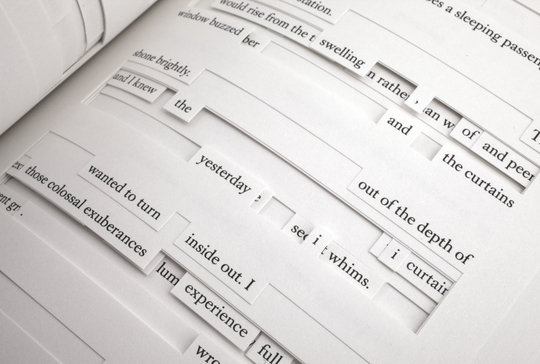
Safran Foer’s explanation (at the end of the book) is that he loved the book The Street of Crocodiles by Bruno Schulz (which I’ve never heard of and have no idea what it’s about). And he often saw a story within the story. So, he decided “to use an existing piece of text and cut a new story out of it,” using only Schulz’s words. But rather than presenting it in a conventional way (or even in an unusual way like Of Lamb), he wanted to push the boundaries of what a physical book could do. He was “curious to explore and experiment with the die-cut technique.”
And so you get this fascinating book that feels like paper dolls. It is much lighter than it should be and it feels so delicate. In fact every time I turned a page I was afraid I would tear it. (You definitely won’t get the same feeling for this book on a Kindle!).
Sarah groaned and said she’d never read it. But I thought it was awesome. And I wanted to show it to people. (For more about the process, including some videos, check out the Visual Editions site).
But here’s the problem with the book. I’ve spent some 400 words writing about it but haven’t said anything about the content. I’ll admit it’s hard to read. Physically, yes it is a challenge, although it’s a fun one. But I found it hard to follow the narrative. In fact I have now read the book three times and I think I am finally getting the hang of reading it. I mean, he leaves in everything that you need, including commas (some of which are in the middle of a blank page) and quotation marks in which the text doesn’t start until the next page–it’s real reading work. And not all of the sentences start with capital letters–which is fine, I mean we can’t ask TOO much of the process–which also breaks the flow of reading.
The story is more than a little strange. It’s also a little strained–if you’ve ever tried to make your own text out of someone else’s words, you know it doesn’t always flow very easily–but Safran Foer does a pretty remarkable job of using the words effectively. There’s only one or two sentences where I felt the word use was clunky.
So Safran Foer’s story deals with parents. The narrator’s father seems obsessed with Mother, but not in a good way. And we get the sense that Mother doesn’t treat father very well. Until eventually he seems to have been left for dead. Then the story follows the narrator the “I” character. He goes on a journey (imaginary?). When he returns his father has come back.
Despite Safran Foer’s dislike for this idea, i found it to be far more like a poem than a story. And far more evocative than narrative.
Perhaps the strangest thing in the book is that the title Tree of Codes appears five times and yet each time it is clearly cut out of other words (as opposed to virtually every other place where entire words are used). But it’s very hard for me to guess what the original words could have been. It’s strange that the title would feel more artificial than anything else in the book.
Overall, I enjoyed reading it (even three times–it’s very short with like a sentence per page). A lot fo work went into it, clearly. And it’s obvious that there’s some kind of story there. But I think if you’re willing to accept the artificial constraints, it works quite well. Is it a good story? Well, I guess not really.I can’t said I understood what was happening on a literal level, but the whole experience was very cool.

 I Just Read About That...
Leave a comment