 SOUNDTRACK: METRIC-Live at the 9:30 Club, June 18, 2009 (2009).
 I love the new Metric album and this tour supported that disc, so, it’s a win-win for me! Metric sound great live, and the notes on the NPR page where I downloaded this give a fascinating history of the band. Evidently they burnt out in 2005 while touring for Live It Out. So they made solo records and kind of went their separate ways. Then:
in March 2008, Haines was on stage, in the middle of a live solo performance, when she had an epiphany: She was tired of being sad. While playing one of the standout cuts from her gloomy but beautiful album Knives Don’t Have Your Back, Haines stopped, turned to the audience and said, “I don’t want to play these songs anymore.” Instead, she spent the rest of the show performing her favorite Metric tunes.
The band reunited and made Fantasies, the poptastic album that I love so much.
This show plays pretty much all of the album (except “Collect Call” and “Blindness”) and they rock the house! The only odd part for me is the opening track, “Satellite Mind.” The band chose to have the first half of the song performed with just the keyboards, so it has no bottom end at all. It sounds kind of tinny and weird. Then when the guitars and bass kick in (for the rest of the show, thankfully), the band sounds whole again.
The other weird thing is Emily Haines’ banter. I like chatty lead singers (–The Swell Season’s banter is great, Wayne Coyne’s banter is emotional but enjoyable), but there’s something about Haines’ musing that are just kind of…lame. She’s very earnest, but her thoughts are kind of, well, vapid. So, I just skip past all the chatter and enjoy the music.
It’s a really great, rocking set and the crowd is very into it.
[READ: August 25, 2011] Atlas of Remote Islands
If you need an unusual but doubtlessly cool book, my brother-in-law Ben is your man. For my birthday and Christmases he often gets me books that I have never heard of but that are weird and interesting.
This book is no exception. As the subtitle states, this is a book about fifty remote islands that virtually no one lives on. True, some are inhabited, but many are not. And a goodly amount of them are little more than icebergs (I wonder how they will survive global warming). There’s even one that the accompanying story implies was created from bird droppings.
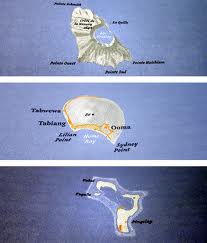 The book is beautifully created with a gray on blue or gray on orange page set up. The islands are lovingly detailed (with physical mapping, not political).
The opening page spread locates these islands on the globe for you. And you can see where all of these specks are located.
The credits state that Schalansky designed the pictures as well as wrote the book so good for her. The most confusing thing is what a name like Schalansky is doing on a German woman. The book was written in German and was translated by Christine Lo.
The introduction places Schalansky as a young person looking at maps and globes and feeling, in general, that she’d been lied to (she was in East Germany and when the wall came down she saw what the West German maps said about East Germany and realized that maps could not be trusted). She also points to the convention on most maps of making Africa much smaller than it actually is. She acknowledges that rendering a sphere onto a piece of paper isn’t easy, but oftentimes the choices of how the countries look is more political than anything else. The introduction also whets our appetite for some of the stories told within about these islands and their discovery stories.
For each island there are two pages. On the left side, we have text: factual details and a story about the island. On the right side is a map of the island itself. It’s beautifully rendered with some place names, where applicable.
So the left side tells us something like this:
Lonely Island (Russia). 20km2| uninhabited. Then there’s distances to other locations: (330 km to Rudolph Island) and a timeline of when the island was discovered as well as any other interesting historical incidents.
Then comes the write up. Here’s the thing. The write ups are not about the history of the island. Rather, they are about an incident at the island. Whether it is the discovery of the island, or perhaps a journal entry from a seafarer, or an apocryphal story about the islanders (if any) or even a brief explanation about the discovery and subsequent extinction of the Steller’s sea cow.
The stories are usually quite interesting and are a cool look into the history of seafaring. However, the stories can also be frustrating because they don’t follow up or give an indication of what’s happening there now. Since most of the stories are a hundred years old, some contemporary info would be great!. Even the uninhabited statement is often undermined by the story itself. There were people there but they are no longer present? Or it was uninhabited but now there are people? What about Macquarie Island which has 20-40 residents?
The other frustrating thing about the book is that Schalansky mentions things but then does not put them on the map. I understand that the map is meant to be pure and a physical landmarks only, but a marker for the cool things she mentions would be very nice. Also, while I appreciate all of the names that the islands have on them “Precarious Point” “Punto Baja” “Asimutodden” there are some spots on the island that are labelled with just a number. Lonely Island for instance has •20 •30 •23 and •12 listed. What could that mean?
Despite these minor complaints, the book was really cool. I loved seeing the details of these fascinating islands. Like the smallest one which is 0.8km2 (Tromelin–which it says has 4 residents!) or the island that is a long strip in the shape of an O which is in total 5km2 (Fangataufa–where the French detonated an atomic bomb–bastards). I also loved Takuu, which the illustration suggests is almost entirely underwater (but still visible).
It’s a weird and wonderful book and something I never would have found on my own. Thanks, Ben!

 I Just Read About That...
this is why we adore wordpress: great writers introducing us to books we haven’t read, places we haven’t seen, thoughts we want to think about … thanks so much for this!