 SOUNDTRACK: FOO FIGHTERS-Wasting Light (2011).
 The Foo Fighters are huge. Duh. But when I think of that, it amazes me that a) the Foo Fighters are the band from “the drummer from Nirvana” and that b) while Dave Grohl knows his way around a melody, he is a metal dude at heart, and some of his most popular songs are really heavy. He can scream with the best of them.
I’ve enjoyed the Foos for many years, but I didn’t listen to their previous discs all that much (or at least I didn’t listen to the mellow disc from In Your Honor and I don’t remember anything off of Echoes…), but this new one is fantastic. There’s not a dull song on the disc, and Grohl has hit new heights of catchiness and singalong-ness.
I also like how noisy the disc is. It opens with some great discord before turning in a majorly heavy rifftastic scream fest in “Bridge Burning.” Despite the screaming and noise of the opening, the chorus is super catchy. “Rope” was said to be inspired by Rush. Knowing that, I can hear a lot of little Rush-isms in the track: The main riff is very Rush-like, there’s a cymbal tapping that reminds me of Neil Peart in the verses, as well as a little drum solo in the middle (with a cowbell!) and the solo is very Alex Lifeson. (It also feels longer than 4 minutes).
“Dear Rosemary” features Bob Mould on backing vocals (but you can hardly tell it’s him). It’s got a great chorus as well. “White Limo” is a wonderful punk song, completely incomprehensible lyrics and all. Meanwhile “Arlandria” (whatever that means) is another totally catchy track (I find myself singing it a lot).
“These Days” should be the next single: catchy and easy on the ears. I wonder why it hasn’t been released yet. “Back and Forth” has another great noisy riff. One thing that I like a lot about the Foos is that they put different things in the same song: so “A Matter of Time” has a very simple verse and a catchy chorus, but there’s some really buzzing heavy guitars too. “Miss the Misery” has a kind of sleazy feel which I think is new for the Foos. And “I Should Have Known” is a kind of angry ballad (I’d like to see Richard Thompson cover it).
The final track, “Walk” is a fast rocker that sums up the album really well. Bravo Dave Grohl. I can’t get enough of this disc, regardless of how popular it is.
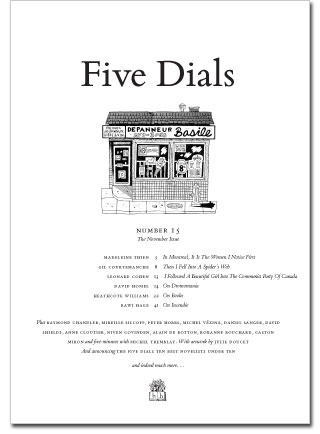
[READ: July 2, 2011] Five Dials Number 15
After the brevity of Number 14, Five Dials Number 15 comes back to a fuller size. It’s strange to me that the issue is titled The November Issue, in part because they never tell us when the issues were published, but even more because this is actually the Québec Issue. Most of the authors are Quécbecers and the issue release party was in Québec as well.
I’d like to point out that while I was looking something up about this issue (more later) I discovered the Five Dials News Page. There are currently 43 pages worth of posts. But most of them are short. If there are any especially noteworthy ones, I’ll add them to reviews of future issues, but for the most part so far they’re just announcements of how well received their books are (I’ve already made notes to read two of them). They also give release dates for the issues, which is how I have been able to retroactively attach dates to some of them.
There are many Québecois writers included in this issue (thoughtfully translated into English), as well as some standard features by Alain De Botton and frequent contributors David Shields and Raymond Chandler.
CRAIG TAYLOR-On Our Québec Issue, and Young Novelists
Taylor’s introduction discusses many Canadian’s attitudes about Québec and their (seemingly perennial) vote concerning separation from the country (“so, let them go”).

creepy beard
The confusing thing here is that it appears that Taylor is Canadian (or at least lived there in 1995/6). But surely he is British, no?
There’s lots of information about Québec in here but no grand statement (except that Celine Dion’s husband’s beard is still creepy).
He also introduces a new section called “Our Town” which is all about London. The final section of the note says that
we are releasing our second Five Dials list of Top Ten Novelists Under Ten (or ‘Ten Under Ten’,or ‘Ten-Ten’, or as some of the writers themselves call the list: ‘Tintin.’) As you know, many of the writers we chose for our first Ten Under Ten list went on to things such as high school.
This is how I discovered the Five Dials News page, because there certainly was no Ten Under Ten section in a previous issue of the magazine. Of course, nor is there any mention in the news that I have seen. So I can’t decide if the whole thing is just a big joke or what. I assume it is (but I’d hate to not give credit to the waaaay precocious kids at the end of the issue).
GASTON MIRON-Poem: That Damned Canuck (Translated by Gail Armstrong)
Miron was one of the first writers to write about a Québecois language. Both the French (Québec?) and English are included.
Then throughout the issue, there are several items that fall under the heading: How to Understand Québec.
How to Understand Québec #1
Madeleine Thien-Transient Beauty
Thein notices how many Québec women are simply beautiful. Stunning. In fact, she has to wonder where the older, uglier women have all gone.
DANIEL SANGER-Currentish Events: Mushroom Man
This is an amusing (historical) tale of a man who is so disappointed by the state of food in Canada that he goes about trying to make his own. Specifically, he is disgusted by the (white, soft) bread. When he hears of a new baker starting up a shop, he travels home to France to get recipes for the man. He also considers making his own cheese. But the titular mushrooms concern his attempts to get everyone to forage for the amazing mushrooms in the woods.
GIL COURTEMANCHE-A Single Book: A Sunday at the Pool in Kigali
The single book is The Kiss of the Spider-Book, which Courtemanche wrote. He describes what happens to a new writer who is courted not for his talent but for his product. It’s a cautionary tale with a potentially happy ending.
RAYMOND CHANDLER-The List: What was it Like
A list of 17 of Chandler’s similes that were found in one of his notebooks. I rather like ‘A mouth like a wilted lettuce’
NIVEN GOVINDEN-Our Town: Into the Québec
This is an amusing story of a dine and dash that takes somewhat somber overtones when the dashing slows down and we get to meet the characters a bit more intently; they prove to be not the young free spirits we initially meet.
How to Understand Québec #2
DANA BATH-On the Concept of Us
This brief article addresses the issue of feeling welcomed in Québec. Bath is from Newfoundland, and her friends state that the French aren’t like us. But Bath’s first experience in Québec is of a comforting croissant that feels like home.
How to Understand Québec #3
ANNE CLOUTIER-On Bear-Spotting (Translated by David Homel)
This is a brief but intense account of returning to her vacation home and almost literally walking into a mother bear and her cubs. The way the situation is resolved is funny, scary and rather amazing.
ROXANNE BOUCHARD-Fiction: Love Stories (Translated by David Homel)
I didn’t enjoy this story very much as it was basically one long argument. However, the subtext of the story is that the author quotes or paraphrases from at least a dozen Québec authors (some of whom are translated into English). I think this would have been cooler if I knew the originals, but I understand why it’s important to experience the unknown.
LEONARD COHEN-Poem: The Part Was Over Then Too
I’m not sure if Cohen is a good poet, but I enjoyed reading this one.
DAVID HOMEL-Fiction (excerpt): Le droit chemin
Homel is doing double duty in this issue, as both a translator and here as a writer.
After an awkward beginning, this story settles down into a tale of dromomania, or a strange wondering (like an awake sleepwalking). There’s an interesting comparison of dromomania (which is exclusively done by men) and hysteria (wandering internal parts).
In hysteria, women’s organs travelled through their bodies. In dromomania, men’s bodies travelled through space in the form of fugue. These disorders don’t exist any more, and that’s a damned shame. So much poetry was lost when psychiatry started cleaning out its house.
MIREILLE SILCOFF-Fiction: Appalachian Spring
This was a wonderful story. But it has two very distinct parts that seem irreconcilable (but they’re not). It begins with a woman who has lost much of the fluid in her spinal cord, which means her brain is simply banging around in her head. She has surgery and then wears a very tight body stocking all the time as her body tries to adjust to the new fluid.
Eventually she gets fed up with the pampering and she up and leaves for Ojai California. She had arranged to rent a house for a time while the owner was away. The house is idyllic and perfect. And then she discovers a secret about the artist who owned the house previously. She breaks out of her exile and goes to the library to find out more about this artist.
This was a very moving and intensely personal story. The artist in question is May Wallace, but I can’t tell if she was real or not.
NIVEN GOVINDEN-Madonna of the North
Govinden imagines what Madonna would have been like if she embraced her Québecois genes rather than her Italian ones. Lightly amusing.
How to Understand Québec #5
ROBBIE DILLON-On Culture
This is very funny brief about finding “culture” the Québecker way. For a most authentic experience one must go to Super-Sexe. (I stayed in a hotel a few blocks from this establishment and the bouncers and clientele terrified me). The editors interrupt his story twice in the name of common decency. Very funny.
HEATHECOTE WILLIAMS-Poem: Books
A poem about the first flash mob in Europe. It gets funnier as it goes along.
How to Understand Québec #6
SARAH STEINBERG-On Seeming Polite And Maybe A Little Shy But Really Just not Wanting to Make an Ass of Myself in French
The perennial fear: wanting to fit into some place by learning the language but never feeling like you know it well enough. This story is especially painful as she has been there for four years!
ROBERT LÉVESQUE-An Explanation: Here is why critics matter. We need them in Québec (Translated by David Homel)
Lévesque cites several examples of the critic in art (like ‘Jedeiah’ in Citizen Kane) or real life critics like Karl Kraus
How to Understand Québec #7
REBECCA HARRIES-On the Montreal Forum
This is a paean to the beloved Montreal Forum. Harries grew up watching the Habs play at the Forum, especially during the dynasty of the 1970s. She speaks of going to the Forum, recently converted into a movie theater, in which you can see the old rink, and maybe feel the ghosts of the greats (The Candaiens have not won a Cup since 1993–they left the forum in 1996.)
ÉMILIE ANDREWES-Fiction: Instinct (Translated by David Homel)
This is a story of persecution. A man, who decides everything based on instinct, believes that he should be building a fortress. He constructs several ramparts in his yard and sits in preparation. But the story is told as a letter. And the letter is written to the men outside who are trying to tear down his ramparts. They believe he is violent, even though he is unarmed and has made no threats to anyone.
The seriousness of the story (and its broader implications) grows with each paragraph.
MICHEL VÉZINA-Memoir: Street Noise (Translated by David Homel)
Vézina talks about how the music he grew up with turned him into a punk. And how even at 50, he is still a punk. Since I don’t know who he is, I can’t attest to that. There’s a tone of protesting way too much here.
How to Understand Québec #8
MAXIME CATELLIER-On Small Town Escape (Translated by David Homel)
Born into the wrong century, Catellier mourns the passing of trends that she has just missed out on. The piece is quite venomous, with particular barbs sent towards: “the most vile press conglomerate in the history of print media in Canada. It would bean insult to newspapers everywhere to call it a ‘newspaper’.”
RAWI HAGE-A Single Film: Incendies directed by Denis Villeneuve
Rawi Hage is one of the authors whose books (Cockroach) I wrote down to read because of the Five Dials news pages I mentioned above. In this critique, Hage rails against the sloppiness of this heavily touted and lauded film (which I’ve never seen). The main criticism
In Villeneuve’s film, the same character might jump from using a Lebanese dialect to a Jordanian or Moroccan one in the very same sentence. To an American reader this doesn’t mean anything, but Hage cites this as a comparison had been written in a mish-mash of Patois, Creole and Parisian French, with a jolt of Tunisian dialect thrown into the same sentence?
To which I say, or Texan, New York and Boston. That’s pretty damning and fairly surprising that no one has ever said if anything about it.
CLAUDE MATHIEU-From the Archive: The Author of Le Temps d’Aimer (Translated by David Homel)
This is a fascinating story about author Jean Gautier. The story is about Gautier’s downfall and suicide and is told from the point of view of Gautier’s friend. It turns out that Gautier, a successful author published as his final work, a poem which was the exact word for word (including punctuation) copy of a poem written by Adolphe Rochet. Further investigation shows a striking similarity between all of Gautier’s and Rochet’s works. It is an odd and incredibly compelling tale. Although the ending of the piece (which occurs on the next page in the magazine and almost seems like it’s not connected) added details that were more than a little confusing.
HOW TO WRITE A LETTER-Oscar Wilde to Alsager Richard Vian
This letter from Wilde to a young editor is a pitch for a future piece. And it’s quite delicious.
ALAIN DE BOTTON-The Agony Uncle
The questioner asks about failing to live up to expectations and the worry about disappointing people. De Botton talks about Madame Bovary and how, taken from a distance, the story of the lady Madame Bovary is as pathetic as a tabloid headline (which is how Flaubert came up on the story in the first place):
A twenty-seven-year-old woman named Delphine Delamare, née Couturier, living in the small town of Ry not far from Rouen, had become dissatisfied with the routines of married life, had run up huge debts on superfluous clothes and household goods and, under emotional and financial pressure, had taken her own life by swallowing arsenic.
Flaubert sat on this story for a long time. Then he added details, pathos and an understanding of the woman and created a masterpiece (and a compelling individual). It’s another wonderful piece of advice.
DAVID SHIELDS-And Finally…
Shields talks about dying. And he tries to be blunt about it–
Death is not a passageway to heaven but a brute biological fact. We’re done. It’s over. All the gods have gone to sleep or are simply moribund. We’re a bag of bones. All the myths are empty. The only bravery consists of diving into the wreck, dancing/grieving in the abyss.
The end of the article quotes extensively from David Foster Wallace that dread of loneliness and relationships is really just a fear of death. Shields ends by saying that
All of my work is an attempt to do exactly what Wallace called for: aggravate exactly this sense of entrapment and loneliness and death in people, since any possible human redemption requires us first to etc.
MICHEL TEMBLAY-Five minutes with… (Translated by David Homel)
A brief interview from the RueFrontenac.com. The best explanation for not drinking or doing drugs:
I just don’t want my body making me do things that my mind would blame me for the next day.
This is an interview with Claudia Larochelle.
PLEASE WELCOME–The Five Dials List of Top Ten Novelists Under Ten
This is a list (with illustrations of their faces) of the best novelists under age ten that submitted to Five Dials. Marvel at the with of five-year old Elisa Vanvitelli’s I’m Not A Boy, I’m Not A Girl, I’m Not A Lady, I’m A Fixer-ing-man Man.
JULIE DOUCET-Illustrations
The illustrations are slightly cartoony versions of real-life scenes from Québec. Everything feels just slightly cartoony, it’s a neat effect.
There is also an 8 page cartoon which is weird and funny and actually quite poignant, which I assume is by Doucet as well
For ease of searching I include: Quebec, Quebecois, Robert Levesque, Emilie Andrewes, Michel Vezina
And here’s the release news for the issue and the cool poster.

 I Just Read About That...
Leave a comment