 SOUNDTRACK: BASIA BULAT-“In the Night” (2008).
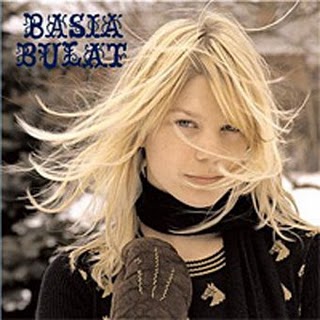 I recently came across Basia Bulat via NPR. She played a Tiny Desk concert and I discovered that she had several other entries in the NPR canon.
Basia is Canadian (of Polish descent); she has a beautiful strong mid-range/throaty voice and a great sense of melody. She also has a bit of a gimmick: she plays all kinds of instruments (guitar, piano, sax, etc) including some really weird and unexpected instruments: Zither, pianoette (!) and autoharp–a couple of years before PJ Harvey brought it back to the mainstream.

pianoette
“In the Night” is a wonderfully chipper poppy song. And that autoharp gives it just a tinge of “huh?’ that makes it more than just a simple pop song. The beat is fast and energetic, the harmonies are wonderful and the melody is top-notch.
I really like this song a lot, and the other snippets of songs that I’ve heard from her are equally wonderful. I’ve even noticed that lately she’s been singing a song in Polish!
[READ: July 12, 2011] “Gastronomania”
I’m not going to go crazy reviewing all of the book reviews in Harper’s (that way lies madness), but occasionally an author I like writes a bit that I want to mention. So Will Self, who I like but have not read a lot of, wrote this essay/book review about food. He reviews three books, but what I especially liked about it was his introduction, which uses Luis Buñuel’s Le fantôme de la liberté [The Phantom of Liberty] as its starting point. In the film (which I have not seen), the house’s dining room is actually a well…watch this clip:
It’s a wonderfully bizarre introduction to an essay about food.
It was unclear to me what made Will Self suitable to review three books about cooking. And then (news to me) he revealed that he used to be a food critic (columns are collected in his book Junk Mail) and that Anton Ego in Ratatouille (yes that Ratatouille) bears “an uncanny, if not legally actionable” resemblance to him.
This essay was so much fun. Self is as viciously negative about these books as he apparently was about food back in the day. But he’s not dismissive of them as cookbooks per se, he’s more about trashing the current worship of food (and many other things too of course).
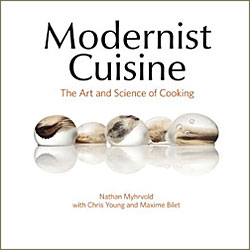 Take Modernist Cuisine: The Art and Science of Cooking a 2,500 page, forty-pound, $625 book that everyone simply must have (and amazingly, is selling well). It features gorgeously photographed scenes of cooking, as well as scene of not-cooking, like a series of photos of eggs the moment a bullet passes through them, which Self decries as “the most high-octane example of food pornography.”
But worse, he says is the tone of the book. Or even the very technology behind this cuisine: “turning liquids into gelled spheres…using hydrocolloids that will gel only in the presence of various ions such as calcium.” Or that you should fill up three baths, “one filled with calcium chloride solution to set spheres two filled with cold water to rinse spheres” Good grief. I highlighted this line from Self because it made me laugh so hard: “One expects in life to be talked down to from time to time , but to be patronized by a cookbook?”
Interestingly, there’s a lengthy (and much more favorable) review of this set in Technology Review (!) magazine (you can see it here). The reviewer, Corby Kummer, raves about the quality of the book (which I think even Will Self would agree to, it looks amazing), but Kummer posits that this will indeed change the face of cooking. And while I can see that some of the information would be useful to even home chefs, I’m doubtful of this assertion:
but my feeling when sampling the 30 courses was that as prices for homogenizers and centrifuges come down, thickening agents become easy to find, and even liquid nitrogen becomes commonplace in professional and then home kitchens, we’ll make our own ketchup and many other staples, and come to cook dishes as basic as fried chicken and hamburgers in completely different ways.
Here’s a centrifuge for only $4,000! Description: “top-notch and uncompromising quality with an affordable price the Labconco Free – Zone Benchtop Shell Freezer Labconco.”
 Less obnoxious is Blood, Bones and Butter: The Inadvertent Education of a Reluctant Chef, by Gabrielle Hamilton (only 291 pages and $26). But Self has it in for Hamilton’s prose. Or not so much her prose as maybe her choices. Like:
She has, she admits in her author’s note, taken a few liberties with the timing and sequence of events, before concluding: “Otherwise, this book is a true account of my experiences as I remember them.” Surely only this last sentence is necessary, and she could’ve done without the “otherwise.”
I concur wholeheartedly. Hamilton talks about what it was like growing up with parents who cook and that she would inevitably become a chef herself. But rather than being simply a story of a chef, she includes her twenty-plus years of not speaking to her mother after their huge fight. Self concludes that this makes it, “if not a misery memoir [then] certainly one that slithers easily enough down the gullet of redemption” and that it “wore him down, as if no life were capable of being related anymore without the obligatory childhood trauma.”
 The final book is Ferran: The Inside Story of El Bulli and the Man Who Reinvented Food, by Colman Andrews. Self ‘s problem is once again with the weird worship of food that is evident here: “Had Andrews simply analyzed the meal he’d eaten…we’d have a perfectly comprehensive view of what Adrià’s innovations consist in”–like this bizarre (to me) foodstuff: “spherified green olives [again with the damn spheres] (intense olive juice enclosed in a skin of olive juice shaped and cured like real olives”. But Andrews’ excessive frothing delivery of the food at El Bulli, “killed my appetite for the experience [of eating there] as effectively as a hit of crystal meth.”

Spherified olives, I gather
I find Will Self to be very amusing, and I’m sure I would like his Junk Mail reviews (in small doses–I think a whole bunch of it might be soul deadening). But if he novels are as amusing as this essay, I need to get to his books pronto.
I agree wholeheartedly with Self that food porn is disturbing; in light of that, I’m amazed I liked Lucky Peach so much.
For ease of searching I include: Luis Bunuel, Le fantome de la liberte

 I Just Read About That...
Leave a comment