 SOUNDTRACK: MGMT-Oracular Spectacular (2008).
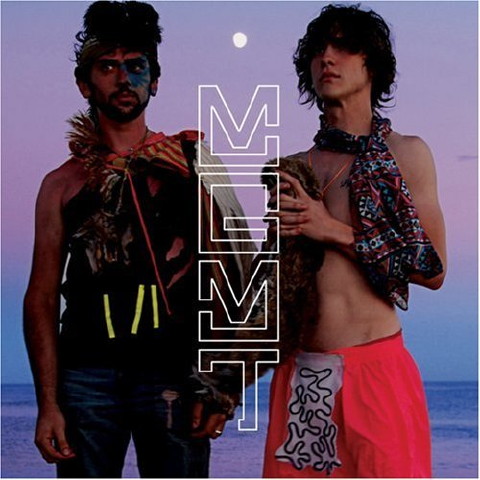 I bought this album a few years after it was hailed as the best album by everyone. I never quite realized that they did all the songs I knew from it, but I was pleased that I bought it. Then I promptly lost the disc. I found it about seven months later in another case (doh!). And I have given it a number of listens since then.
I’m confused as to why this album was so popular. I’m not saying it’s bad, I’m just not sure why it was so hailed. It’s a strange kind of record. There are a number of dancey hits (which aren’t really that dancey or anything), but there’s also a bunch of trippy psychedelic stuff as well.
The opener, “Time to Pretend” has a wonderfully catchy keyboard line that expands into a wonderfully simple, but catchy verse/chorus. “Weekend Wars” reminds me of some of the weirder alternative hits of the early 90s. The sound is kind of trebly and slightly off, but the middle of the song is full of beautiful swells of keyboards, giving it a strangely hippie vibe.
“The Youth” is a slower track which has a gentle sound and a nice chorus. It’s pretty far from the danciness of the opener. “Electric Feel” brings in some disco and funk. The keyboards are very 70s trebly with a big bottom bass.
The standout track is “Kids.” It marries the weird keyboard sound of the opener with a wonderfully catchy riff. It also has a simple chord structure and big drums. It’s the kind of song that sticks in your head from the first time you hear it.
The second half of the disc is where things change and the more psychedelic aspect so the band come in. The album was produced by Dave Fridmann (Mercury Rev, Flaming Lips) and while that style is evident in the front of the album, it’s hidden under the more brash punk sounds. n the last few songs the punky elements are absent and the psychedelia shines through. “4th Dimensional Transition” is a wash of interesting sounds. “Pieces of What” is a simple acoustic guitar with vocals that sound like they come from outer space. “Of Moons, Birds & Monsters” never really coalesces, although the parts are interesting. “The Handshake” is another folkie kind of song with overtones of David Bowie (who is never really absent anywhere on the disc) especially at the end of the song. “Future Reflections” ends the disc with a synthy ballad.
The disc is quite different from the first five to the last five songs. And I find that when I’m enjoying the hits, I’m less excited by the trippy parts (which meander as opposed to the immediacy of the hits). But I think I could find myself enjoying the vibe of the second half of the disc more if the first half didn’t prep me for that stark pop punk sound. I guess it has something for everyone.
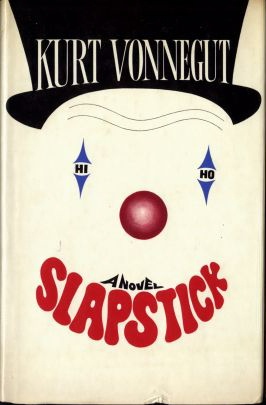
[READ: June 28, 2011] Slapstick
I tend to read books that are long, or at least that feel long. So Vonnegut is like a guilty little pleasure. I read this in three lunch hours. And it felt like something of an accomplishment.
I can honestly say I didn’t enjoy this one as much as his previous books. It was a lot darker and felt a bit more mean-spirited than his others. True, Vonnegut is nothing if not mean-spirited, but there was something different about this one. Was it that the protagonists were two meters tall with six fingers and toes and for the first several years of their lives spoke in nothing but baby talk? Was it that they were so reviled by their parents that they were sent away to the parents’ second home and allowed no visitors? Or was it that Manhattan was now called “The Island of Death?” Or maybe it was just the repeated use of “Hi Ho” at the end of virtually every paragraph.
Or maybe it’s that the story doesn’t really feel complete. There isn’t a lot of story here, but as with lots of Vonnegut, there are a lot of little details that join the story together. The novel is constructed as chapters, but within the chapters are very short almost paragraph long sections separated by dots. These little paragraphs sort of work as small scenes, with most having a kind of punch line at the end (this is not too dissimilar from Breakfast of Champions, but the sections are even smaller here).
The two aforementioned protagonists are as described. But although they speak in nothing but nonsense syllables, they are in fact quite intelligent. Indeed, when they put their minds together (literally) they reach epochal levels of genius. And when they put their heads together they write several massively intelligent treatises and the most popular child-rearing manual in history, So You Went and Had a Baby. Well, actually, Wilbur wrote it for Eliza is illiterate (she just has most of the brainstorms). Technically, the real protagonist of the story is Wilbur, for these are his memoirs.
Wilbur explains his childhood–pretending to be an idiot with his sister whenever others were around, but secretly reading everything they could get their hands on and eavesdropping on all conversations. One day they overhear their mother (on their parents’ annual birthday visit) saying she wished they were dead or barring that, that they weren’t so stupid. The kids aren’t offended (they were never really taught about feelings or love), but they can solve that second wish. So they reveal their intelligence by coming downstairs and speaking in several languages. This, of course, freaks out their parents even more and makes them feel really guilty for what they’ve done to these sentient beings.
The parents hire a series of doctors to see what happened and (in a delightful sequence in which a nasty doctor is called out), they are ordered to be separated from each other–which effectively renders them dumb once again. Eliza is sent away to an institution, but since Wilbur can read, he thrives. He becomes a successful pediatrician. And, several decades later, he is voted President of the United States.
Yes. And the reason he was voted President is because of his brilliant idea: people are sad and violent because they feel they have no one in their lives. So by decree everyone in the country is to be given a new middle name. Any people who receive the same middle name (and number–there are a limited number of words all based on minerals and flowers) are instantly related and are to enjoy all the benefits therein. Which means helping each other out or, in the case of really awful relatives telling them straight out, “Why don’t you take a flying fuck at a rolling doughnut? Why don’t you take a flying fuck at the mooooooooooooon?” [the phrase also appeared in Slaughterhouse-Five, although not in such a glorious fashion as it does here.]. His campaign slogan: a button that read: Lonesome No More.
Now the rest of the story is quite fascinating in its twistings of reality. Most of these have to do with the Chinese. The Chinese have basically dropped out of international communication. They have been working on a technology that makes people smaller (it is much cheaper to feed and clothing tiny people). They achieve their goal with spectacular results. They also steal some documents that Wilbur and Eliza were working on when they were together that talk about the reality of gravity–that it must have been lighter or heavier from time to time (lighter gravity explains how people made the pyramids and the Easter Island sculptures). And so the Chinese learn how to manipulate gravity. The first thing they do is make it much stronger which destroys cities. But then they work on making it lighter as well (which gives all of the men erections).
In his previous novels, Vonnegut made some interesting and valid criticisms of contemporary society. This story just feels kind of nasty all over. Don’t get me wrong, there were funny parts and I really couldn’t wait to see how it would end, but it was still nasty.
Earlier I said that the book is Wilbur’s memoir. Technically that is not true, according to the Prologue. The Prologue appears to be written by Kurt Vonnegut himself. It details a lot of incidents in his own life. How he and his brother were quite different (his brother is a scientist), how their sister died and how they dealt with it. It also states that he and his brother are flying to their Uncle Alex’s funeral. Their sister’s absence is particularly notable on the airplane because there is an empty seat between them. Vonnegut explains that as they were flying he dreamed the contents of this book. And the prologue ends with the words that begin the book:
…my Uncle Alex told me one time [that these words] should be used by religious skeptics as a prelude to their nightly prayers.
These are the words: “To whom it may concern.”
I’m sure there is meant to be a connection between the siblings in the book and he and his sister, but it’s a pretty strange connection.

 I Just Read About That...
Leave a comment