 SOUNDTRACK: BLACK FLAG-Damaged (1981).
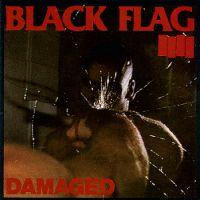 I’ve liked Black Flag since I bought Loose Nut on vinyl way back when (1985, the year punk broke for me). And those four bars were iconic to me even before I had heard a note (although I just learned they are supposed to represent a flag waving).
And this is where their legend really took off. So a few things I never knew about this album until I looked them up recently. 1) That’s Rollins on the cover punching the mirror. 2) He didn’t really punch the mirror (it was smashed prior and the blood is fake). 3) I knew that Black Flag existed for a while before Rollins’ arrival and that they’d had a series of singers before him. But I didn’t realize what a their first EP (Nervous Breakdown–Keith Morris on vocals) came out in 1978, their second EP (Jealous Again–Ron Reyes on vocals–credited as Chavo Pederast (he left the band in the middle of a live show, so they changed his name to that rather offensive one)) came out in 1980. Their third EP (Six Pack –Dez Cadena on vocals) came out in 1981. Rollins joined a few months after that and Damaged–their first full length–came out in December 1981.
“Rise Above” is a wonderfully angry song. The gang vocals of pure empowerment work so well with the chords. It’s still effective thirty years later. “Spray Paint” goes in the other direction: rather than an uplifting, catchy chorus, it’s a deliberately angular chorus that’s hard to sing along to (even for Rollins).
“Six Pack” represents the more “popular” side of the band. And it is a wonderfully funny single. I just can’t decide if it’s serious or ironic (see also “TV Party”). These two dopey songs are great to sing along to and are simply awesome. (Fridays!)
The rest of the album turns away from the lighthearted tracks. “What I See” is a really dark moment on this album. And the negativity is unusual especially given Rollins’ later penchant for lyrics about fighting back. True, Rollins didn’t write these lyrics.
“Thirsty and Miserable” is a blast of noise with some of Ginn’s first real guitar solos (which Guitar World says is as one of the worst guitar solos in history…and I say really? that’s the solo they pick? Ginn has done some pretty outlandishly bad solos over the years…of course the whole list is questionable at best). “Police Story” is a simple but effective description of the punks vs cops scene at the time.
“Gimme Gimme Gimme” seems childish, but that’s clearly the point. “Depression” is a super fast track. (Trouser Press considered Black Flag America’s first hardcore band). “Room 13” is an odd musical track, with pretty much no bass. It’s just some roaring guitars and drums and Rollins’s screams. This track stands out because Chuck Dukowski’s bass propels most of the songs here.
“No More” sounds “typically” hardcore: very fast with the chanted chorus of “No More No More No More No More.” “Padded Cell” is also fast (and is pretty hard to understand) except for the “Manic” chant, but the following track “Life of Pain” features what would become a signature Greg Ginn sound…angular guitars playing a riff that seems slightly off somehow. Compelling in a way that’s hard to explain.
It’s funny that a band that plays as fast as they did also released some pretty long songs. “Damaged II” is almost 3 and a half minutes long. It has several different parts (and a pretty catchy chorus). And the final song “Damaged I” is a kind of crazed rant from Rollins; It’s one of his scariest vocal performances; he sounds really deranged. Especially when it sounds like he just cant think of anything else to say so he just screams maniacally. But his vocals are mixed behind the music as if he’s trying really hard to get heard. There’s very little else on record like it.
It’s a wonderful end to an intense disc, and the beginning of a brief but powerful career.
[READ: March 25, 2011] The Life of Polycrates
I’ve been reading Connell for a few years now. In fact, the first time I posted about his work came with a blistering dismissal of his story “The Life of Captain Gareth Caernarvon” in McSweeney’s 19. That story is included here, and upon rereading it, I learned two things:
- One: context is everything.
- Two: I was totally and completely wrong in that original review, and I take it back.
But before I explain further, some background about this book. This is a collection of eleven stories, eight of which have appeared elsewhere. Unfortunately there’s no dates of publication included so I don’t know how old any of these stories are.
The other thing I’m fascinated about is Connell himself. I’m not the kind of reader who wants to know a ton of details about the author, but I like a little bit of bio (or a photo) when I read someone. The only bio that is consistently presented about Connell is that he was born in Santa Fe, New Mexico. I’m fascinated by this because so many of his stories are set in Europe. So I have concocted a master biography about Connell’s life and how he has lived and toured extensively in Europe, studied theology (and found it wanting) and investigated all of the world’s darker corners.
It’s this latter aspect that really altered my perception of Connell’s writing. I’ve liked the last few things that he’s written, but I fear that I was not looking at him through the proper lens. And this relates back to bullet point one above.
Connell writes in a world not unlike H.P. Lovecraft–a world that is unconventional, dark and more than a little twisted. And yet, unlike Lovecraft, there is very little of the fantastical in his stories. Rather, his characters reside in our own world (with a little chymical help from time to time), but they are all real. They’re just not characters most of us choose to associate with. So, reading that first story in McSweeney’s, where it was so different from all those others, I found it really distasteful. In retrospect, I’m not going to say that it is meant to be distasteful, although some of his stories are, but it was certainly not a pleasant story by any means.
The other fascinating thing to note about this book is that all of the stories are written in short, Roman Numeraled segments. So the title story has 35 segments. But even some of the shorter ones has twelve or thirteen segments (sometimes a segment is just a few lines long). I actually enjoy this style (especially when the segments introduce something totally new into the story–which many of these do).
The Life of Polycrates
“The Life of Polycrates” opens the book. It’s a 77 page novella which is, indeed, about the Life of Polycrates, tyrant of Samos. I don’t know very much about Polycrates (although after reading this story, I guess I do). But from the little research I’ve done, this seems to be an accurate fictionalization of Polycrates’ life from birth to death.
Connell either invented or researched some primary text documents to flesh out the life of this man. It’s a fascinating story: Polycrates was destined to be ruler of Samos (through his family line). But as a young man, while he was away, his father was killed and the murderers took over the throne. Rather than fighting back immediately, Polycrates began a generous program of helping the citizens: donating to the poor, and assisting anyone in need with money or food or anything. He grew very popular, so that when he eventually fought the patricide, the people were all behind him and he became ruler of Samos.
The rest of the story looks at his reign. He was cautious at first (to the detriment of his brothers), but eventually grew confident and lazy. By the end of his reign, he was even ignoring the advice of his soothsayers (and his daughter).
Connell does an excellent job of creating a story that is very much in the style of an ancient Greek text. And that is the main reason why I’ve had a hard time determining whether he wrote the whole story from scratch or if the texts are genuine. There are a few turns of phrase that I found to be especially Connellian, but that’s to be expected. Nevertheless, this was an excellent story, and quite a change of style from Connell’s other works.
Incidentally, the band Kodagain (from Serbia) has made a video to accompany the song
Collapsing Claude
“Collapsing Claude” gets back to the type of story that Connell does best: a story about the seamier side of love and sexuality. Claude is a man who is very attracted to a woman named Mirta. Mirta is a large woman and very animalistic. But after realizing just how crazy he is about her, Mirta takes advantage of him by shacking up with Egon, a beast of a man. Claude is devastated, but Mirta invites him to live with them–at his expense. The worse Mirta treats him, the more he fantasizes about her disgustingness. The ending is deliciously distasteful.
The Dancing Billionaire
“The Dancing Billionaire” is more grounded in a reality that I’m familiar with. If only because he mentions two films that I’ve not only heard of, but actually seen: Top Hat andGold Diggers of 1935. (In my flawed memory, Connell’s stories are mostly set in the Europe of a distant past). This story is about Allen, son of a millionaire who wants nothing more than to dance. His father insists that he find gainful employment.
But whereas a conventional story might show that struggle between dance and work, this story focuses on Allen himself. He goes ahead with his dream and stages a dance recital. It is a disaster. And Allen is changed by the event. While formerly a boisterous, fun individual, he is now hollow, physically and emotionally. His friends are concerned. Is there anything anyone can do to help him? A peacock Rouennaise, perhaps?
Brother of the Holy Ghost
“Brother of the Holy Ghost” is another story that is based on a real person (although this one I am fairly certain is Connell’s own fictionalization). It concerns Pope Celestine V (Pietro da Morrone) who abdicated the throne after five months. It basically details his life: he was an ascetic who lived in a room that was only slightly larger than a coffin, wore a full length hairshirt and ate only bread and water, and talks of his reluctance at first to become pope. There were devious machinations at work to get him into office. And as such, I felt this short story was a little confusing (not least of which because he uses roman numbers for all numbers) but because the politics of the papacy is not really easy to follow (especially around that time). Nevertheless as a character study it was pretty great.
Maledict Michaela
“Maledict Michaela” opens one way and shifts direction about midway through. Michaela is something of a man-eater. Even from a distance she seems to cause men discomfort. And then one day she is seduced by a stranger, and her life changes. Despite the rather simple construct of the story, Connell revels in the discomfort that love causes. And, like with “Collapsing Claude” there is ecstasy in humiliation.
The Life of Captain Gareth Caernarvon
“The Life of Captain Gareth Caernarvon” was the story that I read in McSweeney’s and hated. But now, having read more from Connell and more in this book, I found the story to be quite different from what I remember and in fact I now think it’s very cool. In my memory, this story was exclusively about the Captain killing animals. (And there is a lot about his killing abilities–his is a hunter extraordinaire). I grew weary of the story because it essentially describes in detail all of the game that he has slaughtered during his life (he personally reduced the population of buffalo by a quarter). What I must have missed last time are two small sections about his childhood and how it impacts his adulthood, which were fascinating and a bit chuckle inducing. I also really enjoyed the discussion about whether a Frenchman or an Englishman would taste better.
I’m going to blame the circumstances of my initial reading for disliking this story so much the first time. It’s certainly not a pleasant, feel-good story, and it definitely revels in the bloodletting, but there is plenty more to it which I missed the first time around. At this point I only wish he had continued the story with one more section about his fetish.
Molten Rage
“Molten Rage” struck me as a twisted morality tale about the dangers of listening to the overly virtuous. Massimo works at a forge. One night he meets Klaus who tells him essentially that he will only be free when he removes the shackles of work. Massimo does so with gusto. And by the end, we see just what listening to stranger’s advice can do for you.
The Chymical Wedding of Des Esseintes
“The Chymical Wedding of Des Esseintes” was a wonderful trippy story that was as funny as it was weird. Des Esseintes (where does he come up with names for his characters?) is on holiday, bored out of his mind. And then a native comes up and invites him to a wedding. He has nothing better to do so he agrees to go. The native takes him through back alleys and numerous “shortcuts,” most of which involve much alcohol, until they reach the destination. When they get to the wedding, nothing is as it seems. The brief denouement is fantastic.
The Search for Savino
“The Search for Savino” was a story I was glad I read twice. Savino is an artist (fictional, I presume). He had a bizarre technique for creating his art that involved the human body (others’ bodies). On my first read, I didn’t quite “get” the way that he was doing his art. On my second read, I got it, and was astonished by what I was reading. It is an incredibly creative and dark story. And, as with many of Connell’s best stories, it is full of many different pieces that make up the story: interviews, descriptions of the art from private collections, and even a (hilarious) interview with a constable who asks unintentionally humorous questions. This was really fantastic.
The Slug
“The Slug” was the first story I read in the collection (I wanted a short piece to whet my appetite). And I wound up reading a second time when I read the stories later in order. This is probably the darkest story in the collection (it is reminiscent of Connell’s other works), so I didn’t anticipate the breadth of work in the collection. On the second read, however, the story really came to life for me. I realized it wasn’t just a story that reveled in filth.
Although in many ways it does revel in filth. Dino has reached a nadir in his life. He makes a lot of money, he has friends, he seems like he should be happy, but he is miserable. It’s only when he notices a man begging for money that he hits upon a way to transcend his current static life. As a writer, Connell really explores details. And this piece does not shy from Dino’s details as he really lets himself go. This is the kind of story that I would have dismissed if I read it out of context, but it works very well within a collection of Connell’s other stories about the darker side of humanity.
Peter Payne
“Peter Payne” stands out in this collection (and for all of Connell’s fiction) because it is explicitly set in (more or less) contemporary America. Peter Payne is an Evel Kenevil type daredevil who leaps him motorcycle over various things. [I am vaguely amused by this because there was a real Peter Payne–a 14th century theologian–who I would think would normally be the subject of one of Connell’s stories].
Although this story showcases Payne’s career (and inevitable failure) as a daredevil, the heart of the story is his son, Blaine. Blaine sees what his father does and learns to have no fear.
This was the most recognizably human story in the collection. For although it was dark, it was actually set in the daytime, in a warm place. It almost felt like a David Lynch film: surface normalcy (within reason), but under the surface, percolating rage. There are also a few other currents of domesticity: an alcoholic friend, a wife who has let herself go and, of course, the desire to make more money doing what you love to do. This is certainly the safest story of Connell’s to start with for anyone fearful of reading about the degraded side of humanity.
——-
Because I don’t know when these stories were written, I can’t make any statements about the “development” of Connell as a writer or about the subjects of his writing. Rather, I will say that this collection has really opened my eyes to Connell’s diversity. I’ve always known that he was a fearless writer, but it’s also nice to see him using his talents to tackle a more conventional story.
By the way, if you like this collection, it looks like the folks at Chômu Press (“New vistas of irreality”) have also published other collections of border-pushing fiction.

 I Just Read About That...
[…] March 29, 2011. Connell included this story in his recent collection, which I have reviewed here. I have totally changed myopinion of thes tory, and here’s the new […]
[…] Paul Debarski reviews The Life of Polycrates and Other Stories for Antiquated Children at I Just Read About That. […]
[…] each story in this fascinating and sensual collection as at least one other has already done it very well, and because they’re just so good you ought to read them yourself. If you do, prepare to […]