 SOUNDTRACK: THE TRAGICALLY HIP-Trouble at the Henhouse (1996).
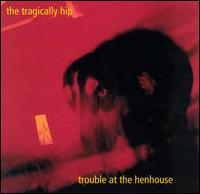 After the major high of Day for Night, The Hip followed it up with Trouble in the Henhouse.
It opens with “Giftshop” which sounds like it could have come straight from Day for Night. “Springtime in Vienna” is a marvel. The opening is quiet with Downie’s almost whispered voice telling a compelling story until it blasts out with a wonderful chorus. “Ahead by a Century” opens with a catchy acoustic intro. Again, the harmony vocals add wonders to the verses.
But overall the album feels like the Hip exhausted their angst and anger on Day for Night and have chosen to go with a more mellow sound here. It almost seems like Day for Lite. Songs like the final track, “Put It Off” dabble with intensity, but have more atmospherics than powerful guitar and verses. It’s like the come down after a big party.
The most peculiar song on the disc is “Butts Wigglin” which was used on the Kids in the Hall Brain Candy soundtrack. It doesn’t really fit on this disc, but it’s such a great song that I understand them not leaving it off. It’s very silly and musically groovy with almost no guitars and all keyboards. It’s a goof, but nice to see the lighter side of the band.
I find Trouble to be really enjoyable in itself, but it kind of pales in comparison to the previous two. Nevertheless, these three albums are a wonderful trio of discs released by a great Canadian band.
They celebrated this era of the band with a live album the following year.
[READ: January 26, 2011] “An African Sermon”
Of all the stories in this Summer Reading Issue of The Walrus, this one was the most powerful. (It wasn’t my favorite because it was rather distrubing) but it had a strong impact on me.
The bulk of the stoiry is set on a train in Africa. Two white men introduce themselves to each other; the older one confides that he hopes no Blacks come into thier car. Of course a Black does come into thier car and the younger man, who is a preacher, tries to embarass the racist man but immediately shaking the black man’s hand.
The black man is hostile to the young man’s advances, more or less shutting him out entirely. Indeed, when the young man follows him to the dining car to talk (he is genuinely sympathetic to people, but he’s also very curious about the man and wants to pry a bit) the black man (whose name is Leonard Sagatwa) listens briefly and then, claiming a headche, returns to the cabin room and goes to sleep.
During the night, the train stops because of a malfunction and it will be some time before it is fixed. The priest goes out to the landing to find something to occupy himself when Leonard comes down. He says to the priest that he wants to tell his story. He wants to tell it once, to a complete stranger so that he can unburden himself and then be done with it. The priest is tickled to hear the story.
But the story is one of Rwandan genocide: Hutu vs Tutsi, brothers who turn against each other; Leonard’s brother turning on him and his family. Killing family members slowly, cruelly, calling them cockroaches. It is harrowing and the priest is taken aback by the brutality.
But at the end of the story, the priest is resilient and insists that Leonard can forgive his brother. Never, says Leonard.
The priest is able to use this story for his very first sermon in Africa. He pretties up the story somewhat and makes it moral, and it works. The new congregation accepts him and he feels welcomed to Africa.
When, several months later, the priest sees Leonard again, everything has been turned upside down. And I’ll just leave it at that.
It is a great story. Wonderfully powerful.

 I Just Read About That...
Leave a comment