 SOUNDTRACK: DAVID FRANCEY AND MIKE FORD-Seaway (2009).
 Mike Ford introduced me to Louis Riel on his album Canada Needs You, Volume One. The song “Louis & Gabriel” features the lyrics “Oh, Louis Reil, here comes your friend Gabriel” outrageously simplistic (it is for kids after all) but so incredibly catchy it’s in my head whenever I see this book. This is Ford’s most recent album, a collection of songs by himself and David Francey–who I didn’t know before this disc.
Seaway is a collection of 16 songs which are in one way or another about the sea. Two of the songs appear on Ford’s release Satellite Hotstove, but the rest are new. I don’t know if Francey’s songs are new or not. I’m also unclear from the credits if Ford and Francey worked on these songs together (the notes suggest they did) or if they were recorded separately and then compiled.
The songs are primarily folk–simple acoustic numbers, often solo guitar, but sometimes with accompaniment. Mike Ford has a great, strong voice, and is capable of some interesting stylistic changes. His songs are more vibrant on this disc. Francey has a wonderful, almost whispered voice. He has a gentle Scottish accent which is great for his storytelling songs. Mostly he speak-sings, but on some tracks, like “The Unloading” he sings a full-bodied chorus.
But it’s Ford’s song that bring a lot of variety to the disc. “There’s No Rush” has a sort of calypso feel to it and “When You’re the Skip” has a wonderfully dramatic sea-shanty/musical feel to it. And “21st Century Great Lake Navigators” is a rap–Ford frequently raps a song on his various albums. His voice is very well suited to it, and his rhymes are clever and often funny.
This is a charming disc. I wouldn’t say it’s essential, but it’s a good introduction to both singers, and, of course .
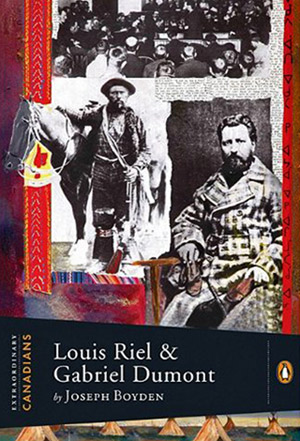
[READ: January 26, 2010] Louis Riel & Gabriel Dumont
Of the six Extraordinary Canadians books, I was least excited to read this one. I’m not sure why, but I wound up leaving it for last. But lo and behold it was easily the most engaging and, dare I say, exciting story of the six. I’m sure part of that is because I didn’t know the outcome (even if Gabriel was somewhat famous in the U.S., I still didn’t know what had happened to him or to Louis). And by the end of the book, I absolutely couldn’t put it down.
Joseph Boyden is a Métis writer (who I’ve never read before). It’s obvious from the get-go that he is sympathetic to Riel and Dumont (which is to be expected in a biography, I would think). He gets a tad heavy-handed about John A. Macdonald, but it seems justified. For really you can pretty much take only one of two points of view about Riel and Dumont: they are either rebel heroes, standing up for the oppressed Métis, or they are traitors, intent upon destroying Canada’s expansion.
Now, I admit that I don’t know much about Canada’s expansion. The first prime minister, John A. Macdonald, was instrumental in Canadian Confederation and was the driving proponent for the completion of the Canadian Pacific Railway. But as with American westward expansion, Native cultures are in the way of this expansion.
For this book, Boyden certainly makes John A. (as he is known) the villain of the story. And it seems valid that Macdonald did some pretty shitty things to the Métis throughout his (very long) tenure as prime minister. But at the same time, it seems hard to argue that his expansion of Canada was a bad thing. Of course, this argument about Native peoples is true in the States as well. Who knows what the U.S. would look like now if manifest destiny hadn’t happened. But it’s disgraceful that the Native peoples were treated so horrifically.
Mike Ford (see the Soundtrack above) also has a song on Canada Needs You Volume One called “Sir John A. (You’re O.K.)” and his take on Sir John A. parallels mine pretty well (I excerpt a pretty large part here):
Although my “You’re OK” song on Canada Needs You, volume one , sounds mostly like cheer-leading, I in fact harbour quite conflicting impressions of John Alexander Macdonald, Canada’s first Prime Minister. There can be no doubt that this lawyer, politician and nation-builder was an incredibly gifted man, with a seemingly super-human facility for what we now call multi-tasking. It is hard to imagine Confederation occurring, or the Canadian Pacific Railroad being built, without John A.’s involvement….
Did he feel remorse about his treatment of pre-Confederation prairie folk (Specifically Metis and First Nations communities)? Is this too unreasonable an expectation for someone of his era? Were huge campaign donations from Railroad financiers (and massive, prime land concessions in return) the only way to get the railroad built? Did he, in his heart, share Ontario’s wish to keep the French language and Catholicism out of the West, or was this just political pragmatism?
But back to the book:
As you read this biography, you can’t help but side with Dumont and Riel, and there’s enough evidence to show that they were reasonable and peaceful men, driven to violence only as a last resort. And that John A. was a real bastard to the Métis in general and to Riel specifically. He ignored their requests and continued occasions, dismissed what were reasonable demands.
The trouble, naturally, stems from the White English Protestant attitude against the Métis, who are, after all, Native, French, and Catholic–the unholy triumvirate for Canadian Englishmen.
The biography alternates between Gabriel’s and Louis’s lives, both as young men and once the “action” of the story commences. Boyden explains how Dumont was a leader of his men and a powerful Buffalo hunter. He was illiterate, but was an excellent tactician. Boyden doesn’t go into too much more about Dumont’s early life.
By contrast, Reil was the first man in his family to go to college. He was initially going to be a priest, but when his father died, he decided against it. And Reil’s later life is utterly fascinating. While the Métis territory was still unclaimed by Canada, Riel established a provisional government of what would become Manitoba. After he called for the execution of an invading Canadian soldier, he was forced into exile in the United States. Nevertheless, while in exile, he was elected to the House of Commons three times (which he could obviously never serve).
Despite all that, the main action of the book picks up when Dumont travels the back roads into the States to find the banished Riel and bring him back to help fight the Canadian army at Batoche. It took some convincing, but eventually Reil agreed to fight with the Métis as John A. looked to expand the railroad into Métis territory. The Métis proposed reasonable land sharing agreements to the Canadian government, but they were basically ignored. And Reil couldn’t sit by and watch his territory get taken away from his people.
The rest of the book deals with this conflict. Dumont, the military strategist, keeps defering to Riel, who wants only peace. Riel promises victory and God’s redemption without violence, but Dumont watches military opportunities slip through his fingers as the Canadian army is able to establish footholds and grow stronger. Boyden posits that it is Dumont’s illiteracy that causes him to question his own ideas and to defer to Riel’s plans. Of course, who knows what would have happened if the Métis had fought them off. Would they have been able to do so forever?
Meanwhile, Riel has become more and more convinced of his divine righteousness. He hears God speak directly to him on many occasions. This causes him to dismiss the established church and call in to question many religious foundations of Canada. Despite God’s “calling” and his apparent rightness, Reil is opposed by virtually all authorities. The Catholic priests obviously can’t agree with him. And the English Protestants can’t stand the half-blood part of him. Even some of the non-Métis Natives are afraid to join his side.
Inevitably, and despite Riel’s pledges for peace, a battle ensues. Riel does not pick up weapons, but Dumont is a fearless fighter (and he loses many family members in the battles). The Métis hold off the much larger Canadian army for many months, including a few decisive victories, but ultimately, they prove to be incapable of keeping off the growing army (and their sophisticated weapons). Louis Reil surrenders to the Army in hopes of saving his people.
John A., embarrassed by Reil’s victories and posturing wants Riel executed, but Europe and America condemn this action. He is eventually put on trial as a traitor. His defense attempts to find him insane (because of all the religious behavior). Boyden goes into wonderful detail (including primary texts) about the trial, and I found it very affecting and powerful to hear Reil stand up for himself. It was also exciting to know that Dumont’s was planning to rescue Riel. These plans never came to fruition, but the Canadian army was on edge anticipating it.
Even though Riel is the more interesting of the two in terms of background, Dumont’s life after all of this was also fascinating. He fled to Montana and eventually turned himself in to the U.S. authorities. The U.S. considered him a political refugee, which ensured his safety in the States. Shortly thereafter he joined Buffalo Bill’s Wild West Show. He then returned to Montreal to give lectures and was eventually granted the land title to Batoche, the lands he settled with the Métis so many years ago. Unlike Riel, Dumont died of natural causes (well, as natural as causes can be after being in so many battles and getting shot in the head).
This all seems like such ancient history, and yet Riel was killed in 1885.
I really enjoyed this book, it was a fascinating account of Canadian history, and Boyden’s storytelling was simply fantastic. This book really leads me to believe that history should be taught by storytellers and not textbooks. And the six books taught me a lot about subjects who I knew and who I didn’t know much about. I would very happily read the others in the series. And so…
And, here’s a shameless plug to the folks at Penguin Canada–I will absolutely post about all of the books in this series if you want to send me the rest of them. I don’t know how much attention these titles will get outside of Canada, but I am quite interested in a number of the subjects, and will happily read all of the books if you want to send them to me. Just contact me here!
For ease of searching I include: Metis

 I Just Read About That...
Leave a comment