 SOUNDTRACK: SHAD-TSOL (2010).
 I first heard Shad on CBC Radio 3 online. The track was “Yaa I Get It” and I really enjoyed it. I haven’t listened to a lot of rap in the last few years; I’ve more or less grown bored by the genre, especially all the violence. So, I was happy to hear this track, which was boastful but funny.
I decided to get the whole disc, and I wasn’t disappointed. “Rose Garden” features a sample of “I Never Promised You a Rose Garden” which sets some of the tone of the disc. But it’s on the next song “Keep Shining” that Shad’s uniqueness shines through. This song is about women. But not in any way that I’ve heard in rap before: “I can’t speak for women. We need more women for that.” And the inspiring final verse:
My mom taught me where to keep my heart.
My aunt taught me how to sing two parts.
My sis taught me how to parallel park,
and tried to teach me math but she way to too smart.
My grandma in the 80’s is still sharp.
My girl’s cousin is in activism in art.
They taught there’s no curls to tight, no mind too bright, no skin too dark to keep shining.
Later on the disc is “We Are the Ones” an oddball jam that sounds like one of those bizarre Atlanta rap tracks (funky vocals and all) and an amusing line about being Lost like Matthew Fox. But his name checks aren’t all pop culture (Moredcai Richler gets a mention as does Glenn Beck (he “better duck like foie gras”).
And of course, there’s the wonderful “Yaa I Get It.” With great horn blast samples and all kinds of noise competing for our attention. Yet, throughout the lyrics stand out: “Maybe I’m not big cus I don’t blog or twitter…Dawg, I’m bitter.” And there’s this wonderful couplet: The precision of my flows in terms of tone and diction/Is akin to that of the old masters of prose and fiction.” Or take this lyrics from “Call Waiting,” “But what they say is hard for a pimp is harder for a man of faith.”
“Listen” has some great scratching on a heavy rocking track. It’s followed by “At the Same Time.” This is a mellow, sad song, which I don’t really like, yet which I find very affecting. And lyrically, it’s great: “I never laughed and cried at the same time… Until, I heard a church pray for the death of Obama. And wondered if they knew they share that prayer with Osama.”
The disc ends with “We, Myself and I” another noisy rocker and the one minute “Outro” an acapella rant.
Shad is a great rapper, doing interesting things and trying to make a difference. He’s worth checking out.
[READ: November 1, 2010] “Marshall McLuhan”
I learned about this book because I’m a fan of Douglas Coupland. And, as it turns out I’ve always had a vague interest in Marshall McLuhan, so it seemed like a sure thing. The problem was that the book was not readily available in the U.S. So, I had to order it from Amazon.ca. And, since you can’t get free shipping to a U.S. address from amazon.ca, I thought it would make sense to order 6 titles in the series, all of which I’ll post about this week.
So, here’s a shameless plug to the folks at Penguin Canada–I will absolutely post about all of the books in this series if you want to send me the rest of them. I don’t know how much attention these titles will get outside of Canada, but I am quite interested in a number of the subjects, and will happily read all of the books if you want to send them to me. Just contact me here!
Each book in the series has an introduction by John Ralston Saul, in which he explains the purpose of the series and states globally why these individuals were selected (“they produce a grand sweep of the creation of modern Canada, from our first steps as a democracy in 1848 to our questioning of modernity late in the twentieth century”). It also mentions that a documentary is being filmed about each subject.
Perhaps the most compelling sentence in the intro is: “each of these stories is a revelation of the tough choices unusual people must make to find their way.” And that’s what got me to read thee books.
This volume was probably a bad place to start in the Extraordinary Canadians series if only because it appears that Coupland’s volume is markedly different from the others. Coupland being Coupland, he has all manner of textual fun wit the book. The other authors seem to write pretty straightforward books, but you know something is up right away when you open the book and the first six pages comprise a list of anagrams of “Marshall McLuhan.”
On to Marshall McLuhan. The Medium is the Message. That’s about all anyone who has heard of McLuhan knows about him (and that he has a hilarious cameo in Annie Hall).
When I was a freshman in college, I took a class in Communications which focused an awful lot on Marshall McLuhan. I didn’t like the teacher very much, but the message stayed with me all these years. And so even though I’m not a student of McLuhan or anything, I was happy to relearn what I should have known about the man and his ideas.
It’s not easy (for me) to write about a biography because, well, that’s what the biography is. So, I’m not going to recap McLuhan’s life, which is pretty readily available. Rather, the excitement comes from Coupland’s placing McLuhan as a man who more or less anticipated the future (our present) but also as someone who would have hated what he predicted had he lived to see it.
Perhaps the most insightful quote that Coupland picks is the one that starts the book:
In 1962 McLuhan wrote:
“Instead of tending towards a vast Alexandrian library the world has become a computer, an electronic brain, exactly as an infantile piece of science fiction. And as our senses have gone outside us, Big Brother goes inside. So, unless aware of this dynamic, we shall at once move into a phase of panic terrors, exactly befitting a small world of tribal drums, total interdependence, and superimposed co-existence.
Coupland gives us some starling physiological information about McLuhan: he had two arteries that led to his brain (very rare in human beings) and this ultimately saved his life. He was also incapable of tuning out extraneous noises (more on that later).
McLuhan’s basic bio: born July 20, 1911 in Edmonton, they moved to Winnipeg when he was 4. His family wanted him to study engineering (although he couldn’t even drive a car), but instead he studied for a B.A. in Literature. He was an excellent debater, although he was rather insecure around others. He enjoyed the lit program, but he found the methodologies limited, and on a trip to England he learned that there were many more ways to study lit. He was accepted at Cambridge (not an easy thing in the 1930s for a non-Englander).
Although such tests were not available then, it seems likely that McLuhan would have scored high on the Autism Spectrum Quotient Test. “He hated being touched or jostled; he hated abrupt noises or extraneous sounds; he loved words and the repetition of words and punning” (147). [Circa December 2005, the AQ Test was all the rage on Facebook, with hundreds of people taking it and posting the results. This is the kind of synchroicty that McLuhan more or less predicted (and would have hated)].
 McLuhan hated modernity and he felt that Dagwood Bumstead represented all that was wrong with American culture: “an emasculated drone who allowed industrial America to homogenize domestic life into three rectangular pussy-whipped panels a day” (102). This complaint was the basis for his first book The Mechanical Bride.
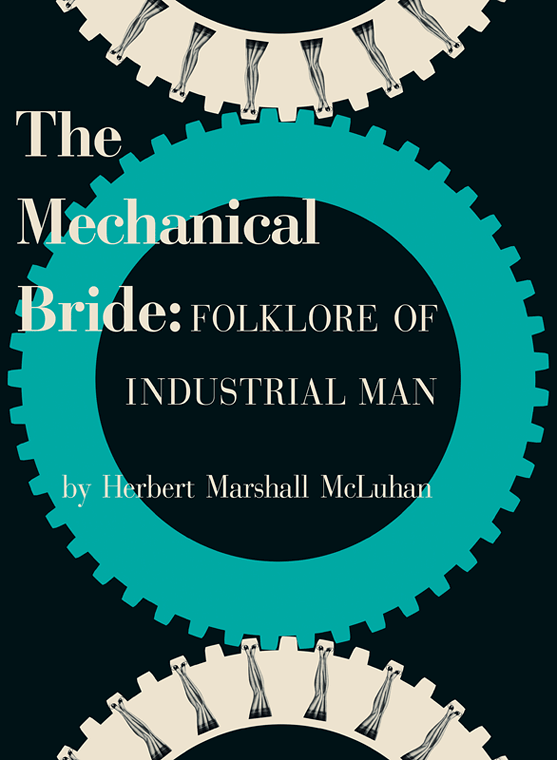 After many unsatisfying jobs, he moved to the University Toronto and finally felt settled.
Another fascinating bit of synchronicity in my life: McLuhan was obsessed with Joyce’s Finnegans Wake: He saw the book as a potential Rosetta stone–a unified teory of culture that could prescribe the healthiest balance between hearing the world and seeing the world…. The book remained a touchstone for alnost all his future work” (130). I haven’t read Finnegans Wake, but anyone who reads this blog knows I’ve been on a Joyce kick as of late.
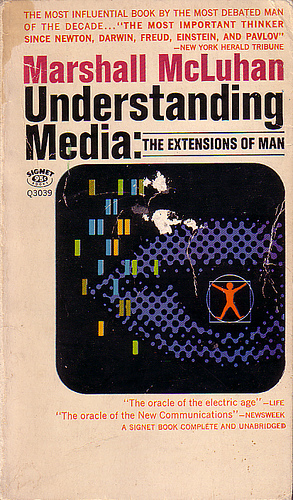
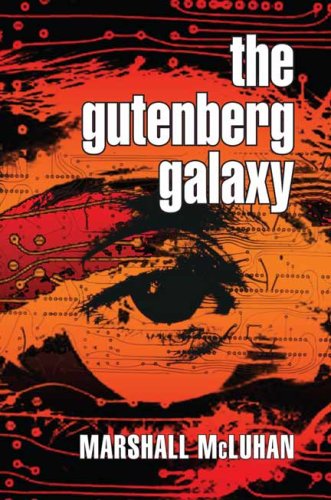 The late 1950’s were a very fertile period for McLuhan. And Coupland summarizes his attitude: “Society was absorbing too much technology too quickly [and] he hated and abhorred it” (148). It was in 1962 that he had his first hit: The Gutenberg Galaxy (with ecstatic reviews!). It was followed quickly by 1964’s super-breakthrough: Understanding Media. (This is where “the medium is the message” comes from). In 1967 his capitalized on his success with the Medium is the Massage.
 Success made him even more eccentric, especailly in his classes where he would have occasional blackouts that freaked out the students. He eventually wound up having invasive brain surgery. By the fall of 1979, his star had faded and he had a massive stroke leaving him unable to read write or speak.
Now despite the fact that the book is a bio of McLuhan, it also about Douglas Coupland as well. He talks about fax machines and how he did a rubbing of McLuhan’s grave and faxed it around the world (its a neat anecdote).
The second really personal piece comes in a footnote (#9). In a nutshell: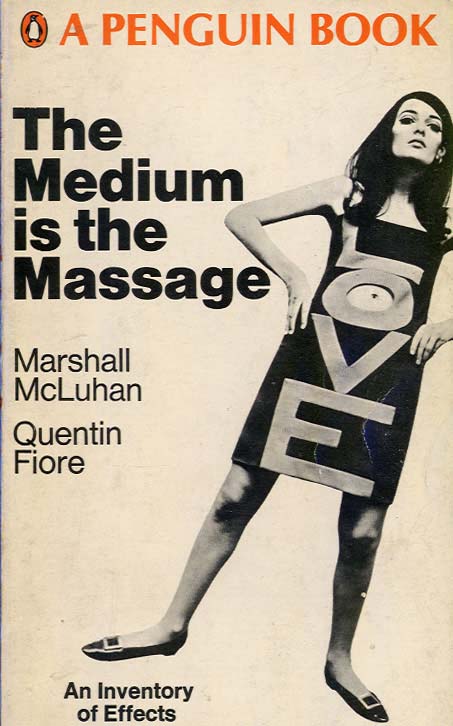
I had the biggest sneeze of my life and …found in my hand a clump of living tissue the size, shape and colour of a green grape. [The doctor] said I should actually be thankful becyuase “at least it’s not inside you anymore” From that morniong on, my hearing has become hyperacute and hasn’t wavered since. [Noises] stop my body in mid-motion… I also lost my ability to focus sounds.
Strange synchronicity with McLuhan, eh?
The book also contains two excerpts from Coupland’s Generation A that relate to McLuhan.
The first is the part in the story in which all speech devolves into text speak which becomes something like the rapture.
The second is a young girl’s mother’s decision to join a “cult” whose mission is to randomly destroy celebrities. Her mother makes news and now suddenly the young girls is, by some standards, a celebrity.
What you get here is a fascinating look at McLuhan’s life–not a comprehensive biography, although one that highlights many aspects that you might not expect in a primer on the man. But you also get some Coupand esoterica. They really are kindred spirits in the media worlds and they are an excellent pairing.
If you’re a fan of Coupland this an interesting book to track down because he puts so much of himself into it. And of course, the writing style and fun with technology is all over the book. And, of course, you’ll learn something about McLuhan, which is never a bad thing.

 I Just Read About That...
[…] Otherwise, the book is identical–same layout, same page numbers, same typefaces(!). If you want the anagrams and excerpts, track down the Canadian version, otherwise, this is a good pop culture biography of McLuhan (with a little about Coupland, of course). You can read more about in my post of the Canadian edition. […]