 SOUNDTRACK: A HOUSE-I am the Greatest (1991).
 A House were a Dublin band that released a number of great songs and a few good albums from the mid 1980’s until the late 1990s. I loved A House (but never knew whether to file them under A or H). They were a smart, often sarcastic, occasionally poppy college rock band who played dissonant songs more often than not and wrote lyrics which could be off-putting more often than not, but which, in the right mind frame, were simply, as the album says, the greatest.
It opens with a nice jangly guitar which is quickly interrupted by a strange feedback sound and Dave Couse’s somewhat unsettling voice. And he gives a litany of things about which he does not care, but mostly because nobody else does. It’s followed by the sweet tender ballad “Too Young.” The next track was the single, of all things. “Endless Art” a simple riff which name checks dozens of dead artists that bridges with Beethoven’s Fifth. It gets tedious after about 200 listens, but since I haven’t heard it in a while, I found myself really grooving to it again.
In keeping with the “let ’em guess” attitude of the disc, the next song is a plaintive moan of longing called “When I First Saw You.” I’m fairly certain he’s singing out of tune for the whole track.
“Take It Easy on Me” opens with a great wah-wah’d guitar sound that should have been a left-field hit like The Flaming Lips had. But it’s their simple acoustic songs that pack the most punch like “I am Afraid.” It’s followed by what sounds like a Tindersticks song, until Couse’s voice kicks in, and we get a great questioning song about religion called “Blind Faith”.
He seems back to his old tricks on “I Lied” (“When I said that I loved you, I lied.”) Then the full band kicks in (with great harmonies) “When I said, when I vowed, I don’t love you anymore, I lied. I adore you!”
The rest of the songs play with this formula: off kilter yet poppy, harmonies on top of dissonant leads. The pace never slackens, and the albums stays strong through the brilliant final track, “I am the Greatest” (a spoken word folk track that is all smackdown which devolves into a bunch of blokes shouting “I am!”).
Check out the fantastic stop motion video for “Endless Art” on YouTube, and let me know if you can find a version that’s better than this one.
[READ: Week of August 23, 2010] Ulysses: Episodes 16-17
Nearing the end of the book, still recuperating from the insanity of the Circe episode, we get two episodes that are considerably mellower. I enjoyed the beginning of Episode 16, but felt a little at sea when it was hijacked by the sailor. Episode 17 on the other hand is definitely my favorite. Even though I love the surrealism of Circe, there’s something about the catechism of Episode 17, with its question and answer format–its own sort of surrealism–that I find fascinating, funny and surprisingly informative. It fills in a ton of details that were left out of the beginning (or that were hidden) and yet still retains a bizarre stream of consciousness. It also offers incredible insight into the man who is Leopold Bloom.
Episode 16 [Eumaeus]
This Episode starts off Part III of the book (The Nostos). It opens with Bloom brushing off the mess from Stephen and trying to wake him up. It is a fairly mellow episode, a sort of shaking off the craziness of the red light scene.
When Stephen is vertical, they start walking toward, well, anyplace where Stephen can get some coffee and food to sober up. Bloom himself is “disgustingly sober” (502), and tries to warn Stephen about the dangers of prostitutes and nighttiown in general. He also observes that all of Stephen’s friends abandoned him but one:
–And that one was Judas, Stephen said (503).
Is that Mulligan or Lynch (who disappeared mid-nightown).
They decide to head to a cabbie shelter. On the way there we meet John Corley (who was in a Dubliners short story). Corley begs for money or for lodging (Stephen can give him neither). After a conference with Bloom, Stephen gives him a half crown [the one thing I have yet to come to terms with in this book is the money. Half crowns, farthings, quids, £, d, s. It’s a mystery. I mean, I know the Euro is kind of boring, but the old early 20th century Irish pound standard is a massive ball of confusion to me.]
Bloom asks Stephen where he will sleep and, more to the point, why he left his father’s house. Stephen, always the great quipper replies:
–To seek misfortune (506).
Bloom speaks highly of Simon Dedalus, and then puts down Mulligan again
I wouldn’t personally repose much trust in that boon companion of yours who contributes the humorous element, Dr Mulligan, as a guide, philosopher, and friend, if I were in your shoes. He knows which side his bread is buttered on though in all probability he never realised what it is to be without regular meals. Of course you didn’t notice as much as I did but it wouldn’t occasion me the least surprise to learn that a pinch of tobacco or some narcotic was put in your drink for some ulterior object (507).
This must be the absinthe that everyone speaks of.
They finally arrive at the cabman’s shelter and encounter the “once famous Skin-the-Goat, Fitzharris” (508). They order some coffee and speak a bit about Italian language (a carload of Italians had just passed).
The other men at the shelter are abrasive and inquisitive. One of them claims that Simon Dedalus could “shoot two eggs off two bottles at fifty yards over his shoulder” (509) [which seems rather unlikely to me]. The sailor’s name is D.B. Murphy and he takes up quite a lot of this episode talking about sailing the sea.
However, as Murphy presents evidence of himself, Bloom seems to seriously question whether he’s telling the truth about his identity. I like this quote:
He had been meantime taking stock of the individual in front of him and Sherlockholmesing him up, ever since he clapped eyes on him. Though a wellpreserved man of no little stamina, if a trifle prone to baldness, there was something spurious in the cut of his jib that suggested a jail delivery and it required no violent stretch of imagination to associate such a weirdlooking specimen with the oakum and treadmill fraternity (519).
Bloom asks him if he has seen the rock of Gibraltar (which is where Molly is from (this piece of evidence becomes clear in the next episode although it is also mentioned in Episode 4, which I missed entirely until listening to the audio CD today)). Murphy says he’s tired of those rocks.
Eventually the same streetwalker who Bloom tried to avoid earlier comes into the shelter. One of the men argues that all whores should be inspected by authorities and deemed clean (legalize it!).
At some point one Possibly Skin-the-goat gets up to pee and swig some (sailor’s) rum. There’s a bit of a kerfuffle, and then Bloom starts telling Stephen about his encounter with the Citizen: “So, I without deviating from plain facts in the least told him his God, I mean Christ, was a jew too and all his family like me though in reality I’m not” (525). This is a strange undermining of his case, although we will see in Episode 17 that Bloom has been baptized (three times) and so is not a Jew.
He also avenges the good name of Jews (so impugned throughout the book):
— Jews, he softly imparted in an aside in Stephen’s ear, are accused of ruining. Not a vestige of truth in it, I can safely say. History – would you be surprised to learn? – proves up to’ the hilt Spain decayed when the Inquisition hounded the jews out and England prospered when Cromwell, an uncommonly able ruffian, who, in other respects, has much to answer for, imported them. (526)
And then Bloom outlines his political belief (which I heartily agree with):
It’s all very fine to boast of mutual superiority but what about mutual equality? I resent violence or intolerance in any shape or form. It never reaches anything or stops anything. A revolution must come on the due instalments plan. It’s a patent absurdity on the face of it to hate people because they live round the corner and speak another vernacular, so to speak.
He concludes with a sentiment that could easily be spoken of today (to ease the rabid mob):
I want to see everyone, concluded he, all creeds and classes pro rata having a comfortable tidysized income, in no niggard fashion either, something in the neighbourhood of £300 per annum That’s the vital issue at stake and it’s feasible and would be provocative of friendlier intercourse between man and man. At least that’s my idea for what it’s worth. I call that patriotism (526).
I quote this section extensively because we have seen so much of Bloom’s mind but very little of what he really thinks. And I found this measured and reasonably well thought out idea quite refreshing (especially among all of the pontificating that others have done). And it is also a great look at Bloom, the man. He may spend a lot of his day thinking about women’s hams, but he also thinks a lot about the world, too.
Stephen, meanwhile, follows up with a single comment that shows the futility of Bloom’s idea.
— Count me out, he managed to remark, meaning to work (526).
They argue over this for a bit until, once again, Stephen gets a good quip:
Stephen, patently crosstempered, repeated and shoved aside his mug of coffee, Or whatever you like to call it, none too politely, adding:
— We can’t change the country. Let us change the subject (527).
Bloom changes the subject when he spies the pink evening Telegraph. He reads about Dignam’s funeral and there’s a lot of comedy in here. All of the attendees are listed by first and last name except Bloom who is listed as L. Boom, and of course McIntosh gets in there too. There’s even sight of CP McCoy who asked Bloom to make sure he was mentioned as being at the funeral–so Bloom did his job.
There’s also an amusing bit about Throwaway (in fact, it’s the entire account of the race–man they used to include SO MUCH in newspapers!)
The discussion turns to Spain. Bloom shows a picture of Molly (and now that I know she’s from Gilbraltar, this section makes more sense). He asks Stephen if he considers Molly a “Spanish type” (533). The picture is from around 1896, and is of the prima donna Madam Marion Tweedy. This leads Bloom to mull about infidelity.
He finally changes the subject and asks when Stephen last ate. He answers yesterday (although he ate bread this morning, correct?). Bloom is astonished and invites him to his house for cocoa. The leave the shelter (Bloom pays for their coffee) and Bloom advises Stephen to lean on him.
On the way home, they talk about music, and Bloom says that Molly would love to meet him. Stephen sings some German (he has a lovely voice) and Bloom imagines getting him on the singing circuit with Molly.
A horse drops three flops on the street as Stephen sings the final line of his song and the cab driver watches them walk away.
Episode 16 [Ithaca]
[minor spoiler]: This is the final chapter that is from Bloom’s or Stephen’s voice. The final episode is all from Molly’s POV. And although we will learn a lot about Leopold in that one, this is the end of the day for our two men. [/spoiler]
I mentioned that I loved this chapter, and I really do. It’s weird and funny. It’s totally informative and weirdly off topic at the same time. I love that the questions aren’t ones we would necessarily ask, but that they give us answers that we’re interested in (and ones we never even considered). And I love that the answers are given in such detail (like the hardest test you’ve ever taken).
Now, if you think one way, you ask, who the hell are these people? Who is asking the questions, who is giving the answers? I have no idea. I’m not sure it even matters. But if anyone can provide an answer, that would be fine too.
So the beginning of the catechism follows Bloom & Stephen as they walk to Bloom’s house. It asks what they talked about (music, literature, Ireland, prostitution, the church, Stephen’s collapse and much more). They find that they agree and disagree on several things.
When they get home, Bloom remembers that he forgot his key (which he also remembered that he forgot in Episode 5, when in the funeral car [I learned upon listening to the audio CD this morning]. Rather than waking Molly, he jumps over the wall and sneaks in through the scullery.
He lights a candle and invites Stephen in. Then he gets the kettle ready (there’s a very long discursion on the topic of water (Bloom is described as a “waterlover”), including a physical explanation of how the water gets from the reservoir to Bloom’s tap. We also learn that Stephen claims to be a hydrophobe and that he has not bathed since October of last year. (Mulligan wasn’t kidding).
Bloom sees some betting tickets (must be Boylan’s, no?) on the counter and is reminded of the race. Even though he gave advice and in theory could have won, “He had not risked, hid did not expect, he had not been disappointed, he was satisfied…. To have sustained no positive loss. To have brought a positive gain to others.” (553).
They drink their cocoa. Bloom thinks of anagrams he had made of his name as a child (a charming detail) and of poetry he wrote to Molly as well as an unfinished song for her.
Then at this point, we get the official details of Bloom and Stephen’s age:
16 years before in 1888 when Bloom was Stephen’s present age Stephen was 6. 16 years after in 1930 when Stephen would be of Bloom’s present age, Bloom would be 54. In 1936 when Bloom would be 70 and Stephen 54… (and it drifts off into a fascinating look a ratios of ages projected far into the future [So, for the record, Bloom is 38 and Stephen is 22]).
The questions reflect on whether Bloom and Stephen had met before. Twice when Stephen was 5 (and shy) and 10 (and not shy). This is also where we learn about Bloom’s three (!) baptisms: twice protestant and once Catholic (by the same priest as Stephen had done).
Bloom mentions his idea of an advertisement of girls in a drawn cart writing. Stephen suggests another one, with a restless woman sitting and writing at the Queen’s Hotel (which reminds Bloom of his father’s suicide at the Queen’s Hotel).
I was astonished to see that the sunrise on June 21 would be at 3.33 am (!) (561).
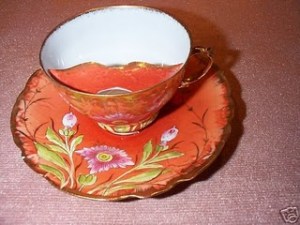
We also learn the origins of the moustache cup (something that is mentioned a lot in the book, which I never quite understood, and am still not exactly sure of its appearance. It was a present from Milly on Bloom’s 27th birthday. It’s imitation Crown Derby porcelain ware.
A brief Google search reveals that it looks like this… and I love it!
Finally Bloom offers to let Stephen stay the night:
Was the proposal of asylum accepted?
Promptly, inexplicably, with amicability, gratefully it was declined (570).
Other proposals are offered by Bloom to Stephen (teaching Italian, teaching music) that are “advanced, accepted, modified, declined, restated in other terms, reaccepted, ratified, reconfirmed.” (So I’m not exactly sure what they agreed upon).
After a few moments, they both head outside (and the cat runs in). They both pee and then Stephen leaves. I liked that as they separate, there is one last example of their utterly different frames of mind.
What sound accompanied the union of their tangent, the disunion of their (respectively) centrifugal and centripetal hands?
The sound of the peal of the hour of the night by the chime of the bells in the church of Saint George.
What echoes of that sound were by both and each heard?
By Stephen:
Liliata rutilantium. Turma circumdet.
Iubilantium te virginum. Chorus excipiat.
By Bloom:
Heigho, heigho,
Heigho, heigho. (578).
We also learn where most of the people that Bloom encountered today are (all in bed except Paddy Dignam, who is in the grave).
Now, Bloom, alone, gets the rest of Episode devoted to himself. And most of this is just Bloom’s thoughts about everything (typical middle of the night musings). He goes in the house and bangs his head on some moved furniture (it seems that Boylan moved furniture that Bloom had said he would move). He looks around the room at his things (including his books, which are out of order).
He thinks about all of the money he spent and received that day and then, in what I find to be a surprisingly moving look into Bloom’s psyche, he thinks about the kind of house he would love to have. [The paragraph is slow and dense, yet it is quite deliberately detailed]. He imagines what the house might have, what he could do to it and even what he could call the place
Bloom Cottage. Saint Leopold’s. Flowerville. (587).
He imagines all of the wonderful things he could do on the grounds, even his social status in the community.
It all comes crashing down when he thinks about how he could afford it (“By rapid but insecure means to opulence” (589)). The final option being “The independent discovery of a goldseam of inexhaustible ore” (589).
And although it seems kind of sad that he imagines this fantasy (although who doesn’t) he’s not sad about the impossibility of it:
For what reason did he meditate on schemes so difficult of realisation?
It was one or his axioms that similar meditations or the automatic relation to himself of a narrative concerning himself or tranquil recollection of the past when practised habitually before retiring for the night alleviated fatigue and produced as a result sound repose and renovated vitality (591).
He goes up to bed and looks in his table. He sees letters addressed to Henry Flowers (and adds the fourth one to the pile), and a remedy for rectal complaints erroneously addressed to Mrs. L. Bloom. (That would have been a fun day in their house). There’s also his birth certificate which shows his middle name as Paula. [Could that have anything to do with gender confusion at all?] As well as other official documents like his father’s name change.
Then he thinks about terrible things that could happen to him: poverty, destitution etc. And how could he avoid that if it happened? By dying or leaving the country. He thinks about where he could move at home and abroad: the straits of Gibraltar for one, or even Wall Street or perhaps he would just wander.
But why wouldn’t he leave? It’s late and there’s a bed right near here. And so, he disrobes and climbs into bed opposite Molly: sleeping head to toe.
When he climbs into bed he feels “the imprint of a human form, male, not his,” (601). And it is asked. “If he had smiled why would he have smiled?” And here we see the very mature attitude of Bloom. Many would say the cuckolded, foolish attitude, but given his temperament it seems consistent with is nature:
To reflect that each one who enters imagines himself to be the first to enter whereas he is always the last term of a preceding series even if the first term of a succeeding one, each imagining himself to be first, last, only and alone, whereas he is neither first nor last nor only nor alone in a series originating In and repeated to infinity (601).
Especially when the series is given:
Assuming Mulvey to be the first term of his series, Penrose, Bartell d’Arcy, professor Goodwin, Julius Mastiansky, John Henry Menton, Father Bernard Corrigan, a farmer at the Royal Dublin Society’s Horse Show, Maggot O’Reilly, Matthew Dillon, Valentine Blake Dillon (Lord Mayor of Dublin), Christopher Callinan, Lenehan, an Italian organgrinder, an unknown gentleman in the Gaiety Theatre, Benjamin Dollard, Simon Dedalus, Andrew (Pisser) Burke, Joseph Cuffe, Wisdom Hely, Alderman John Hooper, Dr Francis Brady, Father Sebastian of Mount Argus, a bootblack at the General Post Office, Hugh E. (Blazes) Boylan and so each and so on to nolast term (601).
The answers in this Episode all appear to be true, so does Bloom know that all of these men slept with Molly? Really?
And despite his feelings about this (envy, jealously, abnegation) he also feels equanimity:
As not as calamitous as a cataclysmic annihilation of the planet in consequence of collision with a dark sun. As less reprehensible than theft, highway robbery, cruelty to children and animals, obtaining money under false pretences, forgery, embezzlement, misappropriation of public money, betrayal of public trust, malingering, mayhem, corruption of minors, criminal libel, blackmail, contempt of court, arson, treason, felony, mutiny on the high seas, trespass, burglary, jailbreaking, practice of unnatural vice, desertion from armed forces in the field, perjury, poaching, usury, intelligence with the king’s enemies, impersonation, criminal assault, manslaughter, wilful and premeditated murder. (603).
And what would he do about it?
Assassination, never, as two wrongs did not make one right. Duel by combat, no. Divorce, not now. Exposure by mechanical artifice (automatic bed) or individual testimony (concealed ocular witness), not yet. Suit for damages by legal influence or simulation of assault with evidence of injuries sustained (selfinflicted), not impossibly. (603).
Despite thinking this, he cleared his head and
He kissed the plump mellow yellow smellow melons of her rump, on each plump melonous hemisphere, in their mellow yellow furrow, with obscure prolonged provocative melonsmellonous osculation. (604).
This gives him something of an erection. Molly wakes somewhat and then asks him some questions. He talks about the day and mostly about Stephen.
And then we learn that since Rudy died at 11 days “there remained a period of 10 years, 5 months and 18 days during which carnal intercourse had been incomplete, without ejaculation of semen within the natural female organ.” (605).
And as the Episode comes to and end, we see Bloom drift off (I love this, too):
Going to a dark bed there was a square round Sinbad the Sailor roc’s auk’s egg in the night of the bed of all the auks of the rocs of Darkinbad the Brightdayler (607).
With the final question “Where?” answered only with: •
COMMENTS
All day long we have been seeing inside Bloom’s head. What he thinks about, who he thinks about, what he does when he thinks about them. But we also learn a lot about him too: he is a nice person. He helps the blind, he lets Simon Dedalus go first on the funeral car. He even helps out a son who is not his own, frankly going way out of his way for him.
He is mocked, yelled at, abused, ignored, cheated on and yet he never succumbs to a wicked demeanor.
He holds his own against the Citizen, but that’s really all we see of his aggressiveness.
And then comes this section. His day is done and he is set to ruminate on the day, his life, his future and his past. This episode alone is a full novel’s worth of information about the man. And yet without the rest of the novel it wouldn’t have quite the impact, quite the effect of denouement that it has.
And we learn so much about what Bloom carries with him all day. He knows that his wife is an adulterer many times over. And yet, he himself has not slept with her for years, since Rudy died. This hasn’t killed his sexual appetite, obviously, so what is happening with he and Molly? He still regards her fondly. They may even still be in love (we’ll find out her opinions next Episode), they just aren’t physical.
So is Bloom a sad person or a pathetic person? It doesn’t seem that way. He seems reasonably fulfilled. He has a sharp mind, he gets his gratification in certain places. He even has dreams. They may be unattainable, but they are dreams, nonetheless. And he continues to be a nice person.
I think he’s one of the most detailed and fascinating characters in literature.
Of course, we don’t know what happened to Stephen after he left Bloom’s house. There is the possibility that Bloom’s words will impact him: break off his friendship with Buck Mulligan, move back with his father, maybe have regular discussions with Bloom and Molly? But given Stephen’s attitude and Bloom’s ability to persuade, it seems unlikely.
Just how much impact can we have on another human being, anyway?

 I Just Read About That...
I think I agree with you that Bloom isn’t necessarily sad or pathetic, but boy there were parts of this episode — and these moments have been very rare for me in this book — that struck me as really sad.
Re: A House. Saw them around this time and they were great. Dave Couse has since done some radio shows in Dublin and he’s a really lovely bloke to boot. Earlier A House is a bit hit and miss but try to find “My Little Lighthouse” for a lovely little love song.
People gave out yards (complained vociferously) about the apparent misogyny of the original “Endless Art” so I knew where to look when Paul ended with this:
“let me know if you can find a version that’s better than this one”:
Too easy. Here’s the female version.
I love that Louise Brooks and Edith Sitwell get mentions alongside Monroe and Plath. Manic Street Preachers would never have bothered.
Will read the Joyce bit tomorrow. In the meantime,
Thanks again for this new version of the song. I’d never heard it before. Oh, and when I said a better version, I meant of the video, they all seem quite shite on YouTube.
I wonder who did all the complaining back then?
…don’t know what the end of the previous sentence should have been but, in a Joyce-tastic link, did anyone notice in the original A House video posted by Paul that the second page down on the left spells out the last page of Ulysses, one letter at a time?
Go look again, that you may better gaze in wonderment on the holistic whatness of all of this.
I am so delighted that you posted this. The final page of my copy of Ulysses (from college) says “underlined is part 4 A House video”. I had no idea what it was talking about, and now I know. I can’t help but assume that you told me that 20 years ago as well. If the underline if correct, it starts around 1575 until about 1582 and then picks up again at 1604 till the end.
A note on Skin-The-Goat: The cabman is named thus in a reference to a man named FitzHarris, named as one of a group of extra-political antagonists called The Invincibles. This band, and other bands of lawless resolutes, contrived to disrupt the efforts of Parnell and Davitt by retaining the practice of killing Englishmen in Ireland when the Land League and Home Rule parties had ceased to do so. In one of the most counterproductive and notorious crimes of these so-called secret societies, the English Chief Secretary in Ireland named Fredrick Cavendish was killed in the Phoenix Park.
The perpetrators were eventually hanged and imprisoned (not necessarily in that order, more of a concurrent thing among a collection of them, some faring worse than others); their story is commemorated in a song which has, in another bout of what the Heathers would call cleansing synchronicity, also been mentioned in a previous Paul D. post. Monto, by The Dubliners, refers to it in a verse:
When Carey told on Skin-the-goat,
O’Donnell caught him on the boat
He wished he’d never been afloat, the filthy shite.
It wasn’t very sensible
To tell on the Invincibles
They stood up for their principles, day and night.
FitzHarris, a cabman, was convicted and imprisoned in England for conveying the perpetrators to the scene.
There’s quite a connection with this event in Finnegans Wake where the spelling of a word in the confession calls its authenticity into question; Joyce was inspired by this in the Shem/Shaun plot. Carey was hated by both sides for turning on his partners, and was deported to South Africa.
FitzHarris left Ireland on his release: a Google search puts him on the Lusitania.
http://query.nytimes.com/gst/abstract.html?res=9505E7D9113BEE33A25754C2A9639C946197D6CF
but he was deported and subsequently hired in Dublin as a nightwatchman. He always protested his innocence and Joyce may well have selected him as the allegory of Emaeus as someone who had been unfairly treated by his younger inferiors.
I’ve had Monto in my head for weeks now, if only I had known it was actually relevant to the reading. I was also listening to Episode 7 today on audio and there is quite a bit of stuff about Skin-the-Goat and basically just what you said.
Again, thank you for this.