 SOUNDTRACK: STORMTROOPERS OF DEATH-Speak English or Die (1985).
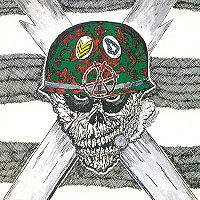 S.O.D. was a side project of Anthrax. It was an over the top (and hilariously un-PC) collection of super fast (and super short) punk songs. A lot of the “mosh” sound that Anthrax was experimenting with around this time is in place here (“Milano Mosh” for instance). So it’s an interesting mix of speed metal and punk.
The lyrics were, as they say, designed to piss everyone off. And they do. Song titles like “Speak English or Die,” “Pre-Menstrual Princess Blues,” “Pussy Whipped,” “Fuck the Middle East” and “Douche Crew” pretty much give you a taste of the music.
And yet, Anthrax are silly. So you know that the band is a parody (even if people took them seriously). And the best way to tell about the serious intentions of the band are by other songs (and their duration): “Anti-Procrastination Song” – 0:06, “Hey Gordy!” – 0:07, “Ballad of Jimi Hendrix” – 0:05 (entire lyrics: “He’s dead”) and of course “Diamonds and Rust” (Extended Version) – 0:05. There’s also a song about “Milk” which laments the fact that all of the milk in the fridge has been drunk.
My favorite track is “What’s That Noise.” The band plays the opening chords of a song and this static crackles in. Billy Milano slowly goes absolutely insane screaming about the noise, yelling at the band to stop playing. It still makes me laugh, 25 years later.
[READ: Week of August 20, 2010] Letters of Insurgents [Last Letters]
Yarostan’s final letter is a long one, but it is justifiably long. And in some ways it makes up for all the weird incest stuff that I had to read. Although really nothing could make up for that.
The beginning of the letter is taken up with Mirna and Yara’s “prank” at Jasna & Titus’ engagement party. There so many details to include that I’m just going to summarize.
Mirna and Yara dress themselves like Luisa and Sabina and go and invite all the old cronies from Yarostan’s carton factory. Mirna is dressed pretty slutty and Jasna is pissed as soon as she sees her. But everything changes when Vera Neis shows up. Then Titus and Zdenek arrive together. A lengthy discussion arises about various things (including Vesna’s death) and one of the key exchanges includes Titus’ declaration:
“Questions of health and disease are in the domain of science, not subjects for children’s fairy tales or uninformed speculation!”
To which Vera added, “I must say I emphatically agree with Titus! I simply can’t imagine a sick child being left without medical care because her eight-year old sister affirmed that she wasn’t sick” (750).
And with that right there, I have officially sided with the bad people in the book. And nothing, nothing, nothing that Mirna or Yara or Jasna can say will convince me otherwise, certainly not for the catatonic condition they described. Then Marc Glavni arrived, in a chauffeur driven limo. He is a big fat man now and much is made about how he eats and eats. Marc was led here under the impression that Mirna is Luisa’s closest companion from [wherever she lives now] and she is trying her best to seduce him.
Vera reveals that there is slander about her, which we learn has something to do with her being a lesbian. Sabina more or less confirmed this in the eighth letter, and we’ll see more of that as soon as Adrian and Irena arrive.
Irena was the secretary that Adrian married as a kind of revenge about Vera. She treats Adrian with utter disdain and mocks him openly to the room. Even Titus weighs in on Adrian, calling him a prostitute: he says Adrian is a kept man, literally Vera’s slave.
Eventually, Adrian confronts Marc about why he wouldn’t give him a job all those years ago.
Marc told him, “The explanation is very simple, Povrshan. You’re an idiot” (755).
Then Vera and Irena have it out with Irena saying that Vera wanted her so badly that when she couldn’t have her, she made sure that Irena could never move up in the organization. When Vera fired that rector who was accused of sexual misdeeds, it ensured that Irena would never be anything but a secretary. It also ensured that Vera would get the position.
The idea that Sophia or Luisa were spies also comes up. Adrian says he saw an article that the police showed him which claimed that Luisa was a spy. Irena shouts at him: “You’d believe the police if they told you the sun was a triangle!” (762). [My favorite line in the book, I think]
The hardest thing to believe about this whole party is that during all the introductions and reintroductions, where Mirna is revealed to be Mirna and Luisa and Luisa’s friend, that the mask never falls off and all the people believe she is who she claims to be.
The conversation turns to Titus and they all talk about him as if he’s not there. Finally he chimes in. But he obfuscates the story in various ways. Zdenek gets very angry, and the argument boils down mostly to them shouting (with occasional comments from Yarostan). But the long and short of it is that Titus did receive Sophia’s letters and felt that everyone was in danger of ruining the workers’ movement by getting re-associated with Luisa.
Titus’ summary of his life’s work is that Nacahlo was Utopian. Even though Luisa thought she changed him, in fact, he made Luisa even more Utopian, especially after he was killed. The influence was:
immaturity of consciousness, insufficient grasp of the needs of the class struggle, lack of any coherent approach to organization and political activity…. And a total incomprehension of the three fundamental tasks of the revolutionary struggle of the proletariat: class consciousness, proletarian theory and organization (790).
But for me the more profound observation is his claim that:
terrorist petty bourgeois elements fighting only to gratify their own personal desires had no place in such a struggle (791).
Of course, when Titus starts talking like this, we see where the danger lies, in the slippery slope:
Individualism is a disease! The entire tactics and strategy of the struggle reside in diagnosing this disease and isolating it as carriers from the rest of the class, not by military methods but by the methods of science (791).
[Just when I think maybe I can agree with someone in this book, he goes and says something like that]. And that pretty much ends it for Titus with this group. Jasna has already fainted (!) and everyone else is reduced to tears (!). Yara realizes that Yarostan is not on Titus’ side. And just as I was starting to feel good about the book again, Yarostan passionately kisses his daughter and I feel sick.
Thankfully, that is interrupted by reality coming in. Tanks are moving toward the city. And an army of four million is surrounding them.
Yara, Julia, Irena and Mirna have joined a “reception committee” for the tanks. Yarostan decided not to go with them so he could finish his letter [which is also a weird choice to make].
Zdenek is still with Yarostan, and he is furious when he learns that the other four have left. At this point they are assumed dead. And yet, between Zdenek’s caution and Mirna’s recklessness, Yarostan at last chooses recklessness.
The next morning Jasna comes in. She says that despite all she heard, she still loves Titus, still believes that they can be good for each other and still wants to marry him. They rush to Titus’ apartment and find that he has killed himself.
And that’s pretty much the end for everyone. Yarostan and Jasna decide they are going out to look for Mirna and the others. And we readers pretty much know that’s the end of them.
So, on Yarostan’s side, the only person presumably left alive is Zdenek.
Phew.
Sophia’s final letter is written even though she knows it will probably never reach him. She’s writing it more for herself at this point. She considers the possible need for censoring her letter (especially in light of what happened all those years ago), but Sabina convinces her that it wouldn’t be from “her” if she censored herself.
She and Sabina conclude (without Yarostan having to spell it out) that “My mother was the agent of my father’s murderers” (805). They puzzle over some of the final details, trying to establish the truth of Manuel’s position and how it compares to Nacahlo’s. They determine that Alberts and Zabran did join Nacahlo at the front, but I found even their definitive explanation of events to be convoluted and confusing.
She follows up on everything that has happened in the last few weeks. Ted & Sophia work together in the press room. Sophia’s feelings for him grow, and Sophia feels like his apprentice and more.
Then things get confusing and maddening, as an issue that has never been an issue is suddenly an issue. Art Sinich returns and says “You people really are the salt of the earth!” Now, it was mentioned before that Art wanted to do work with races, but where on earth does this reaction come from:
Ted exclaimed, “Shit!” He tuned off the press and told Art angrily, “What do you mean ‘you people’ mister? There are just two people at this press, Sophie and me!”
“You racist bigot!” I shouted at Art. “You fascist! Don’t you know what your mouth is full of?” (808).
I was as taken aback as Art was. Where on earth did this come from? No one’s race is ever mentioned in the book. It’s never mentioned what color any of these people are. Sophia and Ted come from different places, so they are presumably not even the same nationality. Ted, who was finally redeemed for me now comes across as just another hotheaded jerkoff (like just about everyone else in the book). Especially because:
Ted was also angry at me…. He had trusted me not to introduce him into that type of environment, or at least to warn him. But I hadn’t recognized it, and I never imagined Luisa or Daman would ever collaborate with racists (809).
Oh, poor Ted, couldn’t handle being introduced to people who disagreed with him. God, now I hate him too.
Then we finally hear about Tina. Tina calls and asks to speak to Ted (she refuses to speak to Sophia). He hangs up saying she never sounded like that before, but that she agreed to meet him. He hopes to talk about rebuilding the printing office.
Before Tina meets with them, Sophia and Ted decide to check out his old printing office by themselves. They’d been staying away for fear that the cops were lingering around the place (I find it very hard to believe that the cops thought enough of these petty criminals to “hang out” there waiting for them).
In the meantime, Minnie calls to say that she’s found Hugh. He’s teaching at a suburban college and he’s married to Bess (the first traitor of the bunch, when she wrote the article against their funeral). [I’m glad that this last missing person was accounted for, although on Yarostan’s side, I’m bummed we never heard definitely what happened to Claude.]
Minnie and Sabina ask to visit Hugh. He reluctantly says okay. They go to his house which is a suburban mansion (he must have an awesome teaching job!). The meeting goes terribly. Bess is cold and actually rude. Hugh is distant and formal, barely acknowledging their past. He explains that he’s lived there for 6 years, since he started teaching. And they have apparently two children, although the way he explains it, “the oldest is seven, the youngest is five” makes it sound like there are several in between (812).
The reason for their rudeness is that they thought the ladies were coming for some ulterior purpose, money or something for a “cause.” Sophia once again has an astonishing reaction: “I felt vomit rushing to my mouth” (812) and then goes and throws up on the street. They don’t go back inside.
Minnie on the other hand takes it all in stride, “What did you expect?” Minnie and Sophia talk about Hugh, and how Hugh’s actions in the past were largely based on Sophia: the project house and everything else stemmed from Sophia’s behaviors. This leads to this fascinating exchange. Minnie says:
“He was a great admirer of Leo Tolstoy–”
“Hugh admired Tolstoy?” I asked.
“I thought everyone knew that!” Minnie exclaimed (814).
And then Tolstoy is dropped. So I have no idea if it’s good or bad or exciting or terrible or just curious that he like Tolstoy. Sophia concludes the Hugh section by saying:
“I have to admit that he had a lot in common with Titus Zabran; both devoted their lives to history and science by serving themselves and the State. To serve the State they had to suppress their own humanity; then they repressed in the world the humanity that they had suppressed in themselves” (814).
Then they go see Tissie in the hospital. She looks terrible, worse than the last time she was hooked. And then she reveals some things. First, Jose was the one who bought protection from the local police for the garage. Even Ted knew that, but he promised he’d never tell Sabina.
Tissie erroneously blamed Jose for everything that went wrong at the house. She felt it was his fault that Sabina and Tina left. And she was angry, so she told Seth about Jose’s whereabouts. Shortly after Seth shot Jose. Tissie was responsible for Jose’s death. Not long after that, Vic called the cops on the garage where they arrested Tissie.
Later, when the riot happened, Tissie went looting. She saw police beating up looters and kids. She couldn’t take it, so she went to Ted’s and stole all his money. She went to the bar to find Seth, and begged him for some heroin. He gave her a hard time (he was hiding his stash from the encroaching police) but eventually gave her some. And as she turned to go, she was sure Seth was killed (by Alec and his group, Sophia informs her).
On the way home, Ted and Sabina get into a fight about Jose’s role in the garage. The fact that Ted knew how much Jose really knew about the heroin gets Sabina super pissed. And they start pushing each other. Ted says, “You’re forcing me to leave, Sabina.” And we get another great Sophia reaction:
I ran between them and begged hysterically, “Stop it, Sabina.” I threw my arms around Ted and begged him, “Please, don’t ever leave us, Ted!” (821).
Sophia realizes that everything that they knew is over and done. And the very next day, she realizes that Pat and Tina are, well in this book, I guess anything is possible: brainwashed, lobotomized, zombified pawns. It’s like they’re Moonies!
Tina and Pat arrive with two other men who they don’t introduce and who seem to serve no purpose (not even as bodyguards). In a “hideously authoritarian” tone of voice (822), Tina states that she will only speak to Ted. There is much posturing and humorous bravado among the family members until finally Tina says that she’d like to reopen Ted’s print shop. Ted is excited, until Pat cuts him off.
For us the problem of group organization is the problem of the coherent organization of our own practice, our common will and effort to clarify and resolve all contradictions between our practical activity and our revolutionary theory…. (823).
Somehow Ted understands this to mean they didn’t like the work he did with the press. He says that he only ever promised to do good work. But basically the reason that Tina and Pat are so angry is that “the print shop was open to people with all kinds of perspectives” (825). Tina is furious that the shop was opened for Luisa and “party hack Professor Daman” to use as they needed. And they believe that only people with their own point of view should be allowed to use it.
Sophia, who must have the weakest stomach ever (must have been all that glass she inhaled) “felt nauseated. ‘You sound just like the police Yarostan has been describing in his letters’ (826). Which is a perfectly valid argument, and which Ted agrees with: “What you’re talking about is policing” (826).
And while I disagree with Tina’s strident tones, I couldn’t help but enjoy this accusation:
A strategy for appropriating the means of production is precisely what you’ve always lacked, Ted! That’s why you’ve always collaborated with your enemies: first with Sabina, then with an anthill of petty bureaucrats, now with a new bordello of nostalgic sentimentalism and eclectic, half-digested platitudes!(826).
I also enjoyed this following absolutely idle threat. (Recently at the library a parent barged in on a program that had started late and said “If you don’t let my child into this program, she’ll never come to another program here.” I felt the appropriate response was, “Okay, so don’t come back.”) Tina’s threat is similarly unimpressive:
The only basis for my future collaboration with you is your suppression of your past contradictions. We can maintain neither an organizational nor any form of abstract relationship with you unless and until you admit your incoherence and clarify your practice, and we’re here solely to inform you of this (827).
So, if we don’t acquiesce to your looney demands then we won’t work with you! Oh, heaven forbid. Ted provides the appropriate response, which is, Get out.
Ted and Sophia set up Ted’s print shop (with Sabina’s help). Ted is now opposed to doing any commercial printing. He concludes that if Tina was complaining about that aspect, then she was right. “It’s no different than what Seth did” (828). On this I disagree. Commercial printing is how you pay for the stuff you use (oh wait you stole it all). Seth sold heroin and got his housemates addicted and oh forget it, you’re all beyond hope.
They decide to use the printing press for a critical analysis of recent revolutionary activity. And Sophia concludes by saying that Ted is just what she was looking for. Not passion, not someone who she could be “his woman” to, but a person who can give her a project. And their project is to write a book. Sophia is excited to do so, even if it’s very close to working in a newspaper. And yet, “My present happiness is a miserable thing” (830).
The dead in Sophia’s country include: Seth, Ron, Jose and Alec. Tissie is in the hospital and not coming out. Hugh and Bess are comfortable now. And Tina and Pat are zombies and not speaking to them again. We don’t know what happened to Luisa, and as far as I can remember, the only people left are Ted, Sabina, and Sophia. That’s a lot of casualties in this novel.
But at last, this book-without-a-redeeming-character comes to a conclu…oh hell there’s a Postscript.
This last letter came back to her, as she thought it might. The stamp was canceled with a Return to Sender stamp, but there was no indication that it had even left her town.
We also learn that it has been eight years since these letters were written. She had kept Yarostan’s letters (and the carbons of her own–now THAT was foresight) and she used them as the basis of her book. She then explains that she changed the names of everyone in the story (and that explains why the locations are so nebulous) for fear of getting anyone into trouble (although as we’ve seen just about everyone is dead).
The strangest thing about the postscript is that the final paragraph thanks everyone who she wrote about and lists them all by pseudonym, and then signs it S.N., just giving it one last layer of removal from reality.
COMMENTS
I’m now trying to think of this book as a comedy. It’s like a mockery of all groups who take themselves too seriously. Of people who overreach their station so disastrously that it causes all of their deaths.
I’m not sure how someone could write a novel with no characters that the reader can admire, or by the end, even respect. Yarostan is dead to me. Sophia is so hysterical that there is very little in the way of anything to redeem her. Even Ted is a dick. And don’t get me started on Mirna.
The only person left to admire is Minnie and maybe Jasna. And, although Hugh and Bess are portrayed as evil, they just seem to be making a happy life, and I don’t really have any problem with them–I don’t think their behavior was vomit inducing. Kind of rude, sure, but that’s it really.
There is a possibility that my 19-year-old punk rocking anti-establishment self would have loved the hell out of this book. It’s got big words, lots of ideas and seems bent on bringing something down. The problem is that their “enemy” seems to be, well, everything. The world. The Way Things Are. And no matter how motivated you are and no matter what kind of printing press you steal, you’re not going to change The Way Things Are. You’re just not.
And you’re not going to have many followers once they find out that you’re sleeping with your daughter.
I wish I had more of a positive response to this book. It started out in a fairly promising way. There was a lot that I thought was silly (everyone over reacted to everything, and that “funeral” was kind of a joke), but I took it as kind of poor writing sacrificed for the overall concept. But as more and more questionable, over the top, and nonsensical behavior, events and attitudes kept cropping up, I had to conclude that this book just isn’t very good.
I appreciate that a lot of interesting ideas are discussed, which is never a bad thing. But from the start, this whole Red Dawn, ten teenagers against society attitude simply wasn’t conceivable. And when you drag down a man like Yarostan, a simple man who fought for what he believed in, by claiming he’s not radical enough, well, you’ve lost the one person who could have been this novel’s Guy Montag. Instead of a downtrodden incestuous pedophile, inexplicably loved from afar by a hotheaded, over-educated daughter of a questionable martyr.

 I Just Read About That...
Very funny. I love this part: “this whole Red Dawn, ten teenagers against society attitude”
Thanks Melissa. I am ready to read your chaser article. Started it and it seemed very soothing. Cheers.
Paul, I have really appreciated your patient reading and criticisms. This time through the book, it has fallen far in my estimation.
Although I like the way the novel is constructed, it is too often overly heavy-handed in the construction, spinning you through yet again another recounting of Nachalo, etc. Although I like the voices, I also found a deficit of literary imagination, and was almost never compelled in 800 pages to linger over a beautifully crafted phrase or image. Although I appreciate the politics that are developed in the novel, I too often find the political actors to be parodic without evoking any related genres where the parody becomes itself political (absurdism, magical realism).
And finally, as Ariel is writing about at the Insurgent Summer site, the incest cycles in the book are presented far too uncritically by Perlman. They don’t really challenge the idea of taken-for-granted sexual norms, but rather just play against the reader’s hope for some reasonableness. Had we really engaged with the characters’ interiority, perhaps this would have been emotionally more complex, but you are correct that there’s not really anyone, in the end, to take all that seriously.
Jeffrey,
Despite not really liking the book, I enjoyed the experience. I’ve really gotten a lot out of these group reads. And it was fun to see different perspectives on what I was reading. And, truly, I think my younger self would have taken a different perspective on things (as it sounds like yours did).
The incest thing, I just don’t know what the point is. A simple question about morality, or an invitation to discard the history of society.
I can’t help but think that if it was better written the point would be more graspable.
But, nothing is for naught. I enjoyed the experience!
So, what’s next off the shelf? I’m planning on reading Cloud Atlas. With a new semester starting, I’ll be reading mostly philosophy for a few months, anyway.
And by the way, you’re correct that S.O.D. was a huge laugh back in the day. We used to crank it in the restaurant kitchen after closing, when we weren’t listening to Carnivore. It is amazing that a bunch of guys who weren’t really all that bright managed to ironize themselves in such a sophisticated manner!
I’m going to do some short books and short story collections next but then I’m off to The Corrections, a book I’ve never read but which I’m hearing great things about (with the release of his new book, of course).
Ah, S.O.D! I always assumed Billy Milano was dumb as a post. I wanted to think Scott Ian was clever, but I guess you don’t have to be clever to grow a crazy ass beard like that, just patient.
Did you do M.O.D. as well? There was always a bit of a laugh around them too.