 SOUNDTRACK: DING DONG DENNY O’REILLY & THE HAIRY BOWSIES-publocked (1996).
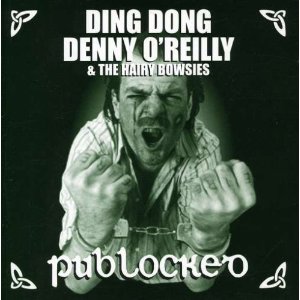 My friend Lar introduced me to this ol’fella (he may have even sent me this CD, as I can’t imagine where I’d have found it on my own).
Ding Dong Denny is the alter ego of Paul Woodfull (who created the Joshua Trio a U2 tribute/pisspull). And, as I know precious little else about the man, I’ll let the more enlightened pass along the details.
Publocked is a lowbrow amalgam of all kinds of Oirish nonsense. It’s vulgar and crass and often quite funny. (Some of the bits stand up to repeated listening–the songs more than the chatty bits, although the chatty bits are especially funny).
Take “The Ballad of Jayus Christ” which sounds like a pretty standard simple ballad until you realize what he’s singing: “Jaysus O Jaysus As cool as bleeding ice…It’s funny you never rode, coz its you I do my shouting for each time I shoot me load.”
But it’s not all blasphemy. The “single” “Flow River Flow” is a very sensitive track about the benefits and majesty of the sacred waters (with tin whistles and everything): “When I was just a young man, I sit on the river bank I loved your gentle water so much I’d have a wank” With the glorious swelling chorus: “Flow river flow, fuck off to the sea, go where you are wanted, to the deserts of Gobi”
True, now, that’s all kind of crass. But Ding Dong takes a political stance, too. Take “Spit at the Brits.” “We Spit at the Brits an we showered’em in a lovely shade of green…we spit at the brits, and then they blew us all to smithereens.”
And what Irishman could ignore the Famine. “The Potatoes Aren’t Looking the Best” is a view of the famine through the eyes of a farmer. Shite.
Not everything is a winner, “I Get A Round” is a “cover” of “I Get Around.” The lyrics are changed to reflect being in a pub (get it?). And “My Heart Gets So Full (You’d Swear I Had Tits)” is pretty funny, especially since it’s played as an oh so serious ballad, but there’s not much in the world that’s funny for 7 minutes.
So, yes, it’s not quite Joyce, but then Joyce does talk about masturbating by the water, so it’s all equal, right?
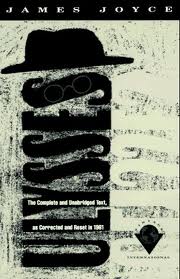
[READ: Week of July 26, 2010] Ulysses: Episodes 7-9
Before I begin, I want to make sure that everyone has checked out Ulysses Seen. It’s an illustrated rendition of the book. The details are exquisite and you’ll no doubt pick up things that weren’t as apparent in the proper text. The only bad thing I can say about it is that it’s not finished yet. So far Robert Perry has only completed Episode One, and it sure looks like that took a long time (it’s really stunning); but between the details ion the drawing and the extensive reader’s guide that comes with it, one can perch there for quite a while.
I admit that this week’s slog through Ulysses was rather unpleasant for me. The three episodes included here were massive doses of stream of consciousness. I actually found them exhausting to read. Not to mention, in terms of plot advancement, they’re rather paltry.
Episode 7 “Aeolus”
It takes a while to figure this out, but each of these sections is headed by what turns out to be newspaper headlines about the following paragraph.
Bloom comes to the newspaper office (where this entire episode is set) with his ad. The ad is for Keyes’ (tea, wine and spirit merchant). He says that Keyes wants crossed keys at the top of the ad. (The employee seems unimpressed at the cleverness). Red Murray, another employee points Bloom toward Brayden, the porter (“all his brains are in the nape of his neck, Simon Dedalus says”) (97).
Bloom sees Hynes and hints (for the third time in three weeks) that Hynes owes him money.
Bloom then gives his ad to Mr Nanetti who wants three months renewal for the ad. Bloom demurs and wanders the building. He watches the typesetters and is amazed at their ability to read backwards (just like his father read Hebrew). Then he enters a room looking for Ned Lambert.
Lambert is sitting with Professor MacHugh and Simon Dedalus (who, seriously has some of the best lines in the book, like: “Agonising Christ, wouldn’t it give you a heartburn on your arse?” (102). Lambert is reading a speech by Dan Dawson.
J.J. O’Molloy enters asking if the editor is here. But Lambert is still quoting (much to MacHugh’s dismay), and we get our first mention of Hamlet in this week’s reading.
Editor Myles Crawford pops into the room, and Bloom runs in to speak to him about the ad. Bloom crashes into Lenehan (knocking over his papers for the second time) and then sprints down the street to get that ad placed.
After Bloom leaves, the men beginning chatting (O’Molloy, Lenehan, MacHugh and Crawford). They shoot the breeze with each other and there’s lots of jokes about the Roman empire (and Lenehan’s riddle: “What opera resembles a railwayline?” (which remains unanswered for several pages).
Stephen Dedalus walks in with Mr O’Madden Burke. Stephen hands Deasy’s article in to the editor and then sits with Professor MacHugh.
Answer: The Rose of Castile (rows of cast steel) (111).
The editor proposes that Stephen write for the paper “In the lexicon of youth…” (111). Meanwhile Bloom calls back to the paper and the editor tells him to go to hell.
After much talk about great newsmen, they begin to chat about the poet A.E.
Eventually Stephen encourages them all to go and have some drinks. On the way Stephen tells a story of two elderly Dublin ladies who climb Nelson’s pillar They bring their own food, of course. And MacHugh finds the story very enjoyable.
Bloom catches up with Crawford at last, and the newspaper headings of “K.M.A” and “K.M.R.I.A” hilariously sum up the editor’s response to Bloom (“He can kiss my royal Irish arse, Myles Crawford cried loudly over his shoulder. Any time he likes, tell him”) (121).
Stephen continues the story and MacHugh wonders where they might have gotten the plums. Stephen says I call it A Pisgah Sight of Paletsine or The Parable of the Plums.
And as the episode ends, there is more chuckling at the joke about the “Onehanded adulterer”
The thing about this chapter is that there is just so much being said in the dialogue and most of it is just a snapshot of real life: friends bullshitting with friends and making in jokes and such. And yet for an outsider (like Bloom and like us) it doesn’t make a whole lot of sense.
Episode 8 “Lestrygonians”
This episode follows Bloom around, almost exclusively in his thoughts. We learn that Simon Dedalus had 15 kids (!) which Bloom finds way too much
“Birth every year almost. That’s in their theology or the priest won’t give the poor woman the confession, the absolution. Increase and multiply. Did you ever hear such an idea? Eat you out of house and home. No families themselves to feed” (124),
He tosses some bread to the gulls (and thinks of Hamlet). And as he’s looking in the river, he sees a floating billboard and thinks about what a good ad it is. He thinks more about ads when he sees men in sandwich boards walking down the street (advertising Tely’s). Bloom thinks that a transparent cart with two smart girls sitting inside writing letters would be an excellent ad–catch the eye at once. [I totally agree].
We also get another metempsychosis joke: “Met him pike hoses she called it till I told her about the transmigration” (126). But he also thinks that Molly is funny: “Ben Dollard has a bass barreltone voice” (“calling him Big Ben isn’t half as witty as barreltone”). (126).
Then he runs into Mrs Breen, who asks about Millie (she’s down in Mulligar at a photographer’s office). Mr Breen is always bad during a full moon, last night he had a dream the ace of spades was walking up the stairs. And then she shows Bloom a postcard, which Bloom thinks about for a while, [and I don’t get]:
What is it… U.P.?
–U.p: up, she said. Someone taking the rise out of him. It’s a great shame for them whoever he is (130).
Bloom asks about Mrs Beaufoy and Mrs Breen corrects him that her name is Mina Purefoy. She is in hospital for three days with a difficult birth (and a houseful of children waiting for her). And then they see a man who walks outside of lampposts, Cashel Boyle O’Connor Fitzmaurice Tisdall Farrell, who Bloom says he must chase after.
Bloom considers lunch as he muses about life and death (Dignam and Purefoy–both ends of the cycle). And he muses about A.E. (from a less intellectual bent–he doesn’t know what A.E. stands for).
Then he finally makes it to The Burton. Bloom surveys the crowd there (we see him turn his nose up at the way people eat) and he decides it is simply too busy and crowded for him. So he leaves and goes to Davy Byrne’s : “Moral pub. He doesn’t chat” (140).
Nosey Flynn is in Davy Byrnes. They greet each other, and Bloom has a gorgonzola sandwich (!) Flynn asks after Molly and the concert and asks if Blazes is involved (But Bloom decides he didn’t mean anything by it). Flynn’s nose is running and almost drops a drip in his drink but he sniffs it up.
Flynn asks for any racing tips. Davy Byrne says he doesn’t do that anymore.
Bloom finished his sandwich and heads to the bathroom. He thinks about sex in a field (with Molly?)
When he leaves the seat, Davy Byrne asks Flynn what Bloom does. In the insurance line? Bloom used to be but now “he does canvassing for the Freeman” (145). Flynn says that Bloom is “in the craft…ancient free and accepted order. He’s an excellent brother” (145) (Suggesting that Bloom is part of the ancient Order of Hibernians? Which is a Catholic group UPDATE: No, as others pointed out it is the Freemasons. Whoops). Flynn concludes that Bloom is a good man:
“He’s been known to put his hand down too to help a fellow. Give the devil his due. O, Bloom has his good points. But there’s one thing he’ll never do….
–I know, Davy Byrne said
–Nothing in black and white, Mosey Flynn said (146)
[What could that be??]
There’s another great example of Joyce’s fun with words in this section:
Davy Byrne smiledyawnednodded all in one:
-Iiiiiichaaaaaaach!
Then Paddy Leonard and Bantam Lyons come in the pub. Bloom says hello as he walks out. Lyons whispers that Bloom gave him a racing tip (referring back to the earlier newspaper scene–Takeaway).
Bloom helps a blind man across the street (and wonders about senses), and then he heads to the library to write his reply letter to his pen pal.
Episode 9 “Scylla and Charybdis”
This section was especially difficult for me to follow. It is mostly about Shakespeare (and while I have read most of the plays they talk about, I don’t know them very well, certainly not in the detail they talk about). There’s even a musical staff with notes on it.
The scene appears to be set in a library (the quaker librarian seems to be the person in charge of the room. And it’s basically a bunch of witty intellectuals trying to make each other laugh (“Monsieur de la Palice, Stephen sneered, was alive fifteen minutes before his death” (151)).
And throughout the episode we get a lot of puns in the descriptions:
–What is a ghost? Stephen said with tingling energy. (154)
–A shrew, John Eglinton said shrewdly… (156).
–Gentle Will is being roughly handled, gentle Mr Best said gently (169).
The quaker librarian, quaking, tiptoed in, quake, his mask, quake, with haste, quake, quack (171).
The scene opens with a greeting from the quaker librarian. Another fellow with them, and the main interlocuter with Stephen, is John Eglington. Stephen remembers that Buck Mulligan has his telegram. And then Mr Best enters.
The quaker librarian seems very impressed by Stephen’s ideas. Then Eglinton announces to the room that he is unshakable in his belief that Shakespeare is Hamlet. Now if an author says this, it seem like he is arguing that he is his main character (especially since no one seems to contradict Eglington convincingly). Is Joyce saying that he is Stephen?
And then Entr’acte, Buck Mulligan comes in from the hallway. And he immediately joins in the play “–Shakespeare? he said. I seem to know the name” (163).
After bantering about, Mulligan flourishes Stephen’s telegram. He also tells Stephen that Synge is looking for him because Stephen pissed on his halldoor.
-Me! Stephen exclaimed. That was your contribution to literature (164).
An attendant pokes his head in and says a gentleman from the Freeman is here and he wants to see the files of the Kilkenny People for the last year.
The door closed.
–The sheeny! Buck Mulligan cried
He jumped up and snatched the card.
–What’s his name? Ikey Moses? Bloom.
…
Suddenly he turned to Stephen:
–He knows you. He knows your old fellow (165).
They then switch to St Thomas. And Stephen notes that
Jews, whom christians tax with avarice, are of all races the most given to intermarriage. Accusations are made in anger. The christian laws which built up the hoards of the jews (for whom, as for the lollards, storm was shelter) bound their affections too with hoops of steel. (169)
And then there is a lengthy discussion of Hamlet and Shakespeare (and even Anne Hathaway: “If others have their will Ann hath a way. By cock, she was to blame”(155). And Stephen makes another interesting comment:
I should say that only family poets have family lives. Falstaff was not a family man. I feel that the fat knight is his supreme reaction (170).
Buck Mulligan trumps him:
–Himself his own father, Sonmulligan told himself. Wait. I am big with child. I have an unborn child in my brain. Pallas Athena! A play! The play’s the thing! Let me parturiate!
He clasped his paunchbrow with both birthaiding hands. (171).
After a brief couple of page written in dramatic form (about Shakespeare’s brothers). And in the course of things we get this fun wordplay:
–Those who are married, Mr Best, douce herald said, all save one, shall live. The rest shall keep as they are.
He laughed, unmarried, at Eglington Johannes, of arts a bachelor (175).
Mulligan mentions that Stephen was in the company of two gonorrheal ladies, Fresh Nelly and Rosalie the coalquay whore (176). But Stephen ignores him thinking of “The constant readers’ room. In the readers’ book Cashel Boyle O’Connor Fitzmaurice Tisdall Farrell parafes his polysyllables (176).
But Mulligan is on a role:
Puck Mulligan, panamahelmeted, went step by step, iambing, trolling:
–John Eglington, my jo, John,
Why won’t you wed a wife?
He spluttered to the air:
–O, the chinless Chinaman! Chin Chon Eg Lin Ton (177).
Until finally at the end, Puck Mulligan creates his own play:
Everyman His Own Wife
or
Honeymoon in the Hand
(a national immorality in three orgasms)
by Ballocky Mulligan *178).
And so, just what happened in this episode? It reads so much like a play, it would probably be more enjoyable (at least for me) to have it performed. [I keep meaning to check out Ulysses on audiobook. The story is so musical, it must sound fantastic…even better if it was by a cast of characters.
I’m not the only one frustrated by this episode (and I thought ineluctable modality of the visible was hard!). The jokes and wit was fun, and it is certainly believable–I have been to parties like that, but it’s another thing altogether to read about someone else’s party.
I recall things getting more interesting at nighttime, especially when [minor spoiler] Stephen and Bloom finally cross paths. So I’ll keep going. At least I’m learning big words!

 I Just Read About That...
I wondered about some of the same things you did (what’s U.P., for example? I figured the society of which Bloom is a member is the Freemasons.). Is it possible that the one thing that the otherwise good fellow Bloom will never do is get to Heaven? He’s Jewish, after all, and Christians tend to believe you have to buy the whole Jesus Christ as Messiah story to get to Heaven. This possibility occurred to me only just now, and I haven’t thought it through much yet.
I agree with your assessment of these episodes re being exhausting (7 and 9 more than 8), though I can already tell that I’m learning a bit more about how to read this book: I just didn’t try quite as hard to understand things as I did in the earlier episodes. This allowed me to chuckle at the funny things, appreciate the humanity of Bloom, and let the rest (which was most of it) just roll over me without too much fuss.
Daryl, I was think ing of you when I wrote that other people were having problems with these chapters, and now that I see you actually wrote that in your post, I’ll be linking to it.
I think that Bloom is a very Christian gentleman, but yes, unless he converts (unlikley) he won’t be getting into Catholic heaven anyhow. I don’t know if this is addressed at all, but isn’t Hebrew lineage determined by the mother? So doesn’t that make him not a Jew either?
It’s funny that you are letting the book flow more, as I was trying to follow your lead and read it twice (not the whole episodes mind you), and I did find that a second read (after an initial quick read) did help in understanding the details.
But aside from learning a lot about a few characters’ opinions of Shakespeare, I’m not sure that I got much out of Episode 9.
Well, I did *want* to read it twice, but I had a lot going on in the last week and didn’t have a chance. I hope to get back to multiple readings for next week.
I’m pretty sure you’re right about Hebrew lineage. I don’t remember anything about Bloom’s mother except that she was awful to his father (I’m not sure I even remember that; lord, this book is full of details).
I agree about episode 9. In a way, it reminds me of things like the locker room scenes in IJ, in which there’s not necessarily a whole lot of important info conveyed, but you’re getting a sense of how the characters situate and present themselves among other people. This is, in its own way, a sort of locker room scene.
Somewhere in somebody’s post I read that he was half Jewish. (Shrug). Again, I don’t know if that means anything.
Yes, the comparison to the locker room in IJ is definitely there, now that you mention it. And yet I found that scene fun and enjoyable. Is it because of the pretentiousness of the characters (although the kids in IJ were pretentious too), is it the time removed from the composition of the story? (I tend to blame that for a lot of things), or do I just care less about Shakespeare than the myriad things that the IJ kids were talking about.
I’m not convinced about the Hibernians (and actually might assume Freemasons as well, although I don’t know their strength in Ireland). But when Nosey Flynn says
— Very much so, Nosey Flynn said. Ancient free and accepted order. Light, life and love, by God.
I assumed that since they are the Ancient Order of Hibernians. But again, I’m not willing to fight over it 🙂
Hey Daryl and Paul. Fancy meeting you here!
The U.P. thing still confuses me. For the record here is Gifford (with very minor ellipsis):
“In Charles Dickens’s Oliver Twist, chapter 24, the expression U.P. is used by an apothecary’s apprentice to announce the imminent death of an old woman. In the French edition of Ulysses the postcard is translated fou tu, “you’re nuts, you’ve been screwed, you’re all washed up.” Richard Ellman suggests: “When erect you urinate rather than ejactulate” [Um… that’s a still a little cryptic, no? -CF] Another possibility is the deisngation u.p. for whiskey, meaning underproof…”
Nabokov, as he often does, feels like his has this totally sussed out, noting parenthetically about the postcard that “some anonymous joker has sent … an insulting postcard with the message U.P.: you pee, up (a reference to the tag ‘U.P. spells goslings,’ meaning it’s all up with a person)” (Lectures on Literature, 322). Um, if you say so Vladimir.
In terms of avowed religion, Bloom is technically a Catholic. Bloom’s father, Rudolph (whence Rudy’s name) Virag, was Jewish, but converted to Protestantism (and changed his name to “Bloom”) in order to marry Bloom’s mother. Bloom himself, in order to marry Molly, would have needed to, at least formally, convert to Roman Catholicism. (Nabokov is helpful summarizing this around p. 316).
Bloom is, of course, neither a practicising Christian nor a practicising Jew (he is freethinker, though obviously of a different stripe than Stephen; a fact relevant, perhaps, to his connection to Freemasonry).
But regardless of what Church he is technically a member of, Bloom remains an ethnic Jew (even though, as Paul suggests, traditionally one inherits this designation matrilineally), a fact that many others seem acutely aware of throughout. (I’m unsure of the degree to which Bloom himself identifies as Jew though; he seems in many way a sort of broadly liberal assimilationist so far).
We might wonder whether we should say he is “racially” a Jew, given the peculiar way in which race seems to circulate through this novel. Race is a notion to which Stephen seems to have frequent appeal. Recall the end of Portrait: “…to forge in the smithy of my soul the uncreated conscience of my race” (my emphasis). The professor in “Aeolus,” talks about the English as race, separate from the Irish: “We serve them. [Recall here too Portrait and Stephen’s declaration “Non serviam. I will no longer serve…”] I teach the blatant Latin language. I speak the tongue of a race the acme of whose mentality is the maxim: time is money.” The culmination of Stephen’s argument about Shakespeare is that Shakespeare “was and felt himself the father of all his race.” Here too, I would suggest, that Stephen isn’t talking about the human race, but about a division between the English and the Irish… Shakespeare not as the inventor of the human (as another Bloom would have it), but as a thoroughly English artist (whatever that might mean for Stephen; and who knows whether he believes it…)
Anyway, I’m not this far yet, but from previous readings I’m looking forward to the chapter with the “Citizen” as perhaps clarifying Bloom’s own positiion w/r/t race, etc.
Happy reading!
Hi Chris, long time no see.
U.P. keeps coming up and up and up in all of the new readings and EVERYONE sees to be amused by it. It seems so odd that critics can’t decide what it menas for sure (or rather, they decide, but they all differ). It looks like you did your research!
You know, as far as Bloom being a Catholic. I assumed, a friend of mine, that Bloom would have to be a Catholic in order to get married in the church. And now, thinking about his trip to the church, he seems not completely unfamiliar with the ceremony (certainly the Latin).
I have just finished the “citizen” section, where it is very apparent that the rest of the community is aware of his Jewishness. Although my reading didn’t make it very clear whether that was from appearance or general knowledge about Bloom.
The citizen chapter was rather difficult to read, as are a lot of them, frankly, because it was a story within a story.
Glad you’re reading along, and I appreciate your insights!
The citizen chapter kind of whipped my ass. Didn’t like all the hating on Bloom, and the framing, as you say, Paul, was also tricky.
On tangentially related news (re U.P.), I just a couple of weeks ago taught my 6-year-old daughter the “spell ‘I cup'” gag.
I am very much looking forward to that gag for my kid (he’s 5, i wonder if he’d get it yet).
(Father of the year award, here I come.)