 SOUNDTRACK: THE DUBLINERS-30 Years A-Greying (1992).
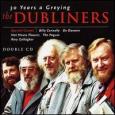
The Dubliners were an Irish folk grew founded in 1962. Probably the most notable thing about the band was lead singer Ronnie Drew’s voice, which out-gravels Tom Waits in depth and impact.
I don’t know a heck of a lot about them as a band or their impact on traditional Irish music, but Wikipedia tells me that they were a major force in the export of trad music. So there.
So if you like traditional Irish music (that’s not as “pretty” as some artists). The Dubliners are a good resource.)
When I bought this album many many years ago, I was under the impression that it was a greatest hits with extras. In fact it’s not (although there are a number of classic trad songs here). The selling point is that there are a lot of guest vocalists (The Pogues, of course, among others).
But I think a cheaper, shorter compilation would be the way to go, (you’d definitely want “Finnegan’s Wake” for instance). And I have to say I was a bit surprised by the inclusion of “The Rose” (even if The Hothouse Flowers are on it, too).
Nevertheless, if trad Irish music is what you’re after, The Dubliners are your man. And they’re named after the Joyce book, too.
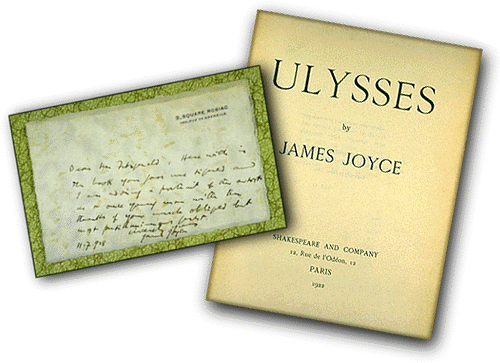
[READ: Week of July 19, 2010] Ulysses: Episodes 4-6
I would be remiss if I didn’t include a link to the Infinite Zombies discussion about Ulysses. There’s some great stuff there!
This week’s reading introduces us to Leopold (Poldy) Bloom. We meet his wife Molly and learn about their daughter Milly (who is away) and their son Rudy who died in childbirth. The most notable thing about these three Episodes is that, despite the continued use of interior monologue, they sound so different. Whereas Stephen’s was very intellectual (ineluctable modality of the visible, and all), Leopold’s is much more visceral. He focuses quite a lot on excrement and organs. And of course, there’s Bloom’s very introduction:
Episode 4 “Calypso”
“Mr Leopold Bloom ate with relish the inner organs of beasts and fowls” (45). He particularly likes kidneys, with their “tang of faintly scented urine” (45). This is all descriptive of Leopold making breakfast for himself and his wife (Molly gets buttered bread).
Leo also feeds the cat breakfast (and we get a fairly lengthy look inside Leo’s head as he thinks about the cat). He decides to go to the butcher for breakfast. He feels for his keys, realizes he doesn’t have them (although he has his lucky potato) and has to sneak into the bedroom to look for them. Molly is still asleep and doesn’t respond to his questions about the butcher.
We learn that Leopold’s morning will be taken up with the funeral of Paddy Dignam.
As Leopold walks down the street to the butcher, we see why Joyce said you’d be able to recreate 1920’s Dublin by reading Ulysses. Bloom reads all of the ads and thinks about the shops and the people he sees.
As he heads along, he sees Simon Dedalus (Stephen’s father) in the pub. He says greetings to all and then goes to the butcher. When he arrives at Dlugacz’s butchers, he sees the nextdoor girl: “His eyes rested on her vigorous hips” (48). He hopes to get his kidneys quickly so he can follow her, “walk behind her if she went slowly, behind her moving hams” (49).
He pays for his kidney (threepence!) and walks home (no sign of the nextdoor girl). When he enters the house he picks up the mail: a postcard from Milly and a letter for himself and one for his wife.
She hides the letter (which has bold, manly handwriting and is addressed to Mrs Marion Bloom) under her pillow and wonders where breakfast is. He goes to the kitchen, puts the kidney in the pan and brings a tray for Molly. (after she yells at him to bring some tea!)
The letter is from Blazes Boylan, Molly’s “manager” (Molly’s is a singer), although Leopold seems to suspect something else. She eats breakfast and he tidies the room a bit.
Then she asks him about a word in a book (Bloom seems to be the smarter one of the two):
–Metempsychosis?
–Yes. Who’s he when he’s at home?
–Metempsychosis, he said, frowning. It’s Greek,: from the Greek. That means the transmigration of souls.
–O, rocks! she said. Tell us in plain words (52).
[David Foster Wallace fans can smile knowingly about the Madame Psychosis/ Metempsychosis joke in Infinite Jest].
Leopold looks at the book–Ruby: the Pride of the Ring, and seeing the cover thinks, “Must be Ruby pride of the on the floor naked” (52). Molly asks him to get another book for her: “Get another of Paul de Kock’s. Nice name he has” (53). So, clearly, Molly has a healthy libido.
The kidney burns on the pan, but Leopold saves it and gives the charred bit to the cat. Then he reads Milly’s letter and notes that yesterday was her fifteenth birthday.
And then he heads to the bathroom. One of the things that I remember from class is Joyce’s use of unfinished sentences. It’s fairly common in his writing, but I also understand it wasn’t so before that. So, you get a wonderful “thought” like: “A paper. He liked to read at stool. Hope no ape comes knocking just as I’m” (55).
As he heads to the bathroom, we get more talk of the stuff:
Want to manure the whole place over, scabby soil. A coat of liver of sulphur. All soil like that without dung. Household slops. Loam, what is this that is? The hens in the next garden: their droppings are very good top dressing. (56)
This explicitness regarding bowel movements and dung was also pretty revolutionary at the time.
He reads a prize winning story in the paper, calculates how much the author was paid and fancies that he could write something as well. Then, “he tore away half the prize story sharply and wiped himself with it” (57).
In this Episode, we contrast Bloom and Dedalus. Bloom is a family man, been married awhile and has worldly problems. He’s smart, although not as intellectual as Stephen. He’s also, like Stephen, concerned with money. He calculates sums quite a bit as the day proceeds. I don’t know if this is meant to be a reaction to the comments about jewish merchants in the earlier chpater or just a contrast between a flush man and a skint man.
But Bloom’s Jewishness proves to be useful in the two Episodes that look at the Catholic Mass.
Episode 5 “Lotus Eaters”
Bloom walks downtown towards the funeral (Poor Dignam). He thinks about tea (he needs to order some from Tom Kernan, but he can’t ask at the funeral). Several times he takes off his hat and looks at the “headband inside his high grade ha” (58). It took me until about the third mention of the “ha” that I realized he’s reading the label and the T has worn off. Ha, indeed.
He goes to the post office and we see that if Molly has her Blazes, so Leopold has a woman on the side. In this case, he has a post office box (in the name Henry Flower, Esq) and Henry has received a letter. He’s about to read the letter when McCoy stops him.
McCoy chats with him for a bit; Bloom tells him that the funeral is at “eeleven” (60). McCoy says he may not be able to make it, can he put McCoy’s name on the registry. Bloom agrees and McCoy goes on his way.
Bloom sees more billboards, including one for Cantrell and Cochrane’s Ginger Ale (Aromatic). He walks on more, finds a place to settle down and opens the letter, keeping it hidden by the newspaper.
The letter is from Martha and it is rather risque. Her spelling is pretty atrocious: “So now you know what I will do to you , you naughty boy, if you do not wrote” (64). She looks forward to meeting him and even asks what kind of perfume his wife uses. He throws the envelope in the river (after tearing it up) and thinks about her some more.
And then he is drawn to go into a church. I think that Bloom’s Jewishness allows Joyce to question and dissect Catholicism and the mass from an outsider’s point of view. A Protestant wouldn’t have worked because the history of hostility there. So, by making Bloom Jewish, he creates an alien with (as Mr Deasy noted) very little baggage in the country.
Bloom sits in the pew and lets the mass float over him. He wonders about the letters on the priest’s back:
INRI? No. I.H.S. Molly told me one time I asked her. I have sinned: or no: I have suffered, it is. And the other one? Iron nails ran in (66).
Of course, neither one is even remotely correct. He also calls Catholics “crawthumpers.”
Then he thinks about a man who received communion in this very church every day who then went out and committed murder. He watches the priest finish off the wine in the chalice: “Wine. Makes it more aristocratic than for example if he drank what they are used to Guinness’s porter or some temperance beverage Wheatley’s Dublin hop bitters or Cantrell and Coochrane’s Ginger Ale (aromatic)” (67).
Bloom leaves the mass (before it ends) and goes to the chemist (where there’s lot more thoughts about money). He orders several tinctures and buys a bar of soap (which he takes with him). He’ll pay for the rest later when he comes back.
On his way out, he runs into Bantam Lyons who borrows Bloom’s newspaper to check the races. Bloom tries to leave by giving him the paper, but he won’t hear of it. He seems to get a bit offended and walks away.
Blooms shrugs him off and then heads towards the baths. He sinks in (using the soap he bought) and sees the “floating hair of the stream around the limp father of thousands, a languid floating flower” (71).
Episode 6 “Hades”
After his bath, Bloom hops on the taxi to go to the funeral services. On the car are Martin Cunningham, Simon Dedalus and Mr Power. They all greet each other and begin talking.
First they talk about the route the taxi is taking them and they watch the buildings go by. (Again, a very detailed look at Dublin).
Them Bloom spots Simon’s son Stephen. Simon asks if “that Mulligan cad is with him?” (73). No, Stephen is by himself. Simon says “That Mulligan is a contaminated bloody doubledyed ruffian by all accounts. His name stinks all over Dublin” (73).
Mr Power asks Bloom about Molly’s concert tour. Bloom says it’s going well although he will not be going himself.
And then Bloom tells a story about Reuben J and his son. He begins to relate that the man and the boy went to the boat, but Dedalus interrupts with some snarky comments. Finally, Martin Cunningham “thwarted [Bloom’s] speech rudely” (78) and relates that the man and the young fella were headed to the Isle of Man when the young one jumped out of the boat into the Liffey. And a boatman fished him out with his pole.
Bloom jumps is,
–Yes… But the funny part is…
–And Reuben J, Martin Cunningham said, gave the boatman a florin for saving his son’s life.
…
–Isn’t it awfully good? Mr Bloom said eagerly.
–One and eightpence too much, Mr Dedlalus said drily (78).
They feel a little remorse about laughing while on the way to Paddy’s funeral and they grow more somber. Then Mr Power chimes in that “the worst of all is the man who takes his own life” (79). Cunningham coughs to get him to desist, but Power continues extolling the wickedness of a suicide.
We learn through Bloom’s thoughts and later when Cunningham talks to Power than Leopold’s father killed himself with pills.
The carriage stops and they mutter about hoping the carriage doesn’t tip. Bloom imagines if Dignam’s coffin tipped over and he was spilled onto the road. And he wonders if the body would bleed. They see a small casket pass them and Bloom thinks about Rudy (he blames himself for his death). Then he thinks of Milly and Molly “(Same thing watered down. Her tomboy oaths. O jumping juniper!”
And they finally reach the cemetary grounds.
We learn that Paddy Dignam had five children, and they are asking for money for them, until the insurance is cleared up.
The priest (“Father Coffey. I knew his name was like a coffin” (85)) begins the service in Latin. (“Makes them feel more important to be prayed over in Latin” (85)). But the more Bloom thinks about the funeral, the more he thinks that it’s a waste of wood and a waste of space, especially since everyone will no doubt be having maggot on them in time anyhow.
Bloom notices a man in a Macintosh raincoat who he doesn’t recognize. Later, when Hynes asks him who the man was, we get this confusion:
–And tell us, Hynes said, do you know the fellow in the, fellow was over there in the…
He looked around
–Macintosh. Yes, I saw him, Mr Bloom said. Where is he now?
–M’Intosh, Hynes said scribbling. I don’t know who he is. Is that his name?
He moved away looking about him.
–No, Mr. Bloom began, turning and stopping, I say, Hynes!
Didn’t hear (92).
The thoughtfulness ends with Bloom thinking that we ought to have recordings of people’s voices to go along with the photographs we keep after they die:
Have a gramophone in every grave or keep it in the house. After dinner on a Sunday. Put on poor old grandfather. Kraahraark! Hellohellohello amawfullyglad kraak awfullygladaseeagain hellohello amawf krpthsth (93).
COMMENTS
A lot more “happens” in these four Episodes than in Stephen’s. But still, there’s more talk than action here. Nevertheless, the three Episodes set up a very stark contradiction between our two main characters: Stephen is so in his head that barely registers where he’s going (he walks past his aunt’s house without realizing it) while Bloom is very aware of all of his surroundings.
Bloom is very visceral, thinking about sex and excrement, while Stephen, if he thinks about bodily functions at all, it’s basically about death, specifically his mother’s. They also both worry about money, of course, Stephen doesn’t have any, while Bloom, a working man, does have some, but he’s very conscious about what things cost.
Bloom and Molly are also sexual beings, with very little of that in the first three Episodes. At this point, we see that they both seem to be seeking satisfaction elsewhere (Molly with her books and Leopold with his pen pal).
There has also been a number of instances where they are aware of the same things (clouds covering the sun etc), or in that one instance, where they cross paths (of course they do not speak to each other). So we know that Bloom knows who Stephen is (although we don’t know vice versa) but we don’t know if they are very aware of each other.
At this point, we’ve passed through the bulk of the morning of this day. One can assume we’ll be moving on to the afternoon with the next Episode.

 I Just Read About That...
Shortening Leopold’s name to Leo may well annoy your common-or-garden Joycean, who would note that Molly shortens it to “Poldy”. They note that this firstly and ironically refers to the less than virile Leopold when compared with the other Poldy: Paul de Kock who wrote Sweets of Sin, the book Molly is reading in episode IV. The second reason they identify it is that she removes the Leo, taking away his threat. It’s about here that I see your eyebrow and raise you one. Sometimes, after all, a cigar is just a cigar.
Music note: the Dubliners’ original lead singer was a man named Luke Kelly. He died in 1984 and had a fantastic tone. If there’s anyone checking out this band, be sure to get a compilation with both Ronnie (who died in 2008) and Luke on it. I’m especially fond of Monto, Springhill Mining Disaster and the sentimental but stirring Scorn Not His Simplicity.
I knew as soon as I typed Leo (out of laziness not heresy), that I was in for trouble there.
And so I was wondering is Stephen’s school meant to be Gonzaga?
I hadn’t listened to The Dubliners in a long time (can you believe I don’t sit around listening to jigsnreels?) It brought back fine memories. I’m rather bummed that I bought that big assed double disc of the band and missed out on the classics. Alas, along the
Gonzaga didn’t open until 1950. I don’t have Gifford’s book at hand but as far as I remember the school is in Dalkey. At that time the Jesuit schools were Clongowes, Belvedere and Mungret, a boarding school which closed about 40 years ago. One of my (retired) colleagues, a Jesuit himself, went there. I don’t think it gets a mention in Joyce, so it’s the Gummo of Jesuit education.
Enjoying your posts, although your volume is positively Ebertian.
I have a blog on the go but it has to get to 50 posts before I tell anyone about it. Diligent research should get you there–it’s on wordpress.
Thanks for the details there. I assumed if you were walking the hallowed halls, I’d know about it.
Heh Heh, Gummo.
Ebertian: I write about women with big breasts? [Faster Pussycat, Kill Kill]. Oh, voluminous. Well, not too far off.
Clongowes is the school I remember from Portrait, though Belvedere may get a mention as well — I believe the young Stephen had to change schools midway through.
That’s right. Bruce Bradley, SJ, the former Headmaster of Clongowes, wrote a book called James Joyce’s Schooldays. Joyce was punished for the first time, according to the records, for foul language. Go figure.
Got an amazing three hour tour of Clongowes from the same Rev. Bradley, SJ, a few years ago. They’re not really forthcoming with such things, but I asked very nicely. The corridor where Stephen hesitates before reporting the injustice of his punishment is still there, as are numerous other detailed details.
Much of the teenage phase of Portrait is set in Belvedere. It’s funny being in Belvedere’s theatre, built on the courtyard in which Stephen smelt “horse piss and rotted straw” after his own performance in the school. His father got him into that day school after the fees for Clongowes proved too steep for his, er, disadvantaged father.
Daryl did you read portrait recently too? The more I’m reading about Ulysses, the more I wish I had reread Portrait too. And, I guess Hamlet, oh and all the Irish poets and….
[…] Here are two links to rather long articles that I’ve no time to read myself right now. Skim reading the content means I’ll certainly give them my full attention later on this week. I’m partial to the music of the Dubliners and I saw the Pogues once a long time ago. How they both relate to the text of Ulysses will be interesting I’m sure. The blog posts are to be found on I just read about that… in two parts the first here and the second here. […]