 SOUNDTRACK: ALANIS MORISETTE-Jagged Little Pill (1995).
 In this book, DFW considers himself to be absolutely useless when it comes to music. He doesn’t know anything at all. He says he listens to Bloomington country radio stations until he can’t take it anymore and then he switches over to the alt rock station. He’d never even heard of Nirvana until after Cobain’s suicide.
And so, the soundtrack for the book is R.E.M., Bush (two songs) and Alanis. In fact, there’s a surprisingly long section devoted to Alanis in the book, including DFW’s admittance that he would love to have a date with her for tea. He admits that she is pretty much manufactured angst and yet there’s something about her that he finds irresistible.
At this stage (2010), the whole Alanis thing seems almost adorable in it’s “controversy” or “hype” or whatever. It’s still hard for me to be objective about the quality of Jagged Little Pill (I mean, Flea plays bass on it so it must be good, right?). I really enjoyed it at the time, perhaps because of its rawness or its honesty (which was pretty novel at the time, especially from a woman), all packed in a clean production of course. There’s also something weirdly appealing to me about her (really not very good) voice. She seems just off enough for all of this to be really sincere.
And of course, the nastiness of “You Oughta Know” was pretty astonishing for pop radio at the time. True, there’s songs on here that make me cringe now (there’s a lot about her that makes me cringe) and yet there’s still some really enjoyable stuff here. Even the perennially mocked “Ironic” for all of its flaws has a stellar chorus.
Now that the “women in rock” phase of alternative music has passed, there’s very little music like this being made anymore. So it’s kind of fun to reminisce about this stage of my musical life, warts and all.
 Oh, and by the way, I also grew up watching Alanis on “You Can’t Do That on Television,” so it was pretty exciting to see a child star that I knew make it big.
I never liked Bush though.
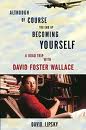
[READ:April 21, 2010] Although of Course You End Up Becoming Yourself
As I mentioned, I was super excited to get this book and I treated it like the artifact it is: trying to read it in one sitting (impossible) or at least in as compressed a time as possible to preserve the stream of consciousness attitude of the book.
For, as the subtitle doesn’t quite state, this is five-day conversation between David Lipsky and David Foster Wallace. The tape recorder was running for most of these five days and what we get is a literal transcript of the conversation (with much of Lipsky’s parts excised). It is an all-access pass to the mind of the man who wrote Infinite Jest as the hype of the book was really taking off and as his brief promotional tour for the book was winding down.
Lipsky was (is) a reporter for Rolling Stone. DFW’s Infinite Jest was the huge media hit (#15 on the bestseller list) and the hype was outrageous. DFW had begun a (sold out) reading tour which actually began the day before the book came out, so he rightfully notes that no one could have actually read the book by then, they were just there because of the hype. And Lipsky himself is part of this hype.
Lipsky was sent to do a profile of the wunderkind, literature’s next great hope (RS hadn’t (hasn’t?) covered a young author like this in a decade at least). The idea was that Lipsky would tag along with DFW, go to the last readings on the tour, an NPR interview, and spend most of their time together: planes, rental cars, hotel rooms, etc generally just hanging out with tape recorder running.
Lipsky opens the book with some introductory materials, basically setting the stage and telling us about the experience. The introductory stuff also deals with all of the more harrowing personal aspects of DFW’s death. As the Howling Fantods noted, and it’s something I wouldn’t have consciously realized, I don’t think:
At first I was thrown by the structure of the introductory material, but it serves the book well – it is about David Foster Wallace in life, not a rumination on his passing. Thus the structure left me feeling uplifted rather than in a dark, sad place.
By the end of the five days, Lipsky say he felt like he and DFW were friends: they had much in common and were similarly minded. But at the same time, he also knows that DFW was very conscious that he was a reporter. And even if they were becoming friendly, there was still the very obvious truth that the whole conversation was being recorded.
So, when the tape starts rolling, DFW is a bit arch, testing the waters with comments and glib assertions. But through the course of the book you can see him opening up, being less “on” and just talking, answering questions.
Lipsky describes the book as an audio commentary for a DVD, and that is very apt: two people discussing an event in an almost free from way. But unlike many aimless discussions, Lipsky had an agenda, and he steered the discussion in the directions it needed to go. Sometime Lipsky seemed to push an issue that upset DFW (I felt he was really pushing DFW on his own drug use, however, since IJ is about addiction, it’s not unreasonable that he did that).
The focus of Lipsky’s questioning is multifold. Lipsky is a fan of DFW’s work, and since he himself is a young writer, he seems to have a personal interest in writerly ambition, fame, the effects of fame, and the effects of fame on the writing process. Also, his angle for the piece is clearly “what’s it like to be DFW, savior of literature?”
And the answer is interesting because of the type of person DFW is: he’s very smart, but he’s also very uncomfortable with showing off his smartness (Lipsky describes him as being very Midwestern in this regard). He’s a gentle generous person who is very protective of himself and his family. And so, rather than just being a profile of a hip young author, the focus turns into what happens to a shy, unassuming hip young author when the spotlight shines on him.
DFW comes across as nervous but funny, engaging and witty, private, yet unafraid to show off his foibles. He is pleased by the attention he receives and yet is embarrassed at the fuss. In short, if you’ve read any of his non-fiction “golly gee, here I am” pieces, the character seems to be pretty spot on for what DFW is like (at least on this interview).
And DFW has a lot on his mind: the state of entertainment in the world today (he doesn’t own a TV, because whenever he sits in front of one, he’ll watch for marathon sessions–and I was shocked to say that I know at least two people who have the same “quality”). DFW loves movies where things blow up. And yet during all of this he is aware of the dangers of passive entertainment (I mean, that’s part of what IJ is all about).
If you read (and loved) IJ, this is an interesting look at the philosophical ideas behind the book. Not exactly what inspired him to write it, but more like the things that were going through his mind which demanded he write down the ideas. And it’s interesting how many of his ideas stem from simple attitudes about people in the late 20th century. While I wouldn’t say he was prescient about things, because I think anyone could have seen where things were going, pretty well, he predicted that we’d end up with a lot of the media celebrities we have now.
Big caveat: you won’t learn any secrets about IJ. None. There’s no sudden revelation about Pemulis, there’s nothing like that at all. There’s a lot about the writing process and physical aspects of it, but very little about the actual content. Although they do spend a lengthy time talking about Lamont Chu and Lyle and their discussion of fame (which makes sense contextually).
DFW also doesn’t shy from his biography. By the end of the book, when the tour is over and the two David’s are hanging out in DFW’s house with his two dogs (Jeeves–great name for a big dog–and Drone) DFW feels comfortable enough to summarize his life up to this point: the failed tennis career, the failed academic career, the suicide watch, the shit jobs, the drugs, up until he was inspired to write the opus.
The book itself has no structure per se. It’s just tape after tape of DFW talking. Lipsky includes a lot of comments and “stage directions” to tell you what’s going on: sound effects, songs on the radio, DFW’s tone, even thoughts about what went though his own mind while the interview was happening [DFW is playing a game with me here, sort of thing]. There are a few places where I wish he had contextualized a wee bit more, as it felt like the tape had paused and we started mid thought (which I suppose is what happened). But for the most part, it’s just unexpurgated DFW (with context by Lipsky).
And as such, this book is probably pretty limited in appeal. Obviously DFW-heads will love it. But I think it also has value beyond the DFW fanbase. There is some interesting insight into the state of celebrity circa 1996 (especially the minor celebrity of a writer). There’s even some interesting insights into just being a writer.
For the casual reader, the book is going to be too much: 300 pages over 5 days is a lot to tackle. There’s a lot of repetition of ideas (Lipsky is trying to focus DFW, to get that sound bite, after all), and there’s a lot of navel-gazing (it is designed as a piece about DFW after all), and yet, I think it’s all quite interesting and rather fun.
Of course, if you don’t like DFW, this book is going to do nothing for you. But then you haven’t read this far down here either, I’m sure.
I don’t want to over dramatize my own feelings about DFW. I also don’t want to make it seem like he’s on a pedestal because he’s not. He’s just an author. However, at this stage I have read enough by and about him (and yes, IJ did have a big impact on me) that I enjoyed feeling like I could get to know him as a person.
This book won’t change my life. The conversation wasn’t mind blowing by any means. And yet, I feel privileged to have access to these thoughts. Like a commentary track, this book answered questions I had about IJ and about DFW. And it also makes me feel more kindly towards him in general.
DFW’s mind was a fascinating place to be immersed for a few days, but I’m glad I don’t have to live there all the time!
The book also makes me want to check out Lipsky’s own fiction (as well as DFW’s friend Jonathan Franzen, an author whose novels I have never read–despite the hype over The Corrections.)
Some other folks who have already (!) posted about the book include this thought review at Infinite Zombies and of course the unflagging Howling Fantods for all your DFW needs (and this list of other reviews)

 I Just Read About That...
[…] is really rife with pop culture, especially television references. In David Lipsky’s book, Although of Course You End Up Becoming Yourself , DFW states matter-of-factly that he has an obsession with TV and pop culture, so this […]
[…] I managed to stop off at the Random House booth and get an autograph from David Lipsky (author of Although Of Course You End Up Being Yourself). I was amazed at how nice, friendly and chatty he was. Now, normally authors are very nice […]
I’m glad to have seen a review of this that just focussed on what it actually was, rather than getting all philisophical about Lipsky. I’ve been wanting to read this for a while as I’ve recently plowed through all of DFW’s nonfiction and am looking for similar stuff, searching the internet for all those uncollected essays and book reviews. So thanks for a comprehensive review. Can’t wait to read the book.
Thanks for reading. I’m glad I could help. A lot of DFW fans are pretty invested in the man, so it’s easy to wax philosophical. Of course, the important thing is if the book is any good.
If you’ve been reading his nonfiction, I think you’ll enjoy the book. Its obviously not his edited thoughts, but it’s still his thoughts.
If you’re looking for uncollected pieces, definitely check out The Howling Fantods. He’s got pretty much everything there!