 SOUNDTRACK: ELFIN SADDLE-Ringing for the Begin Again [CST059] (2009).
 This is a fascinating disc from our friends at Constellation Records. It defies ready classification and offers elements of folk music, eastern instrumentation, klezmer and Asian influences.
The most obvious Asian influences come from Emi Honda who sings in Japanese. In a most misunderstanding, on “The Procession,” which sounds Middle Eastern, I actually thought she was singing in Israeli or something until I realized it was Japanese.
Jordan McKenzie, the other half of the band, sings in English and has a variety of vocal styles. He also plays accordion banjo and xylophone, which complements Emi’s own accordion and singing saw (!). There is also a feeling of random percussion (or as the Constellation website puts it: junk percussion).
The opening track, “The Bringer” begins quietly, building in a gentle staccato with both members singing until it reaches its full height of intensity. “Running Sheep” sung in Japanese, actually feels like a running song, while “Hammer Song” is almost, almost, a straightforward folk song (in which Jordan sounds Scottish) except for perhaps the tuba accompaniment. Yet for all of these disparate elements, the disc holds together amazingly well. These are not nine individual track glued together, they all work together to create a very solid composition.
It should also come as no surprise that Jordan and Emi are visual artists. The cover depicts a sculpture of theirs (and the liner notes are beautifully illustrated). Lyrics are included and the Japanese is translated for us.
The disc doesn’t feature the dramatic highs and lows of some other Constellation releases, but as a solid, slightly avant garde folk release, it’s quite terrific.
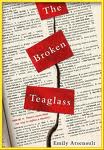
[READ: February 14, 2010] The Broken Teaglass
[UPDATE: Sarah just reviwed the book here. We don’t often read the same books, so this was fun.]
Sarah’s friend Denise said I would really like this book. Upon hearing that this book was right up my alley I had to investigate immediately (I always wonder what people think I would like). And she was totally correct.
So what makes this book perfect for me? Well, it is set in a dictionary. Actually, it is set in the editorial department of the offices of the Samuelson Dictionary, one of the premiere dictionaries in the world. The protagonist is Billy, a recent college graduate (in philosophy) whose first job comes at Samuelson. The offices are located in the small town of Claxton, Mass. Billy moves away from home (although it is still driving distance) to a small apartment in this very small town.
I have no idea if the descriptions of working in a dictionary office are in any way accurate, but it certainly is enticing. Essentially, everyone works in silence all day. They are assigned several magazines to read to see if there are any new words that are coming into common usage which might wind up in future editions of the dictionary. Eventually they are assigned words to define as well (for future supplements to the dictionary).
They are also responsible for correspondence with dictionary users. People write (or call) with questions about word usage, misusage and even suggestions for additions to the dictionary. How fascinating is that? (Oh and these correspondences were absolutely hilarious!).
After several days at his new job, Billy meets Mona. Mona is the newest person prior to Billy (she’s been there about a year). She seems to get a lot of the pervy questions (mail correspondence only, thank you) and is often asked to explain to the questioner about whether to use dominatrixes or dominatrices.
Whenever the editors run into a question about words usage, they must check the cit file. The cit file is a large card-catalog type resource of all of the prior citations of words that formed the basis of the dictionary.
Each cit states the word and then gives examples of that word’s usage in newspapers, books, magazine, etc. Billy finds a cit that is taken from a book called The Broken Teaglass. It is an unusual cit as, typically, the cits give only a line or two for context, but this cit seems to be a large chunk of a story. And the specific word seems weird for the context of the quotation.
When Mona sees that the cit is from The Broken Teaglass, she explains that she has had another cit from that source. She looked up the book and found absolutely no record of its existence, nor even of the author. She considers it a challenge to uncover the meaning of this.
Billy’s not too sure, until they read both cits together and realize that the cits sound very much like they are written about the very office that they are working in. And, that it seems very likely that the cits are describing a murder.
They spend the rest of the book trying to piece together the information (an early lead gives them a lot more cits to investigate) to get to the bottom of the mystery of The Broken Teaglass, its author and just what happened with that dead body. Oh, and maybe just to find out who else in the office knows anything about the story.
Now as a genre, I don’t like mystery novels. And a few times I feared that the story was going to go in a mystery-genre-direction. At one point when they state that the murder brought the death toll in Claxton to a record high number, I feared it was suddenly going to turn into some kind of small town murder mystery. But it never does.
Rather, the book stays resolutely in the realm of literary fiction, with a mystery as the underlying propulsion of the book. And, without giving anything away, what I liked about the book is that it never degenerates into police/agents/investigators looking for clues to a murder. Nor do our young heroes suddenly turn into Nancy Drew. All of the research and fieldwork is confined to the cit file, which makes for a really fascinating mystery.
There aren’t too many characters in the book. Our two main characters, a few office workers (most have one or two lines, but their boss and a retried gentleman become confidants), and Billy’s landlord. His landlord and his wife live downstairs, although his most common compatriot is his landlord’s brother, who is something of a loser, although he is educated (and seems resentful that he never got a job at Samuelson).
The two main characters are fully realized. They have an antagonistic relationship at first, but it becomes a mutually appreciative one as the story progresses. We learn about each of their foibles and quirks and how their families have supported them over the years.
The only thing I found weird or questionable about the book is a revelation that comes about 2/3 of the way through the story. It concerns one of the main characters. It’s strange that the revelation comes so late in the book, as if it were some profound mystery in itself, yet it doesn’t have any bearing in the early part of th ebook and, frankly, it doesn’t really impact the remainder of the story either.
The character winds up taking a personal day and getting drunk. But life goes on as normal regardless, and the investigation into the cits could have continued whether or not drinks were involved.
I suppose that this revelation adds a sense of gravitas to the character, but even without this revelation, his character would have been wonderfully full. It seems like a rather arbitrary addition to the book that added an unnecessary subplot. True, it does add some emotional heft, but I don’t think it was really needed.
But aside from that one gripe, I loved this book. I was so hooked on this story that I brought it home and wound up reading it in bed till all hours of the night.
This is Arsenault’s first book, and I look forward to whatever clever devices she comes up with for future novels.

 I Just Read About That...
[…] 2010 · Filed under Adult Fiction, Arsenault Emily What’s so great about this is that Paul read it too, so when I was finished we were able to discuss it, always a delight. There’s actually a lot […]