 SOUNDTRACK: MUSE-The Resistance (2009).
 If someone were to create a band that tickled all of my fancy spots, on paper it would be Muse. Vocals like Thom Yorke from Radiohead. Heavy heavy guitars. And yet, not afraid to have prog rock keyboard sections. On top of that, throw in pretentious titles (how about a subtitle in French?), or, just for kicks, a three part suite called “Exogenesis: Symphony.” Oh, sure and let’s just throw in a clarinet solo in one of the songs too. Okay, so that’s Muse.
I’ve been a fan of Muse for quite a few years, before they really broke in the U.S. (Origin of Symmetry being a particular favorite). I’m still amazed that they’ve had success here, given their proclivities towards excess. But more power to them.
For some reason, this disc (despite all the pros in the first paragraph) didn’t really grab me that much at first. The first single “Uprising,” is awesome: heavy, rocking, over the top choruses, everything you could want in a pseudo political rebellion type song. But somewhere after that I felt the disc drifted a bit.
Further listens changed my mind though, and I think that “United States of Eurasia” is great while “Guiding Light” (which could easily be mistaken for Queen) is fantastic. In fact the entire end of the album, “MK Ultra,” “I Belong to You/Mon Coeur S’Ouvre a Ta Voix” and the symphony are a wonderfully decadent 25 minutes of music.
Clearly Muse isn’t for everyone, but I’m really pleased that they’re finding their fans.
[READ: Week of February 1, 2010] 2666 [pg 102-159]
This week’s reading contains a lot of dreams and it often felt like a dream while reading it.
We pick up right where we left off, with El Cerdo telling our friends about his visit with Archimboldi. We learn a little about why Archimboldi called El Cerdo, but nothing about what he was doing in Mexico City. It turns out that El Cerdo knows Archimboldi’s publisher Mrs Buber. (And Dieter Hellfield speculates that she, herself, may be Archimboldi. [I secretly wondered if he might be a woman given that earlier in the book, it was mentioned that [part of what was so unusual about Archimboldi’s name was that it was a feminine form of the name.] However, his incredible height has definitely thrown me. And of course, since El Cerdo reports to have talked to him, it seems very unlikely at this point.)
Archimboldi informs El Cerdo that he is headed for Sonora (at the North West corner of Mexico on the U.S. border). Specifically he is going to Santa Teresa. Our heroes decide that since this all transpired but a few days ago that they will head right to Santa Teresa and finally meet the man.
There’s a hilarious bit where each of the four thinks what he or she would most like. One would like to meet him, one would just like to know he’s there for sure. And it says that Alatorre, whom they like a little more but still don’t really respect, “Alatorre, whose opinion no one had requested, would be satisfied to strike up an espistolary friendship with Pelletier, Espinoza, Morini and Norton, and maybe, if it wasn’ too much bother, visit them every so often in their respective cities.”
Morini opts out of the trip. He claims his doctors ordered him to stay home but that really isn’t true (no doubt he has some latent qualms about Santa Teresa after reading that article several months ago). He leaves out the lie about the doctors when he speaks to Norton, and she thinks poorly of him for not joining them.
When the group arrives at the hotel where El Cerdo met Archimboldi, they see the guest book and see that it was signed Hanz Reiter. Oh, and there’s another scene of a taxi driver getting the crap beaten out of him, although this time, our boys have nothing to do with it (this is evidently common at Mexico City hotels, the doormen hate cabbies. Or does Bolaño just hate cab drivers?).
El Cerdo tells them all they need to know about Santa Teresa. While there, they meet with Amalfitano (the subject of Part Two!). Their initial impression is very negative, he appears to be an unisuipred academic in an uninspired city. But after a day or two with him, they learn that he not only read Archimboldi bit also translated him, and their respect grows slowly.
Their first night in the hotel there, all three have crazy nightmares: Pelletier dreams of his bathroom (in reality the toilet has a huge chunk cracked out of it). In the dream, the bathroom is smeared with shit and the floor is a pool of blood. Espinoza dreams about the desert. And Norton dreams that she can see herself in the two mirrors in her room. But she slowly realizes that it is not her and it spooks her to no end.
Their general impression of the Santa Teresa is bad: slums and ghettos and for example “a soccer game between a team of the terminally ill and a team of the starving to death ” 129 .
The 4 travellers [man, I need a better collective noun for them] get a list of all of the hotels in the area (many of which are motels and brothels) but they can find no leads as to where Archimboldi is. Finally Amalfitano tells a long, convoluted story about how intellectuals are treated in Mexico. And just as I was thoroughly confused by what he was saying, Norton comments, “I don’t understand a word you’ve said” (123). So that made two of us.
During their stay, on one evening Norton goes to both of their rooms and invites them back to hers. And they are finally able to consummate their long awaited three way.
But after that, Norton grows cold of any more amorous behavior (Espinoza and Pelletier seem okay with that as their sex drive has plunged as well).
Norton has had it with the place and she decides not to accompany the three men on that days’ adventure. Amalfitano informs them that a German is working for the local circus, Circo Internacional. Of course, when they get their there’s no way it can be Archimboldi (especially when the guy reveals that he’s actually American). They report the news to Norton who says she’s had it and is going back home. The three friends drive up to Tuscon and see her safely to her plane back home. The men say they’ll stay for three days more, tops.
Those three days turn into an incredibly long stay, however. First they accept requests to give lectures at the college (where they meet some more Archimboldi students, one of whom even has a Pelletier translation!). Another of those students reveals to our two men that there have been hundreds of women murdered in Santa Teresa (this was during a drunken revelry, so they’re not entirely sure what he said. And despite not really believing him, or thinking maybe something was lost in translation they conclude that 200 is what the man said. And despite the fact that some men have been arrested in conjunction, women are still being killed.
After some time both Espinoza and Pelletier receive an email from Norton. It is not exactly the same email for each, but the important parts are the same.
What I loved about this section was how it was broken up: a paragraph from Norton’s letter and then a paragraph or two about Espinoza and Pelletier and their lives in Santa Teresa while they absorb Norton’s email. And I especially liked it because Norton’s email was so important: it impacted them and the story at large, and it was a huge revelation for herself. This was an important emotional dawning for her. And every time her letter was interrupted in the story, it was like dropping an anchor on a speedboat, because, the two men are idling their lives away in Santa Teresa.
Some time ago, Espinoza bought a rug from a street vendor. Now he has gone in search of the woman whose name is Rebeca. When he finds her he sets about basically hanging out with her. He helps her and her brother at the stall, he buys even more rugs, he essentially flirts with her, even going so far as to meet her family. One night they go out dancing to a club where Rebeca reveals that two women were picked up from there and murdered. Eventually, they sleep together (he even buys her lingerie to dress up in).
Norton’s letter was so devastating to Espinoza that he said he felt like throwing up.
Everytime Espinoza returns to the hotel, Pelletier is lounging about reading and rereading his Archimboldi books.
Norton remembers when she was 8 years old and how she felt about a boy named Jimmy. And how nakedly honest she was with herself then.
Days and days go on like this until Espinoza just turns off of Rebeca. He tells her he is leaving soon but that he’ll be back someday and maybe he’ll take her back to Madrid with him as his wife. He thinks she says that that would be nice.
And Norton reveals that when she got home, she felt uneasy with herself. Until finally, she went in search of Morini. She stayed with him for a few days until she finally realized that he loved her and she loved him.
And Pelletier and Espinoza realize that they will not find Archimboldi here. Pelletier is convinced that he is there in that city with them right now, but they will never find him.
And Norton and Morini are happy. She doesn’t know how long it will last, but she’s not worried about that.
And thus endeth Part 1.
COMMENTS
I’ve mentioned how in many ways nothing really much happens here. It’s a whole lot of travelling, conferences, taxi driver abuse and sex. And yet, I was totally hooked.
I’ve had a discussion elsewhere about the inviting style of the prose. It is very warm and welcoming, and it feels like you’re a part of something, a cabal, a secret society, something. And, I believe that making the protagonists interested in an author who is largely unknown, and beyond that, physically unknown to them, reinforces the idea of a secret society.
The mystery itself isn’t all that enticing (no mystery writer is going to coopt the slow pacing and lack of real clues) and yet for all of that, it is engaging and fascinating. And I want to know more and more about them.
Now, I’m led to believe that part 2 is a completely new everything, and I suspect that that book is going to do something (unknown yet) to the way I read this book. It’s either going to go in a completely different direction (which I suspect) or it’s going to show the same material from a different point of view (which is possible). Either way, the start of part 2 (and the finishing of it, as it is all due this week) should reveal an awful lot about what’s to come.
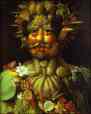 And I also enjoyed the suggestion over at bolanobolano that Archimboldi may be based loosely on the painter Giuseppe Arcimboldo who is famous for works such as this–>
He may not be the actual inspiration (others have been put forth as well) but I’d forgotten who this weird artist was and now I have the name again!
And of course, I’ve been enjoying the discussions at Infinite Zombies!
For ease of searching I include: Bolano

 I Just Read About That...
Leave a comment