 SOUNDTRACK: TINDERSTICKS-Trouble Every Day [soundtrack] (2001).
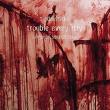 This is the second soundtrack that Tindersticks made for director Clair Denis. This disc is rather unlike Nenette Et Boni, in that this soundtrack is much more stark. There are several moments on the disc where there is nothing but silence for several seconds. “Core on Stairs” features a bass note or two and then even more silence, then one more note and more silence. On “Room 231,” there are times when the only sound is a gently shaken maraca. It’s rather eerie (and I’d like to believe it suits the film well). But predominantly this is a string laden affair, highlighting the sadness of the movie.
The title track, however, contains the full band, including Stuart Staples’ singing. And it’s a moody, evocative song. Strings are plucked as Staples croons about trouble. Actually the title song is broken up into the Opening and Closing Credits. But they rather thoughtfully include the whole song at the end of the disc as well.
This is not an essential Tindersticks disc (you can get the title song elsewhere). But if you like your music moody, this is a good one. It may be a bit too sparse for casual listening, but it certain conjures up some interesting ideas.
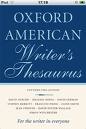
[READ: October 27, 2009 ] DFW’s comments in The Oxford American Writer’s Thesaurus
According to the Howling Fantods I have read all of the uncollected DFW pieces (except for the ones from the Pale King), and so this is my final piece (hooray!). It’s not really anything major. As you can read from the Fantods’ summary below, this excerpt contains DFW’s comments inside this 1100 page Thesaurus. Several authors contributed comments to the Thesaurus and all of their comments appear after the entry for the word. They rest in boxes and are capped off by their initials. The PDF that you can click on below is 85 pages long. But if you search for DFW there are only 24 entries. I copied and pasted them into a Word document that came out to 8 pages long. So, it’s not unmanageable to read just DFW’s entries.
I’m not sure that this is the entirely of his contribution to the book. (I assume it is, as I wouldn’t imagine The Fantods would skimp on us, but I’m also not going to find the book to confirm either.
“The Oxford American Writer’s Thesaurus”. Compiled by Christine A. Lindberg. Oxford University Press; October, 2004. [NOTES: This is an actual (1100-page plus) thesaurus for writers. Scattered throughout are ‘Word Notes’ wherein various authors, DFW among them, discuss usage and that forever quest for the perfect word. Read selections featuring DFW here.]
Basically what you get here is DFW’s knowledge about word usage. Anyone who has read his work knows he’s practically memorized the OED. And with his familial love of grammar, he is stickler for using words correctly. Which makes him kind of a prig, except that he’s not a prig; he’s very funny. And the examples he cites are great!
It will make you feel foolish of course if you do any of the things that he says make you look ignorant at best, but such is the price of learning. If you have any interest in language and words, DFW’s comments are really very useful. I don’t mean to short change the other contributors (I don’t even know how many other contributors there are or who any of them may be) as they are not listed anywhere in this excerpt. I didn’t read any of their contributions (it is a thesaurus after all, so I’m not, just, you know, going to read it all). But DFW’s entries at least, are certainly enjoyable.
If you plan to be a writer I would think the book itself is pretty indispensable.
DFW comments on 24 words in the book: all of, pulchritude, beg, bland, noma, critique, dialogue, dysphesia, effette, impossibly, feckless, fervent, focus, hairy, if, individual, loan, myriad, privilege, that, toward, unique, utilize, mucous.
Some of his entries are quite long, but a few are brief and funny. Like pulchritude: A paradoxical noun because it means beauty but is itself one of the ugliest words in the language….” His entry on if makes a good explanation for the distinction between if and whether. His entry for loan begins: “If you use loan as a verb in anything other than ultra-informal speech, you’re marking yourself as ignorant or careless.” He points out the distinction (that I never knew) that toward is the U.S. version and towards is the U.K. version, and you should always, always use toward, unless you are writing in the U.K. And, my favorite, in the commentary on that, he writes, “you can occupy a bright child for most of a very quiet morning by challenging her to use “that” five times in a row in a single coherent sentence… ‘He said that that that that that writer used should really have been a which.'” It took me a few reads before I could figure out how to say it properly (it’s about the distinction of using “which” instead of “that,” by the way.
And that’s what you get. Smarty pants assistance for helping you become a better writer. The geek in me thinks it would be kind of fun to read the whole book (or at least the boxed comments). That I’d learn an awful lot. Maybe if they made it a page-a-day calendar!

 I Just Read About That...
[…] going to review each score shortly, but since I’ve already discussed Nenette et Boni and Trouble Every Day, I’ll just put links to them. In the meantime, the scores are really beautiful and […]
[…] Word Notes” (2004)According to my previous post about this, I said that I printed out all of DFW’s contributions to the Oxford American Writer’s […]
[…] Word Notes” (2004) According to my previous post about this, I said that I printed out all of DFW’s contributions to the Oxford American Writer’s […]