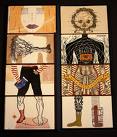
 SOUNDTRACK: ERIC CHENAUX-Sloppy Ground [CST052] (2008).

It took several listens before I fully enjoyed this disc. There’s something about Chenaux’s voice that is very calming, almost soporific. And, since his general songwriting style is kind of ambient and almost formless–with no real choruses or even rhythms, the disc tends to get lost in the ether. There’s also some unusual instrumentation (electric harp & guitarjo (!)) too, which continues the otherworldly feel of the disc.
What really hooked me into the disc though was the three “funk marches” that distinguish themselves from the rest of the disc. “Have I Lost My Eyes” comes in like a raging gust of fresh air after the first three drifting tracks. It’s got a strong melody and raw drums that propel this fantastic track. “Boon Harp” & “Old Peculiar” have a similar strong vibe. And they are really the anchors of this disc.
The rest of the album isn’t bad, I just find it hard to listen to in one lengthy sitting. The opening three songs tend to drift a round a little too much. But one at a time, these songs are pretty cool.
[READ: Last Week of September 2009] The Fifth Column & The Flexicon
These two pieces were part of the list of uncollected David Foster Wallace publications. The difference with thee two pieces is that he plays a small role along with several other authors. Both of these pieces are sort of a exquisite corpse idea. Although unlike a true exquisite corpse, (in which the author sees only a little of the end of the previous author’s work) it’s pretty clear that the authors had access to the entire work. The quotes in bold are from The Howling Fantods.
For a delightful exquisite corpse piece that I authored see the untitled comic strip on my website. About ten years ago I started an exquisite corpse comic strip and sent it to a number of people who all had a lot of fun continuing the story. I have finally put it online at paulswalls.com/comic. (See, artists, I told you I’d do something with the cartoons some day!)
[READ: September 29, 2009] The Fifth Column
“The Fifth Column–A Novel: Week Eleven”. The Village Voice Vol. 41, No. 7; Feb 13, 1996; p. 50. [NOTES: This is from an exquisite corpse (a story written by several authors in which each author will start from where the previous had left off and then pass it on to the next) by Jonathan Frazen, Rick Moody, A.M. Homes, DFW and others. It was published over fifteen weeks (a different author each week) in The Village Voice. DFW did week eleven. The complete “novel” was compiled in the March 26, 1996 issue of The Village Voice in abridged form. All fifteen original parts are available here.]
There are no details of how this “novel” or if there were any guidelines at all.
The “story” is a pretty standard sexy/secret agent piece. Some of the authors try to remove it from its trajectory, but Una, the former Miss Ohio and lover of explosives, keeps resurfacing. It’s not easy to review this because it is more or less a nonsense piece, with authors trying to (I assume) set up the next author with either an impossible or humorous cliffhanger, but the caliber of writers is pretty high so I’ll summarize a little.
Oh, and the PDF link is really poor quality. It’s a little blurry and there are lines that are not legible at all. However, it is the only place online where this work can be found, so, I recommend reading it on the screen at 200% magnification.
JONATHAN FRANZEN-Week One
Franzen sets up the story with a lengthy introduction that serves as the basis for the entire piece. In it, Una, a barmaid and former Miss Ohio is setting off to a Spy Convention.
RICK MOODY-Week Two
Moody gives us some back story on Una, or more specifically her hometown of Toledo, OH, which is now a ghost town. We also learn that she has 10 siblings. Moody also introduces the phrase “Let the Sparks Shower.”
A.M. HOMES-Week Three
Homes names the siblings (all variants of their parents’ names (and quite humorous too)). And then she gets to the heart of the matter: Una has been mailing body parts in padded envelopes. And in a bit more back story, Homes lists the successive pageants that Una won, leading to her being crowned Miss Ohio. In this final pageant, it was the talent show, where she dis- and re- assembled an AK47 that secured her victory. Homes also concludes with the sparks showering.
RANDALL KENAN-Week Four
Kenan introduces a new, lasting character: Michah, a dreadlocked, near-mythical figure in Una’s life. He thinks Una is crazy. And maybe she is.
JIM LEWIS-Week Five
Lewis is the first author to mess with the format of the story. He switches the focus from Una to the publisher of a University Press publishing house. He rejects the Una story and regrets that his publishing house has gone commercial. The story then shifts focus to follow the publisher and his three ex wives.
SUSAN DAITCH-Week Six
Daitch picks up on Lewis’ story by including the publishers’ first wife, Elena, in the narrative. She moves the setting from Ohio to Brooklyn where Elena is taken in for questions regarding a body found floating in a pool. She is a suspect because her ex-husband told the police that she was sending him body parts in the mail. (Nice tie in!)
MATTHEW STADLER-Week Seven
Enter Sergeant Dex who questions Elena and asks to feel her pregnant belly. Dex also informs us that Michah is a fictional character that Elena made up to throw everyone off the trail. And, he pleads, get us back to the story of Una, beautiful Una.
CLAIRE MESSUD-Week Eight
Messud breaks the fourth wall all the way down. She has Elena confess. First “because the plot demanded it” and second because she was guilty. Elena also confesses that her goal has always been to undermine Una because she, Elena, was supposed to win the Miss Ohio pageant that Una swiped from under her feet.
DALE PECK-Week Nine
Peck moves the story ahead six months. Una bursts into a cell, grenades ablaze and rescues Elena. And Una reveals that Elena’s ex husband is The Blind Man for ASAP (the Association for a Swift Apocalypse and Pestilence introduced by Rick Moody), Una also reveals that all of the disparate threads (even the fiction that Elena wrote) that have been floating around in this story were actually part of a larger narrative. Everything has its place.
IVA PEKARKOVA-Week Ten
Pekarkova introduces the thought-to-be-dead-but-very-much-alive Comrade Brezhnev and informs us that he is hiding out under the code name Postmaster General. He reveals that Una is actually an American man in drag. And Brezhnev demands action. He wants to turn the Pentagon into a Square: “This time next week..a shower of sparks would surely fly.”
DAVID FOSTER WALLACE-Week Eleven
DFW simultaneously connects the stories and breaks them apart with his eleven numbered paragraphs. Each details a scene. The first is set 36 hours after Peck’s Six Months Later notice. The third twists the “sparks” into a box of sporks. Number 4 is a cryptogram from “Shower of sparks” to “C. Howe Sparkshauser.” It was Corliss Howe Sparkshauser that tried to convince The Postmaster that Una was a drag queen.
Oh, and Sparkshauser has terrible ear troubles while flying. The pain can only be relieved by yawning, so he has taught himself to yawn at will. Despite the proliferation of extraneous details, DFW narrows down the story with one paragraph: Michah is writing a computer program for Una and Sparkshauser. It is designed to convince Elena to help them neutralize her ex husband (the publisher). DFW also re-introduces editor’s wife #3, Clarissa, with whom he is having violent but ineffectual sex as the scene closes.
CAROL ANSHAW-Week Twelve
Anshaw gives Una a personal moment as she and an unnamed man fight for the remote, rather than having sex. Sparks fly as the veal picatta hits the olive oil.
IRVINE WELSH-Week Thirteen
Irvine Welsh brings a heap of sex and violence to the story. The man whom Una has picked up reveals that he is a spy and that the CIA is on to her (and that he is HIV+ and wants her to kill him). Una says if the CIA knew about her, they’d take her out. But, he says, the CIA needs terrorists and the government needs terrorists, for how else can the (the government) spread fear? Una, fearing that the man will just go on an on, dispatches him with an ashtray, but wishes she had been able to use her detonator.
GARY INDIANA-Week Fourteen
Indiana offers a surreal turn as he reveals the President to be none other than Pat Buchanan (and the first lady is his sister, Bay, whom he married after his previous wife died). There’s a lot of sexual tension between the in-photo-only Bay and Una (and with Bay and Michah as well who claims he would like to have sex with the white women before he decapitates her). All the while Una is dismembering a man named Judy (gay parents named their boys Judy back then). She then jets to New Vatican City for sex with Pope Paul.
NEIL GORDON-Week Fifteen
Gordon ends the story rather satisfyingly. Una kills the Pope (after sex of course), who was the mastermind behind all of her assassinations. And as the “novel” wraps up, the comic final line obscures the potential danger than Una may be in.
For what it was, the novel was kind of fun and satisfying. I don’t even know that I could pick a favorite section because each writing was trying to do something different, but none of them were outrageously original that their piece stood out. A solid effort all around, and a fun experiment, too.
[READ: September 29, 2009] The Flexicon
“The Flexicon”. Parnassus: Poetry in Review Vol. 23 Nos. 1 & 2, 1998; pp. 180-194. [NOTES: ‘An homage to the lexical richness of English’ with contributions by Albert Goldbarth, Paul West, Diane Ackerman, DFW and others. Read it here. DFW’s contribution is pp. 183-188.]
The Flexicon is designed as a word lover’s extravaganza. It begins simply enough as a story in a grocery store.
ALBERT GOLDBARTH
Begins with the simple and rather jokey rhyme:
Do you know where the Cheez Whiz
That you squeeze is?
PAUL WEST
Moves the piece further with some delightful wordplay. He keeps it in the grocery store, showing the man trying to seduce a woman in the ant trap section with delightful words like abonnement, shebang, and fistula. There’s also a mildly obscene James Joyce joke. It sets the bar high for obscure words.
DIANE ACKERMAN
She adds depth to our character by saying that he can only speak in rhyme. “Holy mole my goal is frijoles.” He also has a list of 15 Things to Do Today Like: 6. Auscultate silverfish. 8. Unzip tse tse fly. and 15. Jactitate soundlessly.
DAVID FOSTER WALLACE
Creates an extra character, one who sneers at the very idea of the exercise. He is a bag boy (or a chef, perhaps) who thinks this sort of lexical game was all well and good in 1965 or if you’re French but for a failed MFA student, it’s all hogwash.
His first bit of fun comes with a list of words that are more or less the opposite of what they look like (Big is a small word, Pulchritudinous is an ugly word). But the fun of his section comes with the MFA teacher’s (who never earned his PhD he is proud to report) golden rule: DON’T USE A BIG WORD WHEN A SMALL WORD WILL DO. This leads to a glorious footnote which explains that even with this restriction, cryptorchid & exeleutherostomizes really are exactly the words that the author needed, because no other words match their definitions so precisely.
DFW’s section is quite fun and snarky.
MAC WELLMAN
Follows DFW with a three part poem which I must admit is beyond my ken.
SUSAN WHEELER
Has a lot of fun with some tiny poems that explore the various parts of speech of certain words: The prick pricked his prick; The weenies weaned their Weiners. Although it tends to lose the thread of the “story.”
SUSAN YANKOWITZ
Has four paragraphs of internal rhyming nonsense and fun. I don’t understand a word of it, but it’s fun to read aloud.
ALBERT GOLDBARTH
Reins in the story by bringing it back to food: “Cecilia was tough cookie.”
While overall this piece is nonsense and fluff, it is delightful to see and to say these words and phrases. Oftentimes an exercise like this is sort of show-offy, and this has elements of that, but mostly it’s an excuse to have fun with words. And the authors certainly do that.

 I Just Read About That...
[…] just checked my review of Chenaux’s previous album and it’s funny how similar it is to what I figured I’d write about this one: soporific, […]