 SOUNDTRACK: HÜSKER DÜ-Zen Arcade (1984).
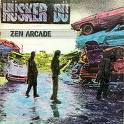 When I was younger and more amused by things like this, it amused me that Hüsker Dü’s first three records were a live album an EP and a double album. They just couldn’t put out a regular old LP?
It also amused me that they put out a song on this disc that was almost as long as their EP and was even almost as long as their Live record. Such was the difference of Zen Arcade.
In reading about it lately I have learned that it is sort of a concept album (Someone even called it the Quadrophenia of 80s punk). I gather I simply never paid enough attention to the lyrics to realize that (although it does explain “Hare Krshna”). There’s also a lot of talk about how influential this disc was. That may also be true, although I can’t say for sure.
Perhaps the most notable thing is how the disc is not just straight punk. Up to this point the Hüskers had released fast, straight ahead punk. Distorted guitar and often screaming vocals. And indeed, Zen Arcade starts off that way “Something I Learned Today” is a classic Hüsker Dü pop punk song. It’s got a cool opening bassline and super distorted guitars, and yet its got a sing along chorus. And “Never Talking to You Again” continues Grant Hart’s streak of great catchy punk. This one includes acoustic guitar, though, just to break things up a bit. It’s with Track 5 “Dreams Reoccurring” that you know things are going to be very different this time around. This 2 minute song is full of reversed guitars sounds and all kinds of weird tape mixing. It’s quite trippy and unlike anything else that the band had done.
As we near the middle of the disc, “Whats Going on Inside My Head” and “Masochism World” are absolute punk vocal shredders (so you know they’re not really going soft). As the disc ends, “Turn on the News” plays around with recorded Newscasts, not a new concept, but new for them. And then, of course, the final track, “Reoccurring Dreams,” a reprise of “Dreams Reoccurring” that goes on for 13 minutes of squalling feedback and demented solos (with a cool, if disconcerting, guitar motif).
One of my favorite facts about the disc is that it was all recorded in one take (except for, as the liner notes point out, 2 tracks that started too fast) and there were no overdubs. It was mastered just as quickly so that the whole thing to about 85 hours to make. It’s amazing that anything done that quickly can be that good. But such is the case of this disc. There’s a clunker or two in the mix, but how could there not be with all that energy bouncing around?
[READ: Week of June 29, 2009] Infinite Jest (to page 151)
After Reading the Infinite Summer site, I see that I got at least one thing wrong. Mario is in fact not Hal’s younger brother, but is Hal’s older, but not oldest, brother.
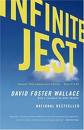
I ordered 2 copies of IJ for our library since we did not have any (!). I’ve been sneaking peeks in the second copy which has the above cover. And an intro by Dave Eggers, which I enjoyed.
Also, when I dropped my old copy, a whole bunch of small squares of paper fell out: notes that I took the first time through. I started to look at them but it revealed too much so I stopped. I’m going to try and read this as purely as possible.
So, surprisingly (or perhaps un-) new characters are coming fast and furious in week two, (up to page 151).
Characters:
Gerhardt Schtitt. The head coach at E.T.A. Despite certain Nazi-like proclivities, he has proved to be an excellent coach, with a certain fine-tuned-ness to the way that Himself enjoyed tennis. He enjoys chatting with Mario, ostensibly because Mario is not entirely there, which allows him to open up in ways that he never would to a fully cognizant person.
Uncle Charles Tavis (C.T.). Avril’s brother. He appeared in the first week of reading, and makes an appearance here. He is the current President of E.T.A., and in the opening of the book, he escorted Hal to his interview.
Tiny Ewell. Resident of St. Mel’s Hospital/Detox.
Remy Marathe. A member of the AFR (French initials for Wheelchair Assassins). They are anti-O.N.A.N. (which more on in a moment). Remy is a triple agent. He is seeking medical help in the U.S. for his wife, but is turned off of the AFR’s attitudes and has flipped from double- to triple-agent.
M. Hugh Steeply. Marathe’s contact. He is currently in very bad drag. We learn that at a later date, Steeply will change his name to Helen and will closely follow the career of Orin as an Arizona Cardinal.
USS Millicent Kent. Leading female player at E.T.A. Attempted to seduce Mario, despite his being wholly unaware of what was happening. The incident was interrupted when Mario laughed hysterically thinking she was trying to tickle him.
More students from the ETA are introduced. And will be mentioned shortly.
Plot developments:
This week’s readings focused primarily on two areas: the Wheelchair Assassins and the students at E.T.A.
The Wheelchair Assassins: Marathe and Steeply meet on the top of a mountainside in Arizona (no explanation of how the wheelchair got there). They discuss the Entertainment that the foreign attache–and now 23 people in total–were killed by viewing. They suspect that the Entertainment was created by Himself, and was disseminated by Avril (who would sleep with anyone). [At least I THINK that’s who they are talking about, I could be wrong]. Although their suspects have no motive. They also reveal that Monsieur DuPlessis, who was killed by Don Gately in the first section, was one of their agents. And, there is talk that there may be an Anti-Entertainment designed as an antidote to the Entertainment that killed all those unknowing people. But they have no evidence of this.
We also learn about The Great Concave. This is a part of North Eastern United States, that seems to entail the Adirondack Park, New Hampshire, Vermont and Maine. We are unclear exactly what has happened here, but it is overrun by feral hamsters and is now under Canadian jurisdiction.
The bulk of the rest of this section focuses on the kids at E.T.A. It shows them all crashing after a tough practice and also shows the older kids: Hal, Pemulus, John Wayne, etc being Big Buddys to the Littles. In each of their (twice weekly) buddy sessions, the older kids talk to them, ostensibly to ease their fears. You get insight into all of the older kids’ characters, and how they handle their responsibility. Nothing much happens, actionwise, but that’s not the point.
Hal: tells the kids that the reason the staff want you to hate them is so that the kids can form a common enemy which provides a sense of community in an otherwise individual sport. We get to see most of Hal’s 5 charges and how he feels about all of them. (He can’t stand Evan Ingersoll).
John Wayne: the #2, soon to be #1 player at E.T.A., provides technical answers, which the kids eat up.
Pemulus: shows them card tricks.
Troeltsch: lets them know that yes, the drills are boring and repetitive, but once you get them memorized you become like a machine, and then the more important stuff is less difficult to keep straight.
James Struck: answers a few weird questions from his nervous kids, like, what if you have to fart on the course and you’re afraid it might not be just a fart.
This section also refers twice to the infamous Footnote Endnote 304. This footnote endnote does not appear properly for several hundred more pages, but two footnotes endnotes in the Marathe passages suggest you go check it out. The Footnote Endnote is all about the Wheelchair Assassins (and is set up as James Struck researching this information for a paper). The history of the Wheelchair Assassins is fascinating. They are a very radical separatist group (most Quebecker separatists just want to secede Quebec from Canada and remove the anglo language), the AFR want to return the Reconfigured section of the Great Concave (that is now part of Canada) back to the US, and they want Quebec to secede from the O.N.A.N.*
*Footnote Endnote 304 also reveals that the O.N.A.N stands for the Organization of North American Nations (and is dominated by America). It cannot be lost on DFW that the initials themselves are a humorous joke about masturbation.
The footnote endnote continues that although there is no awareness of a direct link from the Wheelchair Assassins to the activity that put most of their members in a wheelchair, this “contest” is indisputable: it is called The Cult of the Night Train. It involves 6 kids jumping across a railroad track (from one end of the tie to the other) while a train barrels down on them. The last person across wins. Clearly, there are a lot of accidents, and many become Wheelchair Assassins. But whither the connection?
Back to the projects of Boston. This (new?) writer seems to be texting and is using a very difficult writing style. In this sequence we find that several of the kids like C, Poor Tony (a cross dresser, and likely gay) and yrstruly (the author) run around the Boston area robbing and sometimes killing people for money. They then go to Chinatown to buy heroin. In a previous incident, Poor Tony crossed Wo, the man who runs the “tea” house. Wo, in an attempt to get even with Poor Tony’s crew, laced the skag with Drano, killing C. yrstruly decides to go straight from there. Although the entire section is hard to digest, there’s some funny things. And the writing, like, “none of his brothers unquot” (with no opening quote mentioned) seems very authentic for young kid speak (circa 1996 anyhow).
We are also introduced to the Ennet House Drug and Alcohol Recovery House.
Humorous nonsense:
This week’s reading contained a lot of very funny, seemingly unrelated sections. The are (apparently) unrelated to any plot but are a real joy to read.
There’s a hilarious email that is sent from Murrayf to an unknown recipient. It is absolute slapstick nonsense. It involves an insurance claim from a 75 kg man who tried to lower a 900 kg barrel of bricks via a pulley system on the ground. He goes up, the bricks go down, and hilarity ensues (for us, not for him). There is no context for this email.
There’s also an interesting paper from Hal in 7th grade concerning the merits of Chief Steve McGarrett of Hawaii Five-0 vs Captain Frank Furillo of Hill Street Blues, and how the police procedural changed from the 1970s to the 1980s. It has interesting observations and insights, including how McGarrett simply did his job, solving crime (acting), but Furillo is stuck in bureaucratic nonsense, with lots of other characters asking things from him (reacting). Hal speculates about what future police shows will be about.
An article by Helen Steeply about the woman who received the first heart transplant. She was killed when the purse in which she carried her artificial heart was snatched by an unknown assailant (who turns out to be Poor Tony, but the author never realizes this). When her purse was snatched, she chased after the man in drag shouting, “She stole my heart” much to the whimsy of the spectators. Until she drops dead.
Finally, we get a lengthy discourse (author unknown) about the rise and subsequent demise of videophones. It is written in three sections as if it were a report. At first people were excited about video phones. But it slowly dawned on them that people could watch them while they were talking on the phone. This meant they had to pay attention. Clever entrepreneurs started selling masks that people could wear for speaking on the phone. This grew exponentially, preying on people’s insecurities until finally people bought full body coverings of professionals actors to place in front f their phones while they hid and went abut their own business while talking. Eventually people decide to just go back to the old voice-only phone. Hilarious!
Some Observations:
Some observations: I was reading on the infinitesummer site that one of their guest reviewers didn’t care for a footnote endnote that began “in other words.” Although that wasn’t the whole thing he didn’t like about it, I wanted to address this very issue of footnotes endnotes and, as in one section of the book where the narrator is “I,” but is unnamed, the nature of just who is writing this book: I love the idea that there is “somebody” writing this book, although I’m not sure what in all they ware writing. It is almost written as a term paper or some other intellectual property that implies that the footnotes endnotes are not DFW’s but someone else’s. Perhaps it is Hal, but perhaps not, as Hal is often seen in the third person. It brings a whole new level of meta- to the story that I didn’t realize was there, and it gives justification for the footnotes endnotes (not that he needed it) in a way that makes them more than just a thing to put in a book. For example, Footnote Endnote 304 is written from the POV of an omniscient narrator, following Struck as he plagiarizes his term paper. And Footnote Endnote 19, when referring to the French initials for V.I.P. reads, “‘Une Personne de l’Importance Terrible,’ presumably.” Presumably?
Chronology:
Two new years are added (Purdue Wonderchicken & Maytag Whisper-Quiet), along with some chronology of the Subsidized years. Thus far we know:
- Before Subsidation
- Year of The Whopper
- Year of the Tucks Medicated Pad
- Year of the Trial Size Dove Bar (James I commits suicide)
- Year of the Purdue Wonderchicken (Hal in 7th grade)
- ?
- ?
- Year of the Depend Adult Undergarment
still unsure chronologically:
Year of the Dairy Products from the American Heartland
Year of Glad (Hal applies to College)
Year of the Whisper-Quiet Maytag Dishwasher
Year of the Yushityu 2007 Mimetic-Resolution-Cartridge-View-Motherboard-Easy-to-Install Upgrade for Infernatron/InterLace Tp Systems for Home, Office or Mobile**
**This hilariously named Year is the cause for Avril Incandenza to create the Militant Grammarians of Massachusetts, an organization we will no doubt hear from in the near future.
Overall:
Some things are frustrating: trying to keep all these people straight, trying to figure out who the hell is talking, flipping to the back of the book for footnotes endnotes (even though I do love them) and even the batty chronology. And yet for the most part I’m totally hooked. In fact, I finished this week’s reading on Wed and although I don’t want to read ahead, it’s going to be hard to keep my hands off the book!
When I read it last time, I recall not being able to put it down, and that’s how I feel this time too, as id the book is the Entertainment itself!
For ease of searching I include: Husker Du

 I Just Read About That...
[…] of I Just Read About That … , who provides character profiles, synopsies of plot developments, and […]
This whole site works only if future develoments are not revealed…I stopped reading your entry as you have violated this trust.
M. Hugh Steeply. Marathe’s contact. He is currently in very bad drag. We learn that at a later date, Steeply will change his name to Helen and will closely follow the career of Orin as an Arizona Cardinal.
Sorry you feel this way.
I deliberately wait until the end of the two week infinite summer reading time before posting. The part that is quoted comes from a endnote in this reading period, so I felt it was fair game.
I admit that spoilers will occur, however, since I read the book before I have sense of the really BIG spoilers, so I’m trying my best not to reveal them. But for the most part, I’m treating this as if I’m reading it for the first time. Some things will gt revealed, but that’s for trying to keep things straight.
Bob Rose is a baby. Your write-ups are terrific. Keep it up.
Thanks Mitch!
Thank you for the post. I don’t feel that small spoilers actually spoil anything and you have not violated any trust as far as I am concerned. You have simply tried to clarify things that might not be obvious to the reader. I am determined to read this book and am trying to use all possible internet and print material to help me along the way. Thanks for your guidance.
Thanks Linda. I find the online guidance very helpful too. Especially when a book is as complicated as this, I think everyone sees (and enjoys) different things. I’m glad to be helpful!