 SOUNDTRACK: KING’S X: Out of the Silent Planet (1988).
 I just got the newest King’s X CD XV a little while ago, and I really liked it. I figured I’d go back to the beginning and see how much they’ve changed over the last twenty (!) years.
When I first heard Out of the Silent Planet, I was blown away. I had never heard anything quite like it. It had heavy heavy bass (I always said it was like Black Sabbath, but that’s not really accurate), but they also had beautiful harmonies like late-period Beatles. Add to that Doug Pinnick’s amazing gospel/soulful voice. And top it off with some great acoustic guitar playing and unusual instruments. Amazing. The heaviness is more of a dissonant sound that has become more popular in the last few years: complex chords that are played very heavily. I wouldn’t say that King’s X had anything to do with that popularity, but I heard it from them before I heard others do it.
The one thing that really struck me about the album was just how dissonant some of those chords are. I always think back on the album, which I’ve listened to hundreds of times, as being sweetly harmonic, and yet really the chords are quite aggressive. And the riffs are in a dark, minor key. Which is why those beautiful harmonies make such an impression.
The other thing that really struck me was how religious the record is. Now, when it first came out I didn’t really think of the religious aspects of the disc. There really weren’t any Christian metal bands back then, (except for Stryper) at least not on the cultural radar, and they didn’t proclaim their religiosity overtly, so I just didn’t see it.
But starting from the title: Out of the Silent Planet is a book by C.S. Lewis (of Narnia fame). And much as Narnia is a thinly veiled Christian allegory, so is Out of the Silent Planet. You can read Narnia and not see the Christianity in it, but once you know its there, it’s unavoidable. Same with this album. The lyrics are not overtly Christian, but there’s enough symbolism to tell that when he sings about You, it’s not romance, but God he’s singing about. A verse like “Sometimes my cup is empty; I wish that it stay full; cause I am always thirsty; I can’t get enough of you” can be secular or religious depending on your point of view, and I think that makes the album great.
Plus, it’s got the fantastic “Goldilox” a beautiful song, no qualifications needed. It’s a gorgeous ballad. but lest you think that it’s all sweetness, the album closer “Visions” ends with an unqualified thrash out…which comes after the song should end properly. Ty Tabor’s guitar work is pretty amazing.
Wow, it’s a great album.
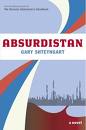
[READ: maybe December 2006/January 2007] Absurdistan.
I read this book a couple years ago, certainly before I started keeping this blog, but while I was working at the library. My memory of it was fuzzy. But when I referenced it in the Petropolis write up I was sorry that I hadn’t written about it. As I’m reading the details of the book in a book review, much of it is flooding back, so I feel comfortable saying a few words about it. Plus, I just did a fascinating thing: I skimmed the book for details. It was fun to “read” this entire book in about two hours. I got lots of great details, remembered parts of it, and enjoyed re-reading some of the funnier parts.
Absurdistan is the story of Misha Vainburg. Misha is a very fat Russian Jew who grew up in St. Petersburg and was sent by his father to Accidental College in New York. He feasted heavily on all that America had to offer and then through a twist of fate, was marooned back in St. Petersburg, Russia. He spends the rest of the book trying to get back to America and to his beloved girlfriend, Rouenna.
The excess of Misha, both in his consumption and his spending is hilariously over the top. His wealth is known far and wide and he is treated royally (somehow, he was able to survive on US $200,000/yr when he was in college).
Misha also has a fascinating relationship with his poor, abused khui. His father always wanted him to get circumsized to fulfill his Jewish heritage. When the Hasidim meet him in the States, they get him drunk and do a horrible job of the proceedings, leaving his poor khui bruised, purple and rather pathetic. Misha fully distrusts the religious Jews now. The leads to a rather amusing scene on an airplane where a Hasidic man brings his own food on the plane, which outrages Misha.
While Misha was visiting his home for the summer, Misha’s father, the 1238th richest man in Russia killed an Oklahoma businessman, who it turns out had lots of connections back home. Consequently, Misha is unable to get a passport to get back to the States. He is stranded in St Petersburg. Then, one evening, his father is killed by a land mine; Misha becomes the 1238th richest man in Russia.
Misha’s friend Alyosha-Bob is an American who came to Russia and became a successful biznesman. Alyosha and Misha (known as Snack Daddy to his friends) enjoy rapping (quite poorly) when they are feeling feisty. Alyosha is the only person holding Misha’s sanity together. Well, he and Rouenna.
Misha met Rouenna at a Hooters-type establishment in the Bronx and she quickly fell for him. Rouenna is a an over-sized black woman who, upon landing in Russia declared, “Russians are just a bunch of niggaz.” They’ve been dating for several years, and before he left for Russia, he agreed to pay for her college education.
Rouenna returns to the states. In one of the more surreal moments of the book, she writes to tell Misha that she is taking a class with Jerry Shteynfarb, author of the Russian Arriviste’s Hand Job. (Shteyngart’s first book was The Russian Debutante’s Handbook.) Misha is enraged that he is paying for her to take a class with Shteynfarb, who was a former classmate of Misha’s and who, according to Misha, “will sleep with anybody.” Rouenna later breaks up with Misha because she has begun dating Shteynfarb.
But in the interim, Misha learns that he can go to Absurdistan to get a Belgian passport which will allow him access back to the U.S. Absurdistan is an oil-rich former Soviet country. It is basically run by Halliburton (or Golly Burton as the prostitutes who service them say). The two main religious factions of the country are the Svani and the Sevo whose only difference appears to be that the footrest on Christ’s cross tilts to the left for one and to the right for the other.
While on a tour of the country, Misha meets Nana Nanabragov. He falls for her and they have a hot and steamy relationship (which is often spied upon by her servant, who then threatens to tell her dad unless he is handsomely paid off).
At this point the story gets really weird, and even funnier. A civil war breaks out between the two religious factions. All communication and transportation is cut off. It transpires that Halliburton and Nana’s father are instrumental in getting this war started, as a Halliburton subsidiary Kellogg, Brown and Root is the exclusive provider of materials to the Army. (The full details of why this war started are too funny to reveal here).
I’m not going to give away any more of the story. It is convoluted and wonderful and a fun read. I wish I had read The Russian Debutante’s Handbook first, but I assume it wouldn’t have made that much of a difference for reading Absurdistan. It’s certainly on my short list of books to read now, though. And, it seems to fit in with my recent Russian phase.

 I Just Read About That...
Leave a comment