 SOUNDTRACK: JOSE GONZALEZ-In Our Nature (2007).
 I first heard Jose Gonzalez, as pretty much everyone did, in the Sony commercial. The one where thousands of superballs are dropped down a San Francisco street to the accompaniment of Gonzalez’ “Heartbeats”. It was a beautiful piece of video. And the song was really perfectly suited. A mellow ballad, which happened to be a cover of a song by a band called The Knife.
The rest of the album was similar: soft, beautifully played acoustic  songs, hushed vocals, just very pretty.
Gonzales’ follow up doesn’t mess with the formula too much. He adds another player or two, to include some harmonies, and he does another cover (Cocteau Twins’ “Teardrops”) but overall the feeling is much the same. The Cocteau Twins cover is interesting for me because I have mentioned another Cocteau Twins cover in a review (by the Deftones) and this is yet another take on what I always assumed was an uncoverable band. This version strips the song down to its bare essentials but keeps the gorgeous melody intact. It’s quite striking.
There’s nothing especially fancy about Gonzalez’ guitar playing…he’s not trying to wow anyone with his virtuosity, which is nice. However, he is a very accomplished classical guitarist. He uses the classical techniques in his pop songs, and he tends to play certain notes harder than others bringing a natural percussion to his otherwise mellow fingerpicking. So, while I say there’s nothing fancy about his playing, it is still quite beautiful. His voice hasn’t changed either, it still retains that peaceful, serene feeling.
It’s funny then to read the words to his songs many of which come across as protest songs. Not about anything in particular but about human nature, and the animals that we can often be. The record is a really string collection of songs. It’s also quite short, about 35 minutes, which also seems fitting somehow: get in, say what you want, and get out.
Of the two records, I prefer the first one, possibly because I know it better, but I think it’s because in the follow up, the extra players detract somewhat from Gonzalez’ singular nature. Not that they do great harm, and surely he needs to evolve his sound, but I feel like with the addition of others, something is lost. Despite that, this one easily gets a 4.5 out of 5 where as Veneer got a 5 out of 5.
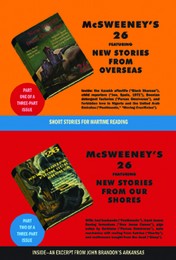
[READ: March 2008]: McSweeney’s #26
This was a great “issue.” I enjoyed all three parts of it.
Part One, is, like Part Two, a small “pocket” edition. Despite my earlier post about the Discworld minis that I read along time ago, I really enjoyed this pocket sized edition. It was, in fact, very convenient to read these small editions, because they weren’t too small. It was also interesting because at 1/3 the size of a normal book, a 20 page story is barely even 7 pages. The books were published in this format as a tribute to pocket sized editions that were sent to soldiers in WWII. The backstory of this is included in the front information of the volumes and I found it utterly fascinating. I love the idea that classics were sent to military personnel, and I think it’s a shame that it was discontinued. Alas.
But anyhow, Part One is “Featuring New Stories from Overseas.” It contains 5 complete stories and 2 “Part Ones” that are continued in the second volume (why this is, I do not know). The stories are:
DANA MAZUR-“Black Shaman”
This was a dark story that I really enjoyed. It concerns two women in Kazakhstan who go to see the Black Shaman. One woman’s son had moved to the US, and had recently died. However, his sprit returned to Kazakhstan. The woman wants her son’s spirit to return to his wife. The only way this can be done is through the help of the Black Shaman. The woman’s friend is sceptical of the shaman, especially when she asks for all of the woman’s possessions. However, the shaman is true to her word, and plans to do this one last “job” before moving away with her lover. The story is a sad one, and yet the mystical powers are handled really well. It’s always hard to say you enjoy a sad story, but I did enjoy this one.
STEPHEN SMITH-“Joe, Spain, 1971”
This story was great. It concerns a 7 year old Canadian boy who becomes a travel writer for the newspaper after his article about his family’s trip to Ireland is a smash hit. The paper sends him and his dad to Spain for another article, and the bulk of the story follows this adventure. The tone of the story (written from the point of view of the seven-year-old’s brother) is one of marvel and respectful confusion. What starts as an exciting travelogue reveals some underpinnings of the family’s darker side. A really geat read.
ISMET PRCIC-“Porcus Omnivorus (part one)”
I read part two of this story this morning and enjoyed it immensely (more down below), and yet when I tried to remember the first part, I couldn’t. In re-reading part one, it seems that the two parts are disconnected enough as to be two separate stories (or, more likley, two events in a narrator’s life as he grows up). The first part concerns Mustafa’s grandfather in Bosnia, and his trials against the various religious factions that rise up and claim his land, killing various members of his family. His grandfather ultimately gets a job as a security guard. Despite his age, he is accepted by the factory. One day he discovers that someone within the company is stealing. But he lets the man go. This has a pretty big impact on young Mustafa. I enjoyed this story while reading it but was surprised at how little I remembered.
ROB SEARS-“Death and Burial Among My People”
This story was an interesting look at a collective of “drifters” or “gypsies” depending on where exactly it is set. The story concerns a woman who was murdered and what her friends and family will do for the greiving process. Despite its dark subject the story was somewhat upbeat. I feel like stories about caravan folks have become more in the public eye, especially with The Riches on FX. I know from Irish stories that “Tinkers” are either a deep rooted family tribe or just pests. It’s amazing to think that people who live near us can be so different. A good story.
UZODINMA IWEALA-“Pentimento (part one)”
This was an interesting story about a Nigerian woman, Nkiru. She is a doctor who married a white Englishman named Christopher. As the story opens she is told that her husband has just died of a heart attack. The remainder of the first part shows her viewing his body while she thinks back to their first meeting and early marriage. Her family disapporoves of her marrying a white man and she is essentially excommunicated from her family. Especially when they move to the United States for his job. It was an especially touching story, and I really looked forward to part two.
FRANK LENTRICCHIA-“The Italian Actress”
This was a short piece. I didn’t really follow the story too well. It concerned an Italian filmmaker who is considering leaving the country, I think because he wants to work with another actress. The actress that he is currently working with tries deperately to get him to stay, but evidently not hard enough.
GARRY CRAIG POWELL-“Moving Crucifixion”
This was an interesting story about marital unhappiness. The title refers to a daredevil who rides his motorcycle by standing on his seat and leaning into the curves. This act of freedom inspires the main character to act on a crazy proposition. He is unhappily married, and is interested in several women who surround his daily life. It’s not until he reads a post online that he considers having an affiar with the adventurous woman. I suppose the surprise revealtion was pretty cliched, and expected, but the denouement was a very good follow up to the revelation. Even if it wasn’t the most original story, it was well paced and very enjoyable.
Part Two is called “New Stories from Our Shores.” I’m not sure what the big distinction is between the two parts, except that some of the part twos to the stories are included here:
JOHN BRANDON-“Arkansas” I’m not reading this story right now. Primarily because I’m slightly annoyed by its inclusion. McSweeney’s has just published the full novel from which this comes. Normally when they include an excerpt from a novel it’s not actually part of the issue itself, it’s usually an addition. So, while I do look forward to reading it, and will most likely be reading the whole novel, I’d rather have had a short story.
AMANDA DAVIS-“Sleep”
This was the first Amanda Davis piece I have read. Every two years, McSweeney’s hosts a contest in Davis’ memory which is open to young women writers. (A nice gesture on McSweeney’s part). This was an introspective story about a woman who buys a mattress from another woman who dies shortly after the transaction. A nice, delicate story, that never became maudlin.
WAYNE HARRISON-“Charity”
This is one of those stories where you just know that it can’t possibly have a happy ending. And for once, I thought that that was a real shame. The story concerns Royce who is hired to work in Oregon after he loses his possessions because of Hurricane Katrina. Royce is an ex-con, but after a few months he really starts to fit in to his new life. Eventually his kid comes up and lives with him, too. I wish the story simply ended there because all of the characters are decent and you just want nice things to happen to them. Of course, that’s not much of a story, sadly, and inevitably things go awry. Despite the sad ending i really enjoyed the story, the pacing was great, and I really cared about the characters.
MICHAEL GILLS-“How Jesus Comes”
This was an impressionistic piece about surviving a tornado. The story is paced and written in a frenetic style as befits the hurricane. It was short, and impassioned, but not all that memorable. I think a little too frenetic for me.
ISMET PRCIC-“Porcus Omnivorus (part two)”
Part two of this story was so different from part one. I was totally absorbed by this part and certainly want to read more. This part concerns an unnamed narrator. A Bosnian young man living in California. He wakes up at a party and realized he doesn’t know where he is. In a fit of panic he runs from the party, not entirely sure how to get home. As he is wandering the streets he hears music that he recognizes from his native country. As he is lured by the music, he finds that a Bosnian family is throwing a party. He ultimately discovers that the family he has been invited to party with is actually of the tribe that fought him in the war. These people are his sworn enemy, and as he looks around the house he sees the ensignia of the enemy. And, as ties in with the title, they eat pig, something which his people expressly forbid. He also learns that the patriarch of the family has been decorated by the US Governmnet. Slowly, everything he believes comes crashing down around him. He tries despreately not to reveal his identity, but when the pig is served to him, rather than eat it, he throws up on it. The tension mounts when he calls his friend to pick him up, and he hears gun shots in the backyard. He hides out in the bathroom, biding his time. The story was very exciting. It packed some real punches. And, whether or not the author intended it, a message that just because two families are Bosnian does not mean they share the same culture really resounded for me. In America, a so-called melting pot, we would assume that people who originate from the same country would be friendly, or at least have a common ancestry. And yet, they could be sworn enemies. How it tied to the first part, I’ve no idea.
UZODINMA IWEALA “Pentimento (part two)”
As the story continues we learn of the marital strife that Nkiru and Christopher have weathered and managed to survive. We also learn that Nkiru is unsure how to tell their son, who now lives in Boston, about his father’s passing. As Nkiru starts to get things in order, she discovers an astonishingly warm gesture from her husband, which she is completely moved by. It ties together all of her feelings of loss, homelessness, and family ties. An excellent story; I really enjoyed the depth of the main characters, and of all of the famiy members.
Part Three is the most confounding part. It is called Where to Invade Next, and is now available as a separate title from McSweeney’s. When I first received the bundle, I assumed that it was a funny, satirical piece about the U.S. and their military policy. Then I read the inscription from Wesley Clark which states that the Dept of Defense has, in fact, planned out the seven most likley next countries that the U.S. should inavde.
The text in this book is a very thorough, very detailed, explanation of whom we should attack next and why. The suspects are not too surprising: Iran, Pakistan, Uzbekistan, Venezuela, Syria, Sudan,and North Korea. There is extensive citation work involved. However, there is not an explicit statemnet of what this book actually IS. Is it the oroiginal document that Clark uncovered? Answers from the McSweeney’s site state that in fact, no it is not. I’m going to quote from the site as it summarizes better than I could, the content:
Now, editor Stephen Elliott, authors Jason Roberts, Eric Martin, and Andrew Altschul, and a team of twenty researchers have re-created this document for the present day. Where to Invade Next contains seven essays, 100 percent factual, laying out in stark detail how the arguments for invasion could be made. A biting look at the role of propaganda in foreign policy, this book outlines exactly how our leaders might make the case for war.
And it is an eerily convincing piece of work. Although you would be hard pressed to read this and say, “Let’s get them!” it certainly points to arguments for preemptive strike, and potentially ones we may be hearing in a year or two, depending on who wins the next election. I only wish they had provided enough convincing rebuttle. It is a powerful work.
Loading image
Click anywhere to cancel
Image unavailable
Loading image
Click anywhere to cancel
Image unavailable
Loading image
Click anywhere to cancel
Image unavailable

 I Just Read About That...
[…] – bookmarked by 2 members originally found by xblonde18x on 2008-07-22 Various–McSweeneys #26 (2008) https://ijustreadaboutthat.wordpress.com/2008/04/08/various-mcsweeneys-26-2008/ – bookmarked by 4 […]
[…] bunch of drawing that didn’t make the issue. People were disconcerted by Issue #26 with the Where to Invade Next book (as was I), and it shows the original books that they based […]