 SOUNDTRACK: NED SUBLETTE: Cowboy Rumba (1999).
 Typically I’m the one who introduces our house to new music. My wife has great taste, but she doesn’t typically seek out new stuff like I do. So, it was a nice surprise when she found this record. I think she heard about it on NPR. I was trying to figure out how best to describe the record, but really the title says it all. It is a country-tinged record that is primarily backed by horns in a “rumba” style (although Sublette admits in the liner notes that it’s not really a rumba). I’m not a big fan of country music, and I’m not a huge fan of South of the Border horn music (sambas, rumbas etc). However, Sarah and I took some ballroom dance classes, and my appreciation for these styles has really grown. We even requested one of these songs (“Feelin’ No Pain”) for our wedding reception.
Overall, the album is good fun, the songs are boozy and dancey, upbeat and downtown. Sublette called in some players from Cuba, Puerto Rico and the Dominican Republic, which adds some authenticity to his tales of loss and lust. In general, all the songs overstay their welcome a little. I don’t know if this is a feature of the region’s songs, or if Sublette would rather stretch his pieces out to 5:30 when 4:30 would suffice. Despite that, “Cheater’s Motel” “Ready to Be Your Lover” and “Feelin’ No Pain” are really great, fun songs. It was only after a number of listens that I really got to hear what he was saying in his monologue pieces (like “Her Point of View”), and they’re all pretty amusing tales. So don’t just listen for the fun horns, stay for the story!
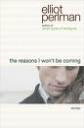
[READ: October 9, 2007] The Reasons I Won’t Be Coming.
There are nine short stories in this collection. It’s tough to review a series of short stories simply because you don’t want to give away too much, or even devote a lot of space to a small part of a book. These stories seem to fit very well with each other, so I think it’s safe to make some claims about the book as a whole, but there are enough distinctions between the stories to select some details from each.
Overall, Perlman uses a very detached style of writing, almost exceedingly formal, which (in a David Foster Wallace sort of way) overanalyzes and often makes humorous the mundane events of life. Unlike Wallace, most of Perlmans’s stories have to do with relationships. I think of all the stories as being darkly comic, but as I try to write about them they don’t seem all that funny. It’s entirely possible that they aren’t funny, but that I found the style to play a role in their humorous nature.
And one thing I wanted to point out, I didn’t know anything about Perlman before I started reading. I read “Manslaughter” first. It wasn’t until about 3/4 of the way through the story that I realized that it was set in Australia, and that he himself is Australian. I was somewhat confused at first because there were mentions of “The Crown” which I assumed meant the case was in England. It was only when he threw in “dollars” that it sank in that we were in Australia.
“Good Morning, Again” features a very detached look at waking up the morning after a less-than-ideal date. Not an original idea, per se, but it is done with an unusual sense of recrimination on the narrator’s part: not because he doesn’t like the woman but because he doesn’t really like himself.
“In the Time of the Dinosaurs” is a story about two neighbors. The boys are in the same class, and there is some competition between them. The parents are also in competition, but for other reasons. From the POV of the boy, it shows a very interesting look at family squabbling, and how it can impact everyone.
“Your niece’s Speech Night.” A man sits, thinking, thinking, thinking as he watches “your” niece’s speech night. But where have “you” gone, while the speech goes on? A great first person/direct address story of a man who is losing faith in a relationship as he wonders what is happening around him. Peripheral events outside of the school impact his daydreams/nightmares, and make the whole scene a hallucinogenic nightmare.
“The Reasons I Won’t Be Coming.”This story is about a probate lawyer, whose life seems to be full of little verbal slips that cause great consternation, especially for his wife. The story parallels his troubles explaining exactly what a probate lawyer does. Watch as the relationship disintegrates because of all of the little things that cause bigger problems.
“Manslaughter.” This story seems to polarize readers. Obviously, I liked it or I wouldn’t have read the rest of the book. The style for this story is very strange. It concerns a “dumpy” woman on the witness stand in a trial for a man accused of manslaughter. It is told from the POV of, I want to say, an ignorant, omniscient narrator. The narrator sees all, but only reveals bits as they proceed. Plus, there are italicized bits that start each section, these italicized bits are either conversations with someone or inside her head. As the “dumpy woman” listens to the testimonies, truths and contradictions overlap as we wonder what the truth really is for her. It is the telling of the story that is so interesting though, as the narrator seems to drift around the room, occasionally picking a character (including some of the jurors) and “zooming in” on his or her recent events. It gives a really great overall picture of the courtroom scene and how the verdict was reached.
“The Hong Kong Fir Doctrine.” A story, told in direct address again, about a man pining for a married woman. He is referred to as Uncle by her kids. The legal aspects of The Hong Kong Fir Doctrine are brought into play as a comparison of his pleas for her infidelity.
“I Was Only in a Childish Way Connected to the Established Order.” Just when you think that all of his stories will focus on the law and direct accusation within a relationship (which I really enjoyed, but which would have been tiresome if the whole collection was like this), comes this story. Again, a failed relationship is at stake. As a woman grows increasingly tired of the protagonist’s tics, she more or less gets him incarcerated into a mental institution. While there, he meets an inmate who has been there for years. They form something of a friendship. His time in the hospital has a direct impact on his son’s life, in a good way, and for that he is glad. It is only when, later in life, he considers voluntarily returning to the institution, that things take a turn for him and his family. There is also a question of marital infidelity, which ends with the narrator needing to make a final choice about what is most important to him: his family, his marriage, or himself.
“Spitlanic’s Last Year.” This is a story about Spitlanic and how his past year has been rather a letdown when it comes to women and school. This is the first time that Perlman’s character is so explicitly Jewish (a issue of huge import in the next story). Essentially, at the beginner of the year, Spitlanic’s girlfriend broke up with him, just before one of his finals. This destroyed his chances on that exam. He spends the rest of the year hanging out with a lunch crowd, a group of students whose company he really enjoys. But who, on the downside, are all involved with significant others. He finds solace in a non-Jewish woman who is happily involved with someone else. Their religions don’t matter at first until Spitlanic realizes how important she is, and wonders if he could cross the religious lines his life has erected. It is a sad story but told in a somewhat humorous flashback style.
“A Tale in Two Cities.” The two cities are Moscow and Melbourne. This story entered into totally new territory (for this book) and turned out to be very powerful and very affecting. I found the beginning a little slow going, but it really built to a powerful conclusion. The Moscow part is set before the fall of Communism and follows a young Jewish girl and her brother as they watch their father rise within the Party. All the while, he speaks of leaving Russia for a better place (because of the general persecution of Jews), perhaps Israel.
Their difficulty in securing the proper visas leads to one humiliation after another until finally they find their way to Australia, a place they had never even considered going to. When they finally arrive in Melbourne, they find that they have an even harder time of it. Their father’s Party affiliations do not endear him to anyone, and their Russian/Jewish heritage is also a cause of mockery and trouble. When Rose’s brother goes missing and she hires a fellow Jew as a private investigator, a PI who has never had a case, and who seems to jump to conclusions based on his personal history, her world really begins to unravel. It is only when the PI’s family meets Rose’s family that they feel their first sense of connection to someone. It is a sad, moving story but one that offers hope at the end.

 I Just Read About That...
hi,
great review of the book of short stories. i started from the beginning and am now in the middle of ‘manslaughter.’ i do have one question though, as you said you purposely left some important analysis out as to no spoil the stories. if one reads the front jacket inside cover (i have the hardback first edition), the description of ‘reasons’ is peculiar- is this suggesting that his wife will upright leave him at the end of the story? i guess i’m jsut confused because the description leads one to believe that there is a greater depth, a larger level of understanding to the story that a reader maybe wouldn’t catch upon first read.
Hi,
Thanks for the nice comments. The part about her leaving is pretty subtle. I think the way the story is written, it’s just full of a whirlwind of thoughts. There’s one line in the end of “Reasons” (in the last section). The second paragraph starts, “She just needs some space,” which is almost a throwaway line, but which I take to be his way of dealing with the fact that she’s not coming back.
I’m glad that I read his stories. I have to see if I’m up for the novel, yet!
Yeah, if you’re talking about Seven Types of Ambiguity, yeah, it’s Definitely worth it.
Thanks. I just wish I had time to read everything!
Just finished “Manslaughter,” and I don’t get it at all. To clarify on your post, the dumpy woman was the widow of the man who was killed, and she served on the jury that acquitted the man who killed him. I am not familiar with Australian law, but I cannot imagine a person with this relationship being seated on an actual jury.
There’s either something odd we’re missing about this story, or it’s so poorly baked that there’s nothing to find.
So much of the story reads like a criminal procedural on TV with absolutely no payoff. The we-can’t-see-inside-the-mind-of-the-perpetrator-to-know-true-motive thing may be the point, but it’s hard to say because of such poor execution.
No, she wasn’t in the jury. She was a witness.