Feeds:
Posts
Comments

Archive for the ‘Theater’ Category

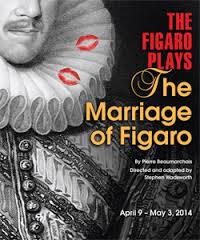
[ATTENDED: May 2, 2014] The Figaro Plays: The Marriage of Figaro

marriageAfter last night’s unexpectedly hilarious Barber of Seville, my expectations were much higher for The Marriage of Figaro.

For a brief explanation of these plays, see yesterday’s post.

The Marriage of Figaro is set three years after The Barber of Seville.  [It must be said that the promotional material said they could be seen in any order, but a lot from Barber is referenced in Marriage and since it is set three years later, it really does behoove you to see Barber first].  The situation is interesting: Count Almaviva and Rosine are still married, although the Count is sleeping around and the Countess is despondent (so much for that rush of first love).  But the main plot concerns Figaro.

Figaro is living with them (as Almaviva’s right hand man) and is set to marry the Countess’ Lady in Waiting, Suzanne.  Figaro is gloriously happy, as is Suzanne.  And they cannot wait to get married.  So, unlike the previous play, there are no shenanigans trying to get them together behind the back of someone else.  The shenanigans are of a slightly different sort.

For Suzanne reveals to Figaro that the reason the Count has given them this glorious space in the chateau–which is but mere feet away from the Count’s private room–is that he plans to deflower Suzanne on the night of her wedding to Figaro.  This was, apparently, the Count’s privilege at the time.  Although Count Almaviva ended that policy when he married Rosine.  But he seems ready to reinstate it now.

Figaro doesn’t believe it at first, but is soon convinced.  The Count wants to meet Rosine in the garden on her wedding night.  And so she and Figaro (with the help of Rosine) decide to hatch a plot.  And that’s just one of many plots in this sequel which is much more complicated, has a much bigger cast and pushes three hours in length. (more…)

Read Full Post »

[ATTENDED: May 1, 2014] The Figaro Plays: The Barber of Seville

barber2I won tickets to see The Figaro Plays at McCarter Theater.  And yes, there are two different plays going on at the same time. I have to say, I’m super impressed that they put on two Figaro plays on alternating days starring many of the same actors—how complicated must that be?

The Figaro Plays are, well, I’ll let the McCarter site, explain:

Stephen Wadsworth makes his triumphant return to McCarter Theatre with The Figaro Plays, two thrilling new translations of the great farces that inspired Mozart and Rossini’s operas: The Marriage of Figaro and The Barber of Seville…. Wadsworth brings his genius to these two delightfully scathing social satires. Figaro, the famous barber, has his hands full with schemes, plots, and a master who chases all the wrong women. Lush, lively, and a little bit naughty, these plays are chock-full of hilarious misunderstandings, passion, disguises, and sumptuous period costumes.

The plays were written by Pierre-Augustin Caron de Beaumarchais, um …who? He wrote three plays about Figaro and Count Almaviva: Le Barbier de Séville, Le Mariage de Figaro, and La Mère coupable.  And so Wadsworth translated, arranged and directed two (I don’t know if the third one was too much to do or not very good or what–according to Wikipedia, it is rarely performed, and the synopsis doesn’t sound great)

So you have certainly heard of these two The Barber of Seville or the Useless Precaution (written in 1773) was turned into Gioachino Rossini’s opera, The Barber of Seville (1816).  The Marriage of Figaro (written in 1778) was turned into the opera Le nozze di Figaro, ossia la folle giornata (The Marriage of Figaro, or The Day of Madness), K. 492, composed in 1786 by Wolfgang Amadeus Mozart,

So that’s a lot of background information, and I knew none of it before seeing this first play.  I wasn’t even sure if there would be music or not.  So no, they were not the operas, indeed, Barber has no music (well, one love song strummed on a guitar).

And it was hilarious. (more…)

Read Full Post »

gorey SOUNDTRACK: 1-SPEED BIKE-Droopy Butt Begone [CST014] (2000).

1speed1-Speed Bike is a remix project by Adian Girt who has played in Godspeed You Black Emperor and Exhaust for Constellation Records.  This is his first release as 1-Speed Bike.  He has released several more on other labels but I haven’t heard any of them.

The most interesting thing about this disc are the titles of the songs.  And those titles are so clever that it gives one high hopes for the album.  I don’t know who Mauro and Elwy are (track 1) but the rest are certainly interesting if not confrontational.

1. The Day That Mauro Ran Over Elwy Yost
2. Seattle/Washington/Prague 00/68 Chicago/Nixon/Reagan Circle-Fighting Machine
3. Yuppie Restaurant-Goers Beware Because This Song Is For The Dishwasher
4. Just Another Jive-Assed White Colonial Theft
5. Why Are All The Dogs Dying Of Cancer?
6. My Kitchen Is Tiananmen Square
7. Any Movement That Forgets About Class Is A Bowel Movement

But what’s disappointing is that the album is comprised almost entirely of a drum machine and some other sounds.  The drums are very very loud in the mix, and there’s very little variation in each song (which befits a remix, I suppose).  And yet, the “musical” section is largely nonexistent.  There’s a lot of spoken word stuff, which is fun, but it also seems randomly thrown on there. The disc opens with him asking someone to be quiet because he has to flush the toilet.  There’s a lengthy declaration of love for his family and war against capitalism.  And that everyone else can fuck off if they don’t want to hear him talk politics.

There are samples sprinkled around the disc, but most of them are inaudible or played with so much that it renders them hard to figure out.  There are some interesting sounds in “My Kitchen is Tienanmen Square,” but the rest is kind of dull.  The end of the last song offers a voice mail message that gives you the title of the album.

Overall, not an exciting debut for 1-Speed Bike.

[READ: April 12, 2014] The Strange Case of Edward Gorey

I bought this book many years ago when I was on an Alexander Theroux kick (which actually means I wanted to read some of his books but did not, although I do hope to).  Anyhow, this book has been staring at me for some time so I decided to just dive in.  I actually know precious little about Theroux except that his novel are supposed to be weird or difficult or something.  I know slightly more about Edward Gorey, although little more than his drawing style (which I love) and his sense of humor (which I share).

So this book is a sort of a biography of Gorey by Theroux.  Theroux was one of Gorey’s close friends.  This is saying something because as a rule Gorey was rather a recluse and didn’t much like people (he did like cats, though).  The book is not a proper biography–a biography of his works or even of his life.  It is more of a biography of the man and his quirks.  There’s very little about his childhood, and not a lot about his books (except for Theroux’s admiration).  But mostly its about what it was like to hang out with Gorey–and to delight in the baroque and fun turns of phrase that Gorey used.

We learn a lot about what he liked (soap operas, classic movies [Metropolis, M, Sunrise, Gold Digger series], obscure horror films [The Town That Dreaded Sunrise, Women of Straw, Suspiria (at least I’ve heard of that one)], TV shows [The X-Files, The Golden Girls, Matlock, Buffy the Vampire Slayer] and of course, classic literature [he was well versed in many original languages].  We also learn what he most assuredly did not like.  He did not like Star Wars, he did not like Mel Brooks, he did not like Robert Altman or Woody Allen [Gorey was a film critic for a time].  And as for our foremost actress, Meryl Streep, he has this to say:

“Oh please!” said he, every time she opens her mouth, the critics insist Dostoevsky’s speaking!” He paused. “And who’s even dippier is Glenn Close. Sexless as a teabag. Neither man, not woman, nor in-between! Julia Roberts’s face looks like it’s made of rubber — remember those Snap, Crackle and Pop cartoon faces? And of course Streisand. God help us, I won’t even go to see.”  Gorey loathed her with a passion, even more than John Waters does.  I once heard him fulminate for a good half-hour on the impossible stupidity of her 1962 hit, “People,” a song that, with its mawkish, politically correct soul-sharing, shrinkingly embodies to a T everything that Edward Gorey utterly loathed:  “Pee-pull, pee-pull who need pee-pull are the luuu-kiest pee-pull in the wooooooorld!.”  I cannot honestly think of a single sentiment that would have driven Edward Gorey battier faster than the flaccid lyrics of that song with its, to him, canasta-closeness, hideous interconnectedness, and ultimate meaninglessness.

He also hated Andrew Lloyd Webber, the Marquis de Sade’s writing, right-wing talk show hosts, every movie Al Pacino ever made [Of Bobby Deerfield he cried out during the movie, “oh for Christ’s sake…what is this in aid of?”] and Martha Stewart.  And while he had great disdain for Barbra Walters and Maya Angelou, he was especially appalled by “the invincible vulgarity of the preposterous Kathie Lee Gifford and the host of miniature faces she was constantly pulling” (20) saying: “her facial contortions would be excessive on Daffy Duck” (44).

One thing to note about the book.  As you can see form the page numbers above, similar sentiments about Gifford are on page 20 and 44.  Theroux tends to circle back onto the same topics a number of times.  So the same names tend to pop up three or four times (Buffy comes up at least 3).  It feels like Theroux (who published this soon after Gorey died) wrote it in fits and just needed to get down as much as possible.  And while the book feels repetitive, it never feels flaccid or like it’s full of padding.  It just feels like a huge outpouring of information.  Or like an essay collections by a person who tends to revisit similar material.

Interestingly, the book isn’t necessarily for fans of Gorey.  I honestly haven’t read any of his works in years, but I found this book funny and strangely cathartic (if you like bitchy, opinionated scholar-types).  If any of the above appeals, you’ll get a kick of out Gorey, whether you like his drawings or not.  The book is also full of Gorey’s drawings (although nothing new), from his books and from some of his posters.

I was also intrigued by the fact that Gorey, clearly no friend of people, did not shy away from the outside world.  He lived on Cape Cod and New York City where his number was in the phone book the whole time.  He walked around Manhattan in a big beard and fur coat (until he gave up the coat for animal rights reasons).  When he moved full time to Cape Cod, he lived in a residential area and did not turn away any fans (he always had manners even if he knew the whole thing was kind of silly).  And apparently his house was simply chock full of fascinating geegaws and gimcracks.

For all of his proclamations about others, he did not have a large ego about his own work.  And the book gives the impression that he was just an opinionated guy who knew what he liked and was happy to share his thoughts with others (or his cats).

I just found out that Theroux reissued this book in 2011 and updated it from 68 pages (my version) to 168 pages.  I don’t know how much has changed.  In looking online it seems like maybe all he has done is make the original pictures larger, but there may be other textual changes as well.


Read Full Post »

beelievrSOUNDTRACK: BECK-“Beercan” (1994).

I beercanhad forgotten how much I liked “Beercan” as a song until I played Mellow Gold again.  It’s incredibly catchy, has some wonderfully weird elements (like the sample of the girl saying “I’m Sad” over flamenco music), and deserved to be heard more.

The B-sides for this single really run the gamut of everything Beck does.  The first track “Got No Mind” is a reworking of “Pay No Mind.” It’s done as a very simple folk song.  The words are largely different and the music is played differently, but the chords are the same.  It’s an interesting conceit to redo a song almost entirely like that.  The second song “Asskiss Powergrudge (Payback ’94)” is just a dirty slow abusive song. The guitar strings are totally muted, just making noise.  The vocals are slowed and sludgy.  And it’s just heaps of abuse.

“Totally Confused” is also on the “Loser” single and is such a pretty, mellow folk song (with Anna and Petra from That Dog singing backing vocals).  And the final song, “Spanking Room” is just a pile of sheer noise and feedback.  It is loud and crazy and goes on for some 5 minutes.  There’s a “bonus” track of which I have learned is called “Loser (Pseudo-Muzak Version).” It’s Loser sampled and played behind some weird keyboard “muzak.”  It sounds like it was done live in a small club.  Really weird.

[READ: February 28, 2014] Some Instructions

This little booklet came with the Believer 2014 Art Issue.  It is called “Some Instructions.”   It is inspired by George Brecht, a Fluxus artist who is credited with creating the written form of performance art (called the “event score”).  Brecht was bored by didactic instructions in art so his creations were utterly open to interpretation.  The example they give is his “Three Chair Events” which is in its entirety:

  • Sitting on a black chair. Occurrence.
  • Yellow chair.  (Occurrence.)
  • On (or near) a white chair.  Occurrence,

–Spring 1961

This is the kind of thing that I think i would have enjoyed in college, being pretentious an d obnoxious, now I realize it is just navel gazing and (in many of the examples below) barely even thought out.  You can kind of see what Brecht was getting at (although why he needed to do more than one or two is beyond me), as a kind of thought-provoking questioning of what we know of as art.  But some of these below are just, well, stupid. (more…)

Read Full Post »

[ATTENDED: March 9, 2014] Cirque Éloize: Cirkopolis

cirkopolosI was a little concerned that we might be circused and acrobatted out when I got us tickets for Cirque Éloize.  But I’m really glad I got them.

What I have learned about circuses, cirques, and acrobats is that there are basically a half dozen things you can do: gymnastics on ropes, gymnastics on poles, contortions, juggling, wheels and balance.  So, when you see a new act, it’s unlikely you’ll get much variation on these essential skills.  The big difference comes in presentation.  And while the Chinese Acrobats do wonderful presentation, they had nothing on Cirque Éloize for overall presentation, stage set up and storytelling.

The first thing you hear as the lights dim is loud industrial noises (the music was a little too loud, I felt, but it really showed the sense of oppression they were trying to convey).  The din grew louder and louder until the curtain rose and we saw a man sitting at a desk stamping papers rhythmically.  He finishes his work and more papers come. More and more (with simple comic touches and sound effects).  He is dressed in drab grays as is every other person, including the women–suits, raincoats, all in drab gray.  They start moving around en masse, doing some simple but interesting footwork as the music grows more tense.  Our worker drone is swept up by the conforming masses.  And then a video backdrop appears with gears and dark buildings.  It zooms in on a scene as the first act begins–one where people start climbing all over his desk and jumping off. You get a feeling of Metropolis, or Brazil or even Charlie Chaplin films–and the zooming nature really makes it feel like you are soaring along.

What amazed about this sequence initially was their dress–you’re used to seeing acrobats in sleek outfits but these folks were in suits.  And they started doing acrobatic stuff–but more of a mix of dance and acrobatics than simple feats of strength and agility.  The most impressive part was when one of them men simple grabbed another man by the hands and essentially hurled him, upright, onto his own shoulders.  There were amazing displays of this kind of strength and balance–nothing slow and subtle, just pop, there he is.  And yet all the while other people are doing things behind him which are also amazing to watch. (more…)

Read Full Post »

[ATTENDED: February 28, 2014] The Peking Acrobats

peking7This was our third time seeing the Peking Acrobats.  Actually I stand corrected, last year we saw the “Golden Dragon Acrobats” who I believe are not the same as the Peking Acrobats.  Typically we see them at RVCC but this year we mixed it up and went to Princeton’s McCarter Theater instead. The location didn’t make much of a difference, although the stage may have been a little bigger.

There weren’t a ton of differences between this show and previous Chinese Acrobat shows.  But it’s always amazing to watch them.  Side note: our Cub Scout Troop went to the Big Apple Circus again this year but we opted not to go.  Clark was bummed that we weren’t going but when I said we were going to see the Peking Acrobats instead, he perked right up.  Turns out he wanted to hang out with his friends more than see the Circus.  I do enjoy the Big Apple Circus, but it seemed a lot more expensive this year (and our seats last year were really lousy anyhow).

This year’s show opened with drums, something that I had never really seen with the Acrobats. There were four women playing on large drums–they played a cool rhythm and did some interesting arms movements.  It was a good start to the show.  However, drums seems to be the theme this year and I felt like there were a few too many drumming interludes (four in total I believe).  Drums are neat, but honestly you can only listen to a drum solo for so long.

I’m quoting from my review from 2012 because it was pretty much exactly the same:

As the show opened, there were ropes hanging from the ceiling (not secured to the ground).  And then several men came out and climbed the ropes. Which would be no big deal, except that they climbed them like monkeys do–or more literally as if they were walking up the rope while holding on to the rope like a grappling hook line.  From there they proceeded to leap back and forth between the ropes.

These ropes were actually attached to the ground, I think–they seemed stiffer, which allowed for slightly different activities–it’s always fun to watch them hang upside down and somehow scoot their way yup the rope. The biggest surprise to us was that at least two of them men appeared to be no more than 10 or 11 years old.  No idea if that is true, but, wow, they looked young.  There were certainly some older acrobats too, but wow, their youth was shocking.

(more…)

Read Full Post »

[ATTENDED: February 21, 2014] Krasnoyarsk National Dance Company

krasnoyarskAlmost a year ago, Sarah and I went to see a Śląsk, the national Polish folk song and dance troupe at McCarter Theater.  It was fantastic.  Now, nearly a year later we went to see the  Krasnoyarsk National Dance Company of Siberian.  And it was also fantastic.  Although there were some similarities between the two shows, overall it was quite a different experience.

There were essentially three types of dance in the fourteen pieces.  The first type was a frenetic dance in which the men displayed amazing, amazing feats of jumping, and what most people think of as the typical Russian dance (squatting and kicking both legs out).  The second type was a slow romantic song in which women glided around the stage with giant smiles but otherwise virtually immobile.  The third was a sort of comic skit that told a story–these (and nearly all of the dances) were romantic posturing type of stories.  And they were each wonderful in their own way.

The dances did not follow the order of the program–which I can really only tell because there were some dances which were easily defined so it was easy to know if they were in order.  Other descriptions were quite vague, so it wasn’t always clear which dances these were.  But that’s okay because they were equally mesmerizing. (more…)

Read Full Post »

[LISTENED TO: December 29, 2013] A Christmas Carol

patAfter enjoying the play of A Christmas Carol, we decided that since we were on a longish trip for Christmas, that we’d listen to the audiobook and see what was different.  The kids were certainly less engaged than a more kid-friendly book, and that’s understandable—the language is pretty opaque from time to time.  But I was pleased at how they were able to tell where we were in the story (as compared to the place) most of the time.

I felt that the play was different, so i was listening for them.  I don’t know anything about the adaptor of the play and his choices to change things—I don’t even know if the version we saw is a standardized version of the play (I feel like next year we should see it somewhere else for comparison).  But there were more than a few things that were changed. (more…)

Read Full Post »

[ATTENDED: December 20, 2013] A Christmas Carol

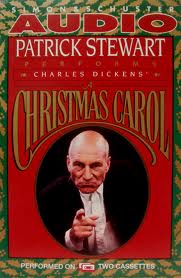
headerI had never seen A Christmas Carol performed.  I was, of course, familiar with the story–from the original (the Patrick Stewart audiobook is amazing) and from the many, many versions of it that have been performed in cartoon and live action formats.

We took the kids as this is a holiday classic and we thought it would be fun for all of us.  And we were right.  Except–this version is at times quite scary and (as my son pointed out) quite loud.  I didn’t find it terribly loud, although the scary bits were considerably louder than other bits.  And yes, the ghosts were certainly scary.  (I had actually warned him that the ghost of Christmas Future would be very scary, but it proved to not be the case, although it was really frikkin cool).

And I must say I was charmed immediately–as soon as the kids ran out on stage in period costume, singing songs and being very Christmassy, I was hooked.  (more…)

Read Full Post »

[ATTENDED: November 14, 2013] Much Ado About Nothing

much adoDespite all of my reading, I am fairly ignorant of Shakespeare. I’ve read or seen most of the big ones, but I don’t know a lot of his works first hand.  As a young reader I realized that reading Shakespeare was hard—as, really, any play with dozens of characters tends to be.  It’s not easy to keep character straight when there are no descriptors about them.  So I more or less gave up on reading Shakespeare and decided I would watch him when I could.

When the Princeton University theater offered us tickets to see Much Ado About Nothing, it seemed a great opportunity to brush up.

This was a student production, and I have to complement all of the students on their wonderful performances.  They never broke characters, and their Shakespearean dialogue was flawless (as far as I know).  What I found interesting was that it took about fifteen minutes before I was absorbed in the dialogue and understood, well, about 45% of it.  Well, maybe 60%.  They did speak a little fast sometimes.

What was incredibly helpful about the dialogue was…the actors.  Duh.  But really, the language comes to life when you see people actually performing the lines (making Shakespeare’s bawdy jokes that much more bawdy).  And while some of the performances seemed almost over the top, I have little doubt that that is how it was performed back in the day—why would they go for subtle when there’s jokes about sex? (more…)

Read Full Post »

« Newer Posts - Older Posts »