Feeds:
Posts
Comments

Archive for the ‘Short Story’ Category

dec2014SOUNDTRACK: TORRES-“A Proper Polish Welcome” NPR Lullaby SXSW (March 21, 2015).

torresFrom March 17-March 21, the SXSW festival raged on. And my friends at NPR Music were there so I didn’t have to be. In past years they have had a nightly recap of their favorite shows of the day. This year they upped the ante by inviting a musician to sing a lullaby.  Most of these lullabies occurred in some unexpected outdoor location at 2 or so A.M. after a long day of music.

The final lullaby comes from new to me singer Torres. She has one of my favorite songs from the NPR Austin 100 “Strange Hellos.” It starts slow and builds and builds.  This is not that song (which would never work as a lullaby).

This is the only lullaby to feature an electric guitar.  And even though it is played quietly you can hear her fingers sliding up and down the strings squealing away.  This is a song from her new album Sprinter.  And it’s quite lovely.  I’m looking forward to hearing the full album when it comes out.

Check it out here.

[READ: March 23, 2015] “Hammer Island”

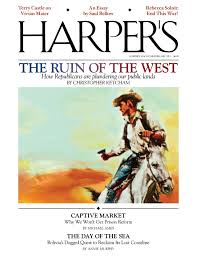
This issue of Harper’s featured five essays (well, four essays and one short story) about “Growing Up: five coming of age stories.”  Since I knew a few of these authors already, it seemed like a good time to devote an entire week to growing up.  There are two introductions, one by Christine Smallwood (who talks about Bob Seger) and one by Joshua Cohen who talks about the coming of age narrative.

I’m not sure why Wells Tower submitted fiction rather than an essay (he comfortably does both), but I’m glad he included this story as I think it’s a really interesting one.  And yes it does cover growing up–and may even be based on fact, who knows.

This is written from the point of view of a seventeen year old girl, Maxine.  She has been invited to Hammer Island (of the coast of Maine) for the summer to watch the (frankly wicked) daughter of famed film producer Morris Walls.  Walls terrifies people in Hollywood, but when he comes to Hammer Island he is treated like everyone else.  I loved this example:

Morris flicked a cigarette butt over the boardwalk rail. A teenage boy walking behind us retrieved it. He jogged up to Morris, tapped him on the shoulder, and slipped the cigarette butt into his palm. “No littering,” said the boy. “I know you’re new here, but we take it pretty seriously. Technically, there’s a three-hundred-dollar fine. I’m not going to report you, but just so you know, most people would.”  In California or New York, threatening Morris Walls and handing him garbage would have been a sure way to get sworn at, slapped, doused with hot coffee. But Morris understood that attacking the boy would be pointless. The boy was of the island, and he spoke with the full authority of the place behind him.

And I loved the general pretension of the island:

Whenever anybody walked by, you had to call, “Hello! Come up, come up! We’re picking crabs!” Or you had to say that if you owned the house and the person passing by owned a house on Hammer, too. If you had been coming to Hammer Island for thirty summers, renting the same house for $4,000 a week, you did not get summoned to a porch for crab picking. You were still looked upon as an interloper and a thug.

Interestingly, this is all just set up for the real story which has little to do with Walls and nothing exactly to do with the island.  For this story is about Maxine and a teenaged boy, Todd Greene.  When Maxine is able to get a way from Lola (the brief story about Lola is hilarious), she would watch Todd play tennis.  He was masterful.  And after his matches he would talk with her.  And soon enough he invited her onto his boat.

When she arrived at the dock, a short, dwarfish man was polishing the boat and Todd was nowhere to be seen.  The man seemed to have nothing but admiration for Todd, talking about what a good sailor he was and making the boat perfect for the young man.  When Todd finally arrives, he takes the keys, says nothing to the man and he and Maxine head out to open waters, where “Todd talked me out of some but not all of my clothes.”

Two days later, Maxine was invited to the Greene’s house where she discovered that the “dwarf” was actually Todd’s father.  Todd’s mother and brother are, like Todd, gorgeous, and she can’t figure out the father’s place.  But it seems that his place is simply to serve everyone.   And when he makes a mistake with dinner, the whole family reams him out.  But this time, having had enough, the father storms out and is not seen on the island again that summer.

Maxine is surprised that Todd keeps in touch over the year with quarterly updates on his exploits.  And they both plan to return to Hammer Island next summer.  When they do return Todd’s father is there waiting (and he has a plan).  The end of the story is exciting and emotionally complicated.  It’s a very satisfying story indeed.

I’m looking forward to more fiction from Tower.

Read Full Post »

harp jan SOUNDTRACK: RHEOSTATICS-CBC Studios (1999, 2000 or 2001).

cbcrheoThis is a hard event to document.  According to the Rheostatics Live website, this show was broadcast on Sonic 102.9 in 2000, but it appears to be a rebroadcast of a live show that the band recorded at CBC2 Studios in 1999 or, possibly, even in 2001 (according to the link to the video below which states Rheostatics CBC In Session October 26 2001 Just Concerts. Vancouver BC Studio 2, although that may just be a cut up version of the audio–so confusing!).

Whatever the case, the sound of this in-studio live show is tremendous.  It is one of the few instances where you can totally hear Dave’s acoustic guitar in the mix.

Kevin Hearn is there too, so they play a number of songs that they might not be able to without him.  And Michael Philip Wojewoda is on drums. (This complicates my understanding of the recording too, since Don left in 2001, but MPW often played with them anyway).

The audio version contains eight songs and two interview segments.  The interviews are funny (of course) and informative (although Tim sounds totally high), but it’s the music which is the highlight.

They play “Wieners and Beans,” “Martin’s Waltz (Blue Hysteria)” and “Kevin’s Waltz” form Music Inspired by the Group of 7.  They play “Easy to Be with You” “Monkeybird” and “Song of the Garden” from Harmelodia and then “Stolen Car” and “P.I.N.” as “new” songs.

The video below (which is the best video version of these recordings I’ve seen) has “Song Of The Garden” “Easy To Be With You” “Martin’s Waltz (Blue Hysteria)” “Stolen Car” and “Wieners and Beans.”  No word where the other three songs went.  But I love watching the video to see the way Martin makes the crazy sounds out of that little Steinberger guitar.

This is the last Rheostatics show I have for 2000.   I’ll be resuming with some shows from 2001, including Don Kerr’s final shows in a few months.

[READ: March 9, 2015]: “Two Parts”

I have only read two things by Dixon–the two McSweeney’s-released books I and End of I.

This story is a reflective look at regrets and decisions. It is told, as you might guess, in two parts.  He asks if he should start with his father or with Lotte.  He decides to start with his father.  He says he was thinking about something and he decided to talk at Abby about it. This framing device is used throughout the story.

The story about his father is from back when he was about ten and his father was about 51.  His father had always been in good health, but he had a temper.  Especially when it came to the narrator.  And while the father never hit the narrator with his hand, he did whack him with a rolled up newspaper. (more…)

Read Full Post »

harp febSOUNDTRACK: RHEOSTATICS-Scherzo Pub, Kingston, ON (October 15, 2000).

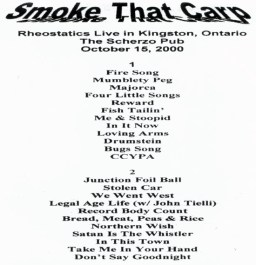
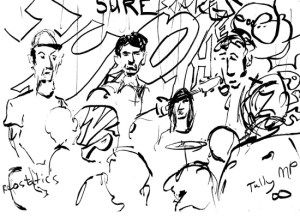
rheoscerzoThis show has some fun art work to go with it.  The notes say:

“Rare original drawing by local artist “tully” drawn during the october 15 2000 rheos gig at the now defunct scherzo pub, kingston, ontario. the story goes that “tully” goes to shows, does a drawing of the band, and just leaves it on a random table for someone (like me!) to find it. i actually found it on the floor!”

The other joke on the set list over here is the Smoke that carp joke which is from Martin talking about something before the set even starts.

They play a lot of songs from the then unreleased NotSS.  The version of “Four Little Songs” is crazy fun–lots of wildness, and a superfast ending.

In addition to playing “Majorca” they play two songs from Introducing Happiness and then talk about Martin’s guitar with the maple leaf on it.  They challenged Gordie Johnson from the band Big Sugar to put a leaf on his guitar. Dave says that not only did he put the leaf on his guitar (on the back) but he plays O Canada at every show now.

In the middle of “Junction Foil Ball” Dave talks about how much he struggled to get the riff (earlier Martin said Dave was very proud of the riff).  It’s a very lengthy talk with demonstration about the riff–quite amusing.

The end of the show has what sounds like an acoustic unplugged set.  Not quite acapella, but Don is only playing the tambourine.  It sounds like perhaps they are in the crowd or near the crowd or something.

Srheoscerzo2o for “Record Body Count,” the crowd sings along beautifully and “Bead, Meat, Peas and Rice” is also done in this format.  For “Northern Wish” Martin say he’s going to start it acoustic while the rest of the band goes back to their instruments.  It’s a great version of the song. In fact all three are wonderful, and it’s cool to hear them sounding so different.
There’s another long chat from Martin about Burton Cummings and how they saw him playing a casino.  It’s very funny.  Then he insists on a “golden drag” on his cigarette before starting the next song.

The disc ends oddly with “Take Me in Your Hand” also done in that acoustic format as the earlier songs–which makes me think it should have been earlier and was placed at the end by mistake.  It sounds great either way.

This is definitely a great show and one for any Rheos fan to enjoy.

[READ: March 5, 2015] “Family Life”

I had recently read something about Zambra that made me want to read him, and then, here he was in Harper’s.  I like serendipity.

This story was translated by Megan McDowell, and I gather is part of a collection of stories called My Documents which will be out soon from McSweeney’s.

This story is a simple one, although it has an unusual beginning.

Martín is headed to a house for a job.  He is to house-sit for a family while they are away for four months.  I enjoyed the way the family members were laid out for us to meet: in alphabetical order: Bruno, the husband, Consuelo the wife (well, actually not the wife, because they never married although they act like a married couple) and Sofía their daughter.

We learn that Bruno sand Martín ‘s fathers were cousins.  Martin’s father has just died.  They barely know each other, although they did know each other when they were kids.  But Bruno tries to strengthen this familial connection, because it builds trust.  Otherwise they have a stranger in their house for four months.

When Martín arrives Sofi runs past him (“These days kids don’t say hi”) chasing the cat Mississippi.  Consuelo is friendly and gives him instructions, which largely entail looking after the cat (who has a swinging door which is open all the time).  When Martín looks at a large hour glass, Sofi runs up and says it last 12 minutes.

To pass the time Martín plays Sofi in chess.  And when they get bored, he changes the rules so that the object is to get beaten, which Sofi enjoys more.

While Sofi is going to bed, Martín and Bruno talk.  Bruno suggest that he “use the time to have ago with one of the neighbors.”  Martín thinks (but thankfully doesn’t say out loud) that he’s like to have a go with Bruno’s wife.

After they leave, Martín discovers a photo of Consuelo and puts it up on the wall.

Martin plans to try a different route every day (different stores, different roads) so as not to make an impression on anyone in the town. But one day Mississippi doesn’t return from his nightly stalking.  Two days go by and Martín grows concerned. So he puts posters up around town.  But when he emails Bruno he doesn’t say anything.

A few days later he sees that someone has posted lost dog posters up over each one of his lost cat posters.  He calls the number (while drunk) and talks to Paz, the woman who put up the posters. He complains about what she has done. The next day she does around moving her posters off of his.  He gets some courage and goes to talk to her about their lost animals.

A week later he sees a dog that looks like hers and he calls her.  They go looking for the dog but don’t find it.  Then, after a month, Mississippi returns. He is beaten up , bloody and gross.  Martín takes him to the vet and gets medicine that he must apply to Mississippi every night.  When Paz calls him, he tells her about the cat and she comes over.

Paz scrutinizes his house–the photo of Consuelo–and he creates and elaborate fiction about his former life with Consuela and their daughter.  How they are broken up and he is reluctant to date.  Later, they have sex and start seeing each other every day.

Things are going quite well, although of course, it is all based on a lie. And the time of Martín’s departure (and Bruno’s family’s return) is coming up.  But the sex is great and he really like her.  She even invites him to go to a wedding with her.

What will happen when it’s time for Bruno and Consuela to return?

This is an unusual story (I guess) to start with because I’m not sure if Zambra’s other fiction is anything like this.  This story was erotic and a bit salacious and was predicated on a lie.  I enjoyed the idea of the main character being someone else and then realizing that he could be that person forever.  (Even if that’s not an original concept).  But Zambra’s handling of the story was really good and I’m interested to read more from him.

Read Full Post »

harp marchSOUNDTRACK: RHEOSTATICS-Call the Office London, On (August 11, 2000).

calltheofficeCall the Office sounds like a great live venue.  It sounds small and intimate and, for this recording anyway, the sound quality is great.

The band is in great form with a ten minute version of “Fat.”   Then there’s a bunch of new songs: “In It Now” (the first time I’m aware of them playing it), “CCYPA” and a great version of “The Fire.”

Then they jump back to an old song and play “Torque Torque” with a very funny introduction about how they wrote this back in the early 60s and that it out-dorks the Doors (the Doors had no bass player).  Dave also says they’ll never play Full Moon Over Russia because it’s too hard.

There’s a lengthy introduction to “Satan is the Whistler” in which Martin tells about writing it–how it was originally going to be about Bigfoot (he used to read Bigfoot books as a kid) and the scariest thing about the Bigfoot stories was when people heard whistling.  The intro devolves into some funny talk about Whistler, the city, and extreme sports.  Someone eventually winds up describing the song as Ian Anderson skiing.

There’s a sadly aborted “Junction Foil Ball.”  Not sure if they just never played it or if there’s a problem with the recording.

There’s also an “off color” joke about Michael Jackson and Bubbles and Dave teases the jokester (Don Kerr?) saying that a guy with neck beard shouldn’t make off color jokes.

“Feed Yourself” a song they don’t play often enough sounds great here with some awesome soloing chords and effects in the middle.  And “Legal Age Life” also has some funny silly parts in the solos.

“Horses” (which the fans have been cheering for all night) sounds fantastic–a great version of it.  The middle section has Dave talking and ranting (all with his voice echoed).  It’s quite intense.  As is the final “Moon” high note at the end of “Dope Fiends and Booze Hounds” which they cap off with another fast run through “Satan.”

As I said this is a great sounding bootleg (and the notes on the site agree: “This is one of the best sounding Rheos boots I have heard. Listen to Don’s drumming. It is awesome. I loved seeing him play.”

[READ: March 2, 2015] “No Slant to the Sun”

I have read so many stories by Boyle, and they are all so very different that I never really know what to expect–or even where they will go.

This story begins with the title–“there as no slant to the sun–it was just there, overhead.”  It is about a man, Sten, and his wife Carolee on vacation.  They are on a cruise and are currently taking a day trip to an island garden path (although he seems unsure where they are–not Mexico or Guatemala or Belize–somewhere with a lot of rum where they listen to reggae).

They, along with everyone else, are on a bus, being driven maniacally by a man wearing earbuds (listening to reggae) as he flies over potholes and around harsh left and right turns.

Sten refuses to drink the water here even though everyone else does. And despite his thirst he sticks only to the rum based drinks (and so is a bit drunk and parched).  He will only drink bottled water, but he forgot his bottle.  When Carolee falls asleep he roots through her purse for her water (which he then drops and it rolls under another seat).

All the people on the bus (mostly older retirees) are unhappy with the driving.  Finally Sten gets up to say something to man and even flicks out his ear buds.  But the man ignores him, clearly disgusted by the white people on the bus.  He grudgingly says they can have a restroom break in five minutes, although it’s more like 15 before they get to the site of their hike–something that Sten now regrets given the heat and his thirst.

As soon as they settle in, a car roars up next to them and some local boys get out.  One has a gun.  And the boys start demanding everybody’s wallets and jewels.

It’s then that we learn that Sten was once in the military.   And he has to decide if he should react to this insolence.

The story went in a direction I absolutely did not expect.  I enjoyed it, especially the way the ancillary characters react to what happens.  I never intentionally seek out Boyle, but I always enjoy his stories (and I am astonished at how prolific he is).

Read Full Post »

harp marchSOUNDTRACK: RHEOSTATICS-Cowichan Theatre, Duncan British Columbia, (January 23, 2000).

cowichanWhoops, slightly out of order here, but no one’s counting.

This third night in BC was at the Cowichan Theatre.  This night was held as a benefit for the Women’s Coalition Institute’s campaign against GM food.  Luke Doucet’s band Veal opened, there were families and young kids in the crowd and Dave even talks about buying some art that was for sale.

Amazingly, the band plays nine songs that they hadn’t played the two previous nights.  The only bad thing about this show is that 6 songs are missing from the posted recording (including a night-ending “Shaved Head.”)  But the set still clocks in at an hour and fifteen minutes.

I found the audio a bit muffled on this recording.  In fact, for the first few songs I thought Martin was hard to hear.  Especially on “Stolen Car.”  But he seems to get louder as the show goes on.

There’s a joke about Martin’s shirt–(like he took Greg Keelor’s shirt (Keelor was in Blue Rodeo).  Martin admires his “cowboy look” and jokes about big city folks.  There’s also a funny bit later about the Beatles where he seems to forget George Harrison’s name and says he was going to call him “Gino.”

Martin was still experimenting with the slower opening of “Northern Wish” here, which sounds cool.  “Claire” sounds great (it’s the first time they played it in the three nights) although I wish the quality were a little better.  There’ s great noisy solo inserted into it as well.  And “Self Serve Gas Station” totally rocks.

It’s a shame that “The Wreck of the Edmund Fitzgerald” was cut off, along with the end oft he set but it s a good sampler of some different songs.

[READ: March 5, 2015] “The Man Stopped”

The introduction to this story says that it may be the last complete unpublished short story by Nabokov.  It was written in 1926 and is believed to be a parody of the then current crop of Soviet writers who wrote in an ornamental pseudo folky style.  The story is full of “rustic idiom” which has been translated to very rough English idiom by Gennady Barabtarlo.

Given that Barabtarlo describes the story as a parody I expected it to be funny, but to my ear it isn’t.

Indeed, it’s a very simple story of a man on a journey who is constantly set upon (verbally) by the locals. (more…)

Read Full Post »

ny216SOUNDTRACK: JEFF The Brotherhood–“Black Cherry Pie” (2015).

jeffJEFF the Brotherhood is back with a new album.  The first song I’ve heard from it is called “Black Cherry Pie.”  It is a slow, heavy, nihilistic track with slightly more instrumentation than the usual duo set up.

And then at 40 seconds, there’s a FLUTE SOLO!

The lyrics are crazy–glass in my teeth, driving vans off cliffs, knives in eyes, with the simple chorus of “black cherry pie.”

And then just as you sorta forget that here was a flute solo (although it is hard to forget), a second one comes up at around 3 minutes.  And since you can’t help but think it sounds like Jethro Tull, I’ll tell you that that flute solo is by Mr Jethro Tull himself–Ian Anderson!  Huzzah!

As you can see by the photo, the Brotherhood has always been fans of Jeffro Tull, so this is a nice flourish.

[READ: February 15, 2015] “Labyrinth”

This is the first story I’ve read by Amelia Gray.  Now, any story that is called Labyrinth pretty much invokes the idea of a maze and a minotaur.  In this short work (only two pages) Gray takes these basic ideas and twists them in an interesting way.

Dale is a local farmer who holds and annual Pumpkin Jamboree to raise money for the fire department.  It features a hayride, face painting and a corn maze.  The narrator, Jim, tells us that Dale had recently been reading about Hellenic myths, and that this year he wanted to do something different with his maze. So he’s made a labyrinth.  The difference?  In a labyrinth, there’s only one road and it leads to only one place.

The folk are disappointed saying that there’s no point if you can’t get lost.  And they’re even more upset when he says that each person must go in alone–there’s no way folks are letting their kids go in alone.  Even when Dale says that people believe the center of the labyrinth possesses magic, allowing you to discover the thing you most desire, the folk start to wander off.  But Jim, feeling bad that Dale went to so much trouble, volunteers. (more…)

Read Full Post »

janfebSOUNDTRACK: TANYA TAGAQ-“Uja” and “Umingmak” live at the Polaris Music Prize (2014).

tanyaTanya Tagaq won the Canadian Polaris Prize this year.  Tagaq is a Canadian (Inuk) throat singer from Cambridge Bay (Ikaluktuutiak), Nunavut, Canada who at age 15, went to Yellowknife, Northwest Territories to attend high school where she first began to practice throat singing.  Mostly I included that so I could have the word Ikaluktuutiak in a post.  She is the first native Canadian to win the prize.

Tagaq sings in a gutteral throat singing style combined with some more traditional high-pitched notes.  She has worked with Mike Patton and extensively with Björk.  Most of her songs don’t have lyrics per se, and the album that won the prize is called Animism.

This is a live broadcast of her set which has been describes as truly mesmerizing in person.  It is certainly mesmerizing in video–marveling that the woman can sound so possessed  and yet so clearly in control.

At 1:38 when the backing vocalists (who were shrouded in darkness sing out, it’s quite startling.  I don’t know when the first song ends and the second begins, but at 3:48. when the drums start a regular beat, you can hear a sense of commercial rock amidst the avant garde music.   Around 5 minutes the music drops away and when Tagaq sings briefly in her non-throat voice she sounds almost childish. But when the throaty growls returns, it’s a bit scary, frankly.

Tagaq has talked about bringing the sensuality of throat singing out into the public and by 7 minutes, the sensuality is right there on the stage.  By the end, when she is screaming her lungs out, it has to have been really intense in the theater.  And her wold howl at the end is uncanny.

Clearly not to everyone’s taste, but probably not lie anything else you’ll hear all day.  And unlike anything you’d hear at the Grammy’s.

[READ: January 2, 2015] “Beyond the Shore”

This is  brief story about competitiveness at the gym.  It’s the kind of story that is probably acted out in gyms across the country and one which shouldn’t have been all that interesting, but Awad chose an interesting setting and characters to flesh this out.

I also enjoyed that the title has nothing to do with the action of the story.  Rather, it refers to the place where they live: “Beyond the Shore, a gated-living community that has nothing to do with California (we are nowhere near California), the apartment building which overlooks the Malibu Club Spa and Fitness Centre.”  Each morning when the narrator wakes up, she can see from her bedroom window that Char, an extremely depressingly fit woman, is already working out ion the gym. And most of the time she is working out on Lifecycle One, the very machine that the narrator has signed up for in fifteen minutes.

This wouldn’t be a problem except that in fifteen minutes, the narrator, who is not in peak physical shape will get to the gym and Char will still be in mid-routine with no intention of stopping.  When the narrator approaches Char, Char says she’s almost done (even though she ‘s already over by five minutes) and then mutters a nasty name about the narrator under her breath.  Often by the time Char gets off, the narrator has but 24 minutes in her time slot before the cardio group comes in next. (more…)

Read Full Post »

spioiledSOUNDTRACK: THE BEATLES-Let It Be (1970).

letOf all the fascinating details about Beatles releases, I don’t think any are more fascinating than the details about Let It Be.  I’m not even close to understanding everything that went on here.  But in a nutshell, it seems that they went into the studio to record an album called Get Back. They were even going to film the whole things.  It got scrapped.  Some members quit the band then rejoined.  And then they recorded Abbey Road.

And then the band did a concert on a rooftop (almost exactly 46 years ago!).  And soon after they broke up. Then some producers decided to release Let It Be as a soundtrack to the documentary made about their recording.  They used some of the material from Get Back and some from the rooftop concert and then Phil Spector got involved and put all kinds of strings on everything and then the album was released in the UK on my first birthday.

There’s lots of snippets of dialogue which seem designed to make it feel like a soundtrack (which it doesn’t).  There’s really short snippets of songs, there’s raw live songs, there’s overproduced string laden songs.  It’s kind of a mess.  But in there are some good songs too.

“Two of Us” is a pretty folkie number that I like quite a lot although I first became familiar with it from a Guster cover (which is pretty fine.  I never quite understood the title of “Dig a Pony,” but it’s a big weird sloppy song. It’s kind of fun to sing along to—especially the falsetto “Beeeecause.”  This song was recorded from their rooftop concert and it feels rawer than some of the other songs.

“Across the Universe” is a lovely song.  Evidently Lennon didn’t contribute much to Let It Be, so they threw this on to give him more content.  I actually know this more from the Fiona Apple version (which I think is actually better than this processed version). I don’t really care for the strings and echoes feel on this version. “Dig It” is a short piece of nonsense. It was exerted from a lengthy jam but for some reason only this little snippet was included on the record–it sounds odd here.

“Let it Be” is quite a lovely song. I don’t really care for the Phil Spectorisms that were done to it—the strings and choruses seem a bit cheesy.  At the same time, the guitar solo (which is quite good) sounds too raw and harsh for the song.  “Maggie Mae” is a traditional song, another bit of fun nonsense.  I like “I Me Mine,” it’s rather dark and the chorus just rocks out.  “I’ve Got a Feeling”, was also recorded on the roof, so it feels raw.  There’s some great guitars sounds on it. Evidently it was initially two songs, and Lennon’s part (the repeated “everybody” section) was added to it.

“One After 909” sounds so much like an early Beatles song–very traditional rock and roll (which means I don’t really like it).  Although the version is raw sounding (it was also recorded from the rooftop) so that’s kind of cool. Huh, Wikipedia says “the song was written no later than spring 1960 and perhaps as early as 1957, and is one of the first Lennon–McCartney compositions.”   “The Long and Winding Road” is where all the controversy comes from.  McCartney hated what Phil Spector did to his song.  He HATED it.  And I have to agree.  It sounds nothing like the Beatles–it sounds very treacly and almost muzaky.  It feels endless.  At the same time, I’m not even sure if the song is that good–it’s so hard to tell after all these years. I think it kind of rips off the transition in “Hey Jude” which was used to much better effect.

“For You Blue” is a simple blues. I like it better than most of the Beatles’ blues, perhaps because of John’s slide guitar (and the funny comments through the song–which makes it seem like the band actually liked each other).  “Get Back” ends the disc as a fun rollicking romp.  I really like this song, although I’m surprised at how short it seems–I thought there was a lengthy outro.  The end of the song (and the disc) has John asking if they passed the audition–lots of fun going on in this contentious recording session.

So it’s not the best career ending disc, although I guess as a soundtrack it’s pretty good.  I’ve never seen the film, and I’m kind of curious to after having walked through all of these Beatles albums.

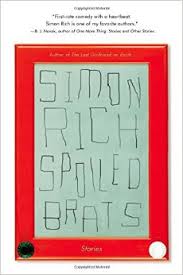
[READ: January 19, 2015] Spoiled Brats

I probably read too much Simon Rich too close together, but it’s so hard to resist him.  I’ve said before that I enjoy his shorter pieces the most, but there were some longer ones in this one which were really good as well.

This is the first book where I thought that Rich went a little too dark (although not as dark as Sarah thought he did).  That’s sort of the point of the book, though, to look at people (especially people named Simon Rich) who are horrible human beings.

“Animals” [New Yorker, April 10, 2013] opens from the point of view of a class hamster.  He is tormented by the children in the class and he knows that when Simon Rich is supposed to feed and give them water that their lives might just be over.  The Simon character is hilarious, and it’s nice to see that revenge is sweet.

“Gifted” wonders what if a child isn’t so much gifted as Satanic–how many euphemisms will be used for this one child?

“Semester Abroad” is the diary of a girl who has gone abroad–to another planet.  And how her insensitivity is handled during an intergalactic crisis.  I enjoyed this one a lot. (more…)

Read Full Post »

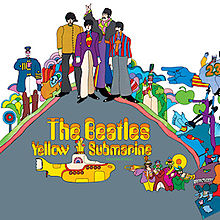
CV1_TNY_01_20_14Blitt.inddSOUNDTRACK: THE BEATLES-Yellow Submarine (1969).

I220px-TheBeatles-YellowSubmarinealbumcover‘ve enjoyed listening to the Beatles lately, but I’ve been marveling more at how they were (I assume) pressured into releasing songs almost constantly (this is their tenth album in six years).  So, this album, a soundtrack to the film, came out six weeks after The Beatles.  Six weeks after a double album which was still on the charts (still #1 in the US) this album came out.

Even though it sold very well, I imagine it has to be the least-listened to Beatles album (even though it is the other vinyl Beatles album that I own, which I got when I was a kid).

There are 13 tracks on the disc.  Two are repeated Beatles songs. Four are “new” songs (meaning they were thus far unreleased, but they were recorded a while back) and the rest are orchestral songs from the movie, composed by George Martin.

The repeated songs are “Yellow Submarine” (from Revolver, although obviously it makes sense here) and “All You Need is Love” which was just recently released as a single (and on Magical Mystery Tour in the US and which works fine in the movie).

The new songs include: “Only a Northern Song” written by George Harrison.  It was recorded during the sessions for Sgt. Pepper.  I didn’t know anything about the song, and I thought the lyrics were kind of, um, dumb?  But now I see that they were written because Harrison was angry about being a contracted songwriter to the Beatles’ publishing company, Northern Songs: “It doesn’t really matter what chords I play/What words I say or time of day it is/As it’s only a Northern Song.”  The song itself is kind of unusual.  It opens with a big organ sound. Then with the lines saying it doesn’t matter what chords the play, the backing music is pretty out there–not quite wrong, but certainly off.

Harrison got a second song (this has to be the most songs per disc for Harrison).  “It’s All Too Much.”  It also starts with an organ.  It’s the only psychedelic song on the album (and has Indian overtones).  It was recorded during Sgt Pepper and was supposed to appear on Magical Mystery Tour.  I like the song, but at 6 and a half minutes, it’s a bit long (the original mix was 8 minutes!)

“All Together Now” is a goofy song.  It’s clearly something written in five minutes–the lyrics and melody are so simple–but man is it catchy and fun to sing along to.   The final new song is “Hey Bulldog.”  I really like this song a lot and I’m bummed that it’s kind of overlooked on this soundtrack.  The riff is really hard rocking (even on piano) and I like the silliness with the barking and whatnot at the end.

The second side was the orchestral songs.  Most of them are about 3 minutes long.  If you know the film, they’re fun to listen to to revisit the visuals, but they’re not what you get a Beatles album for.  Of course, I always listened to sides one and two of my records, so I must have listened to the score three or five dozen times back in the day.

[READ: June 10, 2014] “A Mistake”

This was one of the 2014 New Yorker stories that I thought I had posted about but which I just found in my drafts pile.

This is the story of a boy from India who has emigrated to America with his family.

As the story opens we learn that the boy’s father always wanted to leave India, he felt he could do better in America, although the boy’s mother had no interest in leaving her home.

There’s some very funny lines about the father.  Like “I used to assume that my father had been assigned to us by the government. This was because he appeared to serve no purpose…all he did was sit in his chair in the living room, drink tea and tread the paper.  Often he looked angry.”  But then his father left for America and a year later called for them. (more…)

Read Full Post »

dec2SOUNDTRACK: THE BEATLES-The Beatles (1968).

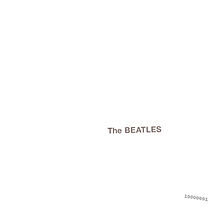
220px-TheBeatles68LPDespite the sound effects, it’s clear from the start that this album is going to be different from the psychedelia of previous albums.  And the whole album is very stark—guitars, bass, drums, occasional piano and organ but not much else.  True there are some strings and horns, but it’s all very much in the vein of rock and roll–nothing trippy.  Turns out that most of the songs were written during a Transcendental Meditation course with Maharishi Mahesh Yogi in Rishikesh, India–a period that was free from drugs (except or marijuana of course).

“Back in the USSR” is a fun rocker, although it always confused me and there’s some explanation that this is sort of a joke on the Beach Boys.  “Dear Prudence” is a mid tempo song (with some cool bass lines).  I should have been keeping track of all the Beatles songs that I know better from other artists.  This one I know better from Siouxsie and the Banshees.  I had no idea what this song was about, and the story is weird and fascinating.  I love the way it builds band builds. “Glass Onion” has a really groovy sound, and I love all the self referential nonsense in it.  “the walrus was Paul” and “I told you about the Fool on the Hill” (McCartney overdubbed a record part to reference the original)–sounds like Lennon goofing around but making cool music out of it.

“Ob-La-Di, Ob-La-Da”is a goofy song (Paul is good at those it seems).  Evidently it was meant as a pastiche of ska (with Jimmy Cliff contributing initially).  According to Wikipedia this song is one of the factors that led to the break up of the band because they got so sick of it.  “Wild Honey Pie” is a weird 50 second snippet of a song.  This seems to foreshadow the medley tracks on Abbey Road.  Evidently it was just McCartney goofing around and referencing “Honey Pie” from later in the album.  “The Continuing Story of Bungalow Bill” is a song that I always sort of liked because it’s so weird.  But I never understood it.  While it may not be necessary to know all of the details of songs, it’s fascinating to learn that this one was written by Lennon after an American visitor to Rishikesh left for a few weeks to hunt tigers. The recording features vocals from almost everyone who happened to be in the studio at the time. Yoko Ono sings one line and co-sings another.  The Spanish guitar at the beginning of the recording was overdubbed later by Harrison.

I’ve always really liked “While My Guitar Gently Weeps” and thought Harrison was an underrated songwriter because of it (although I find that I don’t really like most of his other stuff that much).  I never knew that Eric Clapton played the leads on this song, which may be why I like it so much–not that I’m a huge fan of Clapton but he really scorched this song in a way that I don’t think Harrison every would have.

“Happiness Is A Warm Gun”always surprises me because the first verses sound so unlike the rest of the song–I really don’t recognize it as this song, always assuming it starts at the “I need a fix” part.  Of course, there are so many different parts that it’s really more like several different songs.  And that was all for side one.  Side Two opened with “Martha My Dear” a jaunty piano ballad played entirely by McCartney.  “I’m So Tired” reminds me a lot of “Bungalow Bill” and seems unnecessary.  “Blackbird” is, simply, a beautiful song.

“Piggies” is an interesting criticism of modern society–I love that they used a harpsichord for it (evidently Charles Manson was inspired by it as well as “Helter Skelter”).  Like “Bungalow Bill” I never really understood “Rocky Raccoon.”  McCartney’s crazy accent at the beginning and the whole premise of the song is peculiar–unless of course you don’t think of Rocky Racoon as a raccoon (which I have a hard time getting past).  It’s a pretty decent folk song. though, I suppose.  “Don’t Pass Me By” is a song I really don’t know at all–a honky tonk piano (which was the first solo song Ringo wrote).  It’s fine and kind of nice.

I had always assumed that “Why Don’t We Do It in the Road?” was a Lennon song, but it was all McCartney–Lennon didn’t even play on it.  It’s  just a weird noisy track (written when Paul saw monkeys doing it in the road in India)  Despite its brevity (less than 2 minutes), I actually find it goes on too long.  “I Will” is a sweet acoustic song.  I always assumed that “Julia” was a McCartney song, but it’s a beautiful Lennon ballad.

I asked Sarah, who was a huge Beatles fan, if she listened to sides 3 and 4 as much as sides 1& 2 because listening to these sides, I feel like I don’t really know them that well.  She says they did, so what do I know?

Of course I know “Birthday.”  i find it to be a weird song–why would you write a song about a birthday unless you didn’t want to sing the Happy Birthday song anymore?  It is evidently meant to be in the style of Little Richard.  I didn’t know and rather dislike “Yer Blues,” which I simply don’t believe the lyrics of.  And um, what is the reason why? It’s a pretty dull blues song although the guitars solos are pretty good.

I don’t really know “Mother Nature’s Son” that well–I feel like I know the little bass line between verses as significant but not the song itself.  It’s a pretty acoustic song that kind of reminds me of “Julia.”  “Everybody’s Got Something to Hide Except Me and My Monkey” has some really sharp piercing guitars on it.  I like the ringing bells and c’mon c’mon section. The whole song is fun, whatever it’s about.  “Sexy Sadie” is a song I’ve never been too crazy about.  I like the middle part better than the verses.  Apparently this was originally called “Maharishi” and was written about him–he changed the words later–which makes it all make a bit more sense.

It’s a shame that Manson has co-opted “Helter Skelter” because it’s a wonderfully blistering song.  The guitars and vocals are just awesomely rocking and raw.  I also love that a helter skelter is just a slide and not something sinister (duh, Charles–see what happens when you try to read into Beatles lyrics).  I actually knew Siouxsie and the Banshees and Mötley Crüe’s versions before the original, but now I think the original is the best version.  I love that the song just never really ends–it’s got codas and extras and blisters on fingers.

“Long, Long, Long” is a song I don’t really know.  I like the melody although it’ a bit too slow for me.

“Revolution 1” is weird to me because I knew the more rocking version first and this sounds like a kind of jokey version (with the shoobie doo wops)–although it was actually recorded first.  “Honey Pie” is a cute dance hall/1920s era song–Lennon played the guitar solo on the track, but later said he hated the song, calling it “beyond redemption”.  (He was quite nasty about a lot of Paul’s silly songs).  “Savoy Truffle” is yet another Harrison song that I just don’t know–did radio stations ban his songs?  It’s a decent rocker with electric piano and saxophone.  “Cry Baby Cry” is a song that I kind of know. I like that there’s accordion on it.  It builds very nicely.  The end has a little coda called “Can You Take Me Back.”

“Revolution 9” is probably the most notorious track on the disc.  I have to assume it was left on because there was a lot of empty space to fill in order to make the album a double album.  It’s such a strange creation and has really been responsible for so many cut and paste songs I’m sure.  There’s some sophisticated tape manipulation going on, but at 8 minute sit is just too long for what it is.

“Goodnight” is a sweet song that I have to assume was often ignored by fans who took the needle off the record during “Revolution 9.”  i actually didn’t even know there was a song after revolution 9.  Indeed, I only know the song because it was on a children’s CD that I used to play for my kids every night.  And while Ringo’s voice is nice, I like the other version (which I can’t think of) a little more.

So there’s the big white album–an album I never owned until recently.   It could probably have been reduced to a single album, but there are some undoubtedly brilliant songs on it.

[READ: July 3, 2014] “Road Kill”

I was curious to see how many short stories of older New Yorker magazines I had read.  It turned out that I have read nearly every story in every issue for the last several years from 2009-2014 (and many from 2008).  However, I have missed a few over the years.  Like this one.  I had typed up a post but just never finished it for some reason.

So, I’ve decided that I will go back and make sure that I’ve read each story from each issue from 2008-2015 (but not right away, I’ve done a lot of New Yorker stories recently.  So, I’ve got 13 from 2009, 6 from 2010, 2 from 2011, 1 from 2013 and 1 from 2014 (and, uh 27 from 2008–that’ over half, so maybe I wasn’t quite in the spirit of things yet back then).  But in the meantime, here’s one from 2013.

This is a brief story about a taxi driver in Sri Lanka.  He has been traveling the same route (across country) for two years.  This necessitates a stop in Kilinocchi, a town associated with the nerve center of terror (it is even commented on that it sounds brutal in English).  But the driver is a pro now—he says all you have to do to stay safe is keep your eyes open to drive all night.

On this trip, he is driving Mr and Mrs Arunachalam to see their soon-to-be house.  She is hugely pregnant and complains much of the way and they are both relieved when the hotel pulls into view. (more…)

Read Full Post »

« Newer Posts - Older Posts »