Feeds:
Posts
Comments

Archive for the ‘Constellation Records’ Category

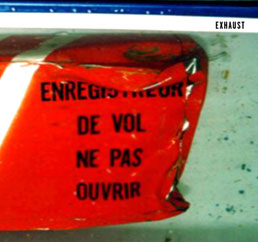
may20014SOUNDTRACK: EXHAUST-Enregistreur [CST021] (2002).

exhaust2While Exhaust’s debut was a mixed affair, their follow up really showed some great improvement.  The band feels more unified, there aren’t any single songs that were remixed (which stand out in a bad way), rather the remixing was done throughout the songs.  And, best of all there’s a lot more of that spooky bass clarinet.

The album feels more organic, “Gauss” opens with waves of music setting a mood until about a minute into track 2 “Behind The Water Tower” when the drums kick in the atmospherics gains urgency. “Voiceboxed” has a feeling of contemporary Portsihead which is neat from an album that came out almost a decade earlier.  This one has some samples of commercials , but they’re a little low in the mix so its hard to make them out. Although the spoken word part that swirls around your head is very cool and a little startling. (Headphones are a must for this album). There’s also a funny standup routine (yes, in the middle of the song)—wonder who it is.

“Ice Storm” opens with a sampled piano & a lot of static.  It morphs into a lengthy play/commercial/PSA by Heathrow Wimbledon and is called “The Maternal Habitat.”  I can’t find anything else about it online.  It’s rather fun to listen to, although when the skit is done, the music becomes strangely slow and the last two minutes (of 9) go on too long.  It bleeds into “Dither” which is mostly sampled voices and more commercials.  I love this Negativland kind of pastiche

“Behind the Paint Factory” mirrors “Water Tower” in that the drums kick in after 2 minutes and the song sounds great.  “My Country is Winter” is mostly tape manipulations including a screaming guitar solo that runs around your head.  “Silence Sur la Plateau” returns to that sort of ominous Portishead vibe with the sound of loud crinkling plastic as its main “music.”  There’ also a lengthy silence in the track which seems rather pointless to me.  The album ends much like it began with “Degauss” which is mostly clarinet solo and atmospheric sounds

It’s much better than their debut but still feels like they could have made a tighter album if they’d gotten rid of some (but not all) of the nonsense.

[READ: December 1, 2012] “The There There”

I have enjoyed Nelson’s stories in the past, and I feel like it’s time to find a collection of hers (and I see she has a lot, too).

What I especially enjoyed about this one was the way the title was used in the story and also the way it encompassed the main character in a way that was unrelated to the way it was used in the story.  In the first instance, the family is on vacation and they overhear some tourists asking “Where the hell are we?” while standing in front of the Colosseum.  The son explains that’s “like not seeing the Grand Canyon until you fell in it, like it’s the there there.”

The story is about a family–a mother, a father, and two sons.   It opens with the sons and the mother discussing the perfect murder.  The husband disapproves of the discussion but only indicates this with a cleared throat.  We see that Caroline, the mother, was imagining her husband when she was describing her murder.

While the story is basically about the mother (although told in third person), it flits back and forth to the other family members and how their behavior affects her.  First we see that their oldest son, having gone off to college, has fallen in love with his landlady–a woman with children older than him.  Caroline is appalled at this especially when Drew reveals that she’s not all that pretty, that he would have chosen one of those daughters. (more…)

Read Full Post »

may20014SOUNDTRACK: EXHAUST-Exhaust [CST004] (1998).

exhaustExhaust’s self titled album was another early release from Constellation (disc number 4).  At this point Godspeed You Black Emperor had not defined the label’s sound yet (correctly or incorrectly), so we get Exhaust.  Aidan, who is 1-Speed Bike, which did not have very good drums, is the drummer for Exhaust.  And man, the drums are awesome here.  The drums are again, loud, and they have a great live feel to them–the beats are funky and different and while they anchor what’s going on they in no way keep things settled.

The rest of the band includes a bass, a guitar, a bass clarinet and samples.  The samples just aren’t loud enough anywhere on the album.  It’s a shame–you simply can’t really hear them, which I guess is the point, but then what’s the point of having them?  So the first song, “A History of Guerrilla Warfare” is interesting (again, those drums!), but it’s in song two “Metro Mile End” when that bass clarinet comes out that it totally rules. The third song “Homemade Maggot Beer” is a 20 second hardcore song with just drums and feedback.  Song 4 “We Support Iran in Their Bid to Win the 1998 World Cup” is a remix by 1-Speed Bike, and after listening to the full length 1-Speed Bike, it sounds like it– a little dull, a little slow and nowhere near as dynamic as the album.  And it has such a good title too.

“Two Years On Welfare” has louder samples–you can hear a kind of political rant going on, but it seems like it could have been used better.  But around 1;30 the sounds get really interesting.  Track six, “This Is Our (Borrowed) Equipment” is another 1-Speed Bike remix, and it is mostly drums again.  “Wool Fever” makes good use of harmonics and drums although it goes on a bit too long.  The 8th song, “A Medley Of Late Night Buffet Commercials” is the final 1-Speed Bike remix.  Unlike the others I really like this one.  True, I wish the song was more akin to what the title says, but the drums are funky and hammering and sound great.  “Winterlude” is 40 seconds of squealing radio sounds before the final track reintroduces us to that great clarinet.  “The Black Horns Of H2T” reminds us how good this album can sound.

So it’s a mixed bag, but the highs are definitely high.

[READ: April 14, 2014] “Humor”

This article appeared in the December 1958 issue of Harper’s magazine.  Mark Twain made over 100 contributions to the magazine (geez).  I have often thought that Twain is an author I need to read more of.  But when I hear he has contributed over 100 articles to Harper’s alone, my mind reels at the output.

Anyhow, this is an article about repetition in the art of humor.  Interestingly, he relates a story that happened forty years before writing this.  So the occasions of the joke he tells was in 1918!  Woah.

The article talks about the first and second lectures that he ever gave.  The first was a success but he was concerned about the second as he had very little in the way of humor to warm up the audience.  He decided to make use of an anecdote that everyone in San Francisco had heard many times and were undoubtedly sick of.  It had been overdone as long as five years ago.  But he decided that he would simply tells the very overdone story over and over until people started to laugh (the precursor of Saturday Night Live, obviously). (more…)

Read Full Post »

gorey SOUNDTRACK: 1-SPEED BIKE-Droopy Butt Begone [CST014] (2000).

1speed1-Speed Bike is a remix project by Adian Girt who has played in Godspeed You Black Emperor and Exhaust for Constellation Records.  This is his first release as 1-Speed Bike.  He has released several more on other labels but I haven’t heard any of them.

The most interesting thing about this disc are the titles of the songs.  And those titles are so clever that it gives one high hopes for the album.  I don’t know who Mauro and Elwy are (track 1) but the rest are certainly interesting if not confrontational.

1. The Day That Mauro Ran Over Elwy Yost
2. Seattle/Washington/Prague 00/68 Chicago/Nixon/Reagan Circle-Fighting Machine
3. Yuppie Restaurant-Goers Beware Because This Song Is For The Dishwasher
4. Just Another Jive-Assed White Colonial Theft
5. Why Are All The Dogs Dying Of Cancer?
6. My Kitchen Is Tiananmen Square
7. Any Movement That Forgets About Class Is A Bowel Movement

But what’s disappointing is that the album is comprised almost entirely of a drum machine and some other sounds.  The drums are very very loud in the mix, and there’s very little variation in each song (which befits a remix, I suppose).  And yet, the “musical” section is largely nonexistent.  There’s a lot of spoken word stuff, which is fun, but it also seems randomly thrown on there. The disc opens with him asking someone to be quiet because he has to flush the toilet.  There’s a lengthy declaration of love for his family and war against capitalism.  And that everyone else can fuck off if they don’t want to hear him talk politics.

There are samples sprinkled around the disc, but most of them are inaudible or played with so much that it renders them hard to figure out.  There are some interesting sounds in “My Kitchen is Tienanmen Square,” but the rest is kind of dull.  The end of the last song offers a voice mail message that gives you the title of the album.

Overall, not an exciting debut for 1-Speed Bike.

[READ: April 12, 2014] The Strange Case of Edward Gorey

I bought this book many years ago when I was on an Alexander Theroux kick (which actually means I wanted to read some of his books but did not, although I do hope to).  Anyhow, this book has been staring at me for some time so I decided to just dive in.  I actually know precious little about Theroux except that his novel are supposed to be weird or difficult or something.  I know slightly more about Edward Gorey, although little more than his drawing style (which I love) and his sense of humor (which I share).

So this book is a sort of a biography of Gorey by Theroux.  Theroux was one of Gorey’s close friends.  This is saying something because as a rule Gorey was rather a recluse and didn’t much like people (he did like cats, though).  The book is not a proper biography–a biography of his works or even of his life.  It is more of a biography of the man and his quirks.  There’s very little about his childhood, and not a lot about his books (except for Theroux’s admiration).  But mostly its about what it was like to hang out with Gorey–and to delight in the baroque and fun turns of phrase that Gorey used.

We learn a lot about what he liked (soap operas, classic movies [Metropolis, M, Sunrise, Gold Digger series], obscure horror films [The Town That Dreaded Sunrise, Women of Straw, Suspiria (at least I’ve heard of that one)], TV shows [The X-Files, The Golden Girls, Matlock, Buffy the Vampire Slayer] and of course, classic literature [he was well versed in many original languages].  We also learn what he most assuredly did not like.  He did not like Star Wars, he did not like Mel Brooks, he did not like Robert Altman or Woody Allen [Gorey was a film critic for a time].  And as for our foremost actress, Meryl Streep, he has this to say:

“Oh please!” said he, every time she opens her mouth, the critics insist Dostoevsky’s speaking!” He paused. “And who’s even dippier is Glenn Close. Sexless as a teabag. Neither man, not woman, nor in-between! Julia Roberts’s face looks like it’s made of rubber — remember those Snap, Crackle and Pop cartoon faces? And of course Streisand. God help us, I won’t even go to see.”  Gorey loathed her with a passion, even more than John Waters does.  I once heard him fulminate for a good half-hour on the impossible stupidity of her 1962 hit, “People,” a song that, with its mawkish, politically correct soul-sharing, shrinkingly embodies to a T everything that Edward Gorey utterly loathed:  “Pee-pull, pee-pull who need pee-pull are the luuu-kiest pee-pull in the wooooooorld!.”  I cannot honestly think of a single sentiment that would have driven Edward Gorey battier faster than the flaccid lyrics of that song with its, to him, canasta-closeness, hideous interconnectedness, and ultimate meaninglessness.

He also hated Andrew Lloyd Webber, the Marquis de Sade’s writing, right-wing talk show hosts, every movie Al Pacino ever made [Of Bobby Deerfield he cried out during the movie, “oh for Christ’s sake…what is this in aid of?”] and Martha Stewart.  And while he had great disdain for Barbra Walters and Maya Angelou, he was especially appalled by “the invincible vulgarity of the preposterous Kathie Lee Gifford and the host of miniature faces she was constantly pulling” (20) saying: “her facial contortions would be excessive on Daffy Duck” (44).

One thing to note about the book.  As you can see form the page numbers above, similar sentiments about Gifford are on page 20 and 44.  Theroux tends to circle back onto the same topics a number of times.  So the same names tend to pop up three or four times (Buffy comes up at least 3).  It feels like Theroux (who published this soon after Gorey died) wrote it in fits and just needed to get down as much as possible.  And while the book feels repetitive, it never feels flaccid or like it’s full of padding.  It just feels like a huge outpouring of information.  Or like an essay collections by a person who tends to revisit similar material.

Interestingly, the book isn’t necessarily for fans of Gorey.  I honestly haven’t read any of his works in years, but I found this book funny and strangely cathartic (if you like bitchy, opinionated scholar-types).  If any of the above appeals, you’ll get a kick of out Gorey, whether you like his drawings or not.  The book is also full of Gorey’s drawings (although nothing new), from his books and from some of his posters.

I was also intrigued by the fact that Gorey, clearly no friend of people, did not shy away from the outside world.  He lived on Cape Cod and New York City where his number was in the phone book the whole time.  He walked around Manhattan in a big beard and fur coat (until he gave up the coat for animal rights reasons).  When he moved full time to Cape Cod, he lived in a residential area and did not turn away any fans (he always had manners even if he knew the whole thing was kind of silly).  And apparently his house was simply chock full of fascinating geegaws and gimcracks.

For all of his proclamations about others, he did not have a large ego about his own work.  And the book gives the impression that he was just an opinionated guy who knew what he liked and was happy to share his thoughts with others (or his cats).

I just found out that Theroux reissued this book in 2011 and updated it from 68 pages (my version) to 168 pages.  I don’t know how much has changed.  In looking online it seems like maybe all he has done is make the original pictures larger, but there may be other textual changes as well.


Read Full Post »

polinaSOUNDTRACK: SOFA-Grey [CST002] (1997).

greyIt’s not nice to compare bands to other bands, because it seems like they are copying the original. But since I just mentioned Slint the other day, I thought it worthwhile to mention Sofa today. They have similar sensibilities—noisy guitars, spoken/screamed vocals and a decidedly quiet feel.

I love the way this disc opens with the song “On/Off”—it has a simple bass with syncopated drums. And then the buizziest buzz saw guitar thrown in counterpoint notes. And then the singer comes in, sounding like Joy Division never went away.  The song builds into a cool noise and then backs off again. But song two, “CH. 2 Chi.” changes everything—a blistering punk song with super fast chaotic drums and fast vocals. The guitars are again punctuating rather than keeping melody. And when it plays the two high chords it adds incredible tension. “Monotone” begins a simple song of two notes (and some great noisy guitars). The vocals are less Joy Divison and more spoken punk. But each verse adds something new to the music, which gets more complex. “Current” has a more conventional post-rock sound—buzzy guitars and quiet vocals. It’s a good calming moment.

“80 000” has a slow menacing vibe. It builds a few times into some really noisy chaotic sections, where the guitars are willfully out of tune—and all the while the spoken word lyrics are quiet enough to make you lean in closer. “Red Lake” is another slow number (they could maybe have used a faster one by this point), but I really like the riff and the way the guitars play off of it. And there’s an actual hummable chorus too.

The fast noise comes back on “Comma” with a frenetic guitar line and pummeling bass. Even the stop/start of the chorus are frenetic. And when the song occasionally slows down, the guitars still punctuate with astonishing noise. “The Fence” opens with a cool bass riff and simple but interesting drums. “Travel” is a slow song that opens with just guitar notes and spoken/sung lyrics. I don’t care for these more atmospheric songs (especially when they push 6 minutes) but the band does it well. “Stress” follows this. This is the shortest song on the disc just under 3 minutes of furious mayhem. “Medicine Hat” ends the disc with another slower song, but this one has a lot of interesting components, like the bass and guitar line that interweaves throughout the song.

This was Constellation Records second release (Ian, who plays guitar, co-founded Constellation).  Sofa broke up around the time of this release, which is a shame as it was a good one. I’d like to hear more from them (they have some earlier records with unknown availability).

[READ: April 5, 2014] Polina

This was a simple and enjoyable graphic novel about a young ballerina who grows up in the world of ballet.  (I admit I was attracted to the title because I thought it might be about Olympic figure skater Polina Edmunds who I remembered primarily because the name Polina which was unusual to me–it is not about her).

It is a bout a fictional ballet dancer.  When we first meet young Polina, she looks so tiny in the back seat of the car as she is driven to class.  And her teacher, Mr Bojinsky looks like such a large man next to her–with his full beard and large hands.  He is an intimidating figure and all of the girls are afraid of him.  And yet, it is an honor to be even considered by him.

So when Polina unexpectedly gets chosen for his class, she is elated and fearful at the same time.  At first Bojinsky seems really mean and the way his hand more or less covers her whole chest as he gets her into place portended all kinds of things.  But rest assured, and perhaps this is a spoiler, but if is, it is one that I would like to know–nothing bad like that happens to Polina.  Phew. She is not molested, or raped or left dying in an alley. It’s not that kind of story.  Rather, it is the story of a young girl trying to make it as a dancer. (more…)

Read Full Post »

scarletSOUNDTRACK: ERIC CHENAUX-Guitar & Voice [CST088] (2012).

chenauxThis album is indeed just guitar & voice.  Chenaux is a performer who grows on me.  His music is incredibly slow and drawn out.  And I often find that his vocal melodies don’t always have much to do with the guitar parts he plays.  It feels like everything is improv.  And it’s unsettling at first.  As is the fact that half the songs are pretty ethereal songs with words and the other half is wild and chaotic guitar solos, in which the guitars sound like anything but guitars.

But when you actually listen to the lyrics (which aren’t always easy to follow, he sings them so languidly) they’re quite lovely.  Like, “With the clouds in the sky and the bags under my eyes I wrote your name a thousand times with an old flashlight last night.”  But the more notable thing is the guitar work.  In “Amazing Backgrounds,” he plays a simple, plucked acoustic guitar but the solo is a crazy electric guitar that is played backwards and sounds completely from outer space.  “Dull Lights (White or Grey)” is another beautiful piece with overdubbed guitars playing some great low bass sections while the other guitar plays pretty, high notes (an a cool wah wahed section too).

“Put in Music” sounds the most traditional–the vocal melody is pretty straightforward and his vocal actually has weight (it’s usually up in the ether somewhere).  And I think it works very well as a grounding for the album.  Although the guitar solo sounds like he’s playing more with the tuning pegs rather than bending the strings–it’s cool and disconcerting at the same time.  “However Wildly We Dream” is a very jazzy feeling song–upbeat finger plucking.  It’s the most conventional song and it really packs a wallop (a gentle, airy wallop but a wallop nonetheless).

The second track “Simple/Frontal” is an instrumental.  I assume it is all guitar but it sounds like slightly discordant violins playing against each other.  “Sliabh Aughty” is a nearly nine minute solo that sounds reversed and is a wild meandering piece (played over a constant drone).  It has an Irish feel, which makes sense as the Slieve Aughty (Irish: Sliabh Eachtaí) are a mountain range in the western part of Ireland.  “Le Nouveau Favori” is a short instrumental–two minutes with what sounds again like a bowed violin/drone.  And how can one not enjoy a piece called “Genitalia Domestique” another 2 minute droney instrumental. Chenaux definitely plays with sounds that don’t quite go together, often making an eerie collection of tunes.  Especially when they are compared against the pretty acoustic of the songs with words.

The final track is “Glitzing for Stephen Parkinson” and it continues with that weird bagpipe/organ drone that he pulls out of his guitar (I’d love to see him perform this stuff live–although how would he do the overdubs?)

The stuff takes a  few listens to get used to, and it’s certainly not for everyone, but the sounds he gets out of a guitar is truly amazing.

[READ: February 16, 2013] A Study in Scarlet

I mentioned recently that we have been watching a lot of Sherlock Holmes items.  So it seemed appropriate to read some of his stories as well.  I brought home a collection of the short stories not realizing that there were two novels written before the stories.  Sarah read the stories, but I held out for the debut novel.

The show Sherlock laid an amazing ground work for the books because the show (despite being set over 125 years after the books) is quite faithful to the stories.  Indeed, the way that Holmes and Watson meet is pretty much straight out of the book.  And, also indeed, the first episode took much of the story form this first book.  There were some very key changes to the story, ones that made the show very very different in the end, but the foundation is certainly there.  Interestingly, the way the murder is performed in the book (which we learn very very late in the story) proves to be the same methodology used in a different episode of Sherlock.  Two episodes from one book!

So in this book Watson opens it by giving a little backstory about himself and his quest to find cheap lodging in London (he’s back from the war in Afghanistan–a fascinating coincidence in terms of timeliness of wars) and he has blown through a lot of his stipend.  A mutual friend introduces Watson to Holmes and they agree to live together   I was a little concerned about the pace of the book at first, as it seemed like Watson was going to go into a lot about himself–but he doesn’t.  It’s a brief chapter that gets all the details out of the way.

Then we meet Holmes.  He explains his own eccentricities and how he is a consulting detective (Watson wondered why these people kept appearing and asking Hiolmes questions about who knew what).  And then finally we (the reader and Watson) are invited into a case.  A man was found murdered in a house.  There were no stab wounds, although there was blood.  The only other evidence was a word scratched in blood on the wall: Rache.

If you saw Sherlock this will sound familiar (except that the victim was a woman).  It deviates quite a bit from here (Rache is used in a very different way from the show, which I really liked), but Holmes recognizes the tobacco and is able to deduce a ton of things just from the surroundings.  He doesn’t tell the police right away, for fear that if the criminal knows the police know about him, he will flee).  And as the first half of the book draws to a close, the murderer is apprehended.

Imagine my surprise though when the next chapter opens up in the American Southwest.  All of a sudden the story has shifted utterly to a man and a girl trudging through the mountains,  lacking food and water and clearly near death   What?   (more…)

Read Full Post »

seamSOUNDTRACKELFIN SADDLE-Devastates [CST087] (2012).

elfinElfin Saddle continues their streak of oddly juxtaposed music that works very well.   The band specializes in a kind of Middle Eastern folk music (there’s a lot of Jewish-style singing), but with Emi Honda singing Japanese-style vocals it really alters the overall sound.  They also use a lot of raw sounding “instruments” many of which are found or quite simply, junk.  Check out the instrumentation list: Jordan McKenzie: voice, guitar, half-accordion, drums, varied percussion, membrane pipes, organs, piano, pvc processing, tapes, phonographs, speakers, etc.  Emi Honda: voice, ukulele, drums, half-accordion, musical saw, extra percussion.  It’s that extra percussion and etc. that you hear a lot, rattling around in the background of these songs.

They play complex rhythms (with lots of low end drumming) underneath ethereal noises (music boxes and the like).  And all the while, Honda and McKenzie trade off their unusual vocals.  It’s mesmerizing.  When the band really starts rocking, like in “The Changing Wind” you hear how well it all works together, and how well the two play off each other.  The slower pieces, like “Boats” are very cinematic, probably because everything sounds so real–you can see the items that are making these odd sounds.

The music is definitely not pop, but with just a listen or two, you can really appreciate what they’re doing.  If you like your folk a little noisy or your rock a little experimental, this is a great record to check out.

[READ: January 13, 2013] The Seamstress and the Wind

Things that I have said about every book of Aira’s that I have read: they are all short, he writes a lot of books (according to Wikipedia he has written at least 45 books since this one came out about twenty years ago), and they are all nonlinear.

And so it is with this 130 page book.

As the book opens, a young boy named César Aira is playing with his friend in the back of their neighbor Chiquito’s truck.  They are playing a game of ghosts when suddenly, César finds himself walking in a trance back to his house.  Turns out his friend Omar couldn’t find him for hours (and when César snaps out of it, indeed hours have passed).  And yet, despite this story, it turns out that really Omar is missing (what? who knows?).  Omar is the son of the local seamstress, Delia Siffoni.  She is sewing a wedding dress for the art teacher, Silvia, who is (scandalously) pregnant.  When she hears that her son is missing, she freaks out and calls out a search party.

She concludes that Omar was hiding in Chiquito’s truck when he left for Patagonia.  So she takes a taxi to chase after Chiquito.  Since the dress is due to be finished right away, she takes it and her supplies with her in hopes of finishing it on the road.  When Ramón, Delia’s husband realizes what she has done, he chases after her.  And when Silvia realizes that her dress is driving away in a taxi she follows Ramón.  And so it becomes a road novel in which none of the characters are together.

By the end of the story there has been a terrible accident with a taxi crashing into a truck.  There has been a poker game where one of the two women has been lost in a bet (unbeknownst to her) and we have met The Wind (Sir Ventarrón) who helps the seamstress with her problems.  Indeed, Sir Ventarrón becomes an integral part of the story, including a flashback when Sir Ventarrón assisted a snowman in his quest for eternal life (yes). (more…)

Read Full Post »

weltySOUNDTRACK: PAT JORDACHE-“Radio Generation”/”Radar” [CST074] (2010).

jordache“Radio Generation” appeared on Jordache’s album Future Songs in 2011.  This 7″ single has an otherwise unreleased B-side called “Radar” as well.

I think of “Radio Generation” as an unusual “single from the album because, as I wrote of the CD: It opens with “Radio Generation,” which has a really cool bouncy guitar riff and bassline.  It doesn’t quite display the signature sound that I think of this album as having but it certainly points to it.

“Radar” has even less of the Future Songs feel.  It is very sparse, with guitars that sound almost like a Western.  The vocals are slow and drawn out and then the spoken word section begins–continuing the meandering nature of the song.  The melody is pretty, but this is justifiably a B-side.

[READ: January 7, 2012] “Why I Live at the P.O.”

I read about this story in the D.T. Max David Foster Wallace biography.  I’d never read anything by Welty before, and I have no idea if this story is representative of her work.

There’s not a lot of plot to the story, which is probably why it is so successful.  Welty constructs a very funny home scenario (one that I actually had a hard time understanding at first because the names of the characters are rather odd–although perhaps not odd to Southerners?)  I had to read the first sentence a few times before I could really parse it.  It’s not complicated but the names and the dialect are…odd.

I WAS GETTING ALONG FINE with Mama, Papa-Daddy and Uncle Rondo until my sister Stella-Rondo just separated from her husband and came back home again. Mr. Whitaker!

The narrator is Sister, the older and much aggrieved sister of Stella-Rondo.  As the opening says, Stella-Rondo has moved back home.  And she has arrived with a baby (which she swears is not hers).  Sister is put out by the intrusion because she says that Stella-Rondo has always gotten everything she wanted (unlike Sister).  We have no direct proof of that although, if Sister’s telling of this story is to be believed, Stella-Rondo is a major instigator  trying to get Sister in trouble as soon as she returns.  Of course, Sister also tries to get Stella-Rondo in trouble, but her parents don’t seems swayed by her complaints. (more…)

Read Full Post »

[WATCHED: 2011 and November 24, 2012] Wurld [CST069] (2010).

Wurld is an art installation.  It was created by Emi Honda and Jordan McKenzie, the co-founders of Elfin Saddle.   As the Constellation Records website explains it:

Wurld is a year-long installation piece constructed, tended and developed in their Montreal apartment, using stop-motion video to document the evolution of the sculptural elements of the work as well as to enact various animated sequences as part of a larger narrative arc for the piece. The resulting 23 minute film Wurld premiered at the Vienna Film Festival in 2009.

The film is indeed, a stop motion film of the daily growth of the plant life in the garden.  It’s got several awesome sequences where you can watch the vines spin around looking for something to grab onto.  But beyond that, they have also created an entire world in this little world.  Things move along train tracks, smoke (cotton) comes out of chimneys, objects exit caves and construct sculptures of themselves.  There’s even an occasional live snail (how did they get it to go where they wanted?  It’s very cool.

Accompanying the video is a soundtrack by Elfin Saddle.  Elfin Saddle plays a kind of world music–accordion, bells, bowed saws and Japanese-style melodies from Honda.  Although in the case of the soundtrack, there are no vocals, and the music is much more soundtracky–not really any style, just a kind of ambient soundscape.  Some of the music is very dark, which comes across especially with some of the found instrumentation (the percussion sounds more like found metal than cymbals or bells).  And some of the other percussive sounds seem to be more like blocks of found wood.  It’s interesting that the music by itself is kind of dark since the video is not dark at all, it is filled with wonder and delight.  Until the end bit which is very mechanized and seems to show a definite downturn in the society of their world.

The DVD comes with a whole bunch of extras: (more…)

Read Full Post »

SOUNDTRACK: SISKIYOU-Keep Away the Dead [CST083] (2011).

I really enjoyed Siskiyou’s first album. This album updates the sound and makes it a bit bigger.  And yet somehow the album still sounds fragile.

The album is full of songs that are catchy, but not really easy on the ear.

The first song reminds me of Arcade Fire.  Something about the ringing guitar and crescendos.  But the recording feels more like a demo, much more intimate that Arcade Fire.  “Where Does That Leave Me” is an even more spare number, just vocals and guitar although it slowly builds.  “Twigs and Stones” is the first song that sounds like the bulk of the album—where Colin Huebert’s vocals really come to the fore.  His vocal style is loud and verging on the whiny (again, like Arcade Fire).  This song also has a lot of other instruments that percolate to the top—reminding me of older Mercury Rev.

“Revolution Blues” is the standout track for me, it’s incredibly catchy (and fun to try to sing in his eccentric voice).  The accordion and the minor key intensity is really powerful.  I guess it’s a shame that it was written by Neil Young, then (although the Siskiyou version is much better).  “Dear Old Friend” is a more country sound (which for me is shorthand for slide guitars), but it keeps the same style and feel as the other songs.  “Fiery Death” is the first song where percussion makes itself known very loudly.  It’s a cool introduction of loud thumping.  “Sing Me to Sleep” is a 2 minute lullaby and “Dead Right Now” is a 2 minute coda that ends the album nicely.

The disc is short (about 30 minutes) but a lot of emotion and craft is packed into it.  It’s really enjoyable.

[READ: May 24, 2012] “Sweet Dreams”

I’m always disconcerted when a story is in English but is set in another country.  Well, that’s not exactly right.  When it seems like it’s set in another country because the author is from that other country and he or she is writing about that other country without specifying it (usually because it is translated).  It’s very Amerocentric, but perhaps everyone thinks a story is set in their town unless told otherwise.  So I didn’t realize that this story was originally written in German (it was translated by Michael Hoffman), but it felt like it was taking place in Europe.  I actually guessed France, until later on it was revealed to be Switzerland.

There’s something cool about stories that are written elsewhere, especially if you don’t know the place well, it allows for almost anything to happen.  A couple riding a bus in Europe doesn’t mean the same thing as a couple riding a bus in, say Tallahassee.  But having set up that distinction, this story is about love.  And love is universal.

The story is written from the point of view of Lara, a shy bank worker.  She has been dating Simon for several months and they have recently moved in together.  They should be in the first bloom of love—on their own for the first  time (they never felt comfortable fooling around at their parents’ houses)—but her shyness in particular won’t loosen.  She doesn’t like him to see her naked, and they are very reserved in their love-making.  And from the start Stamm places a dark tone over the story.  The get a place in the town that he likes but it’s pretty run down.  He hadn’t brought much to the apartment, and he seems critical of some of her purchases.  He even comments that “forever is a long time” when she says that the towels she bought will last forever.  And then on the bus, a man, dressed in a long black coat stares at Lara over and over.  It may be innocent, but it’s still disconcerting.

When they get home, she takes a bath (she won’t let him in the bathroom) and asks him to go to the restaurant downstairs to buy a bottle of wine.  She finishes the bath and he’s not back yet, so she reads the paper.  Which is full of more grim news.  When she reads about a dead body found in the lake nearby and since we know she doesn’t feel comfortable about the restaurant downstairs, we know something bad has happened. (more…)

Read Full Post »

SOUNDTRACK: COLIN STETSON-Those Who Didn’t Run (10″ vinyl) [CST084] (2011).

This 10″ vinyl contains two more of Stetson’s amazing bass saxophone solo monstrosities.  Each is over ten minutes.  And while ten minutes can be a bit much to take for one of these songs, the music is so powerful and so jaw dropping to listen to that, frankly he could play for days (and maybe he actually could) and I’d enjoy it.

The amusing thing about this 10″ is that when I played it on my record player, I didn’t know what speed to play it at.  And, since the whole platter is full of bass saxophone blasts, and all of the percussion is clacking from the saxophone, I honestly couldn’t tell what speed it was supposed  to be played at.  It wasn’t like a song with vocals or anything.  And the first song I played was the B Side “The end of your suffering ” which is played on a low alto sax–meaning it’s higher than his usual stuff, so the 33RPM actually sounded like it might be right!

After knowing the proper sound (you can stream the music here), it’s funny to hear the slow version–which just sounds meaner and angrier (especially around the 6 minuite mark of “Those Who Didn’t Run,” when he’s really hitting some crazy notes.  But I was so intrigued by the slow version that I went back and listened to both sides at the slow speed, just for fun.  In the dark.  By myself.

[READ:May 22, 2012] “About the Typefaces Not Used in This Edition”

This seemed like a perfect piece to put next to Rivka Galchen’s piece about the future of paper.  This is listed as a short story, and in a way it is, although not in any conventional sense.  This was published in 2002, long before Safran Foer’s book of cut up text, Tree of Codes was even conceived, so it’s obvious that he has been interested in type, in the way words play off of each other, in the way words appear on the page for quite some time.

This short piece (two pages) discusses the eight fonts that the editor chose not to use for publishing “this book.”  I don’t know if this references a specific book or not, although he does include character names and broad concepts from “the book”: Henry, Elena, an unsafe wooden bridge, the last word is “free,” and many times the words, “I love you.”

The typefaces are: (more…)

Read Full Post »

« Newer Posts - Older Posts »