 SOUNDTRACK: LAND OF KUSH-The Big Mango [CST097] (2013).
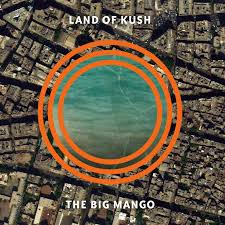 Osama Shalibi is how Sam Shaibi is credited on this album. He is the composer and creator of The Big Mango, although he does not appear on it.
Some background that may or may not be useful. This comes from Popmatters:
“Big Mango” is the nickname for Cairo and The Big Mango is a love letter from composer Osama (Sam) Shalabi to his new home, Cairo, and all of its tumults and contradictions…. Reveling in free-jazz noise, rock rhythms, and the radical propulsion that Shalabi encountered on trips to Dakar, Senegal, the album weaves the divine spirit unleashed through fury and joy and dance into an utterly fascinating whole… This pinging between controlled pandemonium and something beautiful, strident, transcendent, is not accidental. Shalabi is tackling the nature of change and the place of women in Arab culture on Big Mango, and by so clearly blurring the strange and the celebratory, he suggests that even sweeping, radical change need not be a revolution, but perhaps a way of life, movement as vital force in the universe.
With an introduction like that it’s hard not to want to love this record. But a with everything Shalibi does, he is always trying to push boundaries and attitudes. And so, this album has some songs that are really fun ad/or pretty and some songs that feel like (but apparently are not) wild improvisations that test the limit of your patience for experimentation.
As I mentioned, Shalibi doesn’t play on this –I would have loved to hear his oud, but instead we hear all kinds of interesting Western and Eastern instruments: setar (is a Persian version of the sitar), flutes, saxophones, piano, balafon (a wooden xylophone), hand drums: riqq (a type of tambourine), darbuka (goblet drum), and tablas (like bongos) and of course, guitars and bass.
“Faint Praise” opens the disc with 3 and a half minutes of Middle Eastern music quietly played with a rather free form vocal over the top. The vocals are a series of wails and cries (and almost animalistic yips). It sounds like an orchestra warming up, and indeed, the Constellation blurb says:
These opening six minutes are an inimitable destabilizing strategy of Shalabi’s – his lysergic take on an orchestra ‘warming up’ – that serves to introduce most of the instrumental voices and the montage of genres that will form the rest of the work
It comes abruptly to a halt with “Second Skin,” a much more formal piano piece—structured notes that end after a few minutes only to be joined by a saxophone solo that turns noisy and skronking and nearly earsplitting.
After some dramatic keyboard sounds, “The Pit (Part 1)” becomes the first song with vocals (and the first song that is really catchy). It begins with a jolly sax line which is accompanied by another sax and a flute before the whole band kicks in with a refreshingly catchy melody. For all that Shalibi likes exploration, he has a real gift for melody as well. The lovely lead vocals on this track are by Ariel Engle. It’s very catchy, with a somewhat middle eastern setar riff and those voices. When the song stops and it’s just voices, it’s really beautiful. The song is 7 minutes long and I love the way the last 30 seconds shift gears entirely to a more dramatic, slower section. This section is so great, I wish it lasted longer.
“The Pit (Part 2)” is only two minutes long. It’s a quiet coda of piano and flute. After about a minute, a low saxophone melody kicks in, it is slowly joined by other instruments and Engle’s voice. Unfortunately I can’t really tell what she’s singing, but it sounds very nice.
“Sharm El Bango” is a jazzy song with hand drums and all kinds of space age samples spinning around the song. I really like when the flute melody takes over and the song become quite trippy.
“Mobil Ni” is the second song with vocals. It begins with some strings instruments and hand drums over a slow bass line. Then Katie Moore;s voice come s in with a gentle lovely vibrato. Her voice is a little smoother than Engle’s. The song ends with a mellow section. And then there’s a trumpet blast that signals the beginning of “St. Stefano.” The trumpet gives way to brief explorations off free-jazz type before turning giving way to a bowed section with resonating bass notes.
“Drift Beguine” returns to catchy territory with a full Middle Eastern musical phrase and Elizabeth Anka Vajagic’s lovely voice raging from high to scratchy and breathy. Around 4 minutes when the pace picks up, it’s really quite fun.
The final track is the only one that really rocks. “The Big Mango” has a big catchy guitar riff and hand drums filled in by Molly Sweeney’s rock vocals. The song ends the disc as a kind of fun celebration.
As with most of Shalibi’s releases, it’s not for everyone. But there’s a lot of great stuff hear, if you’re willing to experiment.
[READ: August 25, 2016] “Don the Realtor”
I hate to contribute anymore attention to Trump. But it’s hard to pass up a chance to read Martin Amis, especially when he eviscerate his targets so eloquently. Hopefully Trump’s voice will soon disappear from the airways and we can go back to forgetting about him.
Ostensibly this is a review of “two books by Donald Trump,” The Art of the Deal (1987) and Crippled America (2015).
Amis begins, as he usually does, by getting to the point: “Not many facets of the Trump apparition have so far gone unexamined, but I can think of a significant loose end. I mean his sanity: What is the prognosis for his mental healthy given the challenges that lie ahead?”
Some basic questions come up about Trump: “Is his lying merely compulsive, or is he an outright mythomaniac, constitutionally unable to distinguish non-truth from truth. Amis adds that “Politifact has ascertained that Donald’s mendacity rate is just over 90 percent, so the man who is forever saying he ‘tells it lie it is’ turns out to be nearly always telling it like it isn’t.”
But the Trump lying machine has grown from the rubble of the G.O.P. which “has more or less adopted the quasi slogan ‘there is no downside to lying.'” (more…)


 I Just Read About That...