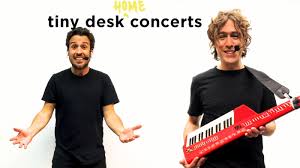
 SOUNDTRACK: COPLAND HOUSE: Tiny Desk (Home) Concert #110 (November 13, 2020).
 Every Tiny Desk (Home) Concert is unique. But this one seems extra special.
the desk – and the home setup – for this performance beats them all. The location is the home, and not so tiny writing desk, of Aaron Copland, America’s beloved composer.
Copland, who would have turned 120 on Nov. 14, gave us Appalachian Spring, Fanfare for the Common Man and Rodeo, among many other works that helped define a singular American sound.
These pieces are familiar to anyone who has listened to any classical music anywhere (or Emerson, Lake & Palmer). But these three pieces were ones I didn’t know at all.
The set begins with one of the composer’s earliest pieces in a jazzy vein.
The piece is called “Three Moods: III. Jazzy.” It is an upbeat, yes, jazzy, bouncy piano piece. That last all of 80 seconds. It is indeed, as Michael Boriskin says, delectable.
Michael Boriskin plays Copland’s own piano. He’s the artistic and executive director of Copland House, located an hour north of New York City in the lower Hudson River Valley. What was once Copland’s home is now a creative center for American music.
Up next, Boriskin plays a duet with violinist Curtis Macomber.
The Violin Sonata that follows embodies America’s wide open spaces, filled with possibilities.
“Sonata for Violin and Piano: I. Andante semplice – Allegro” is the only major piece Copland wrote for violin. It is sombre and pretty, with a kind of back and forth violin and piano. There’s lots of lengthy, slow, almost mournful violin parts.
Macomber departs and is replaced by flutist Carol Wincenc. They play “Duo for flute and piano: II. Poetic, somewhat mournful; III. Lively, with bounce.” Those descriptors are part of the title and also describe how the music is to be played. This piece
was actually written at the very desk seen in this video.
The first part is slow and sad, while the second one is much more fun and bouncy. The middle of the second part has a a sow staccato dialogue between the flute and piano. There’s a fun moment where the flute and piano play the exact same very high note and the sound is really unusual.
I found these pieces to be less engaging than his more famous pieces. But maybe that’s just because I am much more familiar with them.
[READ: December 9, 2020] “Parade for the Dead and Dying”
This year, S. ordered me The Short Story Advent Calendar. This is my fifth time reading the Calendar. I didn’t know about the first one until it was long out of print (sigh), but each year since has been very enjoyable. Here’s what they say this year
You know the drill by now. The 2020 Short Story Advent Calendar is a deluxe box set of individually bound short stories from some of the best writers in North America.
This year’s slipcase is a thing of beauty, too, with electric-yellow lining and spot-glossed lettering. It also comes wrapped in two rubber bands to keep those booklets snug in their beds.
As always, each story is a surprise, so you won’t know what you’re getting until you crack the seal every morning starting December 1. Once you’ve read that day’s story, check back here to read an exclusive interview with the author.
It’s December 9. Kelly Luce, author of Pull Me Under, can always pull a quick U-turn if she misses the exit. [Click the link to the H&O extras for the story].
I love how this story started in a kind of surreal location and then did a U-Turn and wound up in an even more surreal place.
Palmsville, Florida, has decided to have a parade for the dead and dying. The floats were from various hospitals. County supplied four bodies from the morgue to ride on the back of one of the floats. Mount Sinai putthree geriatrics (and their ventilators) in a convertible. (more…)


 I Just Read About That...