Feeds:
Posts
Comments

Archive for the ‘NPR/PRI/PBS’ Category

SOUNDTRACK: HANNI EL KHATIB-“Save Me” (Field Recordings, August 7, 2013).

I love when Field Recordings like this one [Hanni El Khatib Gets Saved In The Desert] are filmed outside.  For this one Hanni El Khatib and his bandmates head to the Mojave Desert where it is getting cold pretty quickly.

I’ve never heard of Hanni before, and his music is generic enough that I don’t imagine I ever will.  The acoustic guitar plays a simple back and forth chord structure to the rhythm of hand jive.  Hanni plays a series of solos on the electric guitar in between simple verses (although the line about boys in the desert seems apt).

After a misfire with the maraca–it is so loud that Hanni can’t hear himself–the other guitarist suggests he should play it more nonchalantly–like business casual.

There’s nothing bad about the song, it’s just , well, bluesy garage rock, a fairly uninteresting style.  But the setting is sure pretty

The Los Angeles singer-songwriter, on a break from touring in support of his latest album In the Dirt, gamely stripped down his loud, bluesy garage-rock sound and let the stunning backdrop of Joshua Tree National Park provide the drama.

[READ: January 9, 2017] “The Gospel According to García”

This story was short and was packed full of so much.  Especially since Garcia wasn’t even present.

The story is told in second person past as a classroom full of kids watch a man come in.  There are 12 students on the verge of failing.  Seven are seniors.  The man seemed to falter a he walked into the room.

The kids knew this was his first mistake–allowing them to size him up.

He sat down where García used to sit, just like that, as if he had the right to do so.

He tried to get them to speak–maybe we should introduce ourselves–but they said nothing.  He tried to make a joke about breaking the ice, but no one responded. (more…)

Read Full Post »

SOUNDTRACK: ELI KESZLER & SO PERCUSSION-“Archway” (Field Recordings, July 12, 2013).

This Field Recording [Eli Keszler & So Percussion: Making The Manhattan Bridge Roar And Sing] takes place under the Manhattan Bridge. Installation artist and drummer Eli Keszler wonders, When does an instrument become a sculpture?  Or can it become something architectural?

I didn’t know Eli, but I know his partners Percussion [Eric Beach, Josh Quillen, Adam Sliwinski and Jason Treuting] from a fantastic Tiny Desk Concert.  But this was my first exposure to them in the real world.  Their combination of crotales and big strings is at once bizarre, otherworldly, interminable and very cool.

There is magic in pure sound. And few know that truth as well as the quartet called So Percussion and the installation artist and drummer Eli Keszler — artists who, before this spring, had never met. We thought that they might find kindred spirits in each other.  So as a matter of artistic matchmaking, we at NPR Music decided to invite them to meet and collaborate on a new work that would have its world premiere at Make Music New York, the annual summer-greeting festival of free outdoor concerts across the city. And along the way to creating a world premiere, they brought a New York landmark in as a sixth instrumental partner: the Manhattan Bridge. They named their piece Archway.

So Percussion says that they wrote this piece just for the installation.  The drummers are present at their drums, but what about the rest?

Using a scissor lift, Keszler and an assistant began the long process of fastening piano wires attached to two large weighted boxes to the tops of lampposts near the DUMBO Archway beneath the bridge. More wires stretched from one of the lampposts up to the Manhattan Bridge itself.

The piece juxtaposes light otherworldly rings and deep resonating, almost mechanical lows.   Complete with occasional drum smacks.

By the time that their performance rolled around at 6:30 PM, Keszler and So Percussion created fascinating layers of sound. The shimmering, nearly melodic lines produced by bowing small cymbals called crotales offset sharply articulated snare drums and the grunting roars, squonks and groans of the piano wire installation. It was urbane and thoroughly urban music for a signature city setting.

And so for about 11 minutes you get a combination of low grunting sounds–the engines or the wires?–and chiming crotales.  Occasional snare hits punctuate the sound.

It starts with the mechanical sounds and the sounds of the crotales reverberating.  About 3 minutes into the piece a snare drum and rhythm is added, but very minimally and only for a instant.   Around 4 minutes the drummers start adding more percussive and less tonal sounds, but that is brief and soon enough everyone is doing his own thing, while Keszler plays a very jazzy style of drum on the drum and crotales.  Others are hitting snares and sides of drums.

But by the 10 minute mark it is a full-on drum solo with the gentlest/flimsiest drum sticks around–making little taping sounds (but a lot of them).

I feel like not enough is made of the piano wires –I would love to hear more from them.  I assume that in a live setting all of the cool sounds (ones that become more audible around the 10 minute mark are just reverberating around and around the arch–something that even the best mic’s can;t pick up adequately.

It’s still neat to watch, though.

[READ: January 28, 2008] “The Only Sane Man in a Nuthouse”

This is an excerpt from And the Hippos Were Boiled in Their Tanks, a novel he wrote with Jack Kerouac.  They alternated chapters.  It was written in 1945 but unpublished until 2008.

On a Wednesday night, he went out with Al, Ryko and Phillips.  Agnes didn’t want to join them–she was broke–some people have some pride.  He joked at Philip that he was an artist so he didn’t believe in decency, honesty or gratitude.

They went to diner and a movie and then went to MacDonald’s Tavern, which is a queer place and it was packed with fags all screaming and swishing around.

The rest of the story is a tale of an older gay men checking out the younger men, straight men howling for women, and men hitting on anyone that moves. (more…)

Read Full Post »

SOUNDTRACK: THE CIVIL WARS-“Kingdom Come” (Field Recordings, November 8, 2012).

I discovered The Civil Wars after they had broken up.  Which is such a shame as they make such beautiful music.

They were Joy Williams and John Paul White and

the two [had] built a gentle, harmony-rich folk-pop sound in which warm chemistry more than counteracts the tension under the music’s surface. Though not a couple themselves — each is married, and Williams just had a baby — they convey many hallmarks of a loving union, particularly in the way she stares at him sweetly as they sing.

That staring is really uncanny–she seems so happy with him.  So it is amazing that at the time of this airing

Williams and White announced that they’ve canceled all of their tour dates in response to “internal discord and irreconcilable differences of ambition.” This, naturally, has fueled talk of a breakup — the assurance that “our sincere hope is to have new music for you in 2013” doesn’t specify whether that music would be made together or separately — which is a pretty crummy development

This Field Recording [The Civil Wars: A Song Of Loyalty, Before It’s Tested] was done in (presumably) happier times — during the Sasquatch! Music Festival in George, Wash.

The pair sing in a field of grapevines.  Just as John Paul arrives, the wind picks up incredibly, almost comically.

Amazingly, given the setting, this song sounds fantastic.  I love that you can hear whistling wind faintly (it might even be cooler if the wind was a bit louder).  But you can see the grapevines (and their hair) blow as the wind picks up.  But their voices and guitar sound perfect.

This song, like every song from The Civil Wars is wonderful.  Their voices are just magical together.  Even if there’s not a lot going on musically (it’s a single guitar although the melody is great), it’s the way they loop their voices together that is just out of this world.

I love them on record, and they sound even better here–White just lets his voice soar at one point and it’s fantastic.

[READ: January 12, 2017] “Back the Way You Went”

I was really puzzled by this story.  I couldn’t tell if it was one story with three parts or three separate stories.  I hoped it was three separate stories because the three pieces don’t seem to go together at all.  But at the same time, the internal parts of each story isn’t entirely coherent either.

Garland
D and F take a woman with them on a weekend getaway.   The woman’s mother recently died.  They go to a honeycomb.  Bees stream through the streets and the night.  D and F are bees too.

But they aren’t, of course.  Because the next day they ride bikes (the woman never learned and is quite bad at it).

Years later she wonders “what it was like for D and F to be thugging her around.”  Thugging?

The next paragraph is a flashback and is a good one.  But each paragraph seems to be separated from each other.  The title appears in the body.

Mexico
In this part “they” go to visit Dad in a home.  He is  in a room with a man whose eyelids don’t close–doctors don’t want to touch them in case they stayed permanently closed.

One Sunday they were coming home from visiting Dad–it was no different from any other visit. but her insides had gone bleak and dangerous. She sat in the back of the taxi thinking about an art work she saw in Mexico

The title of this piece appears in this section as well.  And, again, I enjoyed the part about the art piece and I enjoyed the way her dad tells her this bon mot, but I don’t see how they connect

Trouble in Paradise
Her mother in law Verna is four feet nine.  She feels big and bestial hugging Verna.  Her own mother was also short, but otherwise unalike. She is unlike her own mother except that they both think she needs to shop for clothes because they don’t like the way she dresses.

Vera is telling stories about her best friend Mildred who died.

But the narrator is thinking back to drying dishes with her own mother.

And then the narrator snaps out of it and asks Verna a question about Mildred which she finds quite surprising.  The ending in which she mentions the filmmaker Lubitsch, is just as puzzling as all the rest f the story(ies).

Read Full Post »

SOUNDTRACK: AMIR ELSAFFAR & TWO RIVERS-“Hemayoun” (Field Recordings, July 3, 2013).

I was pretty excited to see the start of this Field Recording [Amir ElSaffar & Two Rivers: Golden Sound In A Gleaming Space] because it begins with hammered dulcimer and oud.  I have never seen these two instruments used in jazz before.

But once the band starts the jazz pushes out he Middle eastern instruments somewhat.

The oud is certainly drowned out by the horns, but you can hear it plucking away.  And the hammered dulcimer is hardly used at all.

I had never heard of the participants although apparently

The session had the feeling of a reunion. ElSaffar — a trumpeter and santur (hammered dulcimer) player who was born near Chicago to an Iraqi father and an American mother, and who grew up immersed in both cultures — had recently moved from New York to Cairo to pursue his work with Arab classical music. But this group with Ole Mathisen on saxophone, Zafer Tawil playing oud, Carlo De Rosa on bass and Nasheet Waits on drums shifted into Two Rivers gear immediately.

At 3:49 when the sax solo starts the minimal oud is used more to keep the beat than anything.  At 5:10 the trumpet returns playing a riff with the sax.  By around 7 minutes its all trumpet and drums (some good improv) with the bassist adding rhythm but playing very hard and being barely heard.  At around 8 minutes there’s a minimal oud solo that runs through to the end of this song.  This is particularly cool, although I kind of wish the other guys didn’t drop out entirely–I’d like to see the oud share the stage with the traditional jazz instruments.

I love that the music has non-Western instrumentation but I feel like it is underutilized.  But maybe that’s not the point

 ElSaffar has found a beautiful and singular way of pairing the sibling spirits of jazz and the classical maqam system of the Arab world, with their shared spheres of improvisation, deep knowledge of tradition and urge to keep innovating. Two rivers, but they lead to the same ocean.

[READ: October 22, 2017] “The Sinking of the Houston”

O’Neill has a way with making stories amusing despite the tension underneath.

It begins with a defense of sleep. The narrator says when he became a parent of young children, he became an opportunist of sleep: “I found myself capable of taking a nap just about anywhere, even when standing in a subway car or riding an escalator.”  But when the boys grew up into “urban doofuses neurologically unequipped to perceive the risk incidental to their teenage lives,” sleep became much harder to get.  He would lie awake until they were all home, and then every sound in the house would be meaningful.

Then comes the phenomenon of Dad Chair, a black leatherette armchair which he has designated as his haven.

It has worked pretty well except when the boys disrupt the peace.

The middle son asks if he’s heard of Duvaliers, the dedicators of Haiti.  The dad says he knows all about them–they were horrible.  When the boy tries to tell him more details, he retorts: “I lived through it ! I don’t want to discuss it!”  The boy logically says you didn’t exactly live through it.

Another son asks where East Timor is.  They all want to talk about atrocities.  But he has a new philosophy–Cest la Vie–it works pretty well. (more…)

Read Full Post »

SOUNDTRACK: BILL CALLAHAN-“Small Plane” (Field Recordings, November 11, 2013).

Many episodes in the Field Recordings series travel far and wide to exotic locations.  For this Field Recording [Bill Callahan Sings ‘Small Plane’ In A Serene City] Bill Callahan travel to exotic downtown New York City.

When we first approached Bill Callahan to do a Field Recording in New York City, we asked him if he had any special place in mind. His reply surprised me: “A community garden.” I guess I’d stereotyped him in my head, because after all those years of dark, thoughtful songwriting — first as Smog and then on the pensive records he’s made under his own name — I’d imagined a library, someplace quiet and dark.

The video starts with the hustle and bustle of the city and then slowly moves into a quiet, peaceful garden, complete with a pond (and turtles jumping into it), birds, tomatoes, and a microphone.

As it turned out, the brightly lit 6th & B Community Garden, with its lush greenery and mellow wildlife, provided just the right setting. The noise of cabs, buses, trucks and the occasional siren wound up punctuating Callahan’s calm, deep baritone, but he makes it easy to ignore.

He sings about being a lucky man flying this small plane.  And he setting compliments his contentment.  It’s just him and his quiet electric guitar and all is well.

[READ: October 26, 2018] “Waugh”

Last week’s New Yorker story was called “Flaubert Again.”  This week’s is called “Waugh.”  The last one was tangentially about Flaubert but this one is (as far as I can tell) not about Evelyn Waugh at all.

This was one of those fascinating stories that was very simple but in which all of the details about the story were so vague that I couldn’t figure anything about it for many many pages.

This is a story of five unrelated boys who live together–they all pull tricks to make rent.  Rod was their defacto leader–not their pimp exactly, because he tricked too, but more like an elder watchmen.  He was tough and very strict.  You could be kicked out of the house for many infractions, and at the first sign of Sickness.

I assumed that this story was set in the 1970s in San Francisco.

Then one of the boys is named Google, so clearly it can’t be set in the 70s. (more…)

Read Full Post »

SOUNDTRACK: WILD BELLE-“Love Like This” (Field Recordings, June 26, 2013).

This Field Recording [Wild Belle: Reggae-Tinged Romance Amid The Big Bikes] is set in the El Segundo-based South Bay Customs motorcycle shop.

It doesn’t seem totally appropriate for the keyboard driven pop of Wild Belle, but there’s something about singer Natalie Bergman’s voice–a little gravelly, a hushed kind of whisper that seems apt.

Wild Belle singer Natalie Bergman seemed a bit confused upon the band’s arrival. … But once we walked past the front doors, we quickly realized that this wasn’t your everyday L.A. bike shop. South Bay’s walls are lined with eccentric oddities, and the facility also houses an art gallery and a performance space for local musicians.

So it was fitting that in a coincidental twist, she told us that she’d be embarking on a motorcycle ride across the Midwest with a close friend in the next month.

“Love Like This” certainly has a reggae-tinged vibe.  I especially like the interesting echoing guitar sounds.  It’s got a catchy chorus, but the whole song seems to have such a relaxed vibe that it makes me laugh to here her nonchalantly sing

My heart’s on fire
You light me up, and I can’t cool down
Your love is wild
You’re dangerous

The song picks up and is certainly catchy.  And while I do actually like her voice, I can’t imagine more than one song from them.

[READ: February 6, 2018] “A New Paradise, or a New Hell”

This is an excerpt from the novel Death with Interruptions. It was translated from the Portuguese by Margaret Jull Costa.

It is a fascinating story with existential implications. Although I cannot imagine how this could be stretched into a novel.

On the first day of the new year, no one died.  In the whole country, not a single person died the whole day.  It was unprecedented.  There were many accidents, several life-threatening, bit no one actually died.  It was especially noticeable because the venerable queen mother who was known to be on the verge of her last breathe also did not die. (more…)

Read Full Post »

SOUNDTRACK: BRANDEE YOUNGER-“Hortense” (Field Recordings, June 6, 2013).

I had never heard of anyone playing jazz harp before.  At first I thought that it was just going to be harp music with an upright bass giving it a jazzy feel, but no.  Younger is playing a beautiful lead melody on the harp while Dezron Douglas’ upright bass adds a real boho jazz element.  Basically, this is in no way new age harp music.

But this Field Recording [Brandee Younger: Taxidermy, Two-Headed Skeletons And Jazz Harp] seems to get more than a little distracted by its surroundings.  And who can blame the filmers?

Among the vestment racks, satchel purveyors and art galleries of New York’s SoHo neighborhood lies a small merchant unlike its neighbors. It’s called The Evolution Store, and it peddles, um, natural-history collectibles. You know, preserved insects, taxidermy, skulls and bones, remnants of marine creatures. It’s as if a museum ran out of space and started putting its sloths and tarantulas in the gift shop.

We’re not quite sure what any of this has to do with Brandee Younger [who doesn’t know a sloth when she sees one], though she is a rare breed in her world: a jazz harpist.

A bit more about Younger:

She’s classically trained, and plays her share of freelance and wedding gigs — in her C.V. are recordings for rappers Common and Drake — but like predecessors Alice Coltrane and Dorothy Ashby, she’s also developed a way to improvise and truly groove on the harp.

I really enjoy the minimalism of this piece.  I am quite fond of the harp. So I’m intrigued to read:

With a full band, the song heard here, “Hortense,” takes on a distinct Caribbean bounce, a one-drop reggae beat anchoring Dezron Douglas’ bass line. Stripped down to a duo, it wafts and glides, all arpeggios and plucked wires.

I’m not sure I would enjoy the full band version as much, so I’m glad I got this one–bizarre as the surroundings may be.

[READ: January 25, 2018] “Willows Village”

This is the story of Guillermo, call him Billy, who has moved to Santa Ana to live with his Aunt Maggy.  Billy has a wife and a child in El Paso, but he doesn’t have a job and he thought he could move to a more wealthy part of the country, get a job and send a lot of money home to his family.  His Aunt Maggy is his mother’s sister and while he has heard a lot of gossip about her, he will still ask for the favor of her hospitality.

He hasn’t seen her in years and he is surprised at how good she looks–she’s actually pretty hot, which he finds disturbing but true.  And she welcomes him with open arms.  She gives him a room and whatever food or drink he wants.

Maggy proves to be quite the character  She drinks.  A lot.  She has a ton of money–when she opens her purse to pay a delivery guy, money just falls out of it.  And she seems to eat one bite  of food and store the rest in the fridge, until it spoils.

She tells Billy that Lorena is also staying with her.  She is a good friend and has been having marital trouble, so Maggy put her up in the guest room.  She put Billy–Guillermo she will call him–in her “playroom,” a pink room with dolls and make up boxes and photos.  It was weird. (more…)

Read Full Post »

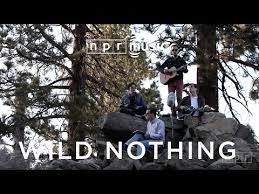
SOUNDTRACK: WILD NOTHING-“This Chain Won’t Break” (Field Recordings, May 31, 2013).

I cannot get over how disconcerting the opening of this Field Recording [Wild Nothing: Nuanced Pop At 8,500 Feet] is.

The band Wild Nothing, whom I do not know, is shown climbing a mountain, with the caption that they are climbing to more than 8,500 feet above sea level (on a tram).

The band is out in the middle (well actually on top) of nowhere.  They are in a beautiful location on top of a mountain.  And the first thing you hear is a cheesy electronic drumbeat.  How disappointing!  Especially since you see they have a makeshift shaker on hand.

But lets enjoy the view.

When most people think of Palm Springs, visions of softly baked desert landscapes come to mind. However, upon arriving at the Palm Springs Aerial Tramway, we were warned that the temperature differential between the desert and the top cliff of the Chino Canyon was about 30 degrees — cold enough that it would require warm clothing and an adventurous spirit. But Wild Nothing singer-songwriter Jack Tatum and his tour players were game to load onto the rotating tram car and ascend to more than 8,500 feet above sea level.

Abandoning extraneous gear at the Tramway landing, both the band and our crew hiked down into the San Bernardino National Forest and then up onto a side of the Mount San Jacinto peak. With rapidly freezing hands, the band performed its song “This Chain Won’t Break” for this Field Recording with a stripped-down assortment of instruments (two guitars, an amplified iPad, a bunch of dried tree pods turned into a makeshift shaker), giving this ode to a challenged relationship a much more nuanced, somber feel.

Despite the electronic percussion, the song itself is quite lovely.  The chord changes are nice and the their vocals meld nicely.

Once our feet were solidly back on the desert floor, the members of Wild Nothing were surprised to come across a group of fans who’d recognized the band from its recent Coachella performance. We toasted the chance meeting with some local wine and a random piece of sheet cake — and took the requisite Instagram pictures — before setting out for warmer climes.

[READ: January 7, 2017] “Who Will Greet You at Home”

I have no idea what the cultural significance of this story is.  I don’t know if some people could relate tho this, but I certainly couldn’t.

Ogechi is a woman who works a lousy job in a hair salon.  She had a fight with her mother and has not seen her in about a year.

And she has just made a baby out of yarn.

The yarn baby made cooing gurgles and other sounds until Ogechi caught it on a nail and it unraveled.

She knew that a yarn baby was risky, but she made one out of yarn anyway,

When she got to work, Mama, the owner of the hair salon demanded payment.  For it was Mama who blessed the yarn baby into existence.  But they both knew that Ogechi couldn’t pay her with money, so instead, Mama took some of Ogechi’s joy. (more…)

Read Full Post »

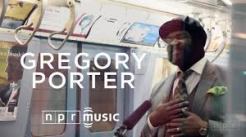
SOUNDTRACK: GREGORY PORTER-“Be Good (Lion’s Song)” (Field Recordings, May 14, 2013).

The still from this Field Recording [Gregory Porter: A Lion In The Subway] certainly led me to think that Porter would be singing on an actual moving train car (the ambient noise would be IMPOSSIBLE to filter out).

Of course, it wasn’t the most practical (or legal–bands and other musical acts need to audition to even set up underground. And those are just the “official” performers) thing to actually get Gregory Porter to perform on an operational MTA train. So we asked him if he’d perform for us at the New York Transit Museum in downtown Brooklyn, a collection of vintage memorabilia and reconditioned cars housed in a former subway station. All the better: Porter has a way with vintage suits, and there was a fortunate coincidence about the way it all felt right among the period-specific ads which flanked him. Accompanied by pianist Chip Crawford — who perfectly punches and beds the gaps here — Porter sang his original “Be Good (Lion’s Song),” a parable of unrequited affection.

The only thing I know about Gregory Porter comes from his Tiny Desk Concert.  I marveled that he wore a hat with ear flaps the whole time.  Well, he does the same thing during this song.

Gregory Porter has the frame of a football linebacker — maybe because he once was one, for a Division I college — and the rich, booming voice you might expect from a guy with such lungs. It cuts through a crowd with its strength, in the manner of an old-school soul singer; it demands attention with its sensitivity. If Porter weren’t winning over the international jazz club and festival circuit, he’d rise above the din wherever he went.

This is a sweet, quiet song, befitting him and the location.  The lyrics are a clever metaphor about lions and love.

[READ: October 22, 2017] “Scared of the City”

This is an essay about being white in New York City.

Franzen says that in 1981 he and his girlfriend were finishing college and decided to spend a summer in New York City– a three-month lease on the apartment of a Columbia student on the comer of 110th and Amsterdam.  It had two small bedrooms and was irremediable filthy.

The city seemed starkly black and white “when a young Harlem humorist on the uptown 3 train performed the ‘magic’ act of making every white passenger disappear at Ninety-Sixth street, I felt tried and found guilty of my whiteness.”

A friend of theirs was mugged at Grant’s Tomb (where he shouldn’t have been) and now Franzen was morbidly afraid of being shot.  The impression of menace was compounded by the heavy light-blocking security gates on the windows and the police lock on the door.

Franzen made some money when his brother Tom came into the city to do some work for hot shot photographer Gregory Heisler at Broadway and Houston.  Franzen was a gopher and made trips around the Bowery and Canal Street but he knew not to go to Alphabet City. (more…)

Read Full Post »

SOUNDTRACK: CAYUCAS-“High School Lover” (Field Recordings, May 9, 2013).

Five clean-cut California dudes, wearing sunglasses, sitting buy the pool.

This image calls a certain band to mind, but this is not that band.  This is Cayucas (whom I have never heard of).  For this Field Recording [Cayucas: Sunlight In Song Form], the five piece was filmed at the Ace Hotel in Palm Springs.

Rather than super catchy melodies and lovely harmonies, Cayucas sings “laconic pop-rock.”

Sitting poolside on a picnic table, the band performed its bittersweet single “High School Lover” with only an acoustic guitar and light percussion for accompaniment. In any form, the song isn’t all sunshine — its youthful nostalgia gets filtered carefully through the prism of regret — but this performance is plenty bright, as Cayucas’ members locate their best-known song’s laid-back heartbeat. “High School Lover” provides a perfect soundtrack to the shimmery leisure that surrounds the band on all sides here. But it also leaves room on the agenda for hints of sadness and sunburn.

I don’t know what their recordings sound like, but this stripped down version is certainly low-key, bordering on uninspired–particularly the “heys” at the end.  It sounds like a Weezer outtake.

Although the guy dancing is certainly an enjoyable visual component.

[READ: January 4, 2017] “An Honest Woman”

I found this story to be more irritating than anything else.

I think that’s maybe the point?  But I was sort of annoyed by it the whole time.

Simply put, this is the story of an old man hitting on a young woman who has moved in next door to him.  It’s told from the point of view of the old man.  And yet he is shown as pretty much the predator right from the start.  I had no sympathy for him at all.  And again, I assume that’s the point, right?  If there was meant to be any empathy for the guy, it did not come through at all.

Having said that, this story was just frustrating.  Jeb is an old man (he used to be a redhead but is now white-haired).  He lies in a small house with a dirt backyard.

Next door a young woman moves in.  She had a guy living with her, but he hasn’t been around for a while.  So Jeb makes his move. (more…)

Read Full Post »

« Newer Posts - Older Posts »