Feeds:
Posts
Comments

Archive for the ‘NPR/PRI/PBS’ Category

SOUNDTRACK: BETTY WHO-Tiny Desk Concert #861 (June 26, 2019).

I had never heard of Betty Who before this show and my word did she win me over.  She is so much fun, so entertaining that it makes me want to explore her music (and maybe even see her live show).

However,  Betty Who is an Australian cellist who plays dance pop music.

Her third LP, Betty, falls squarely in the … sun’s-out, buns-out pop genre.

I suspect that as with most of the pop stars who play quietly at Tiny Desk, I will probably much prefer these version to the original–so maybe I should just leave it here.

Some background

She grew up in Sydney, Australia, and started playing [cello] at the age of four (just like Yo-Yo Ma). Maybe it had something to do with her mom being in the room, but emotions ran high for the charismatic and chatty singer. “I didn’t want to be the girl who played cello and sang,” she told the crowd gathered to watch. “‘Cause that girl feels really far away from ass-out, sparkle-covered pop-star me.”

I would not have guessed her pop star ambitions as the first song starts with just her voice and cello.

When all the studio production is stripped away, what’s left are intricate melodies that soar through Betty’s impressive vocal range and relatable lyrics. As the audio engineer for the Tiny Desk concert series [Josh Rogosin], I’m always curious how the vocals will translate without the aid of pitch correction and tons of effects you hear on the album. I’m a sucker for great melody and Betty Who’s raw vocal performance at her Tiny Desk had me in a state of aural ecstasy.

It sounds fantastic.

She plucks the cello for the beginning.  She has a terrific voice, although she sings a little too pop for my full appreciation.  After the first verse, Myla Bocage adds some keyboard notes to flesh out the song.  After another verse, Jemila Dunham adds some cool bass lines.  Her bass throughout the show is pretty excellent.

After a chorus or two, she throws in a bowed cello solo which works perfectly (and sounds great of course).

After the song she is so bouncy and bright and energetic.

She tells us that she always wanted to be a pop star–she likes sparkles and have her ass out.  She wanted to be the love child of Beyonce and Britney Spears.  But she studied classical music since she was little.  She says, “I told myself I would commit to pop star life and dance and do what I always wanted to do and make that vision come true.  And then one day I’d just whip out my cello and say oh P.S. By the way.…  And this is the first time I’ve been able to do this.”

One of my favorite things about Tiny Desk concerts is that artists are often inspired to experiment. Betty Who was in town recently for a three-night residency at D.C.’s famed 9:30 Club where her sound was larger than life. The subwoofers cranked out backing tracks you could feel in your gut and dancers flanked the pop star, punctuating every pulsating beat. But she began her Tiny Desk performance with only her cello and her voice — the first time she’s ever accompanied one of her original songs with the instrument.

Song two is “Friend Like Me,” which is one of her favorite songs she’s written.

She wanted to wrote a song that said, I love you but you make me fucking crazy and I want to punch you in the face or I love you so much but you’re your own worst enemy and you’re taking yourself down.

It’s just her on the acoustic guitar and her voice is really lovely (less loud and poppy)  After a couple of verses Bocage adds some keyboard twinkles.  Some bass fleshes out the song, but it remains a very pretty ballad.

Before the final song, “I Remember,” she introduces the band and says “Ian Barnett on the [drum] pad.  You should come see us, he does much more than this.”

Betty Who says she dreamed of having a Tiny Desk concert ever since she was a teenager. She chose to end hers by asking everyone to sing along to the track, “I Remember.”

Dancing under the stars
Kissing you in the dark
I remember your love, oh
Never giving you up, giving you up, oh.

I love that she gives hand motions and massive encouragement as she teaches everyone the words.  She says she has three plants in the audience.  They’re going to sing loud and you can all mumble along if you want.

She says this song is about real couples “not kind of Instagram we love each other so much.  People who don’t fight, ick, what is that.  The best couples know each other the best and can push each other’s buttons.  It’s an amazing feeling to love someone so much but also want to strangle the life out of them,  They make you the most crazy, but that’s what makes you love them so much.

Betty’s reaction to their singing is wonderful.

She’s great and I hope she starts selling bigger venues.

[READ: July 1, 2019] “Bad Dream Job”

The Summer 2019 issue of The West End Phoenix was a special all comics issue with illustrations by Simone Heath.  Each story either has one central illustration or is broken up with many pictures (or even done like a comic strip).

Each story is headed by the year that the story takes place–a story from that particular summer.

1978: Dave Bidini got his first job working in a record store at the Albion Mall (made famous (to me) in the Rheostatics’ song “Jesus Was Once a Teenager Too”).

It was a dream job–that’s where he bought his 45s and LPs.  It was right across from an Orange Julius! (more…)

Read Full Post »

SOUNDTRACK: SAINT SISTER-Tiny Desk Concert #863 (July 3, 2019).

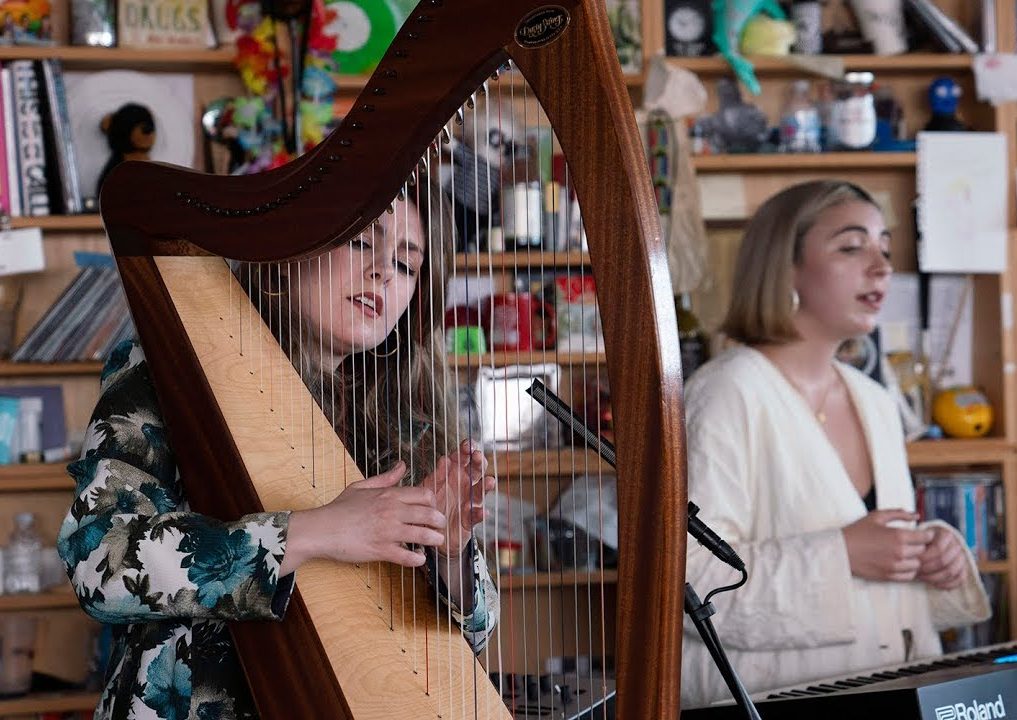
The first surprise from Saint Sister is the harp.  The second surprise comes when you realize that Saint Sister’s music isn’t going to be traditional harp-centric folk songs.

The third is when Morgan Macintyr speaks after the first song and she has a pretty heavy Irish accent.

It’s a surprise because their voices are angelic and accent-free while they sing their pretty songs.

Saint Sister makes the sort of music I’ve been fascinated with for much of my life, music that mixes the organic with the electronic. In this case, the organic sounds come from that Dusty Strings harp and the harmonies of Gemma Doherty and Morgan Macintyre, with electronics performed on keyboards by Morgan and Dek Hynes, and the mostly digital drums of Shane Gough.

So, yes, even if the harp is the centerpiece (“[when] Gemma Doherty pulled her 34-string lever harp from the band’s vehicle; it seemed bigger than all of us”) the rest of the band fleshes out the harp with waves of synths and percussion.

Causing Trouble” opens with single harp notes and echoing drums.  Then Gemma and Morgan start singing and their voices blend beautifully.

You can tell the Irish connection in the lyrics of this song:

We danced from Belfast to the Basin
When you sang, “And it stoned me”
Well it stoned me

“Shape of Silence” is a short instrumental made up of unearthly sounds and voices as Gemma plays a lovely harp melody.  It’s about a minute long and segues into “Is It Too Early? (Kilmainham).”  They sing in a kind of staccato style (and remind me a bit of Lily & Madeleine here).  There’s no much harp in the verses–it’s almost a dance song, but when the synths fade off, the harp returns and sounds even lovelier somehow.

For “The Mater” Dek and Shane leave so it is only Gemma and Morgan.  This song is quieter with just the harp and their voices.

Although the melding of harp and electronics is cool, they sound beautiful with just harp and voices.

[READ: July 1, 2019] “The Not-Okay Corral”

The Summer 2019 issue of The West End Phoenix was a special all comics issue with illustrations by Simone Heath.  Each story either has one central illustration or is broken up with many pictures (or even done like a comic strip).

Each story is headed by the year that the story takes place–a story from that particular summer.

This story is told in comic book style with panels.

1976: If you are Janet, when you are ten years old, the worst thing about horseback riding camp is the horses.  They are massive and muscular and totally in charge.

Much of the camp seemed to be about teaching the horse who was boss. When the kids were told to walk the horses around the ring, that was okay, even if Janet was clearly letting the horse lead.  But when they left the ring to return to the paddock, the horse let Janet know who was actually in charge.  It stopped following the horse in front of it and stopped to eat some grass. (more…)

Read Full Post »

SOUNDTRACK: LARAAJI-Tiny Desk Concert #846 (May 2, 2019).

Who is Laraaji?

I had no idea, and yet, it seems like I should.

40 years ago … Brian Eno produced an ambient album of his music called Ambient 3: Day of Radiance as part of a series of ambient records from Eno that began with 1978’s Ambient 1: Music for Airports. Edward Larry Gordon, now known as Laraaji, was a comedian as well as a musician. I suppose that explains the laughter as part of his meditative and therapeutic music. Laraaji is now in his mid-70s, has released over 50 recordings as well as an abundance of sound-healing sessions.

Laraaji and his musical partner Arji “OceAnanda” Cakouros (“draped in loose-fitted, saffron-tinted clothes, with a table draped in a similar orange fabric — almost the tones of a setting sun”) play an uninterrupted 15 minutes of chillout, which they call “12345678…”

It begins with a small bell, a set of tiny wind chimes and a plucked, angelic zither sounding much like a harp.

Laraaji plays the electric autoharp/zither and has a cool swirling echoing effect on it.  Meanwhile OceAnanda has all manner of percussion at her disposal, including, chimes, shakers, and most surprising, and iPad synth (but that comes later).

The opening is incredibly soothing with just chimes and the autoharp  Laraaji uses a pick and his fingers to create notes and chords.  With the delay on it, it is incredibly chill.

After about two minutes OceAnanda plays some notes on the iPad.  Then around 3 and a half minutes Laraaji picks up drum stick brushes and begins gentle tapping the autoharp.  OceAnanda plays the kalimba, which is a little too loud, but still works nicely.

Then Laraaji began to laugh. I smiled. (His laugh is infectious). Then more of us in the office smiled as he brushed rhythms on his zither and processed the sounds to add delay and intensify the hypnotic pulse.

I agree that his laugh is infectious, but I found it so jarring that his laughter turned into him singing.  Rather than it being fifteen minutes of blissful chill out, it was now a song with words–even if the words were meaningless, or very familiar.  He sang “12345678” and “lum lum lum lum lumalum la”

But since the majority of the song has him singing over it, I soon got used to it and allowed it to wash over me as well.  But, really his voice definitely brings you out of the headspace you’ve created for yourself.  Even if his laugh is indeed infectious.

At seven and a half minutes OceAnanda starts playing a violin melody on the iPad and it works very nicely–slow and pretty with a melody that works, even if it is random.  After a couple minutes she changes the sound of the violin to a more synthy sound, which fits in even better.

With a few minutes left, OceAnanda switches to a shaker which works its own hypnotizing momentum.  And then for the end, she plays a bit more of  that violin iPad while Laraaji sings the words from “this little light of mine.”

And then it all fades and you come back to reality.

[READ: July 1, 2019] “Bacon Fat”

The Summer 2019 issue of The West End Phoenix was a special all comics issue with illustrations by Simone Heath.  Each story either has one central illustration or is broken up with many pictures (or even done like a comic strip).

Each story is headed by the year that the story takes place–a story from that particular summer.

1974: This is a short story about the summer that Michael’s family wanted to build a log cabin on a piece of land in Newfoundland.  It was a popular place and they had next door neighbors at the lake who built a log cabin in what seemed like a weekend.

His parents were from England. But his dad always wanted to be a cowboy and his mom always wanted to live in New York City.  So they settled on Newfoundland. (more…)

Read Full Post »

SOUNDTRACK: “BE MORE CHILL” Tiny Desk Concert #862 (July 1, 2019).

Be More Chill is a musical based on the YA novel by Ned Vizzini.  I hadn’t heard of the musical, but this Tiny Desk Concert makes me wish I had seen it [it closed August 11] (or that they make a movie out of it).  Or at least I’ll read the book now.

This performance was done on the night after the Tonys [June 9] where it went 0 for 1.

winding down a disappointing awards season. Even its big Tonys moment — a skit in which host James Corden parodied the musical’s breakout song, “Michael in the Bathroom” — passed by without anyone bothering to name the source material.

But you wouldn’t have known it the next morning, as the Be More Chill crew — composer Joe Iconis, all but three members of the principal cast and a handful of musicians, each of whom held a key role in shaping the musical’s sound — bused from New York to NPR’s D.C. headquarters.

Their arrival was a genuine event: For our Sesame Street Tiny Desk concert earlier this summer, we’d encouraged our coworkers to bring their young children, but this time around, we asked for their teenagers — the young theater enthusiasts in their lives, and anyone else they knew who’d fallen under the spell of Be More Chill and its pair of prolifically streamed cast albums.

All the performers seem to be having a great time (especially Lauren Marchus who is a treat to watch).

From the moment they arrived for their Tiny Desk debut, the cast and crew of the Broadway musical Be More Chill radiated kind exuberance. They posed for selfies behind the desk, shared stories from the previous night’s Tony Awards and clowned around with cast member Jason SweetTooth Williams, who’d torn a muscle in his leg 48 hours earlier and used a wheelchair to get from the charter bus to the desk and back

Joe Iconis wrote the music and plays piano. He also introduces the story of an avergae kid named Jeremy.  But there’s a thing called a squip, a supercomputer inside of a pill which tells you how to behave.  The story is how Jeremy now navigates high school.

Iconis also explains that this isn’t a show where people play instruments (like Once), but everyone in the cast CAN play an instrument, so they decided to rearrange the songs for the Tiny Desk.  In the show, the music is

set to wiry, hard-driving synth-rock music.  The show has been a true cult phenomenon, with an intense online following and one of the youngest audiences Broadway has ever seen.

So rather, for this show, there is acoustic guitar, upright bass, melodica and even a washboard.

The blurb is one of the longest and most detailed of any Tiny Desk Concerts as it provides a lot of context for the songs.

In the run-up to “The Pants Song,” Jeremy’s recently divorced dad (played by Williams), who’s been embarrassing his son by moping around the house in a bathrobe, senses that Jeremy is in trouble. So he enlists Jeremy’s newly estranged best friend Michael (played by George Salazar) to step up and intervene. As lighthearted as it is, the song conveys a powerful message about loyalty, parenthood, friendship, forgiveness and advocacy, all wrapped up in a simple mantra: “When you love somebody, you put your pants on for them.”

It is funny and really catchy and features the show’s musical director Emily Marshall on melodica, Charlie Rosen who did the orchestration on upright bass, Gerard Canonico who plays Rick on guitar and Tiffany Mann who plays Jenna Rolan with a tasty backing vocal part.

Britton Smith  washboard

A Guy That I’d Kind Of Be Into” is a showcase for Jeremy’s crush, an oddball theater kid named Christine, who’s played on Broadway by Stephanie Hsu. But Hsu couldn’t make the Tiny Desk, so she’s replaced here by the charming Lauren Marcus, who normally plays Brooke Lohst onstage. It’s a sweet song about the early flowering of romantic interest, but it’s also a wise and insightful nod to the way declarations of young love can be so guarded and tentative that they seem, by design, almost nonexistent.

This song is catchy and very funny.  It’s a wonderfully endearing song.  I can’t comment on Hsu, but Lauren Marcus is terrific.  She plays ukulele and is so visibly emotive.  She totally makes the song come alive.  Britton Smith who plays Jake also does vocals [he played washboard in the previous song].  There’s backing vocals from Emily Marshall and Will Roland who plays Jeremy.

“A Guy That I’d Kind Of Be Into” holds its emotions at arm’s length, but “Michael in the Bathroom” is an atomic bomb of teenage feelings — not to mention one of the most broadly relatable songs from any genre in recent years. The backstory is simple enough: Michael, having been abandoned by his best friend, shows up at “the biggest party of the fall,” only to sequester himself in the bathroom and practically dissolve under the weight of his alienation, self-doubt, betrayal and regret. How George Salazar didn’t get nominated for a Tony will have to remain a mystery, because his performance — like the song itself, which feels like a true standard — will be talked about for years.

George Salazar is really fantastic in this performance.  He is funny and nervous and mad and scare and his voice is terrific.  I love the little Whitney Houston musical quote.  Emily Marshall adds xylophone to the melody.

Before the finale, Iconis says that after Vizzini killed himself, Iconis was able to complete this finale in Ned’s memory.    He then notes that this is the first time they’ve done this arrangement so it could be a total train wreck.  But it isn’t.

Finally, “Voices in My Head” closes Be More Chill — and this Tiny Desk concert — with a rousing celebration of Jeremy’s return from the brink. Played by Will Roland, Jeremy seizes center stage here, taking mental inventory (“might still have voices in my head / but now they’re just the normal kind”) as the other cast members pipe up with their own commentary on his life. Above all, it’s wonderfully rousing, building to a buoyant finale.

Will Roland really impresses with his singing–especially at the end when his voice really soars. The whole cast chimes in in sequence: Jason SweetTooth Williams, Gerard Canonico, Tiffany Mann, Lauren Marcus, Britton Smith.

I really enjoyed this and am very curious to hear what the original soundtrack is like.

[READ: July 1, 2019] “Son of Friedman”

This is an interesting story of a father, a son and fame.

George was once a famous actor.  He could pick his own scripts and lived fairly large.  He had divorced twice.  He was meeting his old friend William.  He and William worked together on many projects, although William’s star never really sank like George’s did.

While they are sitting in the restaurant, George is aware that people are checking out William–but ignoring him.

When George’s son Benji was born, George asked William to be the boy’s godfather.  And he was a great godfather–he celebrated Benji and spoiled the boy.   George and William hadn’t been in touch much in the last decade because of their mismatched celebrity.

But Benji brought them together–somewhat inadvertently. (more…)

Read Full Post »

SOUNDTRACK: IMOGEN HEAP-Tiny Desk Concert #859 (June 20, 2019).

I know of Imogen Heap from a song called “Come Here Boy” that she released way back in 1998.  It was stark and dramatic and somewhat sexual. In short, a quintessential 90s track.

Then she disappeared.

Well, she actually made an album with Guy Sigsworth as Frou Frou.  And then she disappeared a again.

Actually she didn’t disappear at all. She released a song, “Hide and Seek” which was mostly just her singing into a vocoder (and was quite transfixing.  It became a huge hit (which I didn’t know about because I didn’t watch The O.C.).

But in 2011, she started experimenting with these high tech gloves that allowed her to do all kinds of audio manipulation just by moving her hands.

She even says, some people know me because I am interested in block chain technology and some people know me for these gloves.  They don’t even know I make music they just know about the gloves.

But in this Concert, the gloves come last.

Up first is the first song that she and Guy Sigsworth have written together in 17 years.  “Guitar Song” (she tends to leave placeholder names, so that will likely change) is a quiet pretty song with a lot of, yes, guitar from Steve Jones.  It’s a simple melody fleshed out with keys from Sigsworth.  It’s really pretty and very catchy.

Up next is “Speeding Cars” which she says was a B-side that was never released as a single but which her fans really love.  Zoë Keating plays cello and Imogen says she has a terrific album of her own called Snowmelt and she hopes Keating gets her own Tiny Desk someday.  Tim Keiper is on drums and vast array of percussion.  Imogen is on the piano she has an excellent falsetto for this very pretty song.

Then she puts on the Mi.Mu gloves.

Imogen Heap not only has an enchanting voice but also the talents of a world-class audio engineer. She’s completely engrossed in a technology she’s helped to develop, one that makes it possible to alter sounds, create loops and compose tunes all with the wave of her glove-wearing hands. The high-tech gloves, now called Mi.Mu Gloves, were first shown at a TEDGlobal conference eight years ago. Her performances, with her sound-altering arm and hand gestures, resemble a summoning of spirits, a far more compelling live experience than what Imogen said used to look like she was standing behind her laptop checking email.

She gives a lengthy explanation and brief demonstration of these very cool loves.  Then it’s on to “Hide and Seek,” which she had re-imagined for the Broadway play, Harry Potter and the Cursed Child and which she says that if she doesn’t play people throw tomatoes at her.

It really sounds nothing like the original but it is amazing to watch her make the song with her hands waving around.

[READ: June 1, 2019] “The Maid’s Story”

This story introduces us to the Gersons, a family on vacation in a hotel. The husband is small and insignificant. But the wife is larger than life.  Both physically and in personality.

Hannah Kohl, the maid, was taken with Mr Gerson’s red brooch and when she went to clean the room later, she pocketed it.  As she did so, she promised herself it would be the last thing she ever took from a patron.

But Mrs Gershon walked in before the maid had time to close the jewelry box.  She told her it was costume and worth nothing but how could the maid have thought Mrs Gerson wouldn’t notice?

The maid is very apologetic.  She begs not to be ratted out and pleads with the woman.  She says her eight-year-old son has polio (“So did our president, but Eleanor doesn’t go around stealing jewelry).

Mrs Gerson asks where Hannah is from–Wroclaw Poland.  In the camp? No, her father moved them before.  And the hotel owner’s second cousin helped them.  Then Hannah did something unexpected–she opened up to Mrs Gerson about her travels and her life.

Mrs Gerson diagnosed her as a kleptomaniac (she compulsively stile things she didn’t need).  But she was mostly concerned about the boy, Isaac.  She insisted that he receive proper care for his polio  The doctor Hannah’d been going to was an elder in the old country synagogue who showed no evidence that he knew anything about medicine  He said the polio would clear up and go away on its own.

The new doctor was in Manhattan, a lengthy trip for Hannah and Isaac.  Mrs Gerson said they could stay with her family when they traveled in.

The doctor gave many recommendations and said that Mrs Gerson was paying for it all.

The Gerson children were uninterested in Isaac until he told them a story about people dying at the hotel.  They found his story (which was partly made up) to be engrossing.

After dinner Mr Gerson excused himself and left the two women to talk.  Mrs Gerson pulled Hannah on to her lap  She soothed her and stroked her head but soon the stroking became sexual.  This made Hannah very uncomfortable and she froze, enduring the touches which gave her revulsed pleasure.

Hannah and Issac went to Manhattan twice a month.  Each time, the same thing happened.  Mrs Gerson never said anything about it, but it happened nonetheless. It was especially upsetting because Hannah very much liked Mrs Gerson otherwise. She was funny and bold and seemed genuinely interested in their health and prosperity.  And Hannah would put p with anything for Isaac;s welfare.

Soon, Issac was deemed just about normal;–one more visit would do it.

One night, Mrs Gerson revealed that all of their money was her husband’s–her family is as poor as Hannah’s. Nobody least of all Mrs Gerson really understood why Bert chose her.  Plus, he always knew that Mrs Gerson liked girls better.

Bert wants things to be easy.  So Mrs Gerson does everything—raises the kids, takes care of family affairs.

The thing with wives is they can leave. Mothers can’t.

Finally Mrs Gerson declared that she loved Hannah.

Hannah grabbed her things and Isaac and left.

When Hannah returned to the hotel, she was called to the office and informed that a guest said that Hannah had stolen from them.  They had to let her go.

What could Hannah possibly do?


Read Full Post »

SOUNDTRACK: JEREMY DUTCHER-Tiny Desk Concert #851 (May 22, 2019).

I have seen this photo from the Tiny Desk of Jeremy Dutcher in his shiny purple clothes for a month or so now and I’ve been very curious about just what was going on.

I had no idea that he was a First Nations performer or that this performance would be so intense.

Jeremy Dutcher came to the Tiny Desk with sparkling, purple streams of glitter draped around his shoulders. Then he set his iPad on our Yamaha upright piano, not to read his score as pianists do these days, but to play a centuries-old wax cylinder recording of a song sung in the incredibly rare language of Wolastoq.

Dutcher is

a 27-year-old, classically trained opera tenor and pianist. He’s not only a member of the Tobique First Nation in New Brunswick, Canada, but one of fewer than 100 people who still speak — and in his case also sing — in Wolastoq.

The song that used that wax cylinder recording was “Mehcinut” which begins with lovely gentle piano music by some quiet cello.

Jeremy Dutcher, along with cellist Blanche Israel and percussionist and electronics wizard Greg Harrison, wove that old recording into a remarkably passionate performance that was very 21st-century, with a deep nod to a century past.

Then the song jumps into a faster rhythm and the drums are added.  When Dutcher sings he sounds operatic and I assumed that he was singing in Italian.  It’s fascinating to learn that it is in Wolastoq.  Then I heard the old recording play.  I wasn’t watching, so I didn’t know what was happening.  That part is even more interesting to know what it is and the way he has based the song melody around that.

His album Wolastoqiyik Lintuwakonawa from which these song are taken won the 2018 Polaris prize.

“Pomok naka Poktoinskwes” [“The Fisher and the Water Spirit”] opens with more beautiful piano melodies and cello drones.  After a verse or so, he slams on the piano and the song takes off.  The percussion grows loud and heavy with Harrison hitting all kinds of things (acoustic and electronic) with both sides of his mallets and cello sliding up to high notes.

His voice As the song nears the end, he sings into the opening of the piano and you can hear his voice echoing as if from miles and miles away.   It’s outstanding.

His Tiny Desk performance illustrates his deep respect for his heritage, even as he sings through vocal processors and looping devices of the very present.

But more importantly, he stresses awareness of a people nearly extinct, to a culture often too steeped in the present.

Introducing “Koselwintuwakon” he says our earth mother is very sick. She will take care of herself.  But we must build relationships with each other.  These should be built on love and song.  He asks everyone to sing a drone–a symbolic and fun gesture that everyone an partake in.

This is a much quieter piece, with his voice looped.  It is peaceful and feel magical.  Harrison starts bowing something–I can’t tell what it is, but it adds magical sounds and his low thumping drums bring this ethereal song down to earth.

By the end of the piece, all of Dutcher’s voices have been looped and he sits at the piano manipulating the sounds.

It’s an amazingly moving moment and really unites the centuries and the cultures.  One can only hope that he inspires others to learn the language as well.

[READ: June 1, 2019] “Remote Control”

This is an excerpt from an interview on the CBC between Megan Williams and Uri Geller, the Israeli-British psychic who I can’t believe is still alive.

I don’t usually post about things like this but I enjoyed this so much I felt it needed to be posted here.

Geller wrote an open letter and made a “threat of sorts” to Theresa May attempting to get her to stop Brexit. (more…)

Read Full Post »

SOUNDTRACK: ENSEMBLE SIGNAL PLAYS JONNY GREENWOOD-Tiny Desk Concert #850 (May 20, 2019).

The blurb for this piece is actually by Jonny Greenwood (instead of an NPR staffer), so I’ll keep the whole thing.

I’ve watched a lot of Tiny Desk concerts over the years. It’s good to see musicians in the raw, away from stage lighting and backing tracks — as if they’ve just stopped by an office to play over a lunch break, with desk-bound employees watching on. The performances should expose flaws, but instead they tend to expose musicians being casually brilliant, like the members of Ensemble Signal, who certainly play these pieces beautifully.

Unfortunately, I was nowhere near Washington, D.C. for this recording. And I still find it bizarre that you can put a musical idea on paper and have it reproduced at such a distance — and with such added life. We’re used to sounds and images being shared as exact clones of one another, but the pleasure in using ink and paper is that the music is interpreted rather than just reproduced. All those years of practice, in all those players, distilled into 15 minutes of music. It’s a big privilege — and a continuing motivation to write the best I can.

The first piece, Three Miniatures from Water, was originally a sketch for an Australian Chamber Orchestra commission in 2014. I thought it’d be easier to approach writing for full orchestra by starting with a piano miniature and scaling it up. In fact, only some of the material made it to the final commission, and I always felt the original three miniatures hung together well enough as its own piece of music.

I’m a big admirer of composer Olivier Messiaen, and one of the musical scales he favored was the octatonic mode. It’s a lot like an Indian rag in that it’s a rigid set of notes, yet isn’t necessarily in a major or minor key. There are hundreds of rags in Indian music, but I was surprised to find that Messiaen’s octatonic scale isn’t one of them. Despite this, it sits nicely over a drone — and that was the starting point for this music. That and the glorious sound of the tanpura, the drone instrument that underpins everything in classical Indian music.

The piece is called Water, after the Philip Larkin poem with the same title, and was especially inspired by the final stanza:

And I should raise in the east
A glass of water
Where any-angled light
Would congregate endlessly.

The second piece, called 88 (No. 1), is also in one of Messiaen’s modes in the first half, before becoming a celebration of the mechanical nature of the piano. The performer has to put fingerless gloves on halfway through, partly in tribute to the immortal Glenn Gould, and partly because the technique requires some painful hammering. But don’t let that fool you into thinking the music is dark or angry: It is — or is meant to be — joyful.

“Three Miniatures from Water” features lots of drones from the strings ( Lauren Radnofsky on cello and Greg Chudzik on bowed upright bass).  There’s also the excellent tanpura drones from Paul Coleman and Elena Moon Park. The violin from Olivia De Prato plays a slow melody that seems to appear and disappear while the piano plays a somewhat spooky pizzicato melody.

“88 (No. 1)” is a solo piano piece by Lisa Moore (who played piano on the other piece as well).  It does seem to use all 88 keys in various fashion.  Indeed, she does put on fingerless gloves a little more than half way through the piece where she does play quite possibly every note (I can’t imagine what that looks like on paper).  For the last 45 seconds, she seems to be banging relentlessly (but tunefully–are there chords?) all over the keys.

Neither one of these pieces seem particularly joyful to me–they both seem kind of scary, but I am fascinated at the kind of compositions the guy from Radiohead makes.

[READ: June 1, 2019] “Then Again”

This is an excerpt from The Other Half, a manuscript that Ciment is writing to rebut her own 1996 memoir, Half a Life.

In that original memoir, she wrote about meeting her husband.  At the time she was seventeen and he was forty-seven (and her art teacher).

She asks what should she call him now.  “My husband”?  Yes, if it is the story is about the man she married and lived with for forty-five years.  But what if it is about an older man preying on a teenager.  Should she call him “The artist” or “the art teacher.”

She says he didn’t know what to expect when he kissed her for the first time–she could have screamed or slapped him.  But she had fantasized about him for the last six months, so that was not going to happen. (more…)

Read Full Post »

  SOUNDTRACK: FOXING-Tiny Desk Concert #857 (June 12, 2019).

I saw Foxing live and they were quite different from their recorded output–louder, more intense, a very physical band.  I was curious if they would sound more like their records or more like their live selves.

They have chosen the album sound–quieter, more subtle with gorgeous orchestration.

But I wasn’t the only one to wonder this.

When we invited Foxing to NPR HQ, we wondered how the band’s big sound would translate to such a (forgive us) tiny space. Would Foxing bring a bagpiper to recreate the shrill accent it snuck onto its latest album, 2018’s Nearer My God, or try to replicate the cathartic energy of its live shows over the hum of computers and fluorescent lights?

I didn’t realize that Foxing was

at the forefront of what’s referred to as “emo revival,” a term for today’s crop of bands heavily influenced by late-’90s and early 2000s groups… But with each new LP, Foxing’s ambitions reach beyond the genre’s boundaries, incorporating broader inspiration.

When I saw them, the show was dominated by singer Conor Murphy and guitarist Eric Hudson.  Interestingly, Hudson is on keys for this set.  Caeleigh Featherstone was on keys for my show.  She is on keys here, but her backing vocals are far more prominent here.

For this performance, Foxing expanded its numbers, bringing a saxophonist (Jordan Pettay) and a couple of string players (Gabriel Valle: violin; Nathan Sander: viola) to accompany the band’s touring lineup — and somehow, we managed to fit everyone behind Bob Boilen’s desk.

The first song, “Slapstick” features Conor’s falsetto and Caeleigh’s backing vocals.  Hudson plays the single wobbly notes that float behind the vocals. The strings are quiet but fill in the silences really nicely.  I love the gentle repeating guitar solo that Ricky Sampson plays through the middle.  Sampson plays bass throughout the rest of the show and Brett Torrence plays it on this song.  That sax solo at the end adds a nice touch to the emotional ending.

For its Tiny Desk, Foxing spotlighted three standout tracks from Nearer My God. The quieter instrumentation pushed singer Conor Murphy’s starkly confessional lyrics and shattering delivery to the forefront, especially on the set’s opening song, “Slapstick.”

And even with minimal amplification, the swelling chorus of the title cut “Nearer My God” is just as impressive as performed during the band’s explosive concerts.

“Nearer My God” accentuates Murphy’s falsetto even further and the harmonies sound truly wonderful.  The opening is quiet but it builds really nicely to the middle section which features great drums from the almost never on camera Jon Hellwig.

The set ends with “Grand Paradise” the song that I think makes them sound most like TV on the Radio.  It’s terrific the way the music counterpoints the vocals. The end section of the song just overwhelms with impassioned vocals.  The ending sax solo is pretty cool too although there’ s a nice bass riff around 11 minutes and we don’t get to see Ricky do it.

This is a great set, although I have a little question over the filming–too much attention to the strings and not enough to the rest of the band.

[READ: June 5, 2019] “Conduction”

This is an incredibly powerful story of slavery and freedom.

The story opens with Hiram Walker departing Virginia.  He is a slave with fake papers and a route to freedom.  The writing is excellent.  You can feel the tension, the fear and the sense that anything could go wrong at any second.  Slave catchers, known as Ryland’s Hounds, were at every turn.

He saw the men who were supposed to help him but he couldn’t make eye contact.  The conductor looked at his false ticket which stated that he had recently purchased his freedom.  The conductor didn’t care and he was allowed on.

After two days, he met a contact whom he also did not know.  After one more silent ride, he was in a house in Philadelphia with members of the Underground.

He explains how he knew the white man who helped him as well as the black man named Raymond White who also helped him.  Raymond’s brother Otha was also there–he was more charming, more jovial than Raymond.

For the next few days he wandered the city of Philadelphia, a free man.  Unused to and somewhat unhappy with this new burden.  It was an unsettling feeling, one that carried great deal of responsibility. (more…)

Read Full Post »

SOUNDTRACK: SESAME STREET-Tiny Desk Concert #856 (June 10, 2019).

Yes, Sesame Street.  Not the OTHER puppet band Fragile Rock, the actual Sesame Street characters.

It’s a convergence of NPR and PBS!

And there they are at the Tiny Desk: Big Bird, Bert and Ernie, Rosita, Abby Cadabby and Cookie Monster, all singing about a sunny day and how everything is A-OK. The Sesame Street crew — including Elmo, Grover and other surprise guests — visited NPR’s headquarters in Washington, D.C., to celebrate Sesame Street’s 50 years of teaching the world its A-B-Cs, its 1-2-3s, how to be kind and how to be proud, all while spreading love and joy.

Everyone knows Sesame Street, but it’s also worth talking about how awesome it is.

Sesame Street has won more major awards than any other group to play the Tiny Desk, including 11 Grammys and 192 Emmys. There was a lot of love as the cast of Sesame Street got to meet NPR hosts and newscasters, who in turn got to geek out meeting their favorite Muppets and the creators behind the felt and fur. These folks include Matt Vogel, Sesame Street’s puppet captain and performer, and music director Bill Sherman.

The Muppets get through six songs in 15 minutes (no soloing here).

Count von Count and the NPR kids count us down: 5 … 4 … 3 … 2 … 1!

Andwhat Sesame Street show could begin without “The Sesame Street Theme (Sunny Days)” (Rosita & Elmo, Ernie & Bert, Abby Cadabby, and Big Bird and Cookie Monster).

Then it’s on to Grover singing “People In Your Neighborhood” with Rosita.  Grover oberves a person making sounds with a soundy-making thingy.  Rosita is there to help learn about musicians.  Then a Reporter comes out to talk about what she does.  Finally Bob Boilen himself comes out (Grover: “who might you be sir, you do not appear to be doing anything.”  Bob: “I’m the producer, Grover.”  Grover: “Oh well that explains it”).

I even got to sing with Grover. And I’ll also say, on a personal note, that this may well have been the hardest-working, most dedicated group of performers I’ve ever worked with. I’m so proud of these Muppets and so happy to celebrate all that they’ve meant to the world for these 50 years.

Then they sang two new songs (imagine them having new sings in the last fifty years).

“What I Am” sung by Abby, Ernie and Elmo, a sweet song if ever there was one.

There’s even some full-sized Muppets in the audience (although the kids don’t seem that excited to be near them).

And then it’s Bert’s turn.  But Bert’s kinda shy and is nervous.  Thankfully Big Bird is there to sing a song together (and then confuse the proceedings): I

Its simple.  We’re gonna sing a song and we’re gonna sing it all together and i’ll start singing the song and then they’ll sing then song when I sing what I sing in the song and the you come in singing the song after i sing what i gonna sing when the song starts and we’ll sing the song.

There’s even more fun when Big Bird sings a long high note and Bert says: really?

Cookie monster wants a cookie, but it’s time for the medley” “Whats the name of that song?” (Elmo) then “Rubber Ducky (Ernie) and “C is fr Cookie” (Cookie Monster).  Then Big Bird sing a line before a funky piano and bass riff for “12345, 678910, 11 12… TWELVE!” (my personal favorite).

It segues into perennial happy song “Sing.”

Then Oscar comes on and tells everyone to scram.

[READ: June 4, 2019] “The Children”

This story reads like a fairy tale.  It has a slow inevitability in the pacing and real lack of urgency.

It is called an adventure of lost heirs.  It runs concurrently with a series of beheadings that were happening on Anjavavy island.  The story is quick to point out that the beheadings do not impact the story, they are just mentioned for context.

It begins in the early 2000’s on the island.  Giustinia was visiting Shay in Anjavavy for two weeks before heading off to Madagascar.  They are staying at Shay’s house which is mostly empty.  Shay lives on the island for part of the year and in Italy for the rest of the year.  Shay’s husband will be returning soon.

Giustinia is a poet and a critic  She and Shay became friends when Shay translated some of her essays for an American magazine.   Her family has ancient roots in Tuscany and has an unconscious regal air.

Shay hopes news of the beheadings doesn’t reach them during the fortnight. (more…)

Read Full Post »

SOUNDTRACK: TOMBERLIN-Tiny Desk Concert #855 (June 6, 2019).

I rather like when we see a glimpse at the workings of things.  Like how a Tiny Desk Concert typically happens:

Before I bring an artist to the Tiny Desk, I try to see them perform live. It helps me get a handle on what they’ll be capable of doing at my desk, minus all the artful tinkering of a studio. But I never saw Tomberlin before she came to my desk. My desire to see Mitski and Overcoats when Tomberlin was last in town had me at another venue and another opportunity failed to happen. But I was simply in love with Tomberlin’s ethereal debut album At Weddings and took a chance.

I didn’t know how her fragile songs would translate; all I knew was that Tomberlin was coming to the Tiny Desk to play acoustic guitar and sing, along with her musical partner Andrew Boylan. The eerie production that felt like the backbone to the fragile songs on At Weddings would be gone.

I haven’t heard this album, so I don’t know about the eerie production.  I wonder if that would set her apart from other similar women-with-acoustic-guitars.   This is not dismissive of Tomberlin–it is genuinely hard to distinguish yourself when all you have is a guitar and your voice.

On the first song, “Any Other Way” she sounds like a couple of other recent quiet(er) female singers.  The addition of Boylan helps a bit because he able to add some delightful harmonies and some simple guitar riffs to accompany her strums.

I think her perspective also sets her apart a bit

Tomberlin is the daughter of a Baptist pastor, grew up singing in the church and, since her teens, has questioned her own beliefs in God and faith. And as you listen to her sing these delicate, vulnerable songs, you may find your way to a new songwriter, capable of distilling doubt and isolation while forming a community around her music and expressing assurance.

So lyrics like this are quite unusual

Feeling bad for saying
Oh my god
No I’m not kidding

They say that even the most seasoned performers get nervous at the Tiny Desk.  Those nerves are apparent a bit between songs as she asks, “How’s work going today?  Anything happening? I don’t keep up with the things when I’m doing this thing.”  She continues, “I tried to mute trump’s name on Twitter but it doesn’t work.”  After trying to banter some more she says, “I’m going to stop talking and we’ll play another song.”

The combined guitars and harmony vocals on “Self-Help” are really wonderful. And this verse is terrific

I used the self-help book
To kill a fly
I think it worked mom
I think I’m fine

The final song, “Untitled-1” plays nicely with the harmony guitars.

When Tomberlin began to sing at her Tiny Desk Concert, wearing a bit of Tiny Desk nervousness on her sleeve while singing “I know I’m not eternal, I’m just a young girl,” these songs questioning her religious beliefs, felt deep and personal.

This song was the most interesting of the three for the guitars and for the way she really puts some power in her voice as the song progresses.

[READ: June 4, 2019] “Poorly Mapped”

The June 10th issue of the New Yorker features five essays by authors whom I have enjoyed.  They were gathered under the headline “Another Country.”

Dinaw Mengestu was born in Ethiopia but had not been back for many years.  His family left when he was two years old, in 1978.  When he returned, twenty-five years later (the only one in his immediate family to do so during that time) his aunt Aster asked him not to leave the house while she was out.

She had told him that nothing had changed in those years” even your mother’s shoes are still there.”  Further, everything he would need was available in their house–satellite television, internet and American food.  So he should stay put.

He assumed her concern as because of the protests and mass arrests dating back to 2005, but she shrugged all of that off saying that Western news made it seem worse than it was, “We’re fine, we go to work we live our lives.” (more…)

Read Full Post »

« Newer Posts - Older Posts »