Feeds:
Posts
Comments

Archive for the ‘Field Recordings’ Category

mar

SOUNDTRACK: SILK ROAD ENSEMBLE-“Saidi Swing” (Field Recordings, March 26, 2014).

I really enjoyed the Silk Road Ensemble’s Field Recording, so I was delighted to see that they did a second recording from the same session [A Field Recording Bonus Track: The Silk Road Swings].  I have no idea how they cleared everyone out and cleaned up the place for this video (how long did these four guys have to hang around?), but it was worth it.

What I find so magical about this piece is that it is four percussionists and yet they make such beautiful music.

They’re playing a piece written by Shane Shanahan called Saidi Swing. While it’s inspired by a traditional rhythm from Upper Egypt called saidi (which goes “dum tek dum dum tek” in its simplest incarnation, for those of you who want to find its seeds sprinkled through this piece), Shanahan uses that pattern just as a launching point. And with such fantastic collaborators — from left to right, Sandeep Das playing the Indian tabla, Shanahan playing the riq, or tambourine, Mark Suter on daff frame drum and Joseph Gramley playing the goblet-shaped dumbek — Shanahan can really let his imagination take flight.

The piece begins with the four drummers playing together.  Then comes the individual moments

First comes a solo by Sandeep Das playing the Indian tabla. I love that it’s mostly finger tapping–the tabla is a fascinating instrument.

Up next is Joseph Gramley playing the goblet-shaped dumbek.  To start his solo, he plays the side of the drum which rings out almost like a tambourine before returning to the proper method of playing.

The third solo comes from Mark Suter on daff frame drum (I assumed it was a bodhran, I wonder what the difference is…ah, the daf has metal rings inside of it and can be made of fish skin (!)).  Suter bangs it for a big open sound but then he rubs his fingers along the skin to create even more fascinating sounds.  It’s awesome.

Then they return to the main rhythm.  All four play loud then quiet and then it’s time for each of them to get a very brief (2 seconds, maybe) solo in order left to right.

Then it’s time for Shane Shanahan playing the riq, or tambourine, to get a solo.  It’s the most conventional instrument except it seems quite different from the one that we see in folk bands.  He does some pretty nifty tricks with it too.

In the last part they each play a solo that’s about a second.  Again, left to right, which sounds cool and probably sounds even better in person.

World music percussion is really fascinating and I’m glad it gets showcased in this way here.

[READ: February 7, 2018] “The Ecstasy of Alfred Russel Wallace”

I never understand why people write fictionalized accounts of true stories.  There must be a reason for doing it–maybe you can’t write a five-page biography and have it get published anywhere?  I don’t know.

This is the true (I assume) account of Alfred Russel Wallace.

Wallace was a student of nature–it filled whim with an ecstasy that sometimes felt like lust.  He was not one for theory–he was all about the search.

He collected specimens and he wrote letters home to his mother about his joyful expeditions.  He traveled endlessly, exhaustively.  Even when wracked with malaria he continued. (more…)

Read Full Post »

SOUNDTRACK: YUJA WANG-“Toccata in D minor, Op. 11” (Field Recordings, February 19, 2014).

I have never given much thought to the physical creation of a piano.  This Field Recording [On A Chilly Factory Floor, Yuja Wang’s Piano Sizzles] is set on the factory floor of Steinway & Sons.  As it opens you can see the craftsmen putting some touches on a piano, which really makes you think about how these machines are created.

This episode also introduced me to Chinese-born pianist Yuja Wang.

She is a [at the time] “27-year-old ultra-glam artist” who came to the factory in

one of her trademark dresses, significant stiletto booties and a Gucci fur stole, as well as some wrist warmers as a concession to the temperature.

The piece she played was also one I was unfamiliar with, played a piece that would chop shrinking violets to mulch: Prokofiev’s “Toccata in D minor, Op. 11.”

The blurb calls the piece “blisteringly difficult” and I totally agree.  It is nonstop notes for nearly five minutes.  Wang is up and down the keyboard, banging out notes in a nearly atonal piece (how she even remembered it much less played it is amazing).  And to see her pressing pedals in stilettos is pretty amusing too.

On a third listen, it’s not so much atonal as just very busy.  The melody is in there, it is just surrounded by so much else.  And watching the blurs that are Wang’s hands is jaw-dropping.

[READ: January 6, 2017] “Cold Little Bird”

I feel like Ben Marcus stories resist me, somewhat.  But this one was fantastic.

Martin and Rachel have two boys: a ten-year old-and a six-year-old.  As the story opens, Jonah, the ten-year-old says he doesn’t want to big hugged anymore. That he doesn’t like it.  He hopes that they will respect his decision about this.  He tells them that they can always cuddle with Lester, the six-year-old.

The parents shrug this off and think it is a phase.  Even when Jonah flatly says “I don’t love you.”

His parents tried to respect his wishes even as it went on for several weeks.  Martin was getting more and more exasperated, but Rachel seemed to be okay with it–telling him to back off and give the boy some space.

Soon enough, Jonah started playing with Lester–being very chummy and lovely with him.  And yet he did not warm up to his parents. (more…)

Read Full Post »

SOUNDTRACK: SILK ROAD ENSEMBLE–“Briel” (Field Recordings, March 26, 2014).

There have been many fun Field Recordings, but this one [Welcome to Yo-Yo’s Playhouse] is surely the most fun. The countless members of Silk Road Ensemble were taken to ACME Studio, a theatrical props warehouse in Brooklyn.  They were given pretty much free reign to put on costumes, to bring out mannequins, to do whatever they wanted and that makes this session seem even bigger than it already is (and it’s already pretty big).

That’s all not to mention that the Silk Road Ensemble is a pretty amazing group of musicians:

cellist Yo-Yo Ma and some of the world’s premiere instrumentalists and composers, including members of Brooklyn Rider, Chinese pipa virtuoso Wu Man, Iranian kamancheh virtuoso Kayhan Kalhor, Spanish bagpiper Cristina Pato, American percussionist Shane Shanahan and clarinetist Kinan Azmeh from Syria.

As we’ve had the opportunity to forge those bonds over time [many of these performers have done Tiny Desk Concerts], we’ve gotten to know the warm, generous-spirited personalities that come along with these immense talents. We thought that setting them loose in a props house, where they could pick and choose among the curiosities for little elements to bring into the camera frame, would bring those aspects of their personalities into sharper focus. What we wound up with was a magical afternoon of play in all senses of the word — not just having the chance to record these virtuosos and their instruments in a spirited performance of John Zorn’s Briel, here arranged by Shanir Ezra Blumenkranz, but also to capture them (and us) having an immense amount of fun.

I had no idea this was a John Zorn piece.  It sounded like a Hebrew composition and now I understand why.  But in the best world music tradition, this piece is arranged for musicians from all over the world–percussion, strings, brass and reed.  There’s a bagpipe solo, a kamancheh solo and a field of percussion.  The song is just way too short.

But to watch Yo-Yo Ma play the cello while holding a mannequin that looks like George Harrison is just one of the many highlights.

[READ: April 2018] Loner

Everything about the look of this book appealed to me.  The title, the crappy cover, the backwards type, the size, it all just seemed like a light, funny story.

Perhaps something about it should have read “creepy” too.

David Federman is a New Jersey native.  He went to Garret Hobart High School (named for New Jersey’s only vice president) He’s smart (he was accepted in to Harvard) but dull and, as we get to know him, pretty unlikable.  He imagines that Harvard will be a place where he (and other geeks like him) will flourish and kick ass.

He’s not wrong in thinking that–everyone he meets  seems to want to change.  But no one wants to change by hanging out with David.

David winds up in a freshman group that he hates–the Matthews Marauders (who are anything but).  In fact, nothing is going very well until he sees Veronica Wells.  She is everything he desires–a sophisticated New Yorker with money, intelligence and beauty. (more…)

Read Full Post »

SOUNDTRACK: MERCHANDISE-“Become What You Are” (Field Recordings, April 17, 2014).

I feel like I’ve heard of Merchandise, but I can’t be sure.  Especially given their complex history:

Merchandise got its start on the Tampa punk and hardcore scene, then got weirder as artier influences like krautrock took hold. As its sound became harder to pin down, the band inspired an 18-month bidding war between record labels: This year, Merchandise finally signed with 4AD, and adventurous new material has begun to trickle out.

For this Field Recording [Merchandise Sprawls Out In The Sunlight] singer Carson Cox and guitarist Dave Vassalotti — a configuration Cox describes as “some component of Merchandise” — held court for an informal session at Friends & Neighbors,

Before he starts singing a bird goes squawking by, Cox says, “The bird’s on backup vocals.”

As the song starts, it’s acoustic guitar and gentle crooning.  Then Vassalotti’s  electric guitar powers in.  It’s so much louder but the acoustic is perfectly audible–great mixing!  For all that build up of punk and krautrock, this proves to be a pretty straightforward folk song with buzzy guitars.

The end builds nicely with the two of them rocking out.  With the ending guitar solo, the song wends it way to over 9 minutes long.

Though it usually keeps its songs to reasonable lengths, Merchandise also knows how to sprawl out: Its new single, “Begging for Your Life/In the City Light,” spans a whopping 14 minutes. So it’s no surprise that even a truncated version of the group would be capable of wringing an epic out of such a casual environment.

[READ: June 2018] The Misfortune of Marion Palm

Because I have been trying to empty my drafts folder of all of the New Yorker and Harper’s stories that have been cluttering it for two years, I have not read that many books this year.  I’m usually good for 100+ books a year, but this year it will be closer to about 30, if that.

I’ve also read some of these books quite a while ago, so my memory isn’t as fresh as it should be.

I’m not exactly sure why I read this book.  The title was intriguing–“misfortune” is a rather compelling noun.  Plus the chapters are almost all around 3 pages.  But I think it was the very premise that was so fascinating.

Marion Palm is a Brooklyn Heights wife and mother.  She works at her children’s (fancy, expensive) school and was a devoted, if suffering wife.  But as the book opens, she is on the lam with $40,000 cash in her pockets.  She said goodbye to her children but did not say goodbye to her husband.

This is all questionable behavior.  What is even more questionable is that she said goodbye to her two girls (aged 8 and 13) in a diner and then ran out on the bill.  It was cash only and all of her cash was in her knapsack and she didn’t want her girls to see it.  So she left them there. (more…)

Read Full Post »

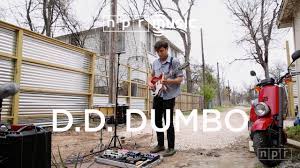
SOUNDTRACK: D.D DUMBO-“Walrus,” “Tropical Oceans” (Field Recordings, May 15, 2014).

I don’t know when people started looping drums and guitar to make fuller sounds.  I guess it’s been a decade or so.  But this recording from 2014 seems positively ancient.  And yet D.D Dumbo uses the technology perfectly.  And in this Field Recording [D.D Dumbo: Looping Sounds In An Austin Alleyway] this one guy sounds huge!

Mystery seems to swirl around D.D Dumbo. We’d heard all sorts of crazy rumors about this solo musician; namely, that Dumbo is a modern-day nomad whose only worldly possessions are his guitar and some crazy customized pedals. But once he arrived for one of our SXSW Backyard Sessions, here’s what we discovered: Dumbo was born outside of Melbourne, Australia (birth name: Oliver Hugh Perry). He performs with a 12-string electric guitar, a simple drum set-up and some loop pedals. And he prefers to let his eclectic, drone-filled music speak for itself — so, alas, no comment on the nomad rumors.

As “Walrus” opens, he plays a nifty guitar riff that is part sliding notes and part harmonics.  These are looped.  He adds some vocal “ahhs” and “eeehs” and then puts in a very simple drum beat.  When the song properly starts, his style of playing reminds me of the West African guitarists I’ve heard on Tiny Desk.  It’s slinky and repetitive, almost turning into a droning rhythm.  He sings, but I’m not even sure if there are actual words.

The song builds and shrinks as he adds previously looped parts and it stops perfectly when he needs to do a quick guitar section before it starts again.

If you listen closely to his music, though, one thing is certain: It’s hard to nail down Dumbo’s influences. As he performed for a curious crowd at Austin’s Friends & Neighbors during SXSW, we heard numerous global destinations in his music — including stops in North African deserts, as well as a jaunt to the American South for a touch of the blues. Here, D.D Dumbo showcases two uniquely minimal songs: an unreleased song called “Walrus,” and “Tropical Oceans,” from his recent self-titled EP.

“Tropical Oceans,” starts with some scratched guitar strings as a percussive sound.  He builds t he ambiance by tapping his guitar body to create waves of sounds.  After the drum beats, he begins playing and singing the song proper.

[READ: June 26, 2014] “Usl at the Stadium”

So Usl is the name of a character in this story.  It’s a strange name and kind of distracts from the story somewhat because why would anyone be named that?

This story actually has nothing to do with his name, so it could have been something else and we wouldn’t even think about his name.

This story is about Usl at a Yankee game.  The Sunday game started at 2PM and Usl had gone. He had fallen asleep and was featured on the Jumbotron intermittently between 4:02 and 4:09.  Usl became an internet sensation because the announcers had talked about him while he was on screen.

So he was getting calls from newspapers and other places for “celebrities.” (more…)

Read Full Post »

SOUNDTRACK: HASSAN HAKMOUN-“Balili (My Father)” (Field Recordings, June 11, 2014).

I didn’t know Hassan Hakmoun, but he is one of many West African musicians whose music I have come to really enjoy.  I absolutely love this song.

Hassan Hakmoun’s music is very much rooted in his homeland. Born in Marrakesh, he is from the Gnawa community, whose ancestors were brought from West Africa to North Africa as slaves in the 15th and 16th centuries. Gnawan music and dance, which are central to their spiritual tradition, fuse Muslim mysticism with sub-Saharan traditions in rituals meant to heal the body and lift the soul.

This Field Recording [On a Magical Mystery Tour with Hassan Hakmoun] has a different component to it–it is (so far) unlike any other one.

When we plan Field Recordings, we usually look far and wide to find off-the-beaten-path locations for filming musicians. But a unique opportunity presented itself when a duo called Wanderlust Projects — designers of “transgressive placemaking experiences” for urban explorers, usually in abandoned or otherwise places — invited us to come along on an adventure.

Wanderlust invited a crew of intrepid New Yorkers to accompany the fabulous Moroccan musician Hassan Hakmoun and his band on a mysterious day trip. So we piled into a van with the musicians, and off we all went to points unknown. After a long morning being driven to our secret destination — with no one but the organizers knowing where we were heading — we arrived upstate at the stunning Widow Jane Mine.

Along with providing spectacular visuals, the mine proved to be an oddly fitting location for Hakmoun and his musicians. The Widow Jane is a limestone mine that once supplied cement for such landmarks as the Brooklyn Bridge, the Statue of Liberty and the U.S. Capitol. Hakmoun’s music has found its fullest flower in New York with a highly transnational lineup of nomads.

The song opens with Hakmoun playing a fast riff on his instrument.  I cannot believe that they don;t say what it is–is it homemade?  is there one string or more?  how does he get such a great sound out of fit?).

He starts playing what will be the song’s main riff–a cool fast melody with some counterpoint loud notes.  The percussionist sings along , the flutist plays a solo of sorts and then after about a minute, the drums kick in and the song just rocks.

His band includes

Percussionist Chikako Iwahori is originally from Japan; guitarist Raja Kassis hails from Beirut; flutist Bailo Bah comes from Guinea; and drummer Harvey Wirht is from Suriname.

The sound is incredible.  Whether the caves enhance the music is unclear, but it sounds wonderful there.  The song is about 8 minutes long.  There’s not a lot to it–the riff is repeated almost throughout, but there are great variations throughout. The flute solo, the guitar solo or when he starts stomping his feet on the limestone while wearing bells on his ankles–it adds a great new component to the music.

This is just fantastic.

[READ: January 19, 2018] “Sprawl”

This is an excerpt from Dutton’s novel Sprawl (getting a reprint in 2018).

It’s a little hard to tell what the novel is about from this excerpt but I loved the whole take on suburbia that the export displays.

The excerpt is full of letters, presumably written by the same person (it’s unstated).

The first one is to Mrs Barbauld and is designed as a re-orientation to the neighborhood.  It is a bit confusing so I’m moving on.

The narrator is talking to us, I suppose as if setting the ultimate example: (more…)

Read Full Post »

SOUNDTRACK: SERGIO MENDOZA Y LA ORKESTRA-Backyard Show (Field Recordings, June 4, 2014).

This Field Recording [Coffee And Mambo With Sergio Mendoza Y La Orkesta] differs from other ones because it is actually a mini-concert.  Almost like a Tiny Desk Concert outside.

Sergio Mendoza and his band La Orkesta are from Arizona and they play three songs in this backyard party.

They mix myriad Latin styles — what Mendoza calls “indie mambo,” salted with generous handfuls of cumbia, merengue and ranchera — and then feed all that through a psychedelic prism. They perform their songs with charm and panache, set off by the fireworks of the group’s resident showman, the multi-talented Salvador Duran.

While NPR Music was in Austin for SXSW this year, we coaxed Mendoza and his crew into a three-song backyard party after a little local coffee. But they didn’t really need the caffeine to get everyone’s blood pumping.

“Traicionera” (Treasons) has a great pedal steel guitar part running through it.  Duran is dancing and stomping on the stomp box and then he takes a great vocal run with his deep resonant voice.

“La Cucharita” (Little Spoon) Sergio sings thee main verses, but when the chorus comes in, Duran takes lead and Mendoza sings backups.  There’s an appropriate trumpet solo as well as a rocking guitar solo from the slide guitarist.

The final song “La Rienda” (The Reins) opens with a wah wah’d slide guitar–it sounds otherworldly.  Throughout the song he plays some very cool slide guitar sounds.  Duran sings lead and I love his gritty but beautiful voice.  As the song nears the end, during a relatively quiet part, you can hear a bird chirping as it quickly flies past–a nice bit of proof that it’s live and outside.

[READ: January 4, 2017] “Deer Season”

The title of this story confused me somewhat because while the story may be set in deer season, the story is actually about a seventeen-year-old girl.  The girl was “almost 18 and determined to have a fuck before it.”

She lives out near the woods and has her sites set on a country man who she has seen around.

She sat out under a tree–knowing he would pass by–reading a novel by Roberto Bolaño.

She was worried that the book might be too much for him, but he seemed interested. Then he told her that he had to burn half of his books last winter to stay warm.  They shared pleasantries and go their ways.

She has about a week to go before her 18th birthday.  And she is planning accordingly. (more…)

Read Full Post »

SOUNDTRACK: BRODY DALLE-“Dressed in Dreams” (Field Recordings, July 15, 2014).

For this Field Recording [Brody Dalle: Raging Into the Light], Brody Dalle plays in an Indian Restaurant!  I fancy myself a knowledgable punk fan, but I’ve never heard of Brody or either of her bands.

Throughout her career, punk icon Brody Dalle has embraced her aggressive side. Best known as the lead singer of The Distillers and Spinnerette, Dalle has a sandpaper- and velvet-tinged voice that speaks to rebellious young punks who are curious about the world yet vulnerable to its sharp edges. “I’ve never understood why there was such a fuss about aggressive women in music,” Dalle says. “To me, aggression is a human instinct. … I’ve felt provoked for most of my life, especially as a child. I guess I’ve carried those feelings into my songs.”

So it was a pleasant surprise that Dalle was open to the challenge of crafting a stripped-down version of her song “Dressed in Dreams.” An anthem about getting back up when you’ve been kicked down, the song is personal to Dalle: After overcoming addiction, she almost immediately faced a brutal bout of postpartum depression. “I had a hard time getting myself up and running before I wrote this record,” she says. “I felt worthless. I was embarrassed and lost.”

Luckily, Dalle was able to use her songwriting as a way to fight back. Earlier this year, she released Diploid Love, her first solo album, and she says she happily embraces her day-to-day life as a working rock mom and wife. As Dalle set up her gear at New York City’s Panna II, we noticed the way the chili-pepper strands that covered every surface of the restaurant bathed her in a weirdly fierce yet serene red light. They provide a nice little visual metaphor for the way raging against the darkest points in life can help bring you into the light.

I love the fuzz she gets on an acoustic guitar.

But I have since listened to the recorded version and I like it a ton more.  The extra guitar really helps make what is an otherwise simple and repetitive song far more interesting.  Her voice also sounds a lot better on the record.

But the weirdest thing is how long this song is.  The Distillers songs were proper punk songs, last about 3 minutes or less.  This one, running over 4 doesn’t have enough variety to sustain that length.

[READ: February 5, 2018] “A Failure of Concern”

I wrote this about a Ben Marcus story published in Harper’s in 2011:

It goes on for several pages.

There is some degree of amusing shock value in the way he speaks … but as with much of what I’ve read from Marcus, I feel like I could have read half of this and gotten enough.

No explanation is given for the problem (and, fair enough, it is only an excerpt) and anyway, by the end, I didn’t really want one.

And I feel exactly the same about this story.

The nutshell story is that the narrator’s father and a lodger in their house are both missing, possibly murdered.  There is a detective there looking for clues.

The narrator is a lunatic, a mental case, and idiot, a deviant, a murderer, something, whatever.  The narrator gets common quotes and facts wrong. The narrator seemed to hate both his father and the lodger and seems likely very guilty. (more…)

Read Full Post »

SOUNDTRACK: SEVYN STREETER-“It Won’t Stop” (Field Recordings, August 6, 2014).

The blurb for this song totally cracks me up (especially 4 years removed) because not only did this song not seep into my collective consciousness, I’ve never heard of it. Nor have I heard of Sevyn Streeter.

Although it is funny that just last week my wife and I were utterly mocking people who name their child a number–what else did George Costanza tell them to do? And how misspelling it like this is even worse.

Anyhow, here’s the blurb:

In the spring of 2013, songwriter and R&B singer Sevyn Streeter released a song called “It Won’t Stop,” which she’s called her “baby.” Over the year and change that’s followed, the song has sunk into our collective consciousness through commercial radio play and a music video viewed more than 35 million times, and on the recommendation of a growing group of critics and fans. The lyrics are vernacular, warm, unpretentious, while the performance demanded by the music is not for the meek. Away from a studio — and air conditioning — in a New Orleans boxing gym, Streeter executed with muscle and grace.

Having mocked the blurb, the song itself is pretty.  I’ve no idea what the original sounds like, but this version is done with just two acoustic guitars–one of whom seems to be playing some bass melodies from time to time.  Streeter sings and warbles all over the song and does those R&B quivering notes that I hate, but she does have a nice voice.

But damn is this song long.  Why is a pop song five minutes long?

It’s neat that they filmed this Field Recording [Sevyn Streeter Knocks Us Out] in a boxing gym–how on earth were they able to eliminate all of the ambient noise?  It almost seems like it’s not live.

[READ: February 8, 2018] “Microstories”

This is a collection of flash fiction pieces which may or may not be connected.

Rain
Never ending rain seemed to be the truth until the day he was born.  While everyone was delighted for him that he never had to experience it, he lived with regret that he would never have the chance.

Divorce
He is dressing for his grown up daughter  What a strange thing to have to do–how infrequently he sees her, how should he look.  No idea what happened at the end of it though?  An earthquake? (more…)

Read Full Post »

SOUNDTRACK: BENJAMIN BOOKER-“Have You Seen My Son” (Field Recordings, September 3, 2014).

This Field Recording [Benjamin Booker: Newport Folk Gets The Summertime Blues] opens with Benjamin Booker taking his tuner off of his guitar and dropping it down a rain grate, never to be seen again.

Like many of the Field Recordings, this one also takes place at the Newport Folk Festival. NPR has a great relationship with the Newport Folk Festival, but they don’t have as much footage that’s available at any time as they used to.

There’s some kind of archway that they seem to use a lot for these Recordings.  Although in this instance, he is not in the archway, but just outside of it.

In 2014, Booker released his debut album.  As of now in 2018, he has quite a following. I know I hear his name on the radio a lot.  Booker has a distinctive voice, raspy and old, even though he himself is young (much younger than I realized).  And, as I thought last time, his speaking voice is so very different from his singing voice.

Even before releasing his debut album last month, Booker’s gravelly voice and bluesy swagger had guitar fans buzzing with anticipation. It didn’t hurt that he’d nabbed a gig touring as the opening act for Jack White, one of his idols.

With a borrowed acoustic guitar, Booker joined us outside one of the secluded secret tunnels in the heart of Fort Adams State Park after his set at this year’s Newport Folk Festival. While we were setting up for this Field Recording, Booker offhandedly mentioned that a few years prior, he’d applied to become an NPR Music intern. He didn’t get that gig, but he told us that missing out spurred his desire to explore another side of his passion for music.

“Have You Seen My Son?” is a quiet shuffle of a song.  Frankly it’s not that impressive as a song, at least you wouldn’t think much of him from just this song.  Except for that voice of course.

[READ: October 7, 2017] I Know What You Read Last Summer

This essay opens with an epigram by Ruth Franklin from Slate, May 8, 2017.

Michael Chabon has spent considerable energy trying to drag the decaying corpse of genre fiction out of the shallow grave where writers of serious literature abandoned it.

LeGuin has a lot of fun with this premise.  She begins with a scary opening about something crawly, squelching, stomping–an unknown force smelling of broken rotting flesh: Goddamn that Chabon, dragging it out of the grave where she and the other serious writers had buried it.

Could he not see that Cormac McCarthy–although everything in his book (except the wonderfully blatant use of an egregiously obscure vocabulary) was remarkably similar to a great many earlier works of science fiction about men crossing the country after the holocaust–could never under any circumstances be said to be a sci-fi writer, because Cormac McCarthy was a serious writer and so by definition incapable of lowering himself to commit genre. (more…)

Read Full Post »

« Newer Posts - Older Posts »