Feeds:
Posts
Comments

Archive for the ‘Sugar’ Category

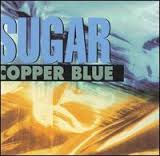
#15SOUNDTRACK: SUGAR-Copper Blue (1992).

copperblueAfter Bob Mould made some solo albums, he created another band.  Another trio, this one called Sugar.  Sugar seems to take Mould’s poppiest elements and wrap them in a big 90s grunge sound–a sound that Mould pretty much invented in Hüsker Dü.  And in many ways Sugar is not all that different from Hüsker Dü–maybe a bit less experimental and a little more commercial.

One thing I noticed about this album that, once I noticed it I couldn’t avoid it, was that when the drummer plays the cymbal (it might even be a hi hat with a tambourine on it), which he plays a lot, the tinny shimmer of that sound is so pervasive, I find it rather distracting.  Or should I say it adds an almost minute level of static over the proceedings.

The disc opens with “The Act We Act,” where big grungy guitars and a simple chugga chugga riff burst out of the speakers. I love the Pixies feeling of “A Good Idea” both that up front bass and the buggy sounding guitars provide an almost false introduction to the catchy verse and chorus that’s to come.  I also enjoy the unexpected break after the chorus.

It’s followed by the ringing guitars that introduce “Changes” a classic poppy rock song that is unmistakably Mould.  The uneasy almost nauseating sounds at the end of the song are again like a feint in the wrong direction as “Helpless” easily the most pop song Mould has ever written comes out.  Of course, as with Mould, this outrageously poppy song is all about feeling helpless.

Keyboards open the next song, “Hoover Dam” (something of a surprise for this album), which proves to be yet another big Mould single.  The song is so open with multiple acoustic guitars (and that cool synth solo) and a really wild reverse guitar solo.  It’s one of my favorite Mould  songs and yet another example of why this album was such a huge hit.

“The Slim” brings back the darker songs that Mould is also known for.  And just when you think that Mould can’t pull out another huge big single, he gives us “If I Can’t Change Your Mind,” one of his great big bouncy acoustic guitar songs.  It is almost obscene how catchy this song is, right down to the simple scale solo at the end.  Mould has this little technique that I find irresistible where he plays a song normally and then plays two fast chord changes segueing into another section.  It’s so cool.

“Fortune Teller” is a fast rocker with Mould’s trebly guitar taking the lead.  “Slick” is the only song I’m not crazy about. There’s something about it that kind of slows the momentum down, which is odd for a song about a car.  It’s got a real middle-period-Who feel to it, which I do like (and I really like the bridge) it just feels odd in this place in the disc.  The end of the song has some snippets of chatter that could have been edited out but lend an amusing air to the final track, “Man on the Moon” which ends the disc with that same air that the rest of the album has—big guitars and Mould’s slightly distorted vocals.  The solo is weirdly processed and kind of fun.  The end of the track with its repeated half step has a very Beatles feel to it. And the very end of the disc has the sound of tape rewinding, an amusing nod to the digital era.

Copper Blue was Mould’s first huge success and in his book he talks about not realizing quite how huge it was until he was in the middle of it.

[READ: March 20, 2013] McSweeney’s #15

I was a little disappointed with McSweeney’s #14, but #15 was once again fantastic.  This issue is a smallish hardcover (I like when their books are this size).  The bottom half of the cover features a cool 2 color painting by Leif Parsons.  The issue is known as the Icelandic Issue because of a few things.  The first half of the book features stories by the usual suspects.  Each of these stories is accompanied by an illustration of a Scandinavian rune that dates to the Viking era.  The stories in the second half of the book have illustrations that are taken from Icelandic grimoires–magician’s handbooks.  It is these second half stories that are all from Scandinavian authors.  It’s a fascinating peek into a culture few of us probably get to read.

There’s no letters in this book, which removes some of the levity, but that’s okay.  The front page has a brief story that it was being written on November 2, 2004 in New Mexico, hoping to bring some voting power to “the good guys “in this “completely fucking terrifying election.”  (The bad guy eked out a victory 49.8 to 49.1).  They went canvassing door to door with an Iraqi veteran named Joey (who was 21).  He was very pro-Kerry and may have even convinced a young girl to vote (she thought her vote didn’t count because she was poor (!)).  It really evokes the feeling on that dark night in 2004 when the iota of hope was snuffed out. (more…)

Read Full Post »

mouldbookSOUNDTRACK: BOB MOULD-Silver Age (2012).

silverage

I was a huge fan of everything Bob Mould put out.  And then he more or less gave up on music.  So I just enjoyed his past and ignored what else he did.  But then I heard great reviews of his new album Silver Age.  So great in fact, that I couldn’t help but listen to it.  And it is amazing.  It’s a major return to his punkier roots.  The guitars are loud and fast but the melodies are still present.  And what’s more important, his voice sounds great and the album is mixed really well–previous Mould records have suffered in production quality.  But this is a great great record.

“Star Machine” opens the disc with loud guitars, a simple melody and lots of attitude.  I love the repeated “Said It” that appears throughout the song.  “Silver Age” is something of a manifesto for Mould.  The guitars are harsh and jagged with lots of distortion and the lyrics tell you everything: “Never too old to contain my rage  This is how I’m gonna spend my days gonna fight gonna fuck gonna feed gonna walk away.”

“The Descent” is classic Mould–big guitars, great catchy vocals and really nice harmonies/backing vocals.  “Briefest Moment” starts with a thudding drum and a sparse fast guitar (which somehow reminds me of Cheap Trick).  The bass comes in with a galloping line rather than playing the same notes and it adds a lot of depth to the album.  “Steam of Hercules” slows things down a bit but “Fugue State” comes crashing back in with more fast thumping drums and sparse but effective guitars.

“Round the City Square” picks up the noise level and includes a wild guitar solo.  “Angels Rearrange” again sounds like classic Mould.  While “Keep Believing” has a great bridge that reminds me a lot of Hüsker Dü (yes I mentioned the band that should not be named).  “First Time Joy” ends the disc on a gentle note.  It’s a ballad (where you can really hear Mould’s voice and how clean and strong it sounds).  There’s keyboards on this song that add some nice dimension.  By the end the song gets bigger and more powerful, ending on a really strong chord.  It’s an awesome return to the rock fold for Mould and I look forward to more from him.

[READ: March 5, 2013] See a Little Light

After getting The Silver Age, I remembered that Mould had written an autobiography and that I’d heard it was quite good.  I don’t really read a lot of autobiographies, but my history with Mould is pretty deep and I was curious to see what had happened in his life to make him abandon his rock roots.  So I tracked it down.  And I really enjoyed it.

The fascinating thing is what a reasonable man Mould presents himself as.  I’m not disputing this–I don’t know really anything else about the guy–but every time someone dumps on him, he accepts partial responsibility for the problem and moves on.  If he’s really like that, that’s very cool.  But he almost seems too nice sometimes.

As I’ve said, I didn’t know much about Mould.  My friend Al got me into Hüsker Dü and I’ve been a fan ever since.  I’ve bought some of his solo records and all of his band records, but I kind of lost interest in him the last decade or so (during his experimental phase).  But I didn’t even really know why Hüsker Dü broke up.

Some interesting things about Bob: he was born numerically gifted–I really enjoyed the section about his childhood and the genius-y stuff he did.  Although he had a pretty rough childhood–his older brother died when Bob was young and so Bob was seen as a golden child (especially after something that happened to him which he didn’t learn about until much later).  And he started drinking at a very young age.

When he got to college he formed Hüsker Dü with Grant Hart (Greg Norton came a little later).  I enjoyed hearing about the early days of Hüsker Dü because I only learned of them much later.  And man were they productive!  They’d release an album and have new material ready to record before they even toured for the album that came out already.  It’s cool reading about the punk scene back in the days before the internet when bands had to rely on each other for support.  There’s also a lot of people who Bob name checks and it’s fun to hear all of the punk names again, especially the names of people who are still active.  (There’s also some bad vibes against SST, but since this is Mould, the bad vibes are pretty mild). (more…)

Read Full Post »

SOUNDTRACK: BOB MOULD-Sasquatch Festival, May 28, 2011 (2011).

I loved Hüsker Dü.  I loved Sugar (a tad less).  I loved Mould’s Workbook.  And then I kind of loss interest in the guy.  He recently wrote an autobiography, which I would consider reading, but musically, I assumed he was done.

So I wasn’t even that interested in listening to his set (shame on me).  This turns out to be a really cool set in which it’s just Bob and his electric guitar.  He plays a varied set of songs from throughout his career.  He plays some of his hits (“See a Little Light,” “Hoover Dam”) but mostly he plays interesting non-hits (“Chartered Trips” (!!), “I Apologize”).  (Is it possible that Grant Hart wrote all of Hüsker’s big hits?)

The most amazing thing about the set is Bob himself.  He sounds so cool and chilled out (even though I think he was like the very first opening act of the concert–which is a pretty shitty time slot).  He seems to be really happy playing (hearing him respond to a request with “I forgot how to play that one” is pretty darn funny.)  Of course, a little later when he says “What’s that?  I’m trying?” he almost sounds like Al Bundy.

But then, look at him, he’s an old man now.  And sure, he’s been playing music forever, so gosh, he’s got to be super old, right?  What?  He was born in 1960?  He’s nine years older than me?  Oh good grief.  So, wait the first Hüsker Dü album came out when he was 22?  He really crammed a lot of music into just a few years.  Not bad, Bob.

And yes, I’m fully invested in relistening to all the great music you’ve made now.  Thanks, Sasquatch.

[READ: July 13, 2011] “Incident in the Orient”

This very short story features a dead dog. I’m getting that out of the way since I know some people won’t read any further once they know that.

I rather liked the brevity of this story, how Theroux is able to cram a lot of information and a lot tension into just a couple of pages.  The story is also a strange little onion of a tale, with the narrator working for a man (Moses) who is a sort of mercenary construction boss.  The narrator gives a lot of insight into Moses, although he also admits that he doesn’t really know the man very well (how could anyone know him).

He has done work in various war-torn countries and has effectively built a crew out of a small group of devoted men, mingled with local help.  The most fascinating thing is that Moses is a short man with a lisp and yet he commands the respect of everyone who works for him.  He takes no shit, but he pays well and uses local materials (including tearing down materials from destroyed buildings if necessary).   (more…)

Read Full Post »

« Newer Posts