 SOUNDTRACK: BORIS WITH MERZBOW-Rock Dream (2007).
 Rock Dream was recorded live in November 2006 at Tokyo’s Earthdom festival. It is a mix of the heaviness of Boris and the noise of Merzbow. And it is lauded as a spectacular live document.
The Austin Chronicle discussed the album in their overview of Boris’ career, declaring it “definitive live document, an impossibly dense double album that touches down on nearly every point of their career, from Dronevil to Smile’s contorted stairway to heaven (“Flower Sun Rain”), with Merzbow’s electronic manipulations stitching it all together like connective scar tissue.”
In a retrospective review Tiny Mix Tapes, declared Rock Dream to be “not just the best album Boris ever made, but also one of the finest live albums I’ve ever heard.” and that “It’s incredible then that someone recorded Boris and Merzbow that night, because for two hours they got to be the best band on the planet.”
And what live show that opens with a 35 minute song wouldn’t be fantastic? “Feedbacker” starts quietly with just guitar and Merzbow’s effects. It has an almost spaghetti western feel to it with all the reverb. Unsurprisingly, there’s moments throughout the 35 minutes where things dramatically change. At 6 minutes there’s loud ringing guitars. At 9 minutes things slow down and then slowly build back up with swells of music from the guitars, keys and effects. At 20 minutes, muted vocals come in and then grow louder. It feels like it’s building to an end but it turns into faster guitars and a lot of noise. By 31 minutes things have slowed down heading towards an ending which is primarily Merzbow’s pulsing sounds. (And there’s so much more going on in that half an hour).
These sounds segue into “Blackout” full of thrashing guitars, crashing cymbals and Merzbow’s noise. This segues into a song that I gather is only heard here: “Evil Stack” which features a lot of Merzbow’s knob twiddling and noise making and a lot of feedback as well.
This all segues into “Rainbow,” a far more mellow song that opens with bass harmonics and simple drum beat with Wata’s quiet vocals. It’s a slinky cool song with a mellow guitar solo. Merzbow throws in some interesting sounds and and mild noises throughout.
If Disc one showcased their more expansive sound, Disc two opens with a bunch of really short fast loud songs all from Pink.
First off is the raging punk blast of “Pink.” It is all-out thrash with a lot of yelling from Atsuo and wailing solos from Wata. It’s followed by the 2 and a half minute rager “Woman on the Screen” with a great punk riff, lots of Atsuo’s screams and of course Merzbow putting a wall of distorrted noise over the top. The trio concludes with the two minute “Nothing Special.” The punky blasts continue with “Ibitsu.” It’s not from Pink but it’s just as fast.
Things slow down somewhat with “A Bao A Qu.” It is 4 and a half minute with a lot of squealing feedback and thunderous drumming. The final four songs return to that epic style–they are alternately 13 minutes or 8 minute long.
“The Evilone Which Sobs” slows things down with more of that reverbed spaghetti-western style guitar. There’s squeals of feedback, slow plucked guitar and Merzow as this 13 minute song gets under way. After three minutes the loudest guitar and bass imaginable come crashing through the melody. The rest of the song is full on loud drone and feedback. It all slows down for their surprisingly catchy of cover of Pyg’s “Flower Sun Rain,” which sounds just as good live as on record–including Wata’s wailing solo.
The final two songs return to Pink. “Just Abandoned My-self” runs over 13 minutes and opens with a scream from Atsuo, wailing guitars from Wata and vocals from Takeshi. The song barely lets up for seven minutes, and when it finally changes pace, it’s more for the guitars to do some e-bow working while Atsuo continues to pound away. The last four minute are those droning chords with Merzbow making some really interesting sounds while the band plays on. Merzbow ends the song with a kind of looping siren that leads into the show ending with a great version of “Farewell.”
Unlike the one from Crossing Waltz, Merzbow’s presence make a pretty big difference in the dynamic of “Farewell.” The band sounds terrific and it’s a fantastic take on this by now iconic song.
For sure this live set isn’t for everyone–it’s loud, there’s some uncomfortable moments–but it really captures a band at full power. And as with most Boris releases, it had a different cover in Japan.
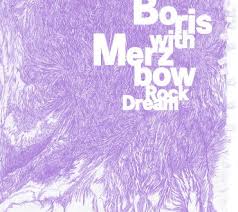 Disc one Total length: 49:58
“Feedbacker” (Originally from Boris at Last: -Feedbacker-) 35:05
“Blackout” (Originally from Pink) 5:19
“Evil Stack” 5:04
“Rainbow” (Originally from Rainbow) 4:30
Disc two Total length: 60:32
“Pink” (Originally from Pink) 4:14
“Woman on the Screen” (Originally from Pink) 2:37
“Nothing Special” (Originally from Pink) 2:14
“Ibitsu” (Originally from Akuma no Uta) 3:35
“A Bao A Qu” (Originally from Sound Track from Film “Mabuta no Ura”) 4:35
“The Evilone Which Sobs” (Originally from Dronevil) 13:41
“Flower Sun Rain” (PYG cover, later released on Smile) 8:04
“Just Abandoned My-self” (Originally from Pink) 13:21
“Farewell” (Originally from Pink) 8:11
[READ: February 21, 2017] “Mrs Crasthorpe”
This story revealed itself slowly and in interesting ways.
We meet Mrs Crasthorpe in the first paragraph. She is humiliated because her husband’s funeral has just been poorly attended. It was also, by his own design, in a small, unassuming, frankly embarrassing cemetery. Mrs Crasthorpe is 59. Her husband was 72. Yes, she had married him for money and yet it didn’t really make her a more fulfilled person. She had cheated on her husband, but he didn’t seem to mind or care.
She had felt herself to be always a rosebud, claiming to be 45 when she was late nearly 60. She also told no one she had a son.
Then we shift to following Etheridge, a man whose wife is near death. He is tender to her, caring, but she doesn’t have long to live. (more…)



 I Just Read About That...