Feeds:
Posts
Comments

Archive for the ‘Ornette Coleman’ Category

SOUNDTRACK: CECIL TAYLOR-Jazz Advance (1956).

As the biography below states, Cecil Taylor was ahead of his time and harshly criticized for being so.  This was his first album and it made waves–as did his subsequent performance at Newport Jazz Festival (it’s like when Dylan went electric, but for jazz).

Since I’m not a big jazz follower, I’ll start with those who are.  Here’s some notes on the album from The Guardian.

A Taylor group comprised of Buell Neidlinger on bass and Dennis Charles on drums is augmented here and there by soprano saxophonist Steve Lacy; the repertoire mixes tunes by Ellington, Monk and Cole Porter with the leader’s fearlessly personal reinventions of the blues. Thelonious Monk’s “Bemsha Swing” is played even more cryptically and succinctly, the lines breaking up into jagged fragments and jutting chords. Taylor’s “Charge Em Blues” is a 4/4 walk with a surprisingly straight Lacy sax solo, and “Azure”‘s lazily struck chords and delicate treble sounds might even remind you of Abdullah Ibrahim, until the cross-rhythmic improvised piano patterns clattering chords typical of later Taylor emerge. …  It’s a historic document that still sounds more contemporary than most jazz piano music being made today.

As I listened I first thought it didn’t sound all that shocking and I wondered if that was because I was listening in 2021 and not 1956, but around two minutes into “Bemsha Swing” he starts throwing in some atonal and dissonant notes.  You can tell that he knows how to play, but that he’s deliberately hitting either “wrong” notes or just letting his fingers fly where they will.   And it still sounds surprising today.

“Charge ‘Em Blues” sounds far more “normal” at least in the beginning.  Lacy’s sax solo is fun and bouncy.  Then around 5 minutes a back and forth starts with Taylor’s wild free-jazz atonal improv and a drum solo.

“Azure” is a more chill track although about halfway through the improv starts going off the rails.

About half way through “Song” the solo is all over the place–sprinkling around the piano and pounding out a few chords here and there.  It’s dissonant and off-putting, but seem more like it’s trying to wake up the listener. When Lacy’s pretty sax comes in and plays a delightful improv and Taylor is bopping around behind him, the contrast is stark.

“You’d Be So Nice To Come Home To” is the only song on the record that I knew before and I never would have recognized it here.  As AllMusic puts it

At his most astonishing, Taylor slightly teases, barely referring to the melody of “You’d Be So Nice to Come Home To,” wrapping his playful, wild fingers and chordal head around a completely reworked, fractured, and indistinguishable yet introspective version of this well-worn song form.

This is a solo piece and he is all over the place.  At no point did I recognize the original melody.

“Rick Kick Shaw” features some lively drums and walking bass while Taylor goes to town.  He plays some really fast runs which slowly turn experimental. I’m very curious if future renditions of this song were in any way the same or if all of this soloing was improvised each time.

“Sweet and Lovely” is very slow and more traditional sounding.  Without the speed of his solos, this song comes across as almost like a standard jazz song.  Although at the very end he throws in a few sprinkles of chaos just because he can.

[READ: February 2, 2021] The Musical Brain

I’d only read a couple of short stories from César Aira (all included here).  His novels are so short it almost seems weird that he’d write short stories, but some of these stories are very short indeed.  They do also tend to meander in the way his novels do which makes it seem like some of them don’t end so much as stop.

“The Musical Brain” was the first story I’d read by Aira, and what I wrote about the story has held true for pretty much everything I’ve read by him:

There are so many wonderful and unexpected aspects to this story that I was constantly kept on my toes.  This also made it somewhat challenging to write about.

“A Brick Wall”
I thought I had read this story before but I guess I hadn’t.  It begins with the narrator saying that he went to the movies a lot as a kid–four or six films a week (double features). He says he has an impressive memory for details.  He remembers seeing Village of the Damned decades ago.  A small village’s children are all born as zombies. The zombies can read everyone’s minds so the hero thinks–erect a brick wall.  He also remembers North By Northwest which was titled in Argentina: International Intrigue.  He and his friend Miguel loved the elegance of the movie. And they decided to become spies.  So they created a game in which they would “forget” that they were spies. They would leave notes for each other and then “discover” them so that when they came upon them they were new and exciting.  It was surprisingly easy to forget the game, apparently. (more…)

Read Full Post »

30SOUNDTRACK: RAHSAAN ROLAND KIRK-“Volunteered Slavery” (live March 1972).
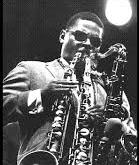
kirkI had never heard of Rahsaan Roland Kirk before reading this story.  This surprises me since i rather like avant garde jazz. I looked him up and was blown away by this live recording from Paris.

The song starts with a catchy saxophone riff.  The band (Ron Burton on piano, Henry Pearson on bass, Richie Goldberg on drums and Joe Texidor on percussion) interacts throughout the song–chatting, laughing.  Then they sing the simple, catchy lyrics:

Volunteered slavery has got me on the run
Volunteered slavery is something we all know

Then at two minute the magic begins.  He starts playing three horns at the same time.  I can’t quite tell what they are from this video, but he puts all three in his mouth and is able to play melody and harmony on separate instruments.  It’s amazing, if all too brief.

Then he starts playing a proper saxophone solo.  It runs for the next seven or so minute with the main melody being fun and bouncy, a perfect representation of 60s/70s jazz.

The band is very into it–“you got it!” and lot of encouragement all around. The song ends with a cacophony of percussion and whistles. What a fun set.  Wish I could have seen him live.

[READ: December 30, 2019] “Super Goat Man”

The end of the year issue is called the Cartoon Takeover: A Semi-Archival Issue.  So there’s a lot of cartoons, but there’s also some old stories. Like this one.

This was originally published in the March 29, 2004 issue of the New Yorker.  I don’t recall reading it then, so it was new to me.

When the narrator, Everett, was ten years old, Super Goat Man moved into the commune down the street from his house in Brooklyn.  Super Goat Man had fallen out of the world of superhero comics because he spoke out against the war and now he was living in a commune. (more…)

Read Full Post »

july 28SOUNDTRACKJazz Lives At Duke Ellington’s Resting Place (Field Recordings July 2, 2015).

Playing jazz at a cemetery during the day seems like an odd decision.  But it’s all part of the one-day Make Music New York festival (MMNY) which celebrates music and community.  It happens every June 21 with more than 1200 outdoor concerts across the five boroughs running from morning till night.

For the 2015 edition, the festival’s organizers invited musicians to six different burial grounds across the city to riff on the idea of “exquisite corpse,” a surrealist parlor game popularized by artists and poets in the 1920s. In the game, someone writes a phrase (or draws part of a figure or scene), folds that part of the page over, and then passes it to the next player, who then does the same. The game ends when everyone has had a turn. That game is a natural bridge to the art of improvisation, and to jazz.

Woodlawn Cemetery is a mecca for the jazz world — it’s the final resting ground of royalty like Duke Ellington, Miles Davis and many others, including Ornette Coleman now as well. So as a tribute to their musical forerunners, the group — singers Michael Mwenso and Vuyo Sotashe, trumpeters Alphonso Horne and Bruce Harris, saxophonist Tivon Pennicott, pianist Chris Pattishall, bassist Russell Hall, drummer Evan Sherman and tap dancer Michela Marino Lerman — took as their point of departure W.C. Handy’s 1914 tune “St. Louis Blues,” a tune essential to jazz’s DNA. But they made it their own via surprising and turns that saunter through many textures, colors and rhythms.

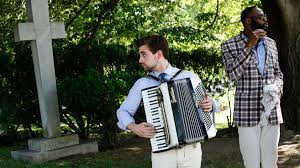
The song begins with vocals from “St. Louise Blues” from Vuyo Sotashe and accordion from Chris Pattishall.  After a verse, Michael Mwenso (whose voice sounds very different) takes over.  The accordion drops out and it’s just voice and bass.

They pass the baton along to the horns, two trumpets, one with a mute in, the other using the mute  and a saxophone play a lively instrumental break.  This is followed by the percussion.  Evan Sherman and Michaela Marino have a percussive call and response.  I could have watched that part for a lot longer.

When that’s over the whole group joins together to end the song.

[READ: September 10, 2018] “Audition”

The first line of this story reads, “The first time I smoked crack cocaine was the spring I worked construction for my father on his new subdivision in Moonlight Heights.”

A first implies a second (especially with crack).

The story is about a 19-year-old college dropout. He went to school to study theater but “unmatriculated” and has been working for his father’s construction firm.  His father came from nothing and build up this firm which is presently creating a development.  His father is not too happy about him wanting to be an actor and as such is paying him the same as everyone else (which isn’t much).

He still acts–in community theater, but usually to 15 people at a time.

No one knew that he was the owners son and he liked it that way–he was using this time to study the laborers to learns their mannerisms–he was acting in his job, too,   New workers came through all the time (the pay was lousy after all).

The crack came from a coworker Duncan Dioguardi who was not acting.  He was a laborer living in his mother’s basement and longing to party.

The narrator knew “party” meant get high. When Duncan’s car died and the narrator drove Duncan home (an hour out of his way), Duncan invited him to party. The narrator was intimidated, then intrigued so he did.  And that was the first time he smoked crack.

He marveled how the lump of crack looked like some drywall that could easily be swept away.  Duncan showed him how to smoke it.  It tasted like nothing.  It smelled like nothing.  It was ant climatic except for his new-found fondness for Duncan whom he now considers a good friend.

That following spring he received a call from his old acting teacher to audition for a role  It was a stage show. The character would be on stage for all three acts but would not speak a word.  The narrator didn’t know if this was a step forward or backward.  The audition went well and he was sure he would get the gig.

Duncan’s car broke down again and the narrator told him all about the potential role.  But the narrator was more excited about the option of partying some more.

The story ends soon after this, which is a little disappointing as it is told from many years later and we never learn how he turned out.  But i did like the details of the past like “wiring th ehouse for internet, whatever that was.”

For ease of searching, I include: Said Sayrafiezadeh

Read Full Post »

SOUNDTRACK: MARS VOLTA-The Bedlam in Goliath (2008).

I’ve liked Mars Volta more in theory than in actuality for their first few albums. I enjoyed them, but they didn’t make me want to listen all the time. I had heard good things about this new one, so I gave it a shot and WOW. The Bedlam in Goliath is off the charts in its craziness and its masterfulness.

Bedlam has most of the same components of a Mars Volta disc: chaos, noise, fantastic instrumentation, bizarre lyrics, jazz-like elements and metal, sweet metal. But for some reason, Bedlam seems to cohere into a masterful project. I haven’t listened to the first two discs in a while (but I’m sure going to check them out again), and I never got the third one, so I can’t really compare them. This one just seems to have something special to it.

The overall sound makes me think of someone tuning in a radio. Some parts are (deliberately) fuzzy, some are crystal clear. As the sound of one segment fades out a new, entirely different section blares in. Anyone who channel surfs can appreciate the sound of this.

All of the literature about this record talks about their use of a Ouija board during their tour and while recording. They bought it in Jerusalem and they say it had a horrible impact on the recording process. (Check out this NPR story…yeah, that’s right, I said NPR.) And, in many respects, rather than a radio, you could think of the album as the voices and sounds from the Ouija board coming through. Some are crystal clear and other are mechanized and ghostly. Spooky, eh?

But what of the music? It is fast, fast, fast. Cedric Bixler-Zavala’s voice is a powerhouse of high-pitched, operatic notes. And the music keeps pace. And yet, despite the speed the album isn’t thrash metal or speed metal necessarily. It doesn’t all have that heaviness, it just has a lot of speed. It lets up once in a while, but for the most part in every song something is going fast: drums, bass, voice, something.

One of the perplexing things about the record is how each song seems to have multiple parts that are unrelated to each other…some songs even have longer breaks within the track than between them. For instance, tracks one and two, the nearly 6 minute “Abernikula” and the over 8 minute “Metatron” blend seamlessly into one long track. However, midway through “Metatron” the song stops for a good second or two and then begins with a brand new, wonderfully catchy riff, which runs through the rest of the song. Truly masterful, and yet impossible to know what track you’re on, half the time.

The album is about an hour long, and it’s such a roller coaster of rocking guitars and high speed chases.  And yet it doesn’t wear out it’s welcome, because the catchy bits are so incredibly catchy. I was amused to see that there is a “single” on the record called “Wax Simulacra.”  It’s the shortest song, possibly that MV has ever done at under 3 minutes, which makes it an ideal single.  Except that the last twenty or thirty seconds are taken up with a mind blowing saxophone solo that could be lifted from Ornette Coleman or John Zorn (and this is a single?).  In fact, the horns come into play a lot on the record.  There’s one or two motifs that sound like they could be taken from a Zappa piece (the Zappa song “Sofa” kept popping into my head during this record. And you can’t ask more from a record than to make you enjoy it while it makes you think of other great music too.

[READ: July 20, 2008] Do the Windows Open?

I read an interview with Julie Hecht in The Believer (some of which is available here). And boy did she come across as an unlikable person. (more…)

Read Full Post »