 SOUNDTRACK: THE CALIDORE STRING QUARTET-Tiny Desk Concert #843 (April 22, 2019).
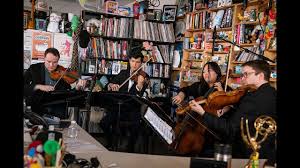 Whenever I hear a wonderful string quartet, I yell at myself for not listening to more classical music. I’m not sure why I don’t–I just like my rock too much I guess. But these 18 minutes of strings are really fantastic. And I’m adding The Calidore String Quartet [Jeffrey Myers, violin; Ryan Meehan, violin; Jeremy Berry, viola; Estelle Choi, cello] to the list of quartets I particularly admire.
The blurb is great for unpacking what’s going on, so I’ll let it do just that.
The [string quartet] genre was born some 250 years ago and pioneered by Joseph Haydn, but composers today are still tinkering with its possibilities. Consider Caroline Shaw. The young, Pulitzer-winning composer wrote the opening work in this set, First Essay: Nimrod, especially for the Calidore String Quartet [back in 2016].
Over a span of eight minutes, the supple theme that opens this extraordinary work takes a circuitous adventure. It unfolds into a song for the cello, is sliced into melodic shards, gets bathed in soft light, becomes gritty and aggressive and disguises itself in accents of the old master composers. Midway through, the piece erupts in spasms that slowly dissolve back into the theme.
I love the pizzicato on the cello–there’s so much of it, from deep bass notes to very high notes. Including the final note.
Their new album explores composers in conflict. In the case of of the next song, loveless marriage.
The Calidore players also chose music by the quirky Czech composer, Leoš Janáček who, in 1913, set one of his operas on the moon. He wrote only two string quartets but they are dazzling. The opening Adagio, from “String Quartet No. 1, ‘Adagio'”, is typical Janáček, with hairpin turns that veer from passionate romance to prickly anxiety.
This piece is much more dramatic with powerful aching chords ringing out.
Reaching back farther, the ensemble closes the set with an early quartet by Beethoven, who took what Haydn threw down and ran with it. The final movement from Beethoven’s “String Quartet Op. 18, No. 4, Allegro – Prestissimo” both looks back at Haydn’s elegance and implies the rambunctious, even violent, risks his music would soon take.
2020 is the 250th anniversary of his birth. They are celebrating by playing all of his string quartets in various cities. He says that this piece is the most exiting part.
I love the trills that each instrument runs through in the middle of the song.
All of these pieces sound amazing.
[READ: April 22, 2019] “Cut”
This story started out is such an amusing way:
There’s no good way to say it–Peggy woke up most mornings oddly sore, sore in the general region of her asshole.
But it’s not an amusing scene at all. It burns when she uses the toilet and she finds blood in her pajamas.
There are so many great moments in this story that I feel th eneed to quote so much of it.
She could see a cut but only when using a hand mirror while she was crouched at the right angle. But even so, her groin “was that of a middle-aged woman and not as strictly delineated as it once had been.” Nevertheless, whenever she looked for it she always “paused to appreciate the inert drapery of her labia.”
The cut was there, but it seemed to migrate. She tried to look it up online, but only found porn. Adding Web MD brought back porn in doctor’s offices. And adding Mayo Clinic introduced her to people with a fetish for mayonnaise. (more…)



 I Just Read About That...