Feeds:
Posts
Comments

Archive for the ‘Gogol Bordello’ Category

SOUNDTRACK: GOGOL BORDELLO-Trans-Continental Hustle (2010).
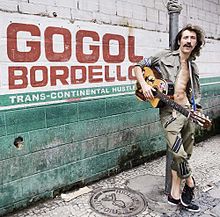
When I first heard Gogol Bordello, they were touring for this album (thanks NPR).  Consequently, I knew this album pretty well when I bought it.  At first I felt that it didn’t have the vibrancy of the live show (how could it?).  But after putting it aside for a few weeks, when I re-listened, I found the album (produced by Rick Rubin) to be everything I expect from Gogol Bordello: loud, frenetic fun, a bit of mayhem, and some great tunes that sound like traditional gypsy songs, but which I assume are not.

While I was listening to the album, I kept thinking of The Pogues.  They don’t really sound anything alike but they have that same feel of punk mixed with traditional music.  For The Pogues, it’s Irish trad, and for GB it’s a gypsy sound–I’m not sure if it is attributable to any specific locale.  But they have a common ground in a kind of Spanish-based trad style.  From the Pogues, you get a song like “Fiesta” which is overtly Spanish.  From GB, you get songs like “My Companjera” or “Uma Menina Uma Cigana.”  Singer/ringleader Eugene Hutz has been living in Brazil, and he has really embraced the culture (and the accent).  He also sings in a kind of drunken tenor (his accent is probably more understandable than MacGowan’s drunken warble, but not always).

I’m led to understand that previous albums were a bit more high-throttle from start to finish.  This disc has a couple of ballads.  At first they seem to not work as well, but in truth they help to pace the album somewhat.

It’s obvious this band will not suit everyone’s tastes, but if you’re looking for some high energy punk with some ethnic flare, GB is your band (and if you like skinny guys with no shirts and big mustaches, GB is definitely your band.  It is entirely conceivable that Hutz does not know how to work a button).

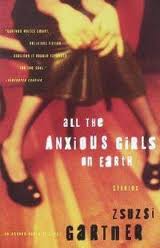
[READ: June 20, 2011] All the Anxious Girls on Earth

I’ve really enjoyed Zsuzsi’s stories in recent issues of The Walrus.  So much so that I wanted to get a copy of her new book.  It wasn’t available anywhere in the States yet, so I went back and got her first collection of short stories.

This collection felt to me like a younger, less sophisticated version of Zsuzsi’s later works that I liked so much.  This is not to say that I didn’t like them.  I just wasn’t as blown as w.

“How to Survive in the Bush”
I had to read the opening to this story twice for some reason.  The second read made much more sense and I was able to follow what was going on (I think there were a few terms that I didn’t know–a 1941 Tiger Moth, East Kootenays–that were given context after a few pages.  It transpires that this is a story o a woman who has given up her life to move to the boonies with/for her husband.  The whole story is written in second person which while typically inviting, I found alienating.  It made the story harder to read for me, but once I got into the groove of it I found it very rewarding. (more…)

Read Full Post »

SOUNDTRACK: GOGOL BORDELLO-East Infection (EP Extra) (2005).

I learned about Gogol Bordello from some live shows available on NPR.  I enjoyed their sets so much I decided to check out their albums as well.  And I love them.  The albums are full of frenetic energy (they give Sarah agita, she says).  But everything that I love about fun, spirited, gypsy music is present here.

The band is essentially a band of gypsies, headed by wonderfully-mustachioed Eugene Hutz.  And their live show (as demonstrated by the included video) is a wild circus of fun (curtains and dancers and fire buckets and bowling pins and musicians jumping out of boxes), it’s like a wild party.  The video is for “Never Young Again” which would appear in full on their next album. It’s a fun song that reverses the age-old lament of wanting to be young again.  But mostly you watch this for the live footage.

This EP is probably not the best place to start as an introduction to Gogol Bordello (but it was really cheap so I bought it first).  Although it does offer many of the different aspects of Gogol’s music.  The EP features 6 songs and the video.  The songs are intense, hyper, crazy and wonderful.  “East Infection” opens with some nonsense lyrics (“Lee lee lee lee lee, la la la la la”) and morphs into what may be more nonsense, although there’s actual lyrics here.  “Ave B.” (which is also on their following album Gypsy Punks) is a more acoustic-based song, but it still has loud parts to it.

“Mala Vida” is a cover of a song by Manu Chao.  This version is a super fast punky track sung in Spanish (despite Eugene Hutz’ origins in the Ukraine, he has lived in Brazil for years and sings many songs in Spanish).  The original is very similar in temperament, although GB version is a bit more frenetic.

“Copycat” is the odd track on the disc, it’s a kind of dub track with big fat bass and a very slinky sound.  It and “Mala” were produced by Steve Albini.

“Strange Uncles from Abroad” is to me a very typical GB song: lots of violin, lots of dah dah dahs and a great melody.  It has a total gypsy feel, and goes through some loud and quiet moments.   The final track, “Madagascar-Roumania (Tu jésty fáta)” is the longest track by far (6 minutes).  It sounds like a demo and lacks the punch of the rest of the disc, but it showcases the softer side of the band (and yes there is one).

So, maybe this EP is a good place to start after all.  It’s certainly not throwaway material.  And the EP cover alone is pretty outstanding.

[READ: June 14, 2011] Five Dials Number 10

This is the issue of Five Dials that introduced me to the publication.  It is a special issue devoted to the memory of David Foster Wallace.  The entire issue is comprised of the eulogies given at the DFW memorial.  [The details are a little sketchy here…I’m not sure if these are all of the eulogies or just the eulogies from well known people.  I’m not even sure who would have been in the audience for this memorial.  The notes say “These tributes were given on 23 October, 2008 at the Skirball Center for the Performing Arts, New York University” and yet the Jonathan Franzen entry says “here at Pomona.”  So… details are sketchy].  Nevertheless, the tributes are heartfelt, informative and very moving.

Of course, I’m not going to ‘critique’ them, I’ll just try to summarize them.  But really, they’re all worth reading if you’re a fan. (more…)

Read Full Post »

SOUNDTRACK: GOGOL BORDELLO-Tiny Desk Concert #66 (June 28, 2010).

I had heard a few minutes of Gogol Bordello before this concert but it was during a TV show that I was half watching.  When I sat down and listened to this show, I was blown away by hem and immediately bought two of their CDs. Gogol Bordello is a multi-piece, multi ethic band that plays rocked-up Russian folk music (mor or less).  The sound is very traditional, with a kind of gypsy edge sprinkled onto it.  I’m not sure how many people are in the band, or how may people showed up for this concert but it sounds like about 100 in the tint room.  This is also the longest Tiny Desk show that I’ve heard (it runs almost 25 minutes).

The band plays five songs (and there’s a little chatting in between) and as the session goes on the band gets more rowdy (and more fun).  The video (also available at the same site) shows the singer sitting in the laps of the NPR folks and jumping on some desks and just having a blast.  And even though I enjoy shoegazing music, this is the kind of rollicking fun that I would love to see in concert.

The songs are political, but not overtly so, it’s more of a communal feel, of people uniting (which is indeed political).  I think they could get old kind of quickly, but in small doses the band is energizing and wonderful.

[READ: March 27, 2011] “U.F.O. in Kushiro”

This story was originally published in the March 19, 2001 issue and was inspired by the incidents of the 1995 earthquake in Kobe, Japan.  It was reprinted here to memorialize the recent earthquake in Japan.  The story is accompanied by rather devastating photos (and some surreal ones) of the aftermath of the earthquake in Kobe.

The story (translated by Jay Rubin) opens a few days after the Kobe Earthquake.  And even five days after the Kobe earthquake, Komura’s wife is still engrossed in the TV footage from Kobe.  She never leaves the set.  He doesn’t see her eat or even go to the bathroom.  When he returns from work on the sixth day, she is gone.  She has left a note to the effect that she’s not coming back and that she wants a divorce.  Komura’s wind is knocked out of him. (more…)

Read Full Post »

« Newer Posts