Feeds:
Posts
Comments

Archive for the ‘Cole Porter’ Category

SOUNDTRACK: CECIL TAYLOR-Jazz Advance (1956).

As the biography below states, Cecil Taylor was ahead of his time and harshly criticized for being so.  This was his first album and it made waves–as did his subsequent performance at Newport Jazz Festival (it’s like when Dylan went electric, but for jazz).

Since I’m not a big jazz follower, I’ll start with those who are.  Here’s some notes on the album from The Guardian.

A Taylor group comprised of Buell Neidlinger on bass and Dennis Charles on drums is augmented here and there by soprano saxophonist Steve Lacy; the repertoire mixes tunes by Ellington, Monk and Cole Porter with the leader’s fearlessly personal reinventions of the blues. Thelonious Monk’s “Bemsha Swing” is played even more cryptically and succinctly, the lines breaking up into jagged fragments and jutting chords. Taylor’s “Charge Em Blues” is a 4/4 walk with a surprisingly straight Lacy sax solo, and “Azure”‘s lazily struck chords and delicate treble sounds might even remind you of Abdullah Ibrahim, until the cross-rhythmic improvised piano patterns clattering chords typical of later Taylor emerge. …  It’s a historic document that still sounds more contemporary than most jazz piano music being made today.

As I listened I first thought it didn’t sound all that shocking and I wondered if that was because I was listening in 2021 and not 1956, but around two minutes into “Bemsha Swing” he starts throwing in some atonal and dissonant notes.  You can tell that he knows how to play, but that he’s deliberately hitting either “wrong” notes or just letting his fingers fly where they will.   And it still sounds surprising today.

“Charge ‘Em Blues” sounds far more “normal” at least in the beginning.  Lacy’s sax solo is fun and bouncy.  Then around 5 minutes a back and forth starts with Taylor’s wild free-jazz atonal improv and a drum solo.

“Azure” is a more chill track although about halfway through the improv starts going off the rails.

About half way through “Song” the solo is all over the place–sprinkling around the piano and pounding out a few chords here and there.  It’s dissonant and off-putting, but seem more like it’s trying to wake up the listener. When Lacy’s pretty sax comes in and plays a delightful improv and Taylor is bopping around behind him, the contrast is stark.

“You’d Be So Nice To Come Home To” is the only song on the record that I knew before and I never would have recognized it here.  As AllMusic puts it

At his most astonishing, Taylor slightly teases, barely referring to the melody of “You’d Be So Nice to Come Home To,” wrapping his playful, wild fingers and chordal head around a completely reworked, fractured, and indistinguishable yet introspective version of this well-worn song form.

This is a solo piece and he is all over the place.  At no point did I recognize the original melody.

“Rick Kick Shaw” features some lively drums and walking bass while Taylor goes to town.  He plays some really fast runs which slowly turn experimental. I’m very curious if future renditions of this song were in any way the same or if all of this soloing was improvised each time.

“Sweet and Lovely” is very slow and more traditional sounding.  Without the speed of his solos, this song comes across as almost like a standard jazz song.  Although at the very end he throws in a few sprinkles of chaos just because he can.

[READ: February 2, 2021] The Musical Brain

I’d only read a couple of short stories from César Aira (all included here).  His novels are so short it almost seems weird that he’d write short stories, but some of these stories are very short indeed.  They do also tend to meander in the way his novels do which makes it seem like some of them don’t end so much as stop.

“The Musical Brain” was the first story I’d read by Aira, and what I wrote about the story has held true for pretty much everything I’ve read by him:

There are so many wonderful and unexpected aspects to this story that I was constantly kept on my toes.  This also made it somewhat challenging to write about.

“A Brick Wall”
I thought I had read this story before but I guess I hadn’t.  It begins with the narrator saying that he went to the movies a lot as a kid–four or six films a week (double features). He says he has an impressive memory for details.  He remembers seeing Village of the Damned decades ago.  A small village’s children are all born as zombies. The zombies can read everyone’s minds so the hero thinks–erect a brick wall.  He also remembers North By Northwest which was titled in Argentina: International Intrigue.  He and his friend Miguel loved the elegance of the movie. And they decided to become spies.  So they created a game in which they would “forget” that they were spies. They would leave notes for each other and then “discover” them so that when they came upon them they were new and exciting.  It was surprisingly easy to forget the game, apparently. (more…)

Read Full Post »

SOUNDTRACK: VANILLA FUDGE-The Beat Goes On (1968).

I thought the first Vanilla Fudge album was odd–covers of contemporary songs done slowly and with little resemblance to the originals.

Well, this second album was downright bizarre.

It  doesn’t really have any “songs.”  Rather, it’s more of a collage–a history of recorded sound as interpreted by the Vanilla Fudge.  There’s a few snippets of classical pieces, some rocks songs, historical vocal recordings and final words from the guys in the band.  All sandwiched between snippets of them playing The Beat Goes On, the Sonny Bono song.

It’s a weird enough record on its own, but when you read just a little but about it, it gets even weirder.  According to the Wikipedia entry:

The group was at odds with producer George “Shadow” Morton during recording, as Morton made his own concept album without significant input from them. In the liner notes of Sundazed Records’ 1990 CD reissue, the band denounces it as a failed experiment on the producer’s part.     ….
In his autobiography Stick It!, Carmine Appice declares: “Even listening to it now – which, let me tell you, I rarely fucking do – The Beat Goes On sounds like an album that Spinal Tap would be wary of making.”

The album opens with an instrumental “sketch.”  It is primarily the Vanilla Fudge keyboard sound with some occasional piano and guitar sounds washing in and out.

After a recording of Thomas Edison reciting Mary Had a Little Lamb, a ponderous voice says PHASE ONE and they start with the first iteration of “The Beat Goes On.”

Then comes what is now probably the fourth surprise already.  The track is titles “Eighteenth Century: Variations on a Theme by Mozart: “Divertimento No. 13 In F Major”” and it’s 45 seconds of Mozart on harpsichord!  It’s followed by a 45 second version of “Old Black Joe” by Stephen Forster, this time sung quietly with acoustic guitar and bass.

That was meant to represent the nineteenth century.  The twentieth century has a bit more diversity with Cole Porter, Glenn Miller and Elvis.  There’s rags on piano with a trap drum.  “In the Mood” sounds like it’s in a roller rink and “Hound Dog” sounds really tinny and awful.  The music is played perfectly, but the quality of the recording is deliberately (I assume) poor.

The next section is called The Beatles, because they clearly didn’t record enough Beatles on their first album.  But this time they do it more like the originals, not like the Vanilla Fudge.  In less than two minutes, they run through excerpts from “I Want To Hold Your Hand,” “I Feel Fine,” “Day Tripper,” “She Loves You,” and “Hello Goodbye.”   Except that for the final track they sing “You say hello and I say goodbye…”  And they laugh into…

PHASE TWO.  This has another version of “The Beat Goes On” followed by six minutes of Beethoven (if you;re keeping track, Beethoven was before the 20th century).  They play “Fur Elise” & “Moonlight Sonata” on keys with bass.  But it builds up with rocking drums and   build rocking with drums and keys and guitar.  It gets crazy fast and loud.

Then another version of “The Beat Goes On” followed by another version of it (the original would have switched sides at this point.

PHASE THREE is called “Voices in Time” and it is literally 8 minutes of historical recordings by: Neville Chamberlain, Winston Churchill, Franklin Delano Roosevelt, Harry S. Truman and John F. Kennedy.

Then on to PHASE FOUR which after one version of “The Beat Goes On” is talking sections with the band members.  They are labelled “Merchant/The Game is Over”

Vinnie on guitar says a few things concluding with “As life goes on, the beat goes on.”  Tim on bass does an “interview” in which he (or someone) asks him questions which he answers–about sex, politics and ice cream among other things.  He sounds pretty much  like an ass.

Carmine says “I play drums.  Listen to my drums if you wanna hear me talk.”  And finally after some Indian style music comes Mark the lead vocalist.  He uses his time to read a bit of the Bible, a passage about Moab.

The whole business ends with the longest yet version of “The Beat Goes On.”

The CD comes with a Bonus Phase.  There’s a cover of The Beatles’ “You Can;t Do That” and an original  These two songs are certainly the highlight, especially their original song “Come By Day, Come By Night.”  I love the bassline and choral voices.  This really points out what a waste it was not to record their own songs.

The sixties were a weird time.

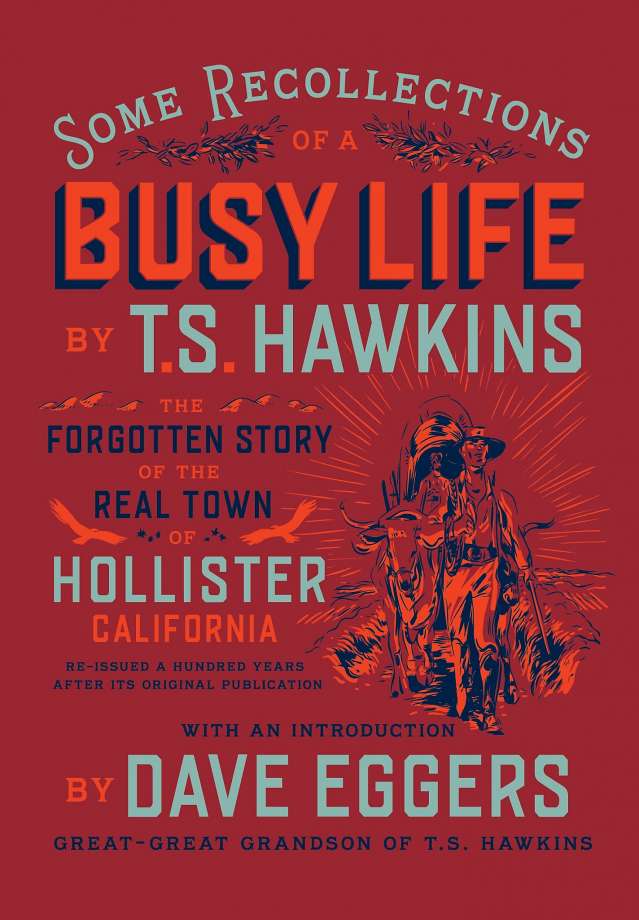
[READ: July 22, 2017] Some Recollections of a Busy Life

The beginning of this book includes Dave Eggers’ essay that was in the New Yorker, July 20, 2015 issue.

Read about it here.

T.S. Hawkins was Dave Eggers’ great-great grandfather.  In 1913 Hawkins wrote Some Recollections of a Busy Life and printed 300 copies.  Now 102 years later, Eggers was able to use his press to get it reprinted,

What’s even more disconcerting is that we’re prepared for the book to be 102 years old, but it starts with Hawkins talking about what it was like seventy years ago.  So the beginning of this book is actually set in the 1840s and 50s.  He was born March 6, 1836 in Missouri about 12 miles from the Mississippi River. His grandfather had been from Virginia and then moved to Kentucky and then on to Missouri.

He is writing his recollection not believing that the general public would care about them but he hopes his children and grandchildren might be interested in the changes which have taken places over the years of their grandfather’s life.

He grew up West of the Mississippi with no railroads and no telegraphic or telephonic communication with the rest of the world.  News in the East took weeks to reach them.  Electrical lighting was a thing undreamed of.  They made their own soap with the ashes from their fires.  Their clothes were homemade. (more…)

Read Full Post »

[WATCHED: March 5, 2012] Midnight in Paris

I took a course on Woody Allen’s films in college and, as a result, I had seen everything he had done (and a lot of what had inspired him).  After college, I made a point of seeing everything he released.  Often on opening day.  (My double feature of Deconstructing Harry and Good Will Hunting on Christmas Day is still a highlight).

But after The Curse of the Jade Scorpion, which was okay, but just barely, I basically gave up on him.  I watched Match Point in three parts (no time at the time) and really enjoyed it, but I never really got back on track with Woody.  And then came Paris.

Despite its huge popularity, I knew nothing about this Woody Allen film.  I knew Owen Wilson was playing the Woody Allen character in this one and it was getting amazing reviews.  Now, it’s very true that critics don’t always get Woody Allen, but when they unanimously get his film it’s pretty safe that it’s a good one.

And boy was it ever. (more…)

Read Full Post »