Feeds:
Posts
Comments

Archive for the ‘Marriage (Happy)’ Category

314SOUNDTRACK: ANE BRUN-Tiny Desk Concert #518 (April 1, 2016).

aneAne Brun is a Norwegian singer who is currently based in Sweden.  She plays piano and guitar and has a pretty voice which reaches high notes but maintains a kind of rough rasp.  She says she had a terrible cold and this is her first day of singing.  She doesn’t trust her voice yet and she thanks everyone for being so quiet.

The three songs she sings are slow (a little too slow for my tastes).  The blurb says that these are the three slower songs on the album, so maybe I’d like them a bit more amid the other songs  This is not to say the songs are bad, just a little too mellow.

Having said that, the melody and vocal lines of “Still Waters’ are beautiful.  This is the one song she plays on the piano and it does sound rather different from the other two.

For “All We Want is Love” (which she describes as the ultimate love song, kind of), she plays a pretty, picked melody on the acoustic guitar.  But its clear that her voice is the main instrument here–and she hits some lovely notes in the repeated refrain of “All we want is love.”

“Signing Off” is the last track on the album.  It is a slow guitar song. The melody isn’t as immediate as the previous song, but her voice really does carry the tune nicely.  I wonder if her voice normally sounds like this or if the cold impacted her singing.

[READ: March 14, 2016] “For the Best”

I wasn’t that inspired by the previous story of Beattie’s that I read.  And I didn’t really love this one either.  I found it very slow going.

The story is about a man named Gerald, an older divorced man, who gets invited to a party.  His ex-wife, whom he has not seen in some thirty years will also be invited.

But the way this was revealed was kind of circuitous, I thought.

the Clavells weren’t the sort to play pranks, so the printed invitation to their annual Christmas party arrived after what Gerald and Charlotte’s son, Timothy, would call a “heads-up,” sent by e-mail, letting them know that both were invited to the event, at the Clavells’ apartment, on West Fifty-sixth Street. Gerald hadn’t seen Charlotte since their divorce, thirty-one years before, and this was the first time he’d seen her e-mail address. Whether she was on any social media he wouldn’t know, as he was not.

I enjoyed some of the oddly phrased ways the story was revealed (like that last sentence), but it took me a few tries to puzzle out if Gerald was the recipient or the sender oft he invite.  It’s a long first sentence, I guess.

I also enjoyed this follow-up sentence: “It was a rather jaunty message from the Clavells, who were not jaunty people.”  But I think that reading so much of the story like this is exhausting. (more…)

Read Full Post »

henrySOUNDTRACK: THEE SILVER MT. ZION MEMORIAL ORCHESTRA-Fuck Off Get Free We Pour Light on Everything [CST099] (2014).

99Aside from the dance remix single of “Hang on to Each Other,” this is the latest Silver Mt. Zion record to be released.  For those keeping score, GYBE has released an album more recently than SMtZ.  This album is full of punk piss and vinegar (as if the title didn’t give it away).  It’s mostly represented by a heavily fuzzed out guitar that runs underneath nearly all of the songs.

The album begins with a child saying, “We live on the island of Montreal … and we make a lot of noise … because we love each other.”

This first song is called “Fuck Off Get Free (For the Island of Montreal)” and the music starts with scratching noisy guitars and everyone else playing a simple ascending and descending riff.  The vocals kick in right away and it feels like the whole group is singing along too–everyone is involved in this noisy song.  It works great.  Even when the song shifts to a more singable part it retains the intensity of the pacing.  Around 4 minutes we get a return to the chanted vocals that lead into a kind of hurricane of a solo section.  And when they come out of that the chorus sings the chanted title.  The biggest change comes at 6 and a half minutes when the whole song shifts and a slower, heavier and deeper guitar chord (unlike any they have played before–it feels unearthly) drives the remainder of the song.  As I’ve noted in other songs, I love when the choir sings by itself (the female singers in this case singing “pull me under”), and they all sound much more “professional” than the kind of loose choir they were a few albums ago.  This choir sings to the end of the song as the instruments all drop off leaving only voices.  It’s pretty fantastic.

“Austerity Blues” is 14 minutes long and opens with a flat sounding scratched acoustic guitar and sing along vocals.  While the scratching  guitar is going on a cool bass line begins.  Things quiet down which leads to a noisy one-note distorted guitar that adds a layer of noise to the melody line.  The song shifts to a louder section with scratchy violins and big pounding drums (David Payant has really added a lot to these songs with his powerful drumming).  Around 6 minutes in, a distorted echoing guitar plays a kind of Middle Eastern-sounding guitar solo.  When the solo settles down a new faster section begins–lots of drums and group singing.  By ten minutes, the song feels like it’s fading out as the music gets quieter.  But a new set of vocals resume more quietly this time, and they sing their melodies quietly until the end.

“Take Away These Early Grave Blues” opens with a girl with a very thick British accent wondering why “people think like that” as a noisy violin kicks in with a see-saw riff and shouted vocals.  This song sounds like a pretty standard SMtZ song with the big exception being the really noisy drums that dominate the track (Payant again).  At around 2 minutes, the music drops away leaving just a buzzy bass introducing a noisy drum and guitar solo.  When the vocals resume the music becomes a fast pounding drum fill and more distorted violins and guitars.  The song is intense and while only about 7 minutes long, it really packs a lot in.  It ends with a fast riff (that’s almost an Irish jig) followed by crashing drums and chanting lyrics: “Love each other that’s all.”

“Little Ones Run” is only two and half minutes long.  That’s unusual in itself for the band.  But even more unusual is that the song is like a lullaby.  It’s a quiet piano melody and lyrics sung by the female members of the band.  It hearkens back to their first albums which were all piano, but this is a much updated version of that early sound.

“What We Loved Was Not Enough” opens with quiet violins and deep bass notes.  The relative quiet is shattered by Efrim singing (this is the first instance on this album where his polarizing voice stands out–on the rest of the album it’s pretty well mixed in with everything else.  But I think he’s won us over by this time and we can accept it, especially since the musical melody is so pretty.  There’s also a lovely violin solo that runs through the middle of the song.  In fact, the whole song would be really quite pretty except for the distortion that permeates it–a noisy guitar underpins the whole thing.  But at 6 minutes, everything drops out except for the pretty violin and the vocals,  “And the day has come when we no longer feel.”  That refrain is picked up by the beautiful choir voices (they really sound great).  As they repeat this section, Efrim sings a harsh lead vocal (he sounds a bit like Larry Kirwan from Black 47).  There’s an instrumental section that scorches with noisy guitars for about a minute and then at 9 minutes the song returns to that beautiful chorus (with male voices added) and that delicate violin.  It goes on like this until the end.  It’s really lovely.

The final song “Rains Thru the Roof at Thee Grande Ballroom (For Capital Steez)” is also rather different for the band.  It is “introduced” by an interview (in English and translated into French) from an unnamed musician who is talking about how being in a band is more than a part time gig … it’s what you devote your life to.  When the music comes in it’s floor toms and an unsettling distorted and scratchy strings or keyboards or sampled voices and keyboard which slowly growing louder.  There’s stabs of piano and vocals which are far back in the mix.  The melody is nice but mournful and it continues for all of the four minutes.  [Capital Steez was a rapper from Brooklyn who committed suicide in 2012.  I honestly can’t tell what this song has to do with him].

I’m not sure which band we can expect to hear from next, but both GYBE and SMtZ have released really strong records in the last few years.

For this album, the lineup stays the same as on the previous album (and the band name has remained the same, too).

Thierry Amar: Upright bass, electric bass, plucked piano, vocals
Efrim Menuck: Electric guitar, acoustic guitar, mellotron, vocals
Jessica Moss: Violin, plucked piano, vocals
Sophie Trudeau: Violin, plucked piano, vocals
and David Payant has taken over for Eric Craven on drums, organ, piano and vocals

[READ: March 15, 2016] “Confessions of a Humorist”

I only found out about this story from reading The Fate of the Artist.  I have always vaguely liked O. Henry, but can’t say that I’ve read much by him.  I found this story to be simple and fairly obvious, although perhaps it was obvious because he introduced this style of storytelling to the world one hundred years ago.

The narrator is a bookkeeper in a hardware firm.  We learn a bit more about him and his family.  This line delighted me for some reason, “Naturally, we lived in a vine-covered cottage.”

On the occasion of the senior partner’s 50th birthday, he was selected to give a speech.  And it was a hit.  People laughed and suddenly his reputation as humorist was established. (more…)

Read Full Post »

fateart SOUNDTRACK: THEE SILVER MT. ZION MEMORIAL ORCHESTRA-Kollaps Tradixionales [CST063] (2010).

kollaspThis album was released as a CD and as double 10″ vinyl.  Each “side” is about 15 minutes long.  And, interestingly, each side has a kind of theme, I guess.  It also includes the shortest song the band has recorded.

“There Is a Light” is one of my favorite songs they’ve done.  The guitar and strings play off each other perfectly and the song ebbs and flows very nicely.  Efrim sounds pretty drunk in his vocals, which gives the whole thing a shambolic quality that contrasts nicely with the elegance of the music.  Of all of their songs, I think this one really captures the intensity that these band can generate with the swelling strings and pounding drums.  At 6 minutes, the whole thing slows to a halt but is then resumed with a new, even more interesting section.  Over reverbed guitars, a series of horns and backing vocals singing “la las” flesh out the lead vocals.  I really enjoy the way the strings swirl around the vocals only pausing to let the words “One Step Two step” come out in staccato vocals.  But the main strings riff that follows these verses is so pretty, I could listen too just that.  This all ends around 9 minutes, when the final part begins with slow guitar and horns.  The vocals come in singing the title “there is a light.”  It starts quiet but soon enough the full choir of voices joins in as the music swells.  After a few round of verses, the song ends with the female choir singing, “Tell me there is a light.”

The second “side” is the “metal bird” side.  It stars with “I Built Myself a Metal Bird” which opens with rocking guitar chords and fast drums–the most overtly rock song they’ve done so far.  The vocals are screamed and staccato.  Things never really let up for the whole six minutes–there’s a concurrent violin solo while the lyrics are sung.  The second half of the song changes things a bit–with more dramatic strings playing.  In the last thirty seconds the tone changes a bit and things do mellow out for the conclusion.  That leads into the second bird song

“I Fed My Metal Bird the Wings of Other Metal Birds” is quite different from the first.  It opens with slow electric guitars and quiet strings.  There’s noisy guitars and other strange atmospheric sounds for the first three and a half minutes when it finally settles into an uptempo string song with more great violin riffs.  At fiver minutes (of 6) the bowed bass takes over the main line and the accompanying strings help to move things along.  There’s only about 30 seconds left when the vocals come in and they are nearly drowned out by the music.

The third side is the “Kollpas” side with three songs.

For “Kollapz Tradixional (Thee Olde Dirty Flag)” the piano comes back with quiet chords and gentle strings accompanying quiet vocals. .  The song stays quiet as different instruments come to the fore.  At around 5 minutes (of 6 in total) a guitar solo winds its way to the end of the song.

After this there is a 1 and half-minute song “Collapse Traditional (For Darling).”  It’s a gentle ballad played on strings with layered vocals.

“Kollaps Tradicional (Bury 3 Dynamos)” opens with pizzicato strings and a fuzzy meandering guitar.  About 2 minutes in, the loud chords strike and the drums kick in with a fairly complex rhythm.  About half way in, one guitars start playing in each speaker and the vocals begin.  Two voices begin singing against each other keeping an interesting rhythm with their staccato phrasing and the thumping drums,.  The last two minutes feature a guitar solo and vocals following a similar pattern as the guitar.

The final side has one 14 minute song “‘Piphany Rambler.”  The song begins with distant guitars and plucked strings.  The vocals are quiet, nearly whispered.  A refrain of “don’t sleep” surfaces from the quiet.  At around 5 minutes the guitars and strings grow louder and the song properly starts.  But even this section is fairly slow, as if preparing to build up to something else.   It’s the strings and their insistent three note melody that really unites the song.  About midway through things slow down even further (with some cool retro organs sounds amidst the strings).  And the song turns into a very catchy string filled section with the vocals working very nicely with the melody.  This section grows louder and more raucous as it heads to the conclusion.

SMtZ has made many diverse styles of albums over the years, and this combination of rocking songs and delicate strings is probably my favorite.  For this one, the lineup has shrunk to a five piece of

Thierry Amar: Upright bass, electric bass, plucked piano, vocals
Efrim Menuck: Electric guitar, acoustic guitar, mellotron, vocals
Jessica Moss: Violin, plucked piano, vocals
Sophie Trudeau: Violin, plucked piano, vocals
and David Payant has taken over for Eric Craven on drums, organ, piano and vocals

[READ: March 15, 2016] The Fate of the Artist

I didn’t love Eddie Campbell’s Black Diamond Detective Agency, and that was manly been because of the art.  That didn’t really bode well for this story.

But Campbell does an incredible thing with this book.  He mixes text and many different kinds of pictures–including comic strips and photographs, to create a fascinating story of his own disappearance.

The story begins “One day the artist wakes up with the disquieting feeling that it has all gone wrong….  It is difficult to obtain sympathy for this condition.”

And then the Artist disappears and all that is left is a picture.  “Most people would leave a note.” “Yes, well he left a picture.” (more…)

Read Full Post »

earnestSOUNDTRACK: THE SILVER MT. ZION MEMORIAL ORCHESTRA & TRA-LA-LA BAND-Born into Trouble as the Sparks Fly Upward [CST018] (2001).

Born_into_Trouble_as_the_Sparks_Fly_UpwardNotice that the band’s name has gotten longer.  That could be because they have added three new members (which means they are slowly growing to be the size of GYBE anyway). In addition to Efrim, Thierry and Sophie, there is now Becky Foon on cello, Ian Ilavsky on guitar and organ and Jessica Moss on violin (all Constellation stalwarts).

The first song is the nine minute “Sisters! Brothers! Small Boats of Fire Are Falling From the Sky!”  Echoed drum sounds slowly grow louder before a slow violin plays a mournful melody.  But with the new members, there is now a cello to accompany the violin, making this album sound even more classical.  Three minutes in, the piano takes over (and the strings slowly fade).  The piano is a bit prettier and more accomplished sounding (even if it has only been a year since the last album).  Despite the addition of all of the extra instruments, the song still veers pretty far from GYBE territory.  It feels very acoustic (what with the piano), and while the song is repetitive it never feels like it is epic or building towards something–it just grows bigger and more beautiful as more instruments enter the mix.

“This Gentle Hearts Like Shot Bird’s Fallen” opens with what sounds like bird noises, but may actually be a child.  The song is primarily echoed guitars which lay a foundation over which the violins and cellos play slow mournful notes.  The song grows as more instruments  play along, including some gentle percussion, and it all seems to end too soon.

“Built Then Burnt [Hurrah! Hurrah!]” is a spoken piece.  Efrim doesn’t recite the words–it sounds like a child (but may be a young woman).  The reading is dramatic and works very well with the slowly building strings that comprise the bulk of this song.

some lines:

Why are we all so alone here
All we need is a little more hope, a little more joy
All we need is a little more light, a little less weight, a little more freedom.
….
Good words, strong words, words that could’ve moved mountains
Words that no one ever said
We were all waiting to hear those words and no one ever said them
And the tactics never hatched
And the plans were never mapped
And we all learned not to believe
And strange lonesome monsters loafed through the hills wondering why
And it is best to never ever ever ever ever ever ever ever ever ever wonder why

As that song fades, the aggressive strings of “Take These Hands and Throw Them in the River” take over. This song features Efrim singing in full voice–the recognizable voice of SMtZ.  On this song his voice is processed and echoed and so the strange timbre of his voice doesn’t quite register because it sounds so…unusual anyway.  I really enjoy the way this song sounds so much bigger than the rest.  At around 4 minutes, while the song begins to build –both instrumentally and vocally, new strings bring more intensity until the whole thing just fades away to the sounds of actual birds which chirp for about 2 minutes.

“Could’ve Moved Mountains…”is eleven minutes long and shows incredible restraint, especially in the vocals.  It opens with slow bass notes.  The whispered spoken vocals return and the song is kind of ominous..  About three minutes in quiet harmony vocals accompany him and soon after, strings are added and continue to grow louder.  The instrumental section is quite pretty although still melancholy.  Around 8 minutes in, a guitar riff begins playing a similar melody to the strings. It plays for a bit and then the strings rejoin the song, playing a more hopeful melody.  The song ends with some kids talking and singing as the song melds into….

“Tho You Are Gone I Still Often Walk W/You”  This song opens with piano and cello, a sad intro indeed.  I like that after a minute the song jumps keys unexpectedly while keeping the rhythm otherwise the same.  The song doesn’t vary much from this simple piano and strings feel although it ebbs and flows in intensity.

“C’monCOMEON (Loose An Endless Longing)” breaks the melancholy of the previous son with a big buzzy electric guitar chord.  Strings eventually come in and the song builds and builds, complete with interesting percussion.  This song is probably the closest to a GYBE song with a dramatic build and very satisfying chord progressions.  When the fast bass notes kick in around 3 minutes it seems like the song is going to grow even faster, but instead, it fades away to some ringing chimes–what sounds like a giant echo chamber (a really neat effect).  That calm is broken by a series of horns playing one note at a time, louder and louder (this whole middle section reminds me of the middle of “Atom Heart Mother” by Pink Floyd–in fact I have found a number of comparisons to some of Floyd’s trippier moments on this and other albums).  And then the drums come crashing back in.  It’s a very different song that resumes–loud bass, lots of drums and everything mixed loud enough to distort the sound.

The final song is “The Triumph of Our Tired Eyes.”  It opens with guitar harmonics and Efrim’s disatnat voice.  It’s a pretty and delicate song, joined by strings and a genuinely pretty vocal melody: “There’s beauty in this land, but I don’t often feel it.”  And as the strings swell and swell, the voices sing the refrain: “musicians are cowards” over and over.  The song and disc end on a surprisingly quiet and beautiful note.

When the songs ends, there’s a few seconds of children singing lyrics to the “Twinkle Twinkle Little Star” melody although the words don’t fit like: “when we finally cross the barricade…”

I really like the way this album plays with the new style of music the band has embraced but also admits some of the strengths from pretty much everyone else’s other band.

[READ: April 4, 2016] The Importance of Being Earnest–The Graphic Novel

This play is one of the great plays in English literature.  Oscar Wilde is at his best, writing witticism upon witticism–each line is a funny rejoinder to the previous one and the wit is infectious.

The story is fairly simple, but he adds so many twists that it’s almost easy to get lost in the story.  In fact, it’s entirely possible that reading the play is a sure way to get lost in the deceptions.  And that’s why this graphic novel is so excellent.

I’ve always maintained that it is difficult to “read” a play, especially if there are dozens of characters.  The short, one act plays that I’ve been reading over the last years are fairly easy to follow, but when you have 20 named characters in three acts, it’s not always easy to keep people straight.  And that’s why to really appreciate Shakespeare you need to see it.  Well, this graphic novel effectively performs the play for us.  The dialogue is exact and there are no changes from the original (except for any stage directions, which are left out of the text, but are presumably addressed in the art).

What’s (intentionally) confusing about this play is that the two main characters are trying to deceive other people about their identity.  Algernon Moncrieff and John Worthing are two gentlemen–well off, single, clever.  Algy talks about how he likes to go Bunburying.  Which means he has “invented an invaluable permanent invalid called Bunbury, in order that I may be able to go down unto the country whenever I choose.  …If it wasn’t for Bunbury’s extraordinarily bad health, I wouldn’t be able to dine with you.”  This comes up because John has informed Algy that he “has always pretended to have a  younger brother of the name Ernest, who lives in the [city] and who gets into the most dreadful scrapes.”

They have lies in common: each man lies to a group about a phony other person whom they use as an excuse for bad behavior. (they are old friends as well, of course). (more…)

Read Full Post »

spacedump SOUNDTRACK: YO-YO MA, EDGAR MEYER, CHRIS THILE AND STUART DUNCAN-Tiny Desk Concert #175 (November 17, 2011).

yoyoYo-Yo Ma might be the most well-known cellist in the world.  I suspect that everyone has heard of him.  But it’s likely that people don’t know just how diverse his musical range is.  As the NPR blurb says:

He’s reached out to a broad range of musicians (and Muppets) to play not just Bach and Beethoven, but also Brazilian samba, Argentine tango, jazz, songs from Sesame Street and a smorgasbord of Asian music with his Silk Road Ensemble. American roots music also figures into Ma’s melting pot: He teamed up with double-bass master Edgar Meyer and fiddler Mark O’Connor 15 years ago for the gentle new-grass album Appalachian Waltz.

For this 2011 venture called The Goat Rodeo Sessions, he has created another Americana album, this time with mandolin master (and multiple Tiny Desk Concert player) Chris Thile.  Meyer is back on double bass and they have added Stuart Duncan on fiddle.

I can honestly say I never expected to see Yo-Yo Ma on a song called “Quarter Chicken Dark” but there he is, playing along as Thile begins the song on the mandolin.  The cello, fiddle and bass are all bowed so, despite the mandolin, the song feels a bit more classical (Thile has also made classical music on the mandolin, so the pairing actually makes a lot of sense).  I think Thile comes off as the star of this song with a wild solo in the middle.

For “Attaboy,” the mandolin starts the song again, but pretty quickly the strings dominate.  There’s a beautiful opening by Ma and a great fiddle interplay in which Duncan hints at the big Irish section he’s going to play.  There’s some wonderful fast mini solos from all of the instruments, including the bass, and then the whole song switches to a jig with Duncan playing a very Irish riff while Duncan and Ma keep the low notes coming.   Incidentally, I believe that Thile and Duncan are playing the exact same solo by the end, which sounds great.  But it’s watching Yo-Yo Ma’s fingers and bow move so fast that is really amazing.

For the final song “Here and Heaven” Aoife O’Donovan joins them on vocals.  And for a chance of pace Duncan switches from fiddle to banjo.  (Although mid way through the song he switches back to fiddle).  Donovan and Thile sing the song together.  On the first verse they are a little too quiet.  But once they start belting out they are fine.  This song is catchy and fun and the vocals really do change the feel of their music.

It’s clear that these accomplished musician are having a lot of fun together.  Meyer and Ma actually wave to each other during the second song, and Thile makes lots of little jokes.  And when he introduces Aoife, it’s funny to hear Yo-Yo Ma cheer like a little kid.

While Yo-Yo Ma if probably the most famous musician here, I like them all, and I’ll honestly listen to Thile do anything.

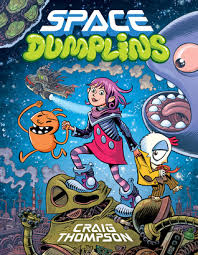
[READ: August 29, 2012] Space Dumplins

Craig Thompson has created a pretty diverse collection of books.  From the serious and beautiful Habibi, to the weird-looking and sad Goodbye Chunky Rice to this trippy sci-fi story.

The story is about Violet Marlocke, a young girl who lives out in a space trailer park.  Her father is a space lumberjack (whatever that means) and her mom is a seamstress.  They are poor but pretty happy, and that’s okay by Violet, since family is everything to her.

But as the book opens we learn that space whales (okay, I’ll stop putting “space” before everything, because he doesn’t) have just eaten her school.  The whales have been rampaging all of the planets in the area. At first Violet is happy to have no school but her parents have to do something with her.  So her mom brings her to work at Shell-tar where they try to see if she can enroll in the state of the art school there.  She can’t because her dad has a criminal record (and he’s opposed to the fancy school anyway).

While Violet is looking around, she meets Elliot Marcel Ophennorth, a small chicken who is incredibly smart (and has visions of the future).  We also meet Zacchaeus, the last Lumpkin in the world. He works at the dump.  Violet quickly befriends them both, although they don’t all get along very well at first.

Two things then happen pretty quickly back home.  Violet and her dad buy an old piece of junk space bike to fix up and Violet’s dad takes on a dangerous job to make some more money. (more…)

Read Full Post »

feb20156SOUNDTRACK: ANTHONY HAMILTON-Tiny Desk Concert #517 (March 28, 2016).

anthamI don’t know Anthony Hamilton, probably because he is a soul singer and I don’t listen to soul music.  He’s won Grammy’s and everything!  He and this band The Hamiltones (nice) had just played for the Obamas, and they came to the NPR offices afterward.

The first song, “Amen,” is new and he says was his attempt to write an R. Kelly song.  The other three songs are apparently the ones that have made him famous.  The songs are “Best of Me,” “Cool” and “Charlene.”

I love his American Flag jacket/sweater or whatever it is.  And his voice and the voices of The Hamiltones are pretty sweet.  No doubt if I listened to soul music, I’d have a lot of Hamilton’s discs.

[READ: January 26, 2016] “Family Business”

This essay was an interesting mash-up of two writers that I’d like to read more of.  I am a fan of Nabokov’s although I have read but a smattering of his work.  And I have enjoyed what I’ve read by Lipsky, although I have yet to delve into his fiction.

This is a book review of the recent publication of Vladimir Nabokov’s letters to his wife Vera throughout the length of their mostly happy fifty-two year marriage.  Sadly, Vera’s letters were destroyed (by her), although as it turns out, she didn’t write very much back to him anyway.

This is the kind of book review that I find exceedingly enjoyable. It sums up what the book has to say and then lets me know that while I might enjoy reading it, I don’t actually have to.  Not that he gives away spoilers–are their spoilers if you know what their life is like already?  But he really gets the gist of the letters and their life. And frankly, I don’t need to be that intimate with the writer, even if I do enjoy his works. (more…)

Read Full Post »

octSOUNDTRACK: CACTUS TRACTOR-“Jelly Donut” (Tiny Desk Contest Runner-Up 2016).

cactus Last week, a Tiny Desk Contest winner was announced. This week, All Songs Considered posted ten runners up that they especially liked.  I want to draw attention to a couple of them.

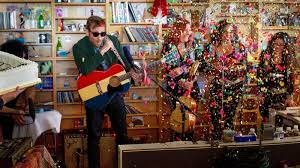
Cactus Tractor also have a lot of fun with the desk part of the tiny desk.  There’s a small purple desk and from behind it comes the lead singer and guitarist.  He is dressed crazily–this song and band are definitely a little goofy.  He pulls out a cactus and a tractor and then starts whistling.  It doesn’t seem like he’s whistling the song but he is. He starts playing along to the song a kind of old jazzy sound.  And it reminds me of “Mister Sandman” at times.

There’s some fairly complicated lyrics, “like reading Chinese, like choosing wine based on the cheese.”

And then a ukulele player comes out from behind the desk.  She is followed by a fisherman (it has to do with the lyrics). Then an accordionist sneaks out and she’s followed by an acoustic guitarist and an upright bassist.  The drummer comes out (they wheel his drums over)  And then finally a saxophonist and 2 trumpeters.

The song is funny and bouncy and catchy with several parts.

Eventually, the song switches to German (Berliner-jelly donut) and they sing many verses in Deutsch.  There’s no explanation for the fisherman by the end of the song (expect that he holds the jelly donut).  But that’s irrelevant because then some acrobats appear at the side of the stage and the camera pulls back as jugglers, stilt walkers and the like fill the screen.  It’s pretty extraordinary and it was done in one take (I expect the music was prerecorded, although I’d love to be wrong).

The song has novelty written all over it (they do lots of visual jokes about the lyrics) and yet it is really catchy and…unexpectedly, it is nearly six minutes long!

[READ: February 20, 2016] “The Cornucopia”

This is a short story that is set in Australia (the author is Australian, so that makes sense).

It is about a woman, Julia Holt, who is never impressed.  No matter what exciting things her friends tell her, she never shows appropriate excitement.  She is happy for her friends’ successes, but nothing seems to make her excited.

Perhaps it is because she is powerful and rich and has everything she needs.  Indeed, she even has her friends do a lot of her work for her–she is quite busy, after all.  But her friends (carefully cultivated by Julia, it must be said) do benefit from her friendship.  And honestly she was a little afraid of their successes because she didn’t want to lose any of them.

She and her husband are wealthy.  They are one of Australia’s millionaire couples.  Ralph, despite this wealth was never arrogant or showoffy.  He also had no time for games or hobbies.  He just did financial work all the time  And Ralph will always acknowledge that Julia is the more powerful one of the two oft hem.

So far so good as stories go.  But there has to be a crisis of some kind, right? (more…)

Read Full Post »

june2015SOUNDTRACK: THE ARCS-Tiny Desk Concert #504 (January 25, 2016).

arcsOkay so the Tiny Desk folks make a pretty big deal out of this being their 500th show and I am stating that it is their 503rd show.  I have to guess that they post some shows out of order because I have counted twice and gotten the same number.  So we will choose to disagree with our numbering system, but I will also agree that this was their 500th episode because, why would they lie?

The Arcs are a band that I wished I liked more.  Everyone seems to enjoy them, but I really don’t.  Of course, I don’t like The Black Keys either, so this is no surprise, really.  Nevertheless, Dan Auerbach, who is in both bands, has a great voice and writes some interestign songs, I just don’t care for his arrangements–the very soulfulness that attracts fans, I guess.

They are accompanied by three members of  the Mariachi band Flor de Toloache, who did a Tiny Desk Concert a few weeks earlier (although I’m guessing it was the same day, hint hint).  They play a great accompaniment–sometimes all of them play, sometimes just one, and they add interesting elements to the songs.  They also sing backing vocals.

The band plays three songs from their album.  “Pistol made of Bones” which I like in this version (I don’t know the original, I don’t think).  I especially like the way the horn and violin play along with the melody and give it a very Mexican feel.  It removes some of the soul that I don’t really like about the songs.

The other two songs are the two singles from the album and I find that I like them less (I guess I’m a deep cuts kinda guy).

“Stay in My Corner” is a fine song.  I like the guitar lines and the way he sings it.  It’s just not my thing.  I really enjoy the backing vocals by drummer Homer Steinweiss, who has this hilarious style of tapping out these beats while leaning (practically asleep) on the drum machine–totally low key.

I really enjoy Auerbach’s singing delivery in “Outta My Mind.”  I just wish the song would do more.  I want it to be…something else.

So the 500th (ish) episode was probably a lot more fun in the Offices than it was for me.  Although I enjoyed the confetti cannons.

But congratulations anyway!  Here’s to 500 more–but take a break for a few weeks so i can play catch up, okay?

[READ: January 4, 2016] “Interesting Facts”

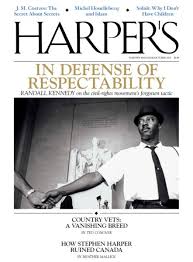
I hadn’t been reading all that many short stories at the time that I read this because I had been focusing on graphic novels and books.  So jumping back into the short stories at Harper’s has been a real treat.  And I really enjoyed this one.

Although I’m always leery of stories that center around a main character with cancer, I thought the way this was done was clever and interesting and it absolutely drew me in to the story.  Plus it was funny (at least at the beginning).

I loved the way it started: “Interesting fact: Toucan cereal bedspread to my plunge and deliver.”  It doesn’t even fully make sense by the end of the story but an essential part does and I enjoyed the way it was presented like this.

The story is told from the point of view of * a woman who developed breast cancer a few years back.  She says that “I’m going to discuss the breasts of every woman who crosses my path.”  And indeed she does. (more…)

Read Full Post »

may2015SOUNDTRACKTHE CLAYPOOL LENNON DELIRIUM-“Cricket and the Genie” (2016).

claypoollennonLes Claypool and Sean Lennon (who has recently come back on my radar as being much more fun than I realized) have joined forces to create this unlikely (but perfectly suited) band.  Lennon’s band Ghost of a Sabre Tooth Tiger opened for Primus and Dinosaur Jr this summer (and I am still bummed that I missed that tour).

What surprised me most about this collaboration is that it (well this song anyway, which is the only one I’ve heard) doesn’t sound like so many other collaborations with Claypool–meaning it’s not all Les.  Les plays bass and provides some backing vocals and that’s about it.  All the rest–the whole psychedelic craziness–is all Lennon.

The song has a totally retro psychedelic vibe (one that Lennon has been working with very well over the last few year) and Les’ bass is thumping and heavy without doing a lot of his Claypoolisms.  Not to say that the bass is shabby–it’s not–it’s just not as Aggressively Claypool as it might be (for the better of the song).

Having said that, the opening notes are pretty distinctly Claypool, but once the music (fuzzy guitars and hummable vocals) come in, the bass sounds more like a big 70s Jon Entwistle bass than a funky Claypool bass.

The song has many many parts and changes.  There’s a brief psychedelic interlude, there’s interesting organs sounds, there’s some heavy dissonant chords sprinkled throughout and there’s some great harmony vocal.  There’s even a pretty lenghty sea-shanty feeling instrumental section (the song is 8 minutes long after all).

But lest you think there is no Claypool, he gets plenty of places to show off his stuff, too.

I really dig this song a lot and I can’t wait to hear the whole album.

[READ: January 8, 2015] “For Something to Do”

As part of my 2016 plan, I intend to catch up on all of the magazines that I blew off during the latter half of 2015.   Basically, that means Harper’s, The Walrus and the New Yorker.  And I’ll write about the stories that I ignored.  Interestingly I was also planning on reading several large books in 2016.  Wonder how that will play out.

So here begins a slew of Harper’s pieces

This is the kind of story that, were it a novel, I would probably give up after a chapter.  But, because it was a short story, I read it all the way through, and I was glad I did.

The reason I’d have given up is because the story is dark and unpleasant, about men getting drunk and beating up other men to try to impress a woman.  I don’t know a lot about Leonard’s writing, so i don’t know how his stories tend to resolve, but I was worried about just how dark this would go before any resolution was present. (more…)

Read Full Post »

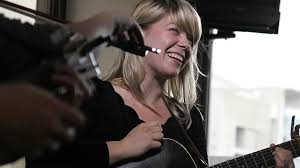
S2008_01_21OUNDTRACK: BASIA BULAT-Tiny Desk Concert #106 (January 24, 2011).

basiaFor some sad reason, this video cuts off about half way through the second song, so you need to watch it on YouTube instead.  Basia Bulat is a Canadian singer of Polish descent.  She’s adorable and plays weird instruments.  What’s not to like?

The first song “The Shore” is done entirely on a pianoette–she may be the only singer to play one.  The pianoette is a zither-like instrument with a strummed section and a hammered section.  Her voice is low and breathy.  And when, during the second verse, her backing band’s harmonies come in, it’s quite breathtaking.

The second song is done on guitar. It’s a Polish folks song–she says it was a big hit in the 60s in communist Poland.  She sings it in Polish and says it was a great way to learn her Polish words and pronunciations.  “W Zielonym Zoo” means “In The Green Zoo.”  It’s cute how happy and smiley she is as she explains this song.  It begins with just her on guitar and it’s quite a delight when Holly Coish on ukulele, Allison Stewart on viola and Ben Whiteley on bass join in.

pianoetteHer brother Bobby Bulat joins her on percussion for “Heart Of My Own.”  This song is louder and more dramatic and a lot of fun. The final song  “In The Night” is one she normally plays on the autoharp (see, unusual instruments) but she didn’t have it so she plays a rollicking guitar version with the full band (there’s some great violin solos in it).  Just before it starts she says that if it sucks, don’t use it.  It doesn’t suck at all.

I really like Bulat’s music a lot and this is a great way to witness it up close.  And here’s a picture of a pianoette.

[READ: January 8, 2015] “Ash Monday”

I wasn’t sure how much I would like this story (same old intro from me) because I didn’t like the main character (or one of the two main characters).  Dill is a delinquent.  He’s 13 and with a car (well, he has the car, he just cant drive it).  And hes loves the smell of gasoline.

When his mother tells him to goes outside to light the grill (as he does most nights–his mom doesn’t cook in the house apparently), he puts gasoline in it to light it up.  On this night he discovers a rat in the grill, so he takes the opportunity to dose the rat with the gasoline and set it on fire.  (If you’re squeamish, there is also the death of hundreds of chinchillas although that is from natural causes).

We don’t learn much about Dill’s mother except that her husband is gone and she is looking to date someone new.

The scene cuts to the next door neighbor, Sanjuro Ishiguro (Dill calls him “Itchy-goro” and once called him a motherfucking gook).  Ishiguro is a respectable businessman.  He works long hours often getting to work before everyone else.  And although he gets along with his workmates, he is definitely not one of them.  They like to ask him about sports when they know he knows nothing about it. (more…)

Read Full Post »

« Newer Posts - Older Posts »