 SOUNDTRACK: IMANI WINDS-Tiny Desk Concert #277 (May 29, 2013).
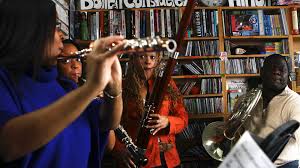 For some reason this video and audio has been removed from the NPR site (no explanation is given). But I found it elsewhere and was able to really enjoy it.
But they have left up the blurb:
When Igor Stravinsky began composing The Rite of Spring, his ballet for vast symphonic forces, he could hear the music in his head but couldn’t quite figure out how to write it down. It was just too complicated.
Today, 100 years after The Rite‘s premiere, the fearless musicians of Imani Winds make it all sound remarkably easy, given that they’ve condensed Stravinsky’s massive walls of sound down to just five instruments: bassoon, clarinet, flute (doubling on piccolo), oboe and French horn.
Make no mistake: Many of the jagged rhythms and crunching chords remain viscerally intact, albeit on a more intimate scale. As the group huddled behind Bob Boilen’s desk, bassoonist Monica Ellis noted the opposing ratios, saying, “It’s apropos in some strange way that we are playing one of the most massive pieces in some of the smallest instrumentation in one of the smallest settings that it could possibly be played in.”
The setting might be small, but in this clever arrangement by Jonathan Russell, we learn that a wind quintet, when called upon, can make a mighty and sonorous wail. Just listen to how the Imanis cap off “Dances of the Young Girls” with the entire quintet in full cry (at about 4:30 into the video). The bassoon repeats a fat bass line while the clarinet runs its snaky scales. The piccolo, in piercing chirps, serves as a foil to a frenzied oboe and snarling “whoops” from the French horn.
But not everything in The Rite is all pound and grind. Stravinsky’s transparent introduction, almost impressionistic, is a fluttering aviary of winds — even in the original — with individual colorings for each instrument. It’s all rendered beautifully here by Imani Winds, musicians brave enough to play David to Igor Stravinsky’s imposing Goliath.
This concert is fascinating to watch (and listen to) because even though this piece is familiar (to me) in theory, it’s apparent that I don’t really know it. And I can see why this piece was so controversial when it came out–it is weird and chaotic and almost random at times. I imagine that seeing it as a ballet might make it more cohesive, but it’s still pretty out there.
I love that the bassoon seems to be the primary instrument–one that doesn’t typically take center stage.
The group breaks up their selections into three primary chunks.
Selections from The Rite of Spring:
For “Introduction” the bassoon is the primary instrument playing the initial melody. Then the clarinet and oboe give the whole thing an unsuaul sound–to say the least. The French horn actually works as the the bass for this part. It’s also neat watching the flautist switching between flute and piccolo. I’m not sure when the second part “Augurs of Spring” begins, but I assume it’s when the bassoon repeats that initial melody and then the French horn plays a staccato bass note. The music sounds kind of threatening but whimsical at the same time.
Somewhere in here “Dances of the Young Girls” begins. I assume once the piccolo starts chirping and swooping. And then the band grows very loud before abruptly stopping.
The second segment she describes as incredibly picturesque. “Ritual of Abduction” begins nosily with almost total chaos from all the instruments–the piccolo stands out as sharp and piercing. As with the other segments, I’m not sure when “Spring Rounds” begins, but I have to wonder if this is when the music seems to go circular and then slow down. There are low notes from the French horn while someone is playing accent notes that sound, not off, but dissonant–providing stark contrast with the rest of the slow movement. There are some blares of music from the French horn as well.
I’m guessing that “Dancing Out of the Earth” begins with the fast bassoon melody: up down up down up down up down with trills and swirls from the flutes and clarinet. It rises and rises very dramatically and then stops.
They tell us that it’s not possible to play the entire ballet so they have taken the “greatest hits” and for this show it’s the greatest hits of the greatest hits. Consider it a deconstruction with five instruments. But it still evokes the spirit of this sacrificial dance.
She talks about how controversial this was in 1913, “when ballet was meant to be about… I was going to say flamingos…. fairies swans, the other water animals.” This is the final moment the virgin who sacrifices herself dances herself to death. And they are going to exemplify trombones and timpani and all that loud stuff (the French horn player laughs and says “Grr I am trombone”).
“Sacrificial Dance: The Chosen One” begins with a three note melody–again it is somewhat threatening. There’s lots of little fast runs by the French horn with accents from everyone else. It stops dramatically at one point and then resumes with so many different melodies. And then comes the surprise ending with a rising flute line and then a low end from the horn.
Without taking away anything from Imani Winds, I ‘m sure this performance doesn’t do the whole thing any justice. But it is amazing to imagine how much more there is to it. And it is amazing that these five instruments can evoke so much. It’s an uncomfortable and somewhat shocking first listen. It’s amazing that is over 100 years old, although it sounds so contemporary.
I don’t know why it’s not on NPR any more. I found it on YouKu (whatever that is). I have been able to watch it twice but on two other times I was unable to watch it. So keep trying, it’s worth the effort.
[READ: May 5, 2016] The Boy in the Dress
David Walliams is best known (if he is known at all) as the tall one on the sitcom Little Britain.
I had no idea he wrote books (he has done over half a dozen children’s books), and I was happy to start with this, his first one.
This book is illustrated by Quentin Blake, who is best known (if he is known at all) as the illustrator for the Roald Dahl books. So his simple, somewhat sloppy, style might look familiar.
The story is, as the title suggests, about a boy who wears a dress. And the story is very funny–not because it makes fun of him for wearing a dress, oh no. In fact, I love the story for going out of its way to show that it is normal that a boy might want to wear a dress. (more…)

 I Just Read About That...