Feeds:
Posts
Comments

Archive for the ‘Magazines’ Category

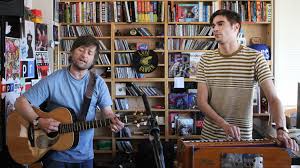
may2016SOUNDTRACK: GROUPLOVE-Tiny Desk Concert #166 (October 11, 2011).

grouploveWith a name like Grouplove, I expected a certain sound–I imagined a dancey, funky, R-rated kinda of band.

  But when I listened to this set, I realized that I knew the first song, “Tongue-Tied” and I loved it–it’s incredibly catchy and poppy and with a title that belies the common refrain “take me to your best friend’s house….” I love the two vocalist and that lead singer Zucconi’s voice strains bit still sounds good.  There’s a middle section that reminds me a bit of Edward Sharpe & The Magnetic Zeros’ “Home” with the two lead singers having a call and response section.  I only wish she was a little louder (he’s very loud).  But the rest of the song sounds nothing like that and is definitely is his own thing.  Special attention should be paid to the bassist who throws in some great lines.  I also like that the xylophone is used for percussion in this song.

speaking of the bassist, his cowboy hat bumps into something on the wall and the drummer mocks: “I’m from England I’m going to come back and get revenge.”  Bob asks for more about ths development, but the drummer continues, “He’s just bitter about the War of Independence.”  The bassist mutters, “It still hurts.”

When they released this song/album they’d only been together for a year and a half.  Hannah Hooper and songwriter, singer and guitarist Christian Zucconi met the other members of Grouplove — Sean Gadd, Ryan Rabin (son of Trevor Rabin) and Andrew Wessen on the island of Crete at an artists’ retreat.

Turns out I also knew “Itchin’ on a Photograph” (most notable for the way he sings (with a aching falsetto) “itchin on a photograaaaaph.”  Some more great bass lines here too.  Zucconi’s voice has got to hurt at the end of this song

Their final song is “Colours.”  Hooper’s harmony vocals are great on this song, and I really like the echoing electric guitar.

It’s hard for me to believe that “Tongue-Tied” is five years old, as  feel like I’ve been hearing it on the radio still.  The band has only put out once album since this one but they’ve been writing songs for all kinds of movies and TV shows.   I’d like to hear if they kept up their success of writing super catchy pop songs.

[READ: April 22, 2016] “A Shrinking World, An Opening Sky”

This story is a look a dementia (see, I said the two stories in this month’s issue were dark).  What I found most interesting about the way it was written was that it was from a close third person.  It got inside the demented man’s head but it wasn’t a first person account, so the confusion was presented objectively–a delicate balance, for sure.

It begins from the old man’s wife’s perspective.  She feels that her husband has lived long enough (she won’t say this to her family members, of course).  A while back he’d had some bad days.  There were some good days sprinkled in, but it has been steadily bad ever since.

This story is not set on his last day, but the narrator recounts his last few days which have been much the same. (more…)

Read Full Post »

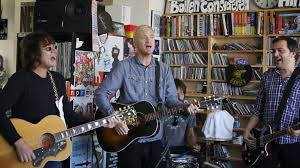
may2016SOUNDTRACK: FOUNTAINS OF WAYNE-Tiny Desk Concert #164 (October 6, 2011).

fowI have never really gotten into Fountains of Wayne even though a) they write incredibly Cathy indie pop, the kind of music I rather like and b) their name comes from a store that I have driven by many times in my life.  I think I didn’t like their first single when it came out or something, so I just dismissed them and never looked back.

Which is a shame because this set is full of delightful, slightly dark pop gems.

Fountains of Wayne put out a couple records in the 1990s and then went away and put out a couple more in the 2000s.  There are two excellent songwriters in the band singer guitarist Chris Collingwood and bassist Adam Schlesinger.  Schlesinger has been writing pop hits for (a lot of) movies and other lucrative gigs.   Clearly he has a knack for pop goodness.  And Fountains of Wayne is on the good side of pop.

“The Summer Place” opens with bouncy chords (the two guitarists play acoustic guitars).  But despite the poppyness, the lyrics are a little dark: “She’s been afraid of the Cuisinart since 1977 / now when she opens up her house she won’t set foot in the kitchen.”  I love the harmony vocals and how the second acoustic guitar sounds vaguely like a violin on the single notes.  “Valley Winter Song” is an older song.  It still has that sound–catchy guitars, nice harmonies and a notable bass line.

“A Dip in the Ocean” (like the first song, it comes from their then new album) features a prominent bass line and wonderful oohs and ahhs.  The lyrics are clever and funny.  Based on these two songs, I’d say that the 2011 album is pretty excellent.

When they ask if they can do one more, Stephen Thompson says that “that clock is one song fast,” and they launch into one of their older songs, the lovely ballad, “Troubled Times.”  The video of the song gets cut off just before the end, but if you listen to the audio you can hear the last few chords.

My friend Steve yelled at me for not liking this band, and I can see that he was right.

[READ: April 21, 2016] “In the Tower”

I had been trying to get caught up on all of the Harper’s stories that I’ve read.  These next two get me caught up to the present, with a couple really old ones left. And man, these two stories are pretty dark.

This is an excerpt from a short story (it must be a long short story).  The narrator, now forty-two years old, explains that he has found a refuge from his family–his tormentors–in the tower of their house.  The tower is a long-unused library which he was familiar enough with to know that the left side was philosophical books and the right side was belletristic books.  He was told over and over to not go into the library.  But it was his refuge.

He grabbed a book, it was by Montaigne.  He didn’t know what he was grabbing as he didn’t light a lamp for fear of mosquitos.

Much of this excerpt is filled with a kind of perverse Oscar Wilde litany:

“In every one of my statements there was nothing but this mockery and scorn in which they will one day perish, but I think that one day I will perish in their mockery and scorn.”

“Our unhappiness isn’t something we are talked into, unlike our happiness, which we talk ourselves into daily”

After several paragraphs denouncing his parents as conflating everything he has ever said he says he has always been in good hands with Montaigne.

“My family was too late in seeing that they had bred their destroyer an annihilator….How often they said that they would have preferred a dog to me, because a dog would have guarded them and cost less than me.”

As the excerpt ends and he is hiding with his Montaigne, he hears his family looking for him saying they hope nothing has happened to him.

It’s hard to know what is really going on, as this narrator sounds totally paranoid, but I didn’t love the excerpt enough to want to find out more.

Read Full Post »

april16  SOUNDTRACK: JEREMY MESSERSMITH-Tiny Desk Concert #158 (September 19, 2011).

jeremyI had never heard of Jeremy Messersmith before this show (the blurb even comments how it’s a shame more people haven’t heard of him since he is so sweetly poppy).

He looks a bit like Buddy Holly although my first though when he started playing was that he sounded not unlike Belle & Sebastian.  But there is more to his music than a simple reduction like that.

Messermith plays five songs (FIVE!).  For the first three he has a four piece behind him–big jangly electric guitar, a cello and a drummer accompanying his really nice picking style.

In “Toussaint Grey, First in Life and Death,” the electric guitar is mostly picking as well.  It’s a gentle song and you can really hear his voice well.

In “Knots” the tempo picks up with bigger drums and louder electric guitar.  I also love the picked cello as a bass guitar (this is the song that reminded me so much of B&S).  But by the end it is wholly his own (the falsetto note at the end is great).  This song is super catchy.  I love the break in the song when the drums kick in again.

For “Violet” the cellist switches to keyboards and the guitar plays some big jangly chords.  The chorus is great once again–super catchy and poppy.  Even better, there’s some great background Bah bahs and then other oohs of harmony.  But it’s the switch to an even higher note at the end of the bah bahs that totally had me hooked.

For the final two songs it’s just him and the cello.  His picking style on “A Girl, A Boy, and a Graveyard” is wonderful.  His voice sounds like someone although I can’t quite place it, but I love it.   The song is sweet and delicate.

Before the final song “Tatooine,” (which is about Star Wars obviously) he says that Steve Earle was in not too long saying that now songwriters write songs for nerds, and so this one is for the nerds.  The first line is “twin suns of Tatooine taught me everything I know.”  Pretty nerdy alright.  It’s just him and the keyboard on this, and the song is perfect this way.

I’m really looking forward to hearing some studio version of these songs.  This Tiny Desk was quite a find.

[READ: March 12, 2016] “Hygge”

I have read several stories by Dorthe Nors and I’ve found most of them a bit odd.  And so was this one, which was translated from the Danish by Misha Hoekstra.  I’m not even sure what the title means.

I’m unclear about a lot of things in this story.  How old is the narrator?  He is at an old folks’ home with a woman named Lilly. She has made the place nice for him (cleaned the dead leaves off the windowsill and put the budgie under its cover so it can go to sleep).

They’d had a fight earlier–she’d said that thing about his face–but she was trying  be nice now.  And she wanted everything to be cuddly.  Her hand was “inside the waist of my trousers.” (more…)

Read Full Post »

april16SOUNDTRACK: SEAN ROWE-Tiny Desk Concert #157 (September 16, 2011).

seanropwe Rowe (rhymes with how) is a burly, bearded folk-singer-songwriter.  When he’s not singing he is into wilderness survival and primitive living.

Before the third song he tells a lengthy story about going out into the woods with just a knife and surviving on whatever he could find.  If you’re interested in his stories, you can read about them on his site.

Rowe plays three songs.  For the first, “Night” he stands and plays a rather delicate guitar.  I don’t love his voice though, especially during the ending “where is my lord?” part.

I was amused by him when he said that for $200 he would eat the toast that is on the shelves behind him.  Robin asks if it’s really that hard out there.

He plays a different guitar (and sits on a stool) for “Bluegrass Baby.”  He sings and plays louder on this song.

The final song, “Surprise,” is my favorite.  I like the repeated riff that he plays, and his voice seems to work better with this louder song.  I especially love the great strumming/picking thing he does at the end

For sure, Rowe is a fascinating character.

[READ: March 13, 2016] “Plexiglass”

This is an excerpt from DeLillo’s novel Zero K (I do like that Harper’s tells you that it is an excerpt right from the get go).

I found that I didn’t rally like DeLillo’s last excerpt that I read.  His books are pretty complex and multifaceted and typically an excerpt doesn’t do it any kind of justice.  And while I enjoyed this one more, it still felt very spare.  And without context clues it’s kind of hard to get invested in the story.

Especially since in this case all of the characters seem to be rather unemotional themselves. (more…)

Read Full Post »

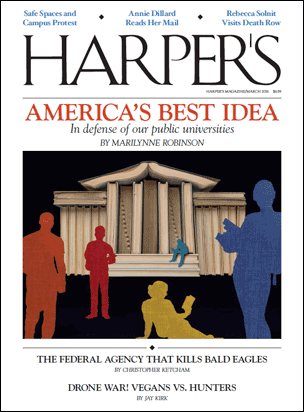
HarpersWeb-Cover-201603-302x410-21SOUNDTRACK: DIEGO GARCIA-Tiny Desk Concert #156 (September 12, 2011).

diegoDiego Garcia is an Argentine-American singer-songwriter.  When I saw the set up of guitar and cello I actually expected a more classical style.  But rather, Garcia is writing some beautiful, catchy songs about love and loss.

The blurb says that his album Laura is meant to be listened to as a full story, not just a few singles.  Since we only get four songs here I don’t know what part of the story we’re missing, but the songs we hear are pretty great.

“Nothing to Hide” is really quite lovely.  Diego sings and strums while Daniel on cello plays some aching notes.  Despite the aching quality the song is actually strangely upbeat sounding as well.

“You Were Never There” is interesting for where he plays the chords (way up on the neck).  And the cello plays the melody quite nicely (even taking a solo).  The song is poppy for such a dark sentiment.  The other guitarist, Zeke, plays a nylon-string acoustic guitar and adds some cool high notes (and a solo) as wonderful accents to what Garcia is playing.

“Under This Spell” begins with some minor chords and a much darker sound.  The tempo is fast again and the harmony vocals during the chorus really make it pop.

After the third song he asks if they can play a fourth song, “Would you mind?” (Who would ever say no?).

“Stay” features some really nice classical style playing from the nylon string guitar as Diego accompanies on strummed guitar and Daniel does some nice oooos as backing vocals.  I don’t really like the fluttering vocals he does in the middle of this song, though.  It might work better in studio or with a loud song, but it jut sounds weirdly affected here.  Nevertheless the way the song ends so dramatically really makes up for it.

I had never heard of him before, although apparently he was the leader of the band Elefant.  I get a sense that these songs tell a full story, and I’d like to hear the whole thing.

[READ: April 4, 2016] “Glory”

There was so much that I enjoyed about this story.  I loved that the main character Glory’s real name is Glorybetogod and how her parents (in Nigeria when she was born) believed that this would set her on the right path: to be smart, to attend church regularly and to “never stray from the Word (amen!).”  But in fact this name has given her nothing but trouble especially since they moved to the U.S.   She would always have to provide copies of her birth certificate for nearly every document and her Facebook account was constantly getting deleted because of their “real name” policy.  Her parents wanted the best for her, but it was her grandfather who was straight with them all: “That girl has something rotten in her, her chi is not well.”

And he proved to be correct as misery and failure followed her everywhere.  While some might say it was fate, a lot of it was her poor decision-making skills.  Like deciding when she was 5 to put her finger into a sleeping dog’s mouth.  And now at thirty she is disappointing everyone by working a terrible job at a call center.

And that is why that night she has written a suicide note and has a handful of sleeping pills. (more…)

Read Full Post »

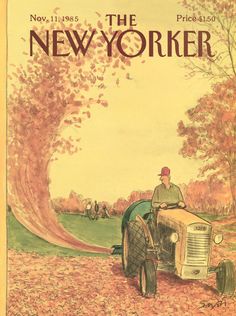
1985SOUNDTRACK: KING CREOSOTE AND JON HOPKINS-Tiny Desk Concert #154 (September 4, 2011).

creosoteI’d heard of King Creosote but didn’t know anything about him.  He’s a Scottish folk singer.  And Jon Hopkins is an English producer and multi-instrumentalist who is better known for his room-filling electronic works–although here he only plays the…yes, harmonium and keyboards.

“John Taylor’s Month Away” is a somewhat upbeat song–although the King’s voice is somber and mellow on every song.  I like watching him thump on his guitar to keep the beat while he’s not strumming.  And when he comes back in with the guitar again it sounds all the bigger for it.

The chord structure and delivery of “Bubble” sounds like a 1960s British folk song.  It’s quite lovely.  And when Hopkins switches to piano, it really brings out a lot more in the song.

These two songs came from Creosote’s album Diamond Mine, which the blurb says was everyone’s favorite album in 2011 (although I don’t recall hearing anything about it back then).  Stephen Thompson writes: “To immerse yourself in Diamond Mine is to be transported to a small, calm town in the Scottish countryside: For all of [Kenny] Anderson’s [King Creosote’s real name] reflective ruminations on aging and regret, he and Hopkins know how to make listeners feel at peace; to make the faraway seem everyday. “

“Cockle Shell” is not from Diamond Mine, although Jon did work on it, he says.  The guitar is a played differently–more picking, less strumming.  And the piano sounds lovely again. Creosote sings a bit bigger on this song.  The way he sings the preposterously upbeat music behind the lyrics “choke me, blind me, cut off my hands,” reminds me a lot of Frightened Rabbit.

For the final song, Hopkins switches back to harmonium.  It’s a short song, lovely and sweet.  And I’m sure if I followed the lyrics a bit more closely it would be rather sad too, as the final line is “while they were alive.”

I enjoyed Creosote’s music, although I feel like I’d have to be in a certain mind frame to put it on intentionally.  I will have to give a listen to Diamond Mine in total though.

[READ: January 26, 2016] “Three Thousand Dollars”

After reading the Lipsky articles in Harper’s I thought I’d see if he had written anything in the New Yorker.  I only found this one item, a short story from his collection.

I was intrigued from the start by this story because of the duplicitous nature of the college-aged narrator.  This was especially interesting to read after reading Lipsky’s Harper’s article about slackers.

The story begins with the statement that the narrator’s mother doesn’t know he owes his father $3,000.  It transpires that his parents are divorced and his father–who has a ton of money–is going to pay for his college after they get financial aid based on his mother’s lower income.  The balance–$3000 is what his dad will pay.

But when the $3000 check came in, the narrator spent it on other things instead. (more…)

Read Full Post »

00011SOUNDTRACK: PHOSPHORESCENT-Tiny Desk Concert #153 (September 1, 2011).

phospI know Phosphorescent from a Newport Folk Festival Concert a number of years ago.  I remember liking the show, although I feel a little disappointed by this Tiny Desk Concert.  This show is just Matthew Houck and his guitar.

The blurb says that Phosphorescent specializes in “free wheeling weariness.”  And that seems to be true.  It also says that Houck’s voice is weary after a lengthy tour and could barely speak which made his voice sound even more weary.  Phosphorescent was wrapping up months of touring and Houck could barely talk, let alone sing solo for 20 minutes on camera. We quickly hooked him up with as much herbal tea as we could find and coaxed that crooked croon back to life.

I found all four songs to be pleasant and, yes a little weary-filled.

I know that Phosphorescent is basically a solo project for Houck.  but when I heard the Newport Folk festival show back in 2013, he had a full band with him.  And I think the fuller sound made his songs sound, well, fuller.

“My Dove, My Lamb” is a pretty song, gently picked with a rather lovely sound and good lyrics.  After “We’ll Be Here Soon” he says that  “The Mermaid Parade” is in the same key with a lot of the same chords, “I’m okay with that if you are.”  The songs do sound rather similar. Before “Los Angeles” he says he has a new guitar with new tuning.  I can’t iamgine what he means by that.  Is he playing all of his sings with the strings tuned differently?

All four songs were pleasant, but they didn’t make me want to get his record.

[READ: January 26, 2016] “The Packaging (and Re-packaging) of a Generation”

Since I found the essay by David Lipsky in the recent Harper’s I decided to see if he had written anything else for Harper’s over the years.  In fact he hadn’t, but they had excerpted a portion of a book that he co-wrote, Late Bloomers: The Declining Prospects of the Twentysomething Generation.  Interestingly, on Amazon, only Alexander Abrams is listed as an author, but only Lipsky’s bio is given )no respect for Gen X).  Of course, the book is only available used since it is 22 years old, but as the slackers say, whatever.

Back in the 90s I read an enjoyed a lot of books about my generation–Gen X–from insightful commentary to parody.  And I’m somewhat surprised that this one missed my radar–although the title is a bit of a downer, let’s be fair.

The Publishers Weekly Review from back then states “In this sweeping and often dull analysis,” but for what it’s worth I found this excerpt to be pretty interesting.  Now if that could be sustained for 224 pages is something else entirely. (more…)

Read Full Post »

feb20156SOUNDTRACK: ANTHONY HAMILTON-Tiny Desk Concert #517 (March 28, 2016).

anthamI don’t know Anthony Hamilton, probably because he is a soul singer and I don’t listen to soul music.  He’s won Grammy’s and everything!  He and this band The Hamiltones (nice) had just played for the Obamas, and they came to the NPR offices afterward.

The first song, “Amen,” is new and he says was his attempt to write an R. Kelly song.  The other three songs are apparently the ones that have made him famous.  The songs are “Best of Me,” “Cool” and “Charlene.”

I love his American Flag jacket/sweater or whatever it is.  And his voice and the voices of The Hamiltones are pretty sweet.  No doubt if I listened to soul music, I’d have a lot of Hamilton’s discs.

[READ: January 26, 2016] “Family Business”

This essay was an interesting mash-up of two writers that I’d like to read more of.  I am a fan of Nabokov’s although I have read but a smattering of his work.  And I have enjoyed what I’ve read by Lipsky, although I have yet to delve into his fiction.

This is a book review of the recent publication of Vladimir Nabokov’s letters to his wife Vera throughout the length of their mostly happy fifty-two year marriage.  Sadly, Vera’s letters were destroyed (by her), although as it turns out, she didn’t write very much back to him anyway.

This is the kind of book review that I find exceedingly enjoyable. It sums up what the book has to say and then lets me know that while I might enjoy reading it, I don’t actually have to.  Not that he gives away spoilers–are their spoilers if you know what their life is like already?  But he really gets the gist of the letters and their life. And frankly, I don’t need to be that intimate with the writer, even if I do enjoy his works. (more…)

Read Full Post »

fableSOUNDTRACK: CALLmeKAT-Tiny Desk Concert #152 (August 29, 2011).

callmekatKatrine Ottosen is CALLmeKAT and she is from Copenhagen.  I’m unclear what her sound normally is–if it’s fuller than it is here–but for this show, it’s her on a couple of synths and a drummer.

I like the interesting synth sound she gets in the beginning of “Tigerhead,” but, despite the two synths, the whole song feels a little thin to me. Nevertheless, she hits some admirable high notes.

She wrote the second song, “Going Home” at Newark airport—she says always miserable there, it’s “so depressing” (no argument there).  She samples herself on a tiny keyboard (Bob asks her what she’s doing singing into the tiny Casio–this has to have been before everyone was looping everything).  The song is very pretty but feels very slight again–even more so because there is no percussion.

The third song, “Glass Walls” also has a sample of her voice–the sample is just an “ooooooh” note.  She says she wrote this one in the Copenhagen airport (which must be nicer than Newark)  This song is a bit more robust.

I liked her voice but the whole show I wanted a bit more oomph, which is not a typical reaction from a Tiny Desk where I know things are usually stripped down somewhat.

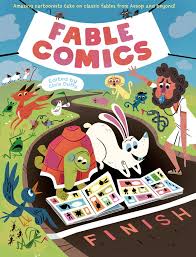
[READ: February 15, 2016] Fable Comics

Following up on First Second’s 2011 collection of Nursery Rhyme Comics, comes this new collection of Fable Comics, also edited by Chris Duffy.

Duffy says that for this collection they wanted to use mostly Aesop’s fables (because they are the most widely knows).  But the book also includes a sampling from other traditions.  He says that cartoonist were allowed to embellish the stories but we asked that the lesson remained.

And so there are 28 fables and the artists are pretty much a who’s who of contemporary comics.  I’ve broken down the Fables by their creators:

Aesop

The Fox and the Grapes-James Kochalka modernizes this a bit with a jet pack, which is hilarious.

The Town Mouse and the Country Mouse-Tom Gauld is back, and it’s great to see his work as he keeps the story fairly traditional

Hermes and the Man Who Was Bitten by an Ant ; Hermes and the Woodsman ; The Frogs Who Desired a King ; Hermes and the Sculptor. George O’Connor is responsible for the First Second Olympians series, so it’s no surprise that he tackles these stories about Hermes.  He remains faithful to the original and keeps up his very cool drawing style.

The Belly and the Body Members–Charise Harper has a wonderfully stylized look for this story about how the body parts need to work together or it can’t do anything.

Lion +Mouse–R. Sikoryak’s Mad Magazine style works very well for this familiar story about a mouse helping a lion (he has modified it somewhat of course).

Fox and Crow-Jennifer L. Meyer’s style is gorgeous.  This fable has a fantastic look to it with pale colors and circles of details.  I could look at it for hours.

The Old Man and Death–Eleanor Davis’s art is boxey and stark.  It works very well with this dark and Communist-looking story.

The Boy Who Cried Wolf–Jaime Hernandez.  I love when Hernandez does kids’ stoires because his characters are so perfectly cartoon and his colors are bright and fun.  His telling of this story is very good.

The Crow and the Pitcher–Simone Lia  I didn’t know this fable.  And I don’t really know how the beginning sets up the end. It shows crow as being very smart for others but the end has the crow being extremely smart for himself.   It’s a weird fable although it rings rather true.

The Dog and His Reflection–Graham Chafee does an awesome job of showing greed in others and leaving the dog’s story to be un-narrated.  He witnesses greed and acts accordingly.

The Dolphins, The Whales and the Sprat–Maris Wicks.  I was completely unfamiliar with this fable.  I’m also curious about how much Wicks has added.  I love that she adds some very funny factual details like that dolphins are actually a type of whale and that there are detailed asides about all of the animals throughout this story.  The moral is that they’d rather die than take advice from a sprat.  Still true today.

The Milkmaid and Her Pail–Israel Sanchez  This fable was also unfamiliar.  Sanchez’ drawings are stark and work well to tell this story of greed.

The Great Weasel War–Ulises Farinas.  This comes from a longer fable called The Mice and the Weasels.  I love Farinas’ art in this story.  The colors are spectacular and the creatures are great   And I love the moral is that they build these giant machines that cannot fight against nature.

The Sun and the Wind–R.O. Blechman. This fable was in Ava and Pip, so its funny to read it there and then see it here. Blechman’s simple drawings complement the story well.

The Hare and the Tortoise–Graham Annable’s art is great for this.  The tortoise is so crabby looking.  I’m unfamiliar with the deus ex machina that happens though.  It’s funny how many of these fables we may know without knowing them in total.

The Grasshopper and the Ants–John Kerschbaum’s art is so busy and full of detail, it’s really wonderful.  I’m unfamiliar with the ants asking the grasshopper to play for them at the end of the story tough.

The Thief and the Watchdog–Braden Lamb & Shelli Paroline. I really enjoyed the way these two created this fable.  The art is great–angular and simple but really powerful.  Having the dog explain why giving him meat won’t work is a great idea.

Demandes and His Fable–Roger Langridge.   I love Langridge’s clear lines and distinctive colors. He tries to get people’s attention and only succeeds by telling them a fable about Demandes.  I’m intrigued that his fable gets interrupted by himself.

The rest of the fables’ origins are mentions in parentheses after the title:

Leopard Drums Up Dinner (Angolan Fable)–Sophie Goldstein makes a fun visual of this story about animals trying to capture others with music.  I wonder how closely this aligns to the original, as its pretty crazy.

The Hare and the Pig (Indian Fable)–Vera Brosgol.  I didn’t know this fable at all.  Rabbit and Pig are arguing about who is best.  Leave it to fox to make the declaration.

The Demon, The Thief and the Hermit (Bidpai)–Keny Widjaja illustrates this amusing tale of a thief trying to join with a demon to rob a hermit

The Elephant in Favor (by Ivan Krilov)–Corinne Mucha.  I love that Corine modernizes the fable (the lion says Dude).  This is all about how everyone talks about the elephant.  He works slow but gets a raise. What makes him so great?  All the other animals speculate.  But it turns out that his ears are the real reason–for reasons other than the obvious.  This may be my favorite fable of all.

The Mouse Council (medieval European fable)–Liniers. This is the story of putting a bell on a cat and how no one wants to risk their life for the good of all.  Liniers’ art is spectacular.  I love the subtle shading of his drawings and then the rough drawings by the mice.

Man and Wart (Ambrose Bierce)–Mark Newgarden.  I love Ambrose Bierce but had no idea he wrote fables.  This one about people’s need for privacy and not belonging to a club is pretty strange.

The Hen and the Mountain Turtle (Chinese Fable)–Gregory Benton. I was unfamiliar with this story about a wise turtle saving a farm.

These collections of short pieces are quite wonderful. I wonder what genre First Second will tackle next.  #10yearsof01

Read Full Post »
feb20156SOUNDTRACK: TEDESCHI TRUCKS BAND-Tiny Desk Concert #516 (March 25, 2016).

ttbandAs I write this, there is no band I am more tired of than Tedeschi Trucks Band.  It seems like they are everywhere.  Coming home from somewhere the other night, there was a whole hour of a radio show devoted to them.  Gah.

When I first heard about them I was interested.  Their story was fairly compelling–husband and wife join forces to make some music.  And then I heard the song they played and I though, huh, Bonnie Raitt and a blues bar band.  That’s fine.

I’ve grown sick of th eone song they’ve been playing a lot, but I enjoyed this Tiny Desk.

Their music is certainly fun–a lot more so in this live setting than on record.  And it’s very cool in “Just as Strange” to watch Derek Trucks play solos while using that slide on his finger.

“Don’t Know What It Is” fares better–the horns add a nice touch and the song gets treated more like a jam than a song.  I love watching Tedeschi play the bitchin wah wah solo.  There’s a lot of toe tapping in this song.  And after the hand clapping section, the song really takes off–the sax solo is tremendous.

The song segues into the one I’ve been hearing on the radio a lot–the one I assumed was Bonnie Raitt.  The problem for me with this song is that the verses are the exact same melody as Radiohead’s “High and Dry” and I keep waiting for the song to turn into that–which it doesn’t.  I don’t love the chorus so much but I really like the horn riffs at the end of the song and the guitar solo is wicked (I don’t think the end is as good on the studio version).

So after watching this I have grown to like them better.  Their musicianship is pretty stellar.

[READ: January 21, 2016] “The Trusted Traveler”

This was a fascinating story in that I loved some parts of it, didn’t like other parts of it and was amazed at how the main crisis developed and then was basically abandoned.

As the story begins we learn that the narrator and his wife Chris have received an annual visit–right after tax season–from Jack Bail, a CPA who is a former student of the narrator.  The narrator loathes this annual visit.  And I loved the reason why: “For some reason, almost anything that has to do with Jack Bail is beyond my grasp, I can’t even remember having taught anybody named Jack Bail.”

He feels worse for his wife Chris, because Chris actually remembers things about Jack and his life. (more…)

Read Full Post »

« Newer Posts - Older Posts »