Feeds:
Posts
Comments

Archive for the ‘New Yorker’ Category

SOUNDTRACK: THE CIVIL WARS-“Kingdom Come” (Field Recordings, November 8, 2012).

I discovered The Civil Wars after they had broken up.  Which is such a shame as they make such beautiful music.

They were Joy Williams and John Paul White and

the two [had] built a gentle, harmony-rich folk-pop sound in which warm chemistry more than counteracts the tension under the music’s surface. Though not a couple themselves — each is married, and Williams just had a baby — they convey many hallmarks of a loving union, particularly in the way she stares at him sweetly as they sing.

That staring is really uncanny–she seems so happy with him.  So it is amazing that at the time of this airing

Williams and White announced that they’ve canceled all of their tour dates in response to “internal discord and irreconcilable differences of ambition.” This, naturally, has fueled talk of a breakup — the assurance that “our sincere hope is to have new music for you in 2013” doesn’t specify whether that music would be made together or separately — which is a pretty crummy development

This Field Recording [The Civil Wars: A Song Of Loyalty, Before It’s Tested] was done in (presumably) happier times — during the Sasquatch! Music Festival in George, Wash.

The pair sing in a field of grapevines.  Just as John Paul arrives, the wind picks up incredibly, almost comically.

Amazingly, given the setting, this song sounds fantastic.  I love that you can hear whistling wind faintly (it might even be cooler if the wind was a bit louder).  But you can see the grapevines (and their hair) blow as the wind picks up.  But their voices and guitar sound perfect.

This song, like every song from The Civil Wars is wonderful.  Their voices are just magical together.  Even if there’s not a lot going on musically (it’s a single guitar although the melody is great), it’s the way they loop their voices together that is just out of this world.

I love them on record, and they sound even better here–White just lets his voice soar at one point and it’s fantastic.

[READ: January 12, 2017] “Back the Way You Went”

I was really puzzled by this story.  I couldn’t tell if it was one story with three parts or three separate stories.  I hoped it was three separate stories because the three pieces don’t seem to go together at all.  But at the same time, the internal parts of each story isn’t entirely coherent either.

Garland
D and F take a woman with them on a weekend getaway.   The woman’s mother recently died.  They go to a honeycomb.  Bees stream through the streets and the night.  D and F are bees too.

But they aren’t, of course.  Because the next day they ride bikes (the woman never learned and is quite bad at it).

Years later she wonders “what it was like for D and F to be thugging her around.”  Thugging?

The next paragraph is a flashback and is a good one.  But each paragraph seems to be separated from each other.  The title appears in the body.

Mexico
In this part “they” go to visit Dad in a home.  He is  in a room with a man whose eyelids don’t close–doctors don’t want to touch them in case they stayed permanently closed.

One Sunday they were coming home from visiting Dad–it was no different from any other visit. but her insides had gone bleak and dangerous. She sat in the back of the taxi thinking about an art work she saw in Mexico

The title of this piece appears in this section as well.  And, again, I enjoyed the part about the art piece and I enjoyed the way her dad tells her this bon mot, but I don’t see how they connect

Trouble in Paradise
Her mother in law Verna is four feet nine.  She feels big and bestial hugging Verna.  Her own mother was also short, but otherwise unalike. She is unlike her own mother except that they both think she needs to shop for clothes because they don’t like the way she dresses.

Vera is telling stories about her best friend Mildred who died.

But the narrator is thinking back to drying dishes with her own mother.

And then the narrator snaps out of it and asks Verna a question about Mildred which she finds quite surprising.  The ending in which she mentions the filmmaker Lubitsch, is just as puzzling as all the rest f the story(ies).

Read Full Post »

SOUNDTRACK: AMIR ELSAFFAR & TWO RIVERS-“Hemayoun” (Field Recordings, July 3, 2013).

I was pretty excited to see the start of this Field Recording [Amir ElSaffar & Two Rivers: Golden Sound In A Gleaming Space] because it begins with hammered dulcimer and oud.  I have never seen these two instruments used in jazz before.

But once the band starts the jazz pushes out he Middle eastern instruments somewhat.

The oud is certainly drowned out by the horns, but you can hear it plucking away.  And the hammered dulcimer is hardly used at all.

I had never heard of the participants although apparently

The session had the feeling of a reunion. ElSaffar — a trumpeter and santur (hammered dulcimer) player who was born near Chicago to an Iraqi father and an American mother, and who grew up immersed in both cultures — had recently moved from New York to Cairo to pursue his work with Arab classical music. But this group with Ole Mathisen on saxophone, Zafer Tawil playing oud, Carlo De Rosa on bass and Nasheet Waits on drums shifted into Two Rivers gear immediately.

At 3:49 when the sax solo starts the minimal oud is used more to keep the beat than anything.  At 5:10 the trumpet returns playing a riff with the sax.  By around 7 minutes its all trumpet and drums (some good improv) with the bassist adding rhythm but playing very hard and being barely heard.  At around 8 minutes there’s a minimal oud solo that runs through to the end of this song.  This is particularly cool, although I kind of wish the other guys didn’t drop out entirely–I’d like to see the oud share the stage with the traditional jazz instruments.

I love that the music has non-Western instrumentation but I feel like it is underutilized.  But maybe that’s not the point

 ElSaffar has found a beautiful and singular way of pairing the sibling spirits of jazz and the classical maqam system of the Arab world, with their shared spheres of improvisation, deep knowledge of tradition and urge to keep innovating. Two rivers, but they lead to the same ocean.

[READ: October 22, 2017] “The Sinking of the Houston”

O’Neill has a way with making stories amusing despite the tension underneath.

It begins with a defense of sleep. The narrator says when he became a parent of young children, he became an opportunist of sleep: “I found myself capable of taking a nap just about anywhere, even when standing in a subway car or riding an escalator.”  But when the boys grew up into “urban doofuses neurologically unequipped to perceive the risk incidental to their teenage lives,” sleep became much harder to get.  He would lie awake until they were all home, and then every sound in the house would be meaningful.

Then comes the phenomenon of Dad Chair, a black leatherette armchair which he has designated as his haven.

It has worked pretty well except when the boys disrupt the peace.

The middle son asks if he’s heard of Duvaliers, the dedicators of Haiti.  The dad says he knows all about them–they were horrible.  When the boy tries to tell him more details, he retorts: “I lived through it ! I don’t want to discuss it!”  The boy logically says you didn’t exactly live through it.

Another son asks where East Timor is.  They all want to talk about atrocities.  But he has a new philosophy–Cest la Vie–it works pretty well. (more…)

Read Full Post »

SOUNDTRACK: BILL CALLAHAN-“Small Plane” (Field Recordings, November 11, 2013).

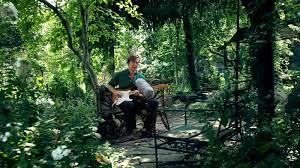
Many episodes in the Field Recordings series travel far and wide to exotic locations.  For this Field Recording [Bill Callahan Sings ‘Small Plane’ In A Serene City] Bill Callahan travel to exotic downtown New York City.

When we first approached Bill Callahan to do a Field Recording in New York City, we asked him if he had any special place in mind. His reply surprised me: “A community garden.” I guess I’d stereotyped him in my head, because after all those years of dark, thoughtful songwriting — first as Smog and then on the pensive records he’s made under his own name — I’d imagined a library, someplace quiet and dark.

The video starts with the hustle and bustle of the city and then slowly moves into a quiet, peaceful garden, complete with a pond (and turtles jumping into it), birds, tomatoes, and a microphone.

As it turned out, the brightly lit 6th & B Community Garden, with its lush greenery and mellow wildlife, provided just the right setting. The noise of cabs, buses, trucks and the occasional siren wound up punctuating Callahan’s calm, deep baritone, but he makes it easy to ignore.

He sings about being a lucky man flying this small plane.  And he setting compliments his contentment.  It’s just him and his quiet electric guitar and all is well.

[READ: October 26, 2018] “Waugh”

Last week’s New Yorker story was called “Flaubert Again.”  This week’s is called “Waugh.”  The last one was tangentially about Flaubert but this one is (as far as I can tell) not about Evelyn Waugh at all.

This was one of those fascinating stories that was very simple but in which all of the details about the story were so vague that I couldn’t figure anything about it for many many pages.

This is a story of five unrelated boys who live together–they all pull tricks to make rent.  Rod was their defacto leader–not their pimp exactly, because he tricked too, but more like an elder watchmen.  He was tough and very strict.  You could be kicked out of the house for many infractions, and at the first sign of Sickness.

I assumed that this story was set in the 1970s in San Francisco.

Then one of the boys is named Google, so clearly it can’t be set in the 70s. (more…)

Read Full Post »

SOUNDTRACK: WILD NOTHING-“This Chain Won’t Break” (Field Recordings, May 31, 2013).

I cannot get over how disconcerting the opening of this Field Recording [Wild Nothing: Nuanced Pop At 8,500 Feet] is.

The band Wild Nothing, whom I do not know, is shown climbing a mountain, with the caption that they are climbing to more than 8,500 feet above sea level (on a tram).

The band is out in the middle (well actually on top) of nowhere.  They are in a beautiful location on top of a mountain.  And the first thing you hear is a cheesy electronic drumbeat.  How disappointing!  Especially since you see they have a makeshift shaker on hand.

But lets enjoy the view.

When most people think of Palm Springs, visions of softly baked desert landscapes come to mind. However, upon arriving at the Palm Springs Aerial Tramway, we were warned that the temperature differential between the desert and the top cliff of the Chino Canyon was about 30 degrees — cold enough that it would require warm clothing and an adventurous spirit. But Wild Nothing singer-songwriter Jack Tatum and his tour players were game to load onto the rotating tram car and ascend to more than 8,500 feet above sea level.

Abandoning extraneous gear at the Tramway landing, both the band and our crew hiked down into the San Bernardino National Forest and then up onto a side of the Mount San Jacinto peak. With rapidly freezing hands, the band performed its song “This Chain Won’t Break” for this Field Recording with a stripped-down assortment of instruments (two guitars, an amplified iPad, a bunch of dried tree pods turned into a makeshift shaker), giving this ode to a challenged relationship a much more nuanced, somber feel.

Despite the electronic percussion, the song itself is quite lovely.  The chord changes are nice and the their vocals meld nicely.

Once our feet were solidly back on the desert floor, the members of Wild Nothing were surprised to come across a group of fans who’d recognized the band from its recent Coachella performance. We toasted the chance meeting with some local wine and a random piece of sheet cake — and took the requisite Instagram pictures — before setting out for warmer climes.

[READ: January 7, 2017] “Who Will Greet You at Home”

I have no idea what the cultural significance of this story is.  I don’t know if some people could relate tho this, but I certainly couldn’t.

Ogechi is a woman who works a lousy job in a hair salon.  She had a fight with her mother and has not seen her in about a year.

And she has just made a baby out of yarn.

The yarn baby made cooing gurgles and other sounds until Ogechi caught it on a nail and it unraveled.

She knew that a yarn baby was risky, but she made one out of yarn anyway,

When she got to work, Mama, the owner of the hair salon demanded payment.  For it was Mama who blessed the yarn baby into existence.  But they both knew that Ogechi couldn’t pay her with money, so instead, Mama took some of Ogechi’s joy. (more…)

Read Full Post »

SOUNDTRACK: GREGORY PORTER-“Be Good (Lion’s Song)” (Field Recordings, May 14, 2013).

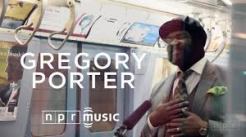
The still from this Field Recording [Gregory Porter: A Lion In The Subway] certainly led me to think that Porter would be singing on an actual moving train car (the ambient noise would be IMPOSSIBLE to filter out).

Of course, it wasn’t the most practical (or legal–bands and other musical acts need to audition to even set up underground. And those are just the “official” performers) thing to actually get Gregory Porter to perform on an operational MTA train. So we asked him if he’d perform for us at the New York Transit Museum in downtown Brooklyn, a collection of vintage memorabilia and reconditioned cars housed in a former subway station. All the better: Porter has a way with vintage suits, and there was a fortunate coincidence about the way it all felt right among the period-specific ads which flanked him. Accompanied by pianist Chip Crawford — who perfectly punches and beds the gaps here — Porter sang his original “Be Good (Lion’s Song),” a parable of unrequited affection.

The only thing I know about Gregory Porter comes from his Tiny Desk Concert.  I marveled that he wore a hat with ear flaps the whole time.  Well, he does the same thing during this song.

Gregory Porter has the frame of a football linebacker — maybe because he once was one, for a Division I college — and the rich, booming voice you might expect from a guy with such lungs. It cuts through a crowd with its strength, in the manner of an old-school soul singer; it demands attention with its sensitivity. If Porter weren’t winning over the international jazz club and festival circuit, he’d rise above the din wherever he went.

This is a sweet, quiet song, befitting him and the location.  The lyrics are a clever metaphor about lions and love.

[READ: October 22, 2017] “Scared of the City”

This is an essay about being white in New York City.

Franzen says that in 1981 he and his girlfriend were finishing college and decided to spend a summer in New York City– a three-month lease on the apartment of a Columbia student on the comer of 110th and Amsterdam.  It had two small bedrooms and was irremediable filthy.

The city seemed starkly black and white “when a young Harlem humorist on the uptown 3 train performed the ‘magic’ act of making every white passenger disappear at Ninety-Sixth street, I felt tried and found guilty of my whiteness.”

A friend of theirs was mugged at Grant’s Tomb (where he shouldn’t have been) and now Franzen was morbidly afraid of being shot.  The impression of menace was compounded by the heavy light-blocking security gates on the windows and the police lock on the door.

Franzen made some money when his brother Tom came into the city to do some work for hot shot photographer Gregory Heisler at Broadway and Houston.  Franzen was a gopher and made trips around the Bowery and Canal Street but he knew not to go to Alphabet City. (more…)

Read Full Post »

SOUNDTRACK: THE EBENE QUARTET-“Felix Mendelssohn: String Quartet No. 6 in F Minor Allegro assai” (Field Recordings, January 25, 2013).

I don’t quite understand why this Field Recording [The Ebene Quartet Powers Through Mendelssohn] sounds so great–it is rich and full with resonant bass notes.  Is it the recording or the quartet itself?

The title suggests it is the players.

The Paris-based Quatuor Ebene — the “Ebony Quartet” — has risen fast in the musical world with two separate artistic identities. In recent years, audiences have gotten to know the “other” Ebenes — the sophisticated cover band that plays everything from “Miserlou” (the Pulp Fiction theme) to jazz to “Someday My Prince Will Come” (yes, the one from Disney’s Snow White).

But when violinists Pierre Colombet and Gabriel Le Magadure, violist Mathieu Herzog and cellist Raphaël Merlin play classical music — whether Beethoven’s transcendent Op. 131 quartet or, as on their latest recording, works by brother-and-sister composers Felix and Fanny Mendelssohn — you realize the depth and beauty of vibrantly intense performances.

Felix Mendelssohn completed his String Quartet No. 6 in F Minor just two months before his own death, and very shortly after the death of his beloved sister Fanny. Even though this second movement, marked Allegro assai, is architecturally the “light” section in this piece, it’s full of dark colors, tense and moody and shaded with grey and black. The music provides rich counterpoint to the setting, the bright and spacious powerHouse Arena, a bookstore, gallery and performance space in Brooklyn’s Dumbo neighborhood.

We thought that the setting would appeal to the quartet’s double identities, given powerHouse’s signature mix of art titles and whimsical children’s selections, including a board book with a cute little piglet that clearly fascinated Raphaël to no end. And our idea worked: The shoot was bookended, so to speak, by the quartet browsing and buying. Maybe our idea worked a little too well? No matter — once the quartet got down to playing, the results were magical.

I have enjoyed Felix Mendelssohn’s music before, but this recording is outstanding.

[READ: October 20, 2017] “Strangler Bob”

I don’t enjoy prison stories.

This one is a little different, I suppose.  It concerns a guy remembering his days in prison.  He was eighteen and hadn’t been in too much trouble when his malicious mischief landed him a sentence of forty-one days.

His cellmate was an older guy, late forties, who was in the cell for doing “something juicy.”  The narrator would eventually learn that his roommate is Strangler Bob, and that his own nickname is Dink.

He befriended a guy his own age named Donald Dundun, who liked to stroll the catwalks and climb the bars spreadeagling himself against the jambs .suspended in the air. (more…)

Read Full Post »

SOUNDTRACK: MOUNT EERIE-“Ocean Roar” (Field Recordings, January 3, 2013).

For reasons I’m unclear about, I had been posting about these Field Recordings in reverse order.  So I decided to mix it up for the 2013 releases and do them in proper order–it feels better that way.

This particular one makes you wonder how much work they went to in order to record less than 3 minutes of music.  This Field Recording [Mount Eerie Plays ‘An Absurd Concert To Nobody‘] was taped in the Folger Shakespeare Library’s gorgeous Elizabethan-style theatre in Washington, D.C., just across the way from the Supreme Court.

Mount Eerie is a band I’ve heard of but don’t really know.  I don’t know if this stripped down song is in any way representative.  The band is the brain child of Phil Elverum who sings songs of “life-affirming, death-obsessed mysticism.”

“Ocean Roar” is a smart tangle of words; its alternate stories oddly complement and complicate each other, while telling of lost thoughts and wandering souls. On record, the song chimes with guitars and drums that subdivide the dreaminess, but at the theatre, it’s just Elverum, a nylon-stringed acoustic guitar and touring band members Allyson Foster and Paul Benson singing soft harmonies at his side.

The song starts with them singing some lovely harmonies, they add lovely notes to flesh out the brief song throughout.

“We just played an absurd concert to nobody,” Mount Eerie’s Phil Elverum says, as he faces a sea of empty red seats.

[READ: October 20, 2018] “Flaubert Again”

I have not enjoyed much by Anne Carson–she’s just not my type of writer.

This story also left me flustered.

This is about a writer who seeks to write less and less, not more. Other writers have tried, Barthes, Flaubert, but she hopes to go further.

To be a different kind of novel it would have to abolish things–plot, consequence.  And fully abolish, not just renounce, which is a weak and egoistic attitude.  She felt the pleasure of reading derived from answers withheld. (more…)

Read Full Post »

SOUNDTRACK: YUJA WANG-“Toccata in D minor, Op. 11” (Field Recordings, February 19, 2014).

I have never given much thought to the physical creation of a piano.  This Field Recording [On A Chilly Factory Floor, Yuja Wang’s Piano Sizzles] is set on the factory floor of Steinway & Sons.  As it opens you can see the craftsmen putting some touches on a piano, which really makes you think about how these machines are created.

This episode also introduced me to Chinese-born pianist Yuja Wang.

She is a [at the time] “27-year-old ultra-glam artist” who came to the factory in

one of her trademark dresses, significant stiletto booties and a Gucci fur stole, as well as some wrist warmers as a concession to the temperature.

The piece she played was also one I was unfamiliar with, played a piece that would chop shrinking violets to mulch: Prokofiev’s “Toccata in D minor, Op. 11.”

The blurb calls the piece “blisteringly difficult” and I totally agree.  It is nonstop notes for nearly five minutes.  Wang is up and down the keyboard, banging out notes in a nearly atonal piece (how she even remembered it much less played it is amazing).  And to see her pressing pedals in stilettos is pretty amusing too.

On a third listen, it’s not so much atonal as just very busy.  The melody is in there, it is just surrounded by so much else.  And watching the blurs that are Wang’s hands is jaw-dropping.

[READ: January 6, 2017] “Cold Little Bird”

I feel like Ben Marcus stories resist me, somewhat.  But this one was fantastic.

Martin and Rachel have two boys: a ten-year old-and a six-year-old.  As the story opens, Jonah, the ten-year-old says he doesn’t want to big hugged anymore. That he doesn’t like it.  He hopes that they will respect his decision about this.  He tells them that they can always cuddle with Lester, the six-year-old.

The parents shrug this off and think it is a phase.  Even when Jonah flatly says “I don’t love you.”

His parents tried to respect his wishes even as it went on for several weeks.  Martin was getting more and more exasperated, but Rachel seemed to be okay with it–telling him to back off and give the boy some space.

Soon enough, Jonah started playing with Lester–being very chummy and lovely with him.  And yet he did not warm up to his parents. (more…)

Read Full Post »

SOUNDTRACK: GRUFF RHYS-Yr Atal Genhedlaeth (2005).

In honor of the author being from Wales and of me recently seeing Gruff Rhys in concert, this is a post about his debut solo album, Yr Atal Genhedlaeth.  The title is in Welsh, as id everything else.

If you don’t understand Welsh, as I don’t, Wikipedia gives us a guide line for the album which I’m going to trust.  There are 11 songs in just under a half an hour

  • Yr Atal Genhedlaeth [‘The Stuttering Generation’, but ‘atalgenhedlu’ is Welsh for a contraceptive] is 8 seconds of stuttering voices.  I feared the disc was broken when I put it on.
  • Gwn Mi Wn [‘I Know [that] I Know’, could also mean ‘a gun I know’, a reference to the battle in the song].  Gruff played this song live with two members on drums.  It’s a cacthy near-a capella song with just the drums and his voice.  He loops his voice here (and live) to make more and more harmonies of himself.
  • Epynt [named after a mountain in Mid Wales, but about money, with the ‘E’ standing for the Euro, and ‘pynt’ sounding similar to the Welsh word for Pound].  This song has a DIY punk feel–two chords, loud drums and chanted chorus Eh-pint, eh-pint.
  • Rhagluniaeth Ysgafn  [‘Light programming’, but ‘lluniaeth ysgafn’ means a light snack].  This song has an electronic drums and simple guitar chords.  Once again, it’s Gruff’s voice that carries the melody.  As with most of these songs, he makes a big song with very few elements.
  • Pwdin Ŵy 1 & 2 [literally ‘egg pudding’, means ‘”egg custard’, two love songs]  The first part is under 2 minutes with a slinky guitar and bass.  It’s fleshed out with all kinds of weird sound effects.  The second part (all of 3 minutes) is quieter, with just his guitar and voice and some quiet percussion.  The solo is either a melodica or harmonica, I can’t quite tell.
  • Y Gwybodusion [‘The Experts’] is a simple garage rocker.
  • Caerffosiaeth [literally ‘sewage fortress’. ‘Caer’ is a common part of Welsh place-names (for example, Caergybi), used to indicate that there was originally a castle or fortress in the town/city]  This is the strangest song on the disc–full of all manner of weird sound effects.  These effects accompany the simple (cowbell and drumbeat) electronic percussion that sets the tone for Rhys’ overlapping vocals.  This song sound the most like one you might try to insert English words into the Welsh that he is singing like maybe: “Blue-eyed fork, blue-eyed fork, I love your bag and your power torch.”
  • Ambell Waith [‘Sometimes’] opens with a pretty acoustic guitar melody as all manner of quiet sound effects skitter around in the background.
  • Ni Yw Y Byd – [‘We Are The World’] is not a cover of the charity song, it is an incredibly catchy folk song with a flute (piccolo?) solo.
  • Chwarae’n Troi’n Chwerw [‘When Play Turns Bitter’, from a Welsh proverb. A Welsh language standard originally written and sung by Caryl Parry-Jones].  This six-minute song starts quietly with just an acoustic guitar,  It starts to build and go a little faster when the drums come in. By four minutes, there’s cymbals and what feels like a full accompaniment.  The last minute or so is Gruff playing the banjo.

It’s a pretty album with pretty melodies and a splash of Gruff’s wackiness strewn about.

I don’t think you’ll learn any Welsh from this records but it is neat to think you can sing along with it without knowing what any of it means.

[READ: January 4, 2017] “The Edge of the Shoal”

I thought that this was going to be yet another story about a guy fishing–and how he and his father had bonded over fishing.  Because that is how it started.

He didn’t tell his wife where he was going–just left a note to make salad.  He assumed he would catch a fish, but his real reason for going out in the kayak was to disperse his father’s ashes into the water.  (I’m not exactly sure where this is set, but I assumed Europe–okay Cynan Jones is Welsh).

The narrator was still hearing his father’s voice as he cast out for the fish.  Frankly I was worried that this story was far too long if that’s all it was going to be about.

But then things take a very different turn. (more…)

Read Full Post »

SOUNDTRACK: CORY HENRY AND THE FUNK APOSTLES-Tiny Desk Concert #792 (October 5, 2018).

Cory Henry & The Funk Apostles blew me away with the first song of this Concert.  “Love Will Find A Way” opens with a deep bass sound as the funk starts.  And then Henry adds the great sound of the Hammond.

There’s so much joy in the sound of the Hammond organ, especially for those of us of a certain age. Hearing it can transport you to the early ’70s, when every rock band seemed to have one in its arsenal: The Allman Brothers, Santana, Deep Purple. In the hands of true masters — like the late Billy Preston and the very-much-alive Booker T. Jones — the organ can be a melodic, funky rhythm machine.

Cory Henry’s name belongs in the same breath as the Hammond organ masters of the past. The instrument creates the central sound of his dynamic, neo-soul- and funk-infused musical identity, and he opens his turn behind the Tiny Desk with what feels like an encore: the full-on soul assault of “Love Will Find a Way.” The song twists and turns, then winds up as a full-on celebration — and it’s only the first song in his set.

The song does have several part including a lengthy middle solo section.  Over the heavy organ chords there’s a wailing guitar solo and a keyboard solo from the synth player.

By the end of its six minutes it absolutely feels like an encore–a show ender.  It’s awesome.

“Trade It All” is a bit more soul, less funk, which means I don’t like it as much.  B

Henry’s keyboard skills are on full display during a synth solo in “Trade It All,” which also spotlights his entire band. To my mind, they’d have sounded right at home on Stax Records in the ’70s — no small accomplishment.

The middle shows a softer, quieter side of the Hammond–one that sounds a bit cheesier to my ear.  And yet there’s no denying Henry’s deft finger work (there’ a hint of Stevie Wonder in there for sure).

The final song, the ten-minute “Send Me a Sign” has a lengthy, almost preacher-like quality and is clearly gopsel-inspired.

It showcases some of the roots of Henry’s songwriting; it’s inspired by church sermons that bloom into group sing-alongs. Just another way Cory Henry digs way back to give us something new and exciting.

[READ: October 11, 2017] “One Saturday Morning”

I have never been disappointed with a story from Tessa Hadley.  She might be one of my favorite writers whom I’ve never read outside of magazines.

This story is wonderful because the we learn so much about so many people through the eyes of one woman.

Valerie is Gil’s second wife.  Gil is in his fifties and Valerie is twenty-four.  Gil is a successful professor and she was (as someone described her with disdain) a typist.

But as the story opens, Valerie is trying to cope with Gil’s daughter.  Robyn is nine years old, can’t button her own dress and is utterly unprepared for several days at another house.  This was the first time Valerie had met her…stepdaughter?  And Robyn was plain and kind of dull.  She was polite but had no toys (she played cleverly with scraps of fabric, but would not engage when asked about them).

She was certainly a dullard when it came to food–toast was all she could think of. (more…)

Read Full Post »

« Newer Posts - Older Posts »