Feeds:
Posts
Comments

Archive for the ‘Details’ Category

SOUNDTRACKGABRIEL GARZÓN-MONTANO-Tiny Desk (Home) Concert #147 (January 19, 2021).

Gabriel Garzón-Montano did a solo Tiny Desk Concert a few years ago, as the blurb quickly points out

If Gabriel Garzón-Montano’s solo Tiny Desk back in 2017 was an exercise in restraint and vulnerability, his home set is the polar opposite. It beams ingenuity and unveils multiple layers, figuratively and literally.  In this performance he brought the full band, sporting all white from mask to toe and bringing to life all the sonics we hear on the record, last year’s genre-snubbing Agüita.

They play three songs.

Garzón-Montano morphs into three different characters from Agüita and stretches the boundaries even more, adding salsa flavor to “Muñeca” and delivering some bonus bars on the set opener, “With A Smile.”

“With A Smile” opens with just his face surrounded by flowers as he plays a pretty acoustic guitar.  The flowers move away as the Gracie Sprout’s harp adds more pretty notes.  As the song moves along with Gabriel’s soft and sexy voice, Itai Shapira’s bass and Lenny “The Ox”‘s drums come thumping in.

Like the rest of his band, Gabriel is in all white, including white Uggs and a long white coat with tails.   The only color is from the sweater underneath.

At the end of the song he raps in Spanish, which has a really nice flow.

Taking advantage of of the rare opportunity to gather musicians in quarantine times, he says “It’s like being a child who’s allowed to do what they always wanted to do when they didn’t wanna get up for school, and it’s also felt like an adult who didn’t know what to do at 3 p.m. on a Tuesday afternoon. I’m focusing on oscillating between those states with ease.”

For “Muñeca” he takes off the big coat and shows off the colorful sweater which has a fascinating cut, including tails.  For this song, it’s a trio of bass and Daniel Rodriguez on drums. Rodriguez plays a funky middle with conga and cowbell as Gabriel gets up and dances.  He picks up the guitar again at the end of the song for a little strumming outro.

Before the final song, Gabriel moves to the piano.  He takes off the colorful sweater to reveal a sleeveless shirt underneath (which shows off his tattoos).

“Tombs” features the KROMA Quartet and everyone else on synths.  Nicholas Semrad plays the lead, but everyone else adds melody.  It’s a delicate song with an interesting and slightly creepy synth melody.  About half way through this six minute song he gets up and picks up an electric guitar.  He and  Justin “Jhawk” Hawkins play a harmony solo together, which sounds pretty cool.

I am quite intrigued by this singer, and I love the description of genre-snubbing.

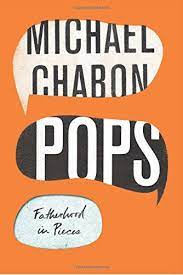
[READ: February 28, 2021] Pops

I have often said I wanted to read more books by Michael Chabon.  And after finishing this I realized that the only novel by him that I’ve read is Kavalier and Clay and that was 21 years ago.  So maybe it’s time to get into some of these other books.

Pops is a collection of (very) short essays.  Most were written for Details Magazine (which folded in 2015), one for GQ and a final one I’d already read in the New Yorker.

“Introduction: The Opposite of Writing”
It’s not too often that you really enjoy an introduction, but this one was pretty great.  In it, Chabon talks about when he was an up and coming writer and he met a well-established Southern writer.  This writer told him that the secret to being a good writer was not having children.  That for every child you have, you will lose one book.

Chabon had no children with his first wife but has had four with his second wife (the writer Ayelet Waldman).  So clearly they have lost eight books between them.

The writer’s argument was that children take away time from novel writing and that novel writing takes away time from children.  Chabon had always felt that his father was not very present (as one of the essays says) and he promised to be much more involved in his children’s lives).  These essays suggest that he was.  So how did he find time to write?  He does not say. (more…)

Read Full Post »

SOUNDTRACK: SANDRO PERRI-Impossible Spaces [CST085] (2011).

This album has become one of my favorite releases of the year.  I simply can’t stop listening to it.  And the funny thing is that on first listen I thought it was too treacly, too “sweet,” especially for Constellation Records (home to the over-the-top Godspeed You Black Emperor amongst other wonderful bands).  But after a listen or two, I heard all of the genius that is present in this record–so many different layers of music, and so many interesting instrumental choices. Indeed, it does come off as sweet, but there’s really nothing wrong with that.

This album gives me a happy pick me up without being cloying in any way.  That’s a great accomplishment.

“Changes” opens kind of all over the place, with some noisey guitars and really high bass notes.  But once the shk shk of the shakers comes in, the sing settles into a great groove (and there’s a cool bassline that really holds the song together).  After about 3 minutes, it turns into a cool light funk jam, with retro keyboards, buzzed out guitar solos and some funky drums.  It’s unlike anything you’ll hear anywhere else.  “Love & Light” is one of the shorter pieces at just under 4 minutes.  It’s different from the other tracks, in that Perri’s vocals seem to be the dominant motif, rather than the cool music.  I like the song, but it’s probably my least favorite here.  “How Will I?” uses a similar multi-tracked vocal style but it has some wonderful flute moments (yes flute) that make the song bubbly and happy.  The song kind of drifts around the ether in a kind of jazzy world until about 5 minutes in, when the bassier notes anchor the song with great contrasting notes.  And the electronic ending is as cool as it is disconcerting.

“Futureactive Kid (Part 1)” is a shuffling minor key number that’s just over 3 minutes, it features a cool bass clarinet and backwards guitars to propel the song.  The backwards guitar solo segues into the uplifting (literally, the keyboards just go higher and higher into space. “Futureactive Kid (Part 2)” features fretless bass, a flute solo and My Bloody Valentine-esque sound effects (although radically simplified from MBV’s standards).  It fades out only to introduce my favorite song in forever–“Wolfman.”  I can’t get enough of this song.  It’s a simple structure, but at ten minutes long, it deviates in amazingly complex ways.  It has so many cool aspects that I love–I love the chord changes at the end of each verse.  I totally love the guitar solo that goes up and down the scale for an impossibly long run–well over 100 notes by my count.  I also love that the end of each section features a different guitar style playing the simple chord progression–from acoustic to loud solo to full band playing those same notes–so by the end of the ten minutes you ‘re not sure what to expect.   By the time the flute solo comes in at nearly 7 minutes, I’m totally committed to the song and wherever it’s going to take me.  So when it gets a bit of an electronic ending, I’m ready to go there with it.  Oh and lyrically the song is just as curious as the music.

The final song “Impossible Spaces” is a beautiful, quiet guitar song which is actually easy to sing along to.  It quiet a departure from the rest of the record, but it ties things together very nicely.  I have listened to this record so much lately, I just can’t get enough of it.

You can stream the whole thing here.

[READ: May 10, 2012] Conversations with David Foster Wallace

This is a book that collects interviews with David Foster Wallace.  Although DFW was reticent about d0ing interviews (as the introduction states), he did do quite a lot of them–often at the same haunts.  This book contains 22 interviews that span from 1987-2008.

The conversations are in chronological order, which is really a treat because you get to see DFW’s opinion (and his addiction to nicotine) evolve over the years.  You also get to see the topics that he was really focused on at one time and whether or not they stayed with him until the final interview.  DFW was outspoken about certain things, especially entertainment, which is unsurprising.  But he was also a big advocate of truth, honesty, realness.  It’s amazing seeing him when he lets his guard down. Although his honesty is there for all to see in his work, he is better known for his difficulty with language or his humor.  So seeing him without the multiple revision is quite enlightening.

The first pieces, “David Foster Wallace: A Profile” published after his first novel The Broom of the System launched Viking’s paperback imprint actually looks into his classroom a little bit and shows him interacting with a student (I wonder if she knows she is in this book?).  It seems sweet and almost naive compared to what is to come next.  And, for anyone who is familiar with him from later in, it’s a wonderful look behind the scenes.  There’s also a number of pieces from The Wall Street Journal.  Like the second piece in the book, the worryingly named, “A Whiz Kid and His Wacky First Novel.”  It’s not a bad piece at all, but man, headlines can be delicate matters. (more…)

Read Full Post »