Feeds:
Posts
Comments

Archive for the ‘Huh?’ Category

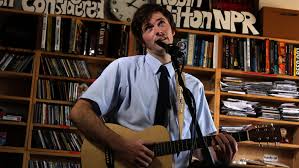
july2015 SOUNDTRACK: THE HELIGOATS-Tiny Desk Concert #98 (December 15, 2010).

heligoat I thought that I would have written about all of 2010’s Tiny Desk shows last year, but it turns out that I missed two.  This was one and tomorrow’s will be the second.

According to the blurb, Stephen Thompson says that this was the 100th Tiny Desk Concert.  I have counted all the shows (twice) and using my counting method, I found this to be the 98th show.  So either this was aired out of order or they never aired two shows.  I have noticed that I’ve been off on all of their milestones, so something is up (and I’m pretty sure it’s not my counting).

Chris Otepka is the Heligoats. He has another band called Troubled Hubble, but Heligoats are his acoustic unplugged band.

In addition to singing unusual songs (he’s a songwriter for whom lyrics are very important (if not always comprehensible)), he tells some elaborate stories between songs.  His stories seem spontaneous, although I expect that they are not (especially the cremation story)

“Goodness Gracious” is a slower song (although he somehow makes a really full sound with just his (small) acoustic guitar).  There’s some great lyrics and twists of phrase in this song.  And his voice is quite nice, too.

“I’m Pretty Sure I Can See Molecules” is a song he says he started writing when he was 8 years old.  He says he liked pushing his fingers back into his eye sockets to see what kind of fractals appeared.  He gives a lengthy explanation about this phenomena which he says is the cause of floaters.  All of this is an introduction to this uptempo song.  I really like the somewhat “off” chord he plays between chorus and verse.

Before “A Guide to the Outdoors,” he talks about cremation and the metal parts in his body.  And about having his will explain about his robotic existence.  The song seems to be a letter written to the person who has found his dead body?  It’s surprisingly upbeat though.

The final song, “Fish Sticks,” is my favorite.  It is about a man named Carl Beakman who gets a grant to protect a wetland for migratory birds (I suspect all of this is nonsense, but whatever).  I like the way the song has super fast strumming and the bouncy chord progression in the verses.

The Heligoats require close listening, and the songs are worth it.

[READ: January 6, 2015] “A Little Bottle of Tears”

As part of last year’s push to read a lot of books, I blew off most of my magazines.  So this year I’m going to get back to all the issues I missed and I’m going to try to keep up with my subscriptions going forward.

I’m starting with the Harper’s that I hadn’t read in 2015 and then I’m going to move on to the errant New Yorkers.

I’m starting with this story.

I haven’t really liked any of Diane Williams’ stories.  I find them maddeningly elliptical.  She has some excellent sentences and turns of phrase but as for an entire story, I’m always left wondering what I just read.

This is a short piece about how people could have better friendships if they weren’t so old. (more…)

Read Full Post »

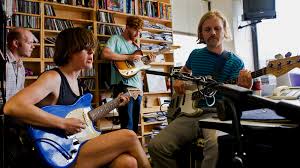
acSOUNDTRACK: LOWER DENS-Tiny Desk Concert #84 (October 10 2010).

lowerLower Dens are a band from Baltimore who I’ve heard of but who I didn’t really know.  And after hearing this Tiny Desk, I immediately fell in love with their peculiar song structure and wonderfully expansive sound.

The set opens with “Two Cocks Waving Wildly At Each Other Across A Vast Open Space, A Dark Icy Tundra” which has a long (nearly 2 minutes) instrumental opening.  And then the song proper changes style completely.  It has great interplay of guitar and bass and gentle vocals.  And amazingly the song is only 4 minutes long, even with all that build up.

“I Get Nervous” is slower with waves of guitar washes.  It builds and ends quite suddenly.

Just before the third song, “Rosie” you can hear singer/guitarist Jana Hunter whisper “This is fun.”  She busts out an old beat up acoustic guitar on which she plays a slow 90 second guitar pattern before the chords kick in and then seconds later the vocals come along.  I love the soaring electric guitar over the top.  And again it is over before you suspect (the song is only 3 minutes).

The final song, “What Isn’t Nature” is moody and minor key.  It goes on for longer than the other songs and is just as good.

I have to check out more from this band who totally fell under my radar.

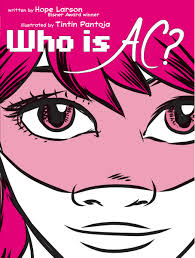
[READ: July 12, 2015] Who is AC?

I really like Hope Larson’s books and I especially like her drawing style.  So I was a little bummed to see that she didn’t draw this one.  Tintin Pantoja’s art style is very different and it was easy for me to forget this was a Larson story.  I liked Pantoja’s style but not as much as Larson’s–it’s just very different.

At the same time I didn’t really like this story that much.  There were some very cool elements but whether it was poorly explained by Larson or if the illustrations didn’t quite convey what was meant to be there, I’m not sure.

The book starts with Lin on a plane writing her zine, Rhea Ironheart.  She is flying to a new city and misses her friends already.  But mid-flight she receives a strange phone call from a number that is all binary.  She answers the phone and blacks out, but what could it mean? (more…)

Read Full Post »

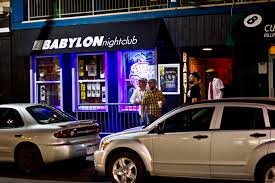
2015-07 SOUNDTRACK: RHEOSTATICS-Babylon, Ottawa, ON (July 15, 2005).

babylonContinuing their summer run, the Rheos returned to Ottawa for this show. The recording is a bit muddy and kind of low.  But the crowd is really into it, shouting out requests all through the set (which seem especially loud, given the recording).  One guy wants to hear “Queer” really badly (and he gets to).

Perhaps it’s the recording, but the usually angry sounding “Marginalized” feels a but muted here.  On the plus side, during the short drum break in “I Dig Music” MPW is able to get the “Lakeside Park” fill in perfectly.

I learned that “Night of the Shooting Stars” is an actual Italian holiday (known as The Night of San Lorenzo).

This is the first time I’ve heard them play “”Try To Praise This Mutilated World” which is based on the poem by Adam Zagajewski.  Th recording has a poem within the song (“The Expected” by Ken Babstock) read here by Andy Creeggan.

After this, the band loosens up some.  They start “Four Little Songs” and then invite two guys from the mailing list who came all the way from NYC up on stage.  Rather than making up a little song, the guys sing “Legal Age Life” (and quite well).  The song resumes with one little song and throw in a bit of The Doors’ “The End.”  And they follow that with “P.I.N.” which has a bit of “My Humps” in it!

There was another guy who was calling for “Satan is the Whistler” all night.  And when they finally played it, it was outstanding.  Then the crowd cheers for “Shaved Head” and they absolutely kill on that one too–I wish the recording quality was a little better because the show is great.

[READ: September 7, 2015] “Prends Donc Courage”

This story bugged me right from the get go.

It seemed like the author was trying to write a story about a defiantly nontraditional group.  There’s a washed up former TV star, there’s a guy with a phantom limb, a guy who is collecting pinball machines, and they are all more or less destitute.

And that can be interesting, but I felt like the story was pushing me away the more I tried to read it.

The main character is a guy named Blue.  He is the former TV star.  His friend Mitchum is amassing old pinball machines in a garage that is dilapidated (so how did he gets these expensive machines?).  The “arcade” is to be called Sick Bay (in honor of Blue’s act–although that’s not really explained).

Blue doesn’t speak, and hasn’t spoken for some time–mostly he’s afraid to find out that his voice doesn’t work anymore. (more…)

Read Full Post »

nymay156SOUNDTRACK: RHEOSTATICS-Evolve Festival Antigonish, NS (August 28, 2004).

evolveBestThe Rheostatics do a lot of festivals, and they always seem to have a good time.  But it also means a shorter set.  Unlike yesterday’s Nova Scotia show, this one doesn’t focus on new music too much (although they mention that 2067 is coming out Oct 5).

The sound quality isn’t great in this show either–there’s a lot of rumbling which sounds like winds, but who knows.

But they are even more charming in this setting.  Dave compliments someone one on their excellent sign and says that the sign demographic has let everyone down for this show–so her request will be honored.

The show starts with a cool jam from the Whale Music soundtrack (mostly “Song of Flight”).  When they play “Four Little Songs” one of the verses is a verse from Gordon Lightfoot’s “Early Morning Rain.”

Later they play a great version of “Saskatchewan” and perennial festival mates Chris Brown and Kate Fenner are there to help.  During “Stolen Car” they sing a few lines from “Another Brick in the Wall Pt 2.”

There’s great versions of “California Dreamline” and “Claire.”  The show ends with the new song “Power Ballad for Ozzy Osbourne” and there’s a breakdown during the song (no way to know what happened, but they have a laugh about it).

You can see photos from the day here (although none of the Rheostatics).

[READ: July 21, 2015] “The Freezer Chest”

I found Nors’ previous story to be a little odd.  And so I find this one.  There’s something about the way it was written (or translated) that I found it very stiff to read.  It is also told in a flashback which is later revealed to be a very-long-ago flashback.

What is particularly strange about the story is that the “action” of the freezer chest is all of about three paragraphs.  And while the story isn’t long overall, it takes a circuitous route to get to that part.

The narrator is a young girl, Mette.  She is on a boat with her classmates and their English teacher. Mark is also part of the group and he has made it clear that he does not like the narrator (that happened in a previous instance).  The crux is that Mark claimed to be an amazing guitarist.  And he is trying to get the narrator to respond to this information.  She genuinely does not care although she says she believes him. (more…)

Read Full Post »

stupidSOUNDTRACK: DAN BEHAR-Songs from All Our Happy Days Are Stupid (2002).

beharIn the book, it says that you can hear all of Behar’s songs from the book here.  But that link takes you nowhere.  Bummer.  You can hear newer versions of four of the eight songs on Destroyer’s Your Blues album.

[READ: August 2, 2015] All Our Happy Days Are Stupid

Pretty much the only reason I read works by Heti is because she is often published by McSweeney’s (and since I subscribe to their book series, I’m going to read what they send me).  I tend to not really like her books–they often feel arbitrary and neither funny nor thoughtful enough to warrant the arbitrariness of the characters’ actions.  But this was a ply, written much earlier in her career.

This play was conceived in 2001.  She tinkered with it and rewrote it and it eventually became a convoluted mess.  She gave up on it and wrote her novel How Should a Person Be, in the mean time.  Then Jordan Tannahill read the novel and talked to her and learned about this play.  He asked to see the first draft and he liked it, so he put the play on.  Initially it was done a in small theater (about 30 people max) and since then it has been performed in larger venues.  This release corresponded with a joint Toronto and New York City series of performances in February 2015.

So this play is ostensibly about two families, the Oddis (who have a 12-year-old daughter, Jenny) and the Sings who have a 12-year-old son, Daniel).  They are both from Cedarvale (which I assume is in Canada) and they both happened to take a vacation to Paris at the same time.  The kids know each other from school but aren’t exactly friends.  Nevertheless, Jenny is super excited to see someone she knows.  In part that’s because she is generally pretty happy (even though her parents tend to shoot down her happiness), but also because she is sick of Paris because it appears that there is a parade every day and she hasn’t seen anything authentically French.

The families talk and immediately fail to hit it off.  Mrs Sing is intolerant of Ms Oddi and frankly none of the grown up appear to be very thoughtful or even nice.  By the end of their meeting, Daniel has run off.  And he remains missing for most of the play. (more…)

Read Full Post »

atwq3SOUNDTRACK: YES-Tales from Topographic Oceans (1974).

Tales_from_Topographic_Oceans_(Yes_album)After the huge success of Fragile and Close to the Edge (with its 18 minute suite), what could Yes do next?  Well first they would release a triple live album, which I’ll get to later.  And then?  Why they would release a double album with only 4 songs on it!  That’s right 4 songs each around 20 minutes long!  And it would be ponderous and pretentious and it would be reviled by everyone!

The album shipped gold (because their previous records were so popular) and then sales plummeted.  The album is much maligned and, frankly, deservedly so.  Now, I love me a good prog rock epic.  So, four 20 minutes songs is pretty heavenly for me.  But man, these songs just don’t really have any oomph.

My CD’s recording quality is a little poor, but I don’t know if the original is too.  The whole album feels warm and soft and a little muffled.  You can barely hear Anderson’s vocals (which I believe is a good thing as the lyrics are a bunch of mystical jiggery pokery).  But despite the hatred for the album, it’s not really bad.  It’s just kind of dull.

Overall, there is a Yes vibe…and Yes were good songwriters–it’s not like they suddenly weren’t anymore.  There are plenty of really interesting sections in the various songs.  It just sounds like they have soft gauze between them.  Or more accurately, it sounds like you get to hear some interesting song sections and then the song is overtaken by another song that is mostly just mellow ambient music.

Without suggesting in any way that this album influenced anyone, contemporary artists are no longer afraid to make songs that are super long (see jam bands) or songs that are just swells of keyboards (see ambient musicians).  Yes just happened to put them all in the same song–way before anyone else did.

The album is very warm and soft—rather unlike the last couple of Yes albums which were sharp and harsh.  There are washes of keyboards and guitars and Anderson’s echoing voice. But what you’ll notice is that I haven’t really mentioned Chris Squire.  He’s barely on the album at all, and when he is, it’s usually to provide very simple bass notes–bass notes that anyone could play–it’s such a waste!  And while Alan White is no Bill Bruford (who was off rocking with King Crimson then), he’s also barely there.  In fact, Rick Wakeman himself is barely there–the king of elaborate classical riffs is mostly playing single notes at a time.  According to Wikipedia,

Wakeman took a dislike to the album’s concept and structure from the beginning. He made only minimal musical contributions to the recording, and often spent time drinking at the studio bar and playing darts. [During the recording session] he played the piano and synthesiser on the Black Sabbath track “Sabbra Cadabra”.

Evidently Anderson wanted a pastoral feeling in the studio

According to Squire, Brian Lane, the band’s manager, proceeded to decorate the studio like a farmyard to make Anderson “happy”.  Wakeman described the studio, “There were white picket fences … All the keyboards and amplifiers were placed on stacks of hay.” At the time of recording, heavy metal group Black Sabbath were producing Sabbath Bloody Sabbath in the studio next door.  Ozzy Osbourne recalled that placed in the Yes studio was a model cow with electronic udders and a small barn to give the room an “earthy” feel. Anderson recalled that he expressed a wish to record the album in a forest at night, “When I suggested that, they all said, ‘Jon, get a life!'”

So we have an earthy pastoral album.  But what about the four sides?  Steve Howe describes it:

“Side one was the commercial or easy-listening side of Topographic Oceans, side two was a much lighter, folky side of Yes, side three was electronic mayhem turning into acoustic simplicity, and side four was us trying to drive the whole thing home on a biggie.”

Despite Wakeman’s complaints, he did have some nice thing to say about it.  he said that there are

“very nice musical moments in Topographic Oceans, but because of the […] format of how records used to be we had too much for a single album but not enough for a double […] so we padded it out and the padding is awful […] but there are some beautiful solos like “Nous sommes du soleil” […] one of the most beautiful melodies […] and deserved to be developed even more perhaps.”

And if Rick Wakeman says an album is padded, you can just imagine what the rest of the world thought!

The lyrics (and mood) are based on Jon Anderson’s vision of four classes of Hindu scripture, collectively named the shastras, based on a footnote in Autobiography of a Yogi by Paramahansa Yogananda.  So if I read this correctly–he wrote 80 minutes of music based ona  footnote!

The four songs are

“The Revealing Science of God (Dance of the Dawn)” [which Howe says is the commercial or easy-listening side] builds slowly and eventually adds vocals.  And then come the drums and a decent keyboard riff.  There’s some noodling on the keyboards.  The riff is catchy but not immediate (which might be the subtitle for the album).  At nearly 4 minutes a faster section kicks in and there’s a catchy vocal part, which seems like where Anderson might normally soar but he holds back.  The “must have waited all our lives for this moment moment moment” is catchy, but again I can’t help but feel it would have been much more dramatic sounding on an earlier record.  At 7 minutes there’s a nice jump to something more dramatic—good drums, but the bass is mixed very low (poor Squire).  There’s some good soloing and such but it is short lived and things mellow out again.  It resolves into a new riff at 9 minutes, but resumes that feeling of washes and noodling guitars.  At 11 minutes there’s an elaborate piano section and the song picks up some tempo and drama. Especially when the bass kicks in around 12 minutes.  The most exciting part happens around 17 minutes when the whole band comes to life and adds a full sound, including a good solo from Wakeman.  And while this doesn’t last, it recycles some previous sections which are nice to hear.

Track 2 “The Remembering (High the Memory)” [which Howe described as the much lighter, folky side of Yes] has a slow, pretty guitar opening with more harmony vocals.  The whole first opening section is like this—layers of voices and keys. Then come some keyboard swells and more vocals.  Some bass is added around 6 minutes. And then around 8 minutes the tone shifts and there is a lengthy slow keyboard solo that reminds me of the solo in Rush’ “Jacob’s Ladder” (released 6 years later).  At around 9 minutes there’s a more breezy upbeat section with a cool riff.  At 10:40 a new section comes in with some great bass lines and guitars and an interesting vocal part. It could easily have been the structure for a great Yes song (vocals are singing “relayer” which of course is their next album’s title). But this is all too brief (it thankfully returns again) and then it’s back to the gentle keyboards.  At 12 minutes there’s a new medieval type section with some great guitar work.  When the “relayer” part returns around 13 minutes there’s a whole section that is great fun.  And even though it doesn’t keep up, the song feels rejuvenated. By around 17 minutes there some interesting soloing going on and then the band resumes to bring it to the end (with a reprise of an early section). And the final section is quite lovely.

Track 3 “The Ancient (Giants Under the Sun)” [Howe: electronic mayhem turning into acoustic simplicity] is probably the most interesting.  It opens with some clashing cymbals and then a fairly complex percussion section and mildly dissonant guitar riff.  There’s even some staccato bass line. The vocals come in around 4:30 and the song shifts to a less aggressive sound, but the big bass continues throughout the beginning of the song until a fast riff emerges around 6 minutes. But more unusual Yes-type riffage resume briefly before segueing into the next part with lots of percussion.  While the staccato bass and drums continues, Howe solos away.  Then around 12 :30 the whole things shifts to a pretty, slow acoustic section with a classical guitar and vocals.  This entire end section sounds like it could easily have been its own song and it is quite lovely.  Howe’s acoustic work is great and there’s even a lengthy solo.

Track 4 “Ritual (Nous Sommes du Soleil)” [Howe: us trying to drive the whole thing home on a biggie] is also quite good.  It’s probably the most fully Yes track of the four, with many sections of “full band” material.  There’s a noodly guitar intro switching to an interesting dramatic minor key movement.  There’s a pretty, if simple, riff (done by guitar and voice) that is quite lovely.  Around 4:30 the guitar solo brings in a riff from a previous Yes song. By 7 minutes, the song settles into a fairly conventional sounding Yes song (with actual bass and drums and…sitar!).   Around 11 there’s a bit of Wakeman soloing (he did show up for some of the album after all) and then some wild guitar and bass work.   The crazy percussion resumes and there’s a wild keyboard solo on top of it. The end of the guitar solo even has a bit of “Born Free” in it.

I hadn’t listened to this record in probably 25 years.  And so I listened to it 4 times in the last few days.  And I have to say that I thought it was bloated and awful at first, but it slowly grew on me.  I found some really interesting sections and some very cool riffs.  If these pieces could have been truncated into individual songs they would be quite good.  The biggest problem for me is that so much of it is so slow and mellow–like it’s building up to a big climax which never arrives.  On previous albums, Yes had made quite a show of being insane musicians, and that just isn’t here.

So even though I have come around on these songs, they certainly aren’t my favorites.  But if you’re at all interested in Yes, there’s some gems hidden away in these monstrosities (just don’t think too much about what Anderson is talking about).

Since almost every Yes album had different personnel, I’m going to keep a running tally here.  The band stayed together after Close to the Edge, but this was too much for Wakeman who left after the recording:

Chris Squire-bass
John Anderson-vocals
Alan White (#2)-drums
Rick Wakeman (#2)-keyboards
Steve Howe (#2)-guitar

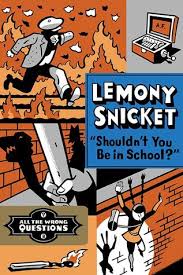
[READ: June 20, 2015] Shouldn’t You Be in School?

I am finding this series to be ever more and more confounding.  And I know that is its intent, but it is still a challenge.  Whenever anyone asks a question someone else replies that it is the wrong question.  But they never say what the right question should be (deliberately confusing!).  There are also so many threads and confusing characters, that if Snicket didn’t make the story funny and strangely compelling, it would be incredibly frustrating.

In this story, Hangfire, having been thwarted in his previous endeavor to capture children (for what end we do not know) is back with a new plan to capture children.  Also, the mysterious (and presumably wicked, but who can be sure) Ellington Feint has returned as well to help or hinder as she sees fit.

The other characters are back too, of course: Moxie is back taking notes, Jake Hix is cooking delicious foods at Hungry’s (in fact there are even some recipes that sound pretty yummy–Snicket himself makes a passable tandoori chicken).  S. Theodora is still his mentor (and the pictures by Seth of her are hilarious).  Late in the book Pip and Squeak show up.  And naturally the policemen and their bratty son Stewie are there too.  And we are still wondering what in the heck is going on with the bombinating beast.

There’s also some new characters, like Kellar Haines, a young boy who when we first meet him is typing up something in the offices of the Department of Education (with posters all over the walls that say Learn! Learning is Fun, etc).  And his mother is also becoming quite chummy with S. Theodora.

The danger in this book is fire.  Building after building is being burnt down.  The Stain’d Secondary School is engulfed.  Even the library is at risk!  And that’s when S. Theodora solves the crime!  She gets the library Dashiell Qwerty arrested for setting the fires.  And even though it is quickly determined that he did not do it (a building was burnt down while he was in custody), that doesn’t stop S. Theodora and her new friend Sharon Haines (in matching yellow nails) from partying.  It also doesn’t stop Qwerty from being taken to prison.

This story is a bit darker than the other ones (which were admittedly pretty dark).  Every kid is being drugged with laudanum which makes you sleepy.  We’re unclear exactly what they are being drugged for, but Snicket has a plan to stop it.  Snicket himself winds up getting beaten up–pretty badly–from Stew and others.

And for the first time, S. Theodora is kind to Snicket (more or less) and apologizes for her behavior (sort of).

By the end of the book a plan is hatched, a bunch of people join the V.F.D. (as seen in A Series of Unfortunate Events) and someone is taken to jail. There’s even a mysterious beast who is living in the fire pond.

As in previous books there is ample definition building–either from people saying they don’t know what a word means so that it can be defined or from Snicket himself simply defining a word.  As in “my brother and I played an inane game” “inane is a word which here means that my brother and I would pretend we couldn’t hear each other very well while we were talking.”  This game actually sounds fun:

What do you think of the weather this morning?
Feather? I’m not wearing a feather this morning.  This is just a hat.
Just a cat? Why would you wear a cat on your head?
A Bat in your bed etc etc.

The artwork by Seth is once again fantastic and noirish.

And the end of the book has a fragmentary plot “a great number of people working together, but they plotted together in such a way that nobody knew exactly what the other people were doing”  And finally we learn what the right question is, but it’s the unsatisfying: “Can we save this town?”  We’ll have to find out in the concluding book 4.

You can also check out the website for some fun.

Read Full Post »

wrenchiesSOUNDTRACK: FOO FIGHTERS-In Your Honor Disc Two (2005).

Foo_fighters_in_your_honorSo disc two is an all acoustic collection (and is actually a little longer than the rocking side, bring the total time to about 85 minutes).  Because of the guests, I tend to think of this as a less than exciting collection of songs.  But it is actually quite solid.  And even though I have always preferred Foo Fighters’ louder songs, Grohl’s voice is well suited to acoustic songs and his songwriting withstands stripping away the noise.

“Still” is a mellow acoustic opener.  Grohl’s voice is gentle.  It’s the kind of opening that on later records would lead to a big loud chorus, but this album is all mellow.  I like the way the song unexpectedly shifts chords about half way through.  The song also has keyboards done by Rami Jaffee (I believe a first for a Foo Fighters record).  It’s 5 minutes long and perhaps a little samey.

But the album perks up with “What If I Do?” a brighter song with a catchy chorus.  It is also 5 minutes but doesn’t feel long. It’s followed by “Miracle” a lovely ballad with a great chorus (and John Paul Jones on piano).  I really like the entire composition of “Another Round,” the clear guitars and the bright chorus.  And John Paul Jones plays mandolin on this one!

“Friend of a Friend” is done on just a quiet acoustic guitar. It’s a lovely, dark song.  Although it is always tempting to assume Grohl’s songs are about Kurt Cobain, this one apparently was.  According to Wikipedia, this was the first acoustic song Dave Grohl had ever written.  “The song was written by Grohl in 1990 (and recorded in secret the same year), and it was about his first impressions of new bandmates Kurt Cobain, and Krist Novoselic.”  The way it is so sparsely recorded was a really good choice.

“Over and Out” has a cool and interesting riff and a nice big chorus.  “On the Mend” has some lovely acoustic guitar pairings.

Then comes “Virginia Moon.”  It has a slow jazzy feel, a shuffling drum sound and really delicate vocals.  The biggest surprise of course is that Norah Jones (no relation to John Paul Jones) sings a duet with him.  It’s a pretty song and, while I wouldn’t want a bunch more songs like this, it works well as a one off.  The next song “Cold Day in the Sun” was written by drummer Taylor Hawkins.  Evidently they tried to make a rocking version but it never really came off so they made it acoustic.  Hawkins sings lead vocals (and has a raspy Peter Criss type of voice–is that a drummer thing?) and Grohl plays the drums.  It’s got a super catchy chorus.

“Razor” ends this disc with a neat hammering guitar line.  Josh Homme plays rhythm guitar on this song.   It’s a very pretty song, although I feel like Homme is underutilized.

For an 85 minute album, this is mostly really quite excellent.  I tend to forget about it in the Foo’s discography but there are a number of stand out tracks here.

The band did some acoustic shows following this album, and made a CD and DVD from them.

[READ: January 20, 2015] The Wrenchies

Most of the First Second books I had been reading were either for kids or young adults. This one is squarely in the adult category–and I feel you can tell that by the rather ugly style of drawing on the cover.  (First Second does an admirable job of getting books that are pretty as well as ones that are ugly).

Dalrymple has a broad spectrum of styles in this book.  He has excellent realistic characters (warts and all) but he also has really nice pretty sections as well–where the characters are quite beautiful.  The fact that he chooses to pick the uglier style more is likely a matter of the location–a post apocalyptic hell–than anything else.

This story is (obviously) quite dark.  In fact I can see a lot of readers being turned off right from the get go with how dark and violent it is.  It’s also a little confusing because the post apocalyptic world that we are introduced to is not really explained.  There are also riffs on T.S. Eliot-with lines like “In the room the children a come and go.”

The story begins with Sherwood and Orson entering a cave. It all seems rather idyllic until we see just what kind of creepy thing lives in the cave–and what it does to Sherwood. (more…)

Read Full Post »

may11SOUNDTRACK: WYE OAK-Tiny Desk Concert #52 (March 29, 2010).

wye oakI don’t know Wye Oak that well, except for some shows from NPR.  So this Tiny Desk Concert is a good closeup look at what they’re all about.

Wye Oak is just two people: Jenn Wasner and Andy Stack.  Wasner plays a wonderfully loud acoustic guitar.  She has great fingerpicking skills and there’s something about the way she uses her open low strings that adds a great percussive quality–she really wails on those chords!  It’s fun to watch her hands fly along the fretboard.

Stack plays a couple of drums with a mallet and bare hands (the percussion is subdued but effective), although evidently they are generally much louder in concert. But Stack also sings, plays keyboards and guitar.

“My Neighbor” comes from their then new EP My Neighbor/My Creator.  It’s a great song that showcases all of Wasner’s skills.  She has a great voice and I love the way she sings along to her playing. 

“Civilian” was, at the time, unreleased.  It is minor key and a bit darker.  Stack plays keyboard and drums simultaneously (something he evidently does in concert to amazing effect).

“Regret” comes from their first album. For this song, Stack takes over guitar (and the seat where the guitar is played) while Wasner sits behind the drums (to play keyboards).  This song is about not having health insurance.  It is a much more somber song and I don’t like it as much, even though it is pretty and Stack a has a nice voice.  I just like Wasner’s stuff better.

For the final song, they switch positions back.  It also comes from My Neighbor/My Creator and is called “I Hope You Die” (which she promises isn’t as dark as the title suggests).

I really enjoyed this show.  You can check it out here.

[READ: May 11, 2015] “My Life is a Joke”

I simply don’t get Sheila Heti.  And I assume that’s my fault.  But everything I read by her seems just so nebulous that I feel like I’m, missing something.

I liked the way this story started out: “When I died, there was no one around to see it.”  So the narrator is dead. Cool.

She says that her high school boyfriend wanted to marry her because he wanted to have a witness to his life (he eventually got married so he wound up okay).  The narrator never married and was hit by a car–she was not witnessed by anyone.  Well, at any rate the driver didn’t get there before she took her last breath, “So I can say I died alone.”

I even liked that the next paragraph started, “Now you can probably tell that I’m lying.”  About what?  Everything?  No, “If I really am O.K. with the fact that no one I loved witnessed my death, why did I come all he way back here from the dead?” (more…)

Read Full Post »

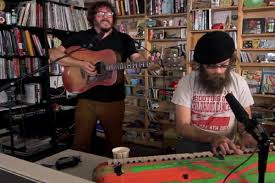
capnSOUNDTRACK: BOBBY BARE, JR.-Tiny Desk Concert #417 (January 27, 2015).

Ibbjr don’t really know anything about Bobby Bare Jr.  I don’t know anything about Bobby Bare Sr.  I knew he was from Nashville and I assumed he was a country singer.

But in this Tiny Desk Concert it’s just him on his acoustic guitar and Matt Rowland on keyboards (often employing a Hammond organ/1970s sound).  This makes his songs fall more into the singer-songwriter category than the country superstar category. (I particularly enjoy the way the keyboards “build” for the instrumental section of the first song, “Don’t Wanna Know” when Rowland lays his arm on the keys.

Bare is very funny (and Rowland’s keyboard “comments” add to the humor).  He introduces the second song “The Big Time,” a rocking catchy number about moving to Nashville to become famous.  He seems to have a love/hate relationship with Nashville.  He introduces the song by talking about hanging out with his friends and telling them, “I can’t wait til I become famous because I’ll never hang out with any of you motherfuckers again.”

As an introduction to the final song “Visit Me in Music City” he describes Nashville as making the worst music ever recorded and the best music ever recorded.  He talks about a guy at a bluegrass festival who, upon realizing that Robert Plant was in the audience said he’d like to welcome Robert Plant from ZZ Top.  “And this sums up Nashville.”  This is a funny and actually sweet song that shows how charming Bare can be,

I enjoyed the whole set, and it totally changed what I thought I knew about Bobby Bare Jr.  Check it out.

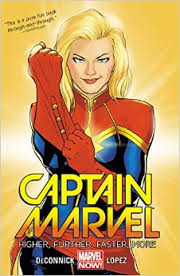
[READ: January 15, 2015] Captain Marvel

I was pretty excited to see a female super hero cross my desk.  I don’t really know much about the history of Captain Marvel (who was a man at some point).  Nor do I know why she is a woman now (there is a previous book in this new series written by DeConnick but I couldn’t find it).

This book opens in the middle of the action with Captain Marvel, Carol Danvers, walking with several aliens (a robot creature, a green figure in a hood, a woman with snakes for hair and a bull-looking guy) on the Maniaciano Outpost.  They are looking for something.  The plan, which is a simple one, goes awry and soon they are all trying to escape at top speed.  Captain Marvel has what they are looking for but they have lost the green woman.  (Whose name is Tic).

Flash back six weeks ago where Captain Marvel is speaking to Captain America and she has just encountered a pod with, of all things, an alien girl with green skin.  We see that Carol lives in the Statue of Liberty and is also friends with Iron Man.  And as the first book closes we learn that she is ready to go back out on another mission.  This one proves to be pretty dangerous and she is saved at the last minute with help from…The Guardians of the Galaxy (holy crossover Spiderman!–it looks like she will be getting her own movie in 2018, so just hold on to your tights for a few more years). (more…)

Read Full Post »

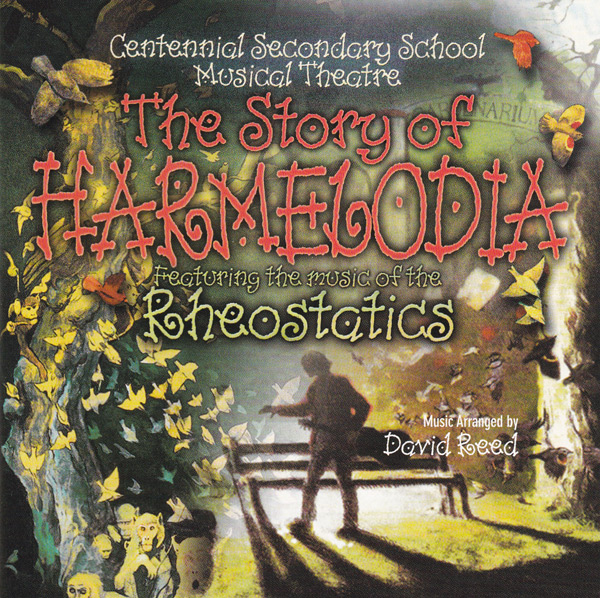
sardineSOUNDTRACK: CENTENNIAL SECONDARY SCHOOL MUSICAL THEATRE-The Story of Harmelodia (2000).

Cover-CSSMT-HarmelodiaAs mentioned in yesterday’s post.  The Centennial Secondary School and Choir released their version of The Story of Harmelodia. This CD (which to the best of my knowledge is no longer available for purchase anywhere) is newly available from the Rheostaticslive website.  While the (very cool) cover is there, there’s no information about the musicians.

The disc is about 35 minutes long and it recreates most of the music from the original CD.  For reasons which I’m sure have to do with rights, they do not include “Monkeybird” (everyone’s favorite song) and the songs about the Wingophone.  Those songs were all written by Kevin Hearn. I’d be very surprised if Hearn didn’t give them the rights to the songs, so there must be something else at play.

They also do not include the narration.  This of course makes the story a lot less clear–although at this point I feel like the songs are just fun and sweet, even if they story is lost.

The school’s version is quite good.  The band sounds great (with a whole host of instruments).  While the opening music on the first track sounds a bit high school bandish (perhaps because it so spare) as soon as the choir kicks in it really ratchets up the quality of the music.  And it stays high throughout.

The choir is outstanding, and the variety of instruments (I can hear all the brass, an autoharp, synths (there’s some fun spacey keyboard sounds on “I am Drummstein”) and some electric guitars) makes for a really compelling collection of songs.

One of the biggest difference is that many of the songs have horns playing the main melodies. “Invisible Stairs” has a flute as the lead instrument.  It’s very pretty and I like that it plays the “twinkle twinkle” melody as a counterpoint to the proper melody. It’s a very pretty version.  I also love the way “The Music Room” came out.  And the mostly instrumental “The Sky Dreamed” sounds really lovely.

I don’t know how many lead singers there are (or what their names are, although judging by the concert, I assume it is the same kids).  The female lead as featured on “Home Again” is great.  I like the male lead a little less.  He sounds a but too stiff to me.  Although I do like that on many songs he gives his own reading of the material.

The final song, “Song of the Garden,” sounds terrific.  I love the way the two singers harmonize and the way they place a cool horns section (which reminds me of The Beatles) as the song trails out.

I am of course curious why the couldn’t release those missing songs.  But I’m more impressed that the school (presumably with different people) performed a stage version of the show in 2004 which was played live in several places.

[READ: December 5, 2014] Sardine in Outer Space 2

Sardine is a children’s book published by First Second.  It was originally published in France (and in French) and was translated by Sasha Watson.  There are six Sardine books out.

This time the inner flap says “No Grownups Allowed (Unless they’re pirates or space adventurers),” and I found that I enjoyed book 2 quite a bit more than book 1. Perhaps the jokes just appealed to me a bit more–there were a number that I thought were very funny.

I enjoyed the double cross (well they pretty much all have a double cross) in The Brainwashing Machine.  But I really got a kick out of The Cha-Cha Fly.  When the fly bites you, you get stupid dance songs stuck in your head.  Nice premise–even funnier that the flies are named Britney, Christina, Justin and Clay. (more…)

Read Full Post »

« Newer Posts - Older Posts »