SOUNDTRACK: MADISEN WARD AND THE MAMA BEAR-Tiny Desk Concert #444 (May 26, 2015).
I love that Mama Bear is actually Madisen Ward’s mother, Ruth. They play some really wonderful roots music.
Madisen has a powerful soulful voice and Mama Bear’s harmonies are excellent–ranging from deep to high pitched.
And their joint harmonies on second song, “Sorrows and Woes” (especially the final note) are really amazing.
Mama Bear also adds some great licks to some of the songs (Madisen plays leads on “Silent Movies” while mama Bear plays the main riff on “Daisy Jane.”
Between songs, Madisen has some funny banter. I laughed when he said that he was now going to retire since he has played the Tiny Desk. And Mama Bear talks about how excited she is that their new record is on yellow vinyl.
The songs are delightful folk songs (with “Daisy Jane” being the boppiest of the lot with some delightful “ooh hoos” at the end). I’d never heard of them before, but I wish them a lot of success.
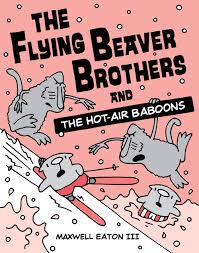
[READ: February 11, 2014] The Flying Beaver Brothers and The Hot-Air Baboons
I saw this book in the library and was delighted to have another Flying Beaver Brothers book to read (I also just saw online that there is a sixth book too!).
Poor Beaver Island is under attack yet again (my kids were surprised to see that there were so many beavers on the island with them, and I admit I didn’t realize there were quite so many either).
The threat this time is a group of baboons who are melting the snow off of the skiing mountain (beaver island really has it all!). When Ace and Bub finally get caught up to speed with what’s happening, the baboons (Pete, Kyle and Ringo) hilariously get mad about having to repeat the whole story that they told everyone earlier. There is a helpful chart with Proboscis and Baboon listed as types of monkeys and buffoon as not a type of monkey. (more…)
SOUNDTRACK: JASON VIEAUX AND YOLANDA KONDONASSIS-Tiny Desk Concert #443 (May 22, 2015).
Typically, the Tiny Desk doesn’t have performers back after they have played once. But occasional exceptions are made, like when performers who played solo come back as a duo. Like this.
Jason Vieuax was one of the first 20 people to play the Tiny Desk and Yolanda Kondonassis played back in 2010. And here they are touring as a duo, which really helps to accentuate both of their skills. And their music is beautiful together.
Vieuax is an amazing classical guitarist. And Kondonassis plays an amazing harp that is more about singular notes than trills and “heavenly” sounds. And in these songs, they work together doing harmony runs and fills–both instruments are lead instruments.
Apparently there aren’t very many pieces written for the combination of harp and guitar. Kondonassis explains the origins of the Hovhaness piece (which gives some lovely context).
Vieaux explains the origins of the two movements of the Piejo suite.
The first piece is sweet, while the second one is a little more aggressive (but still lovely). And the third one features some cool riffs and chords (especially on guitar) and percussion done on the instruments.
The three songs they play are
Gary Schocker: “Elysian” (from Hypnotized)
Alan Hovhaness: Fuga: Allegro – Andante grazioso, Canon: Allegro (from Sonata for Harp and Guitar, “Spirit of Trees”)
Máximo Diego Pujol: Vals, Candombe (from Suite mágica)
The pieces are familiar and yet quite different. And 456+it is much fun to watch their fingers fly around their instruments.
[READ: January 24, 2015] Tommysaurus Rex
I brought this book home for Clark to read. I wasnt going to read it myself but then I saw that I had read a book by TenNapel before and liked it.
But I did not care for this one. Perhaps it was because it was marketed in my library as a kids book but I thought it was just too violent or something–the story turned me off.
Perhaps it was just that the story opens with the main character’s dog getting hit by a car and dying. I mean, who needs that? And the cover looks so fun, too. (more…)
SOUNDTRACK: YOUNG FATHERS-Tiny Desk Concert #442 (May 19, 2015).
Young Fathers may have the shortest Tiny Desk Concert ever. It’s only 4 minutes long. I know that these are edited down from the full show, but wow.
Young Fathers evidently sing a kind of hip-hop, but in these two songs they don’t really rap very much and are more soulful. The members met in Edinburgh but are from distant exotic locales like Ghana and, um, Maryland.
Something must have happened with their technology. As the blurb says, “Full-on drums and electronics weren’t going to happen on this day.” So they chose a simpler path.
They sing two songs virtually a capella. I don’t know any of the members’ names, but there’s one singer for “Am I Not Your Boy” (the guy in the photo above). He has a soulful voice (more or less R&B) and there’s a simple keyboard backdrop.
On “Only Child” there are three vocalists, each taking a turn with a verse. It is surprising that the man who sounds Jamaican (the first singer) is white. The final vocalist raps, and then all three harmonize very nicely over the final chorus.
Bob Boilen raved about them when he saw them live. I’m not all that impressed, as they sound like any other R&B band to me, but a four-minute sampler isn’t all that much to go on.
[READ: February 12, 2015] Prime Baby
I’ve enjoyed just about everything that Gene Luen Yang has done. But I had no idea that a) he wrote a serialized comic strip and b) that it appeared from 2008-2009 in the New York Times Magazine!
It’s interesting to see these strips presented in one strip per page format. But far more interesting is the very strange direction that this story goes in.
It begins with the main character, a boy named Thaddeus K. Fong. He is a reasonably selfish young man with a penchant for saying things to get him in trouble. (He calls himself a martyr for truth). And then his parents have a baby. And his whole life is upended.
The baby girl only says the word, “ga.” His parents say that everyone develops in their own time, but he is not convinced. And one day, when he learns about prime numbers in math class, he realizes that his sister only says “ga” in increments of prime numbers. That is kind of interesting, but even more interesting is when his math teacher says that NASA has theorized that if aliens were to make contact with us it would be through prime numbers. (more…)
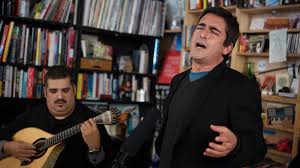
Camané is a Portuguese Fado singer. The NPR blurb says that fado, “which means “fate” in Portuguese, emerged from the gritty barrios and docks of Lisbon in the early 19th century and has evolved in fascinating ways. Think of it as the Portuguese blues.”
The songs are sung in Portuguese and I don’t know a word of what’s he’s saying, but as the blurb continues: “[The songs] flow with an ineffable mix of longing, loss and melancholy, framed in resignation. It’s a kind of glad-to-be-unhappy feeling the Portuguese and Brazilians call saudade.”
The most interesting part of this to me was what I thought was a bouzouki but which I see is actually a Portuguese guitar–12 steel strings, played in very fast runs. While Camané’s voice is clearly the focus (and it is amazing), José Manuel Neto’s Portuguese Guitar is pretty darn awesome. And the accompaniment by Carlos Manuel Proença on guitar is lovely too.
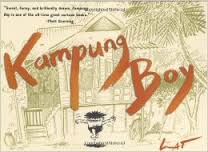
[READ: January 7, 2015] Kampung Boy
This book was written (and drawn) in 1979. First Second books had it translated and published in 2006.
This is the story of a boy growing up Muslim in rural Malaysia in the 1950s. Evidently it was serialized in Malaysia back in 1979 (it does feel kind of episodic, but it holds together very well).
It is a charming story of a simple life in the village that is slowly being changed by progress.
It starts with Kampung Boy’s birth and the simple way he was born (midwifed by his grandmother for which she was paid $15) and how he slowly grew from a baby into a naked toddler running around the village. His aunt worked at the local rubber factory (his parents owned the rubber plantation) where they removed latex rubber from the rubber trees. (more…)
Eskmo is a guy from Iceland (Brendan Angelides). He plays electronic music.
His music is pretty and rather mellow. What makes this Tiny Desk so enjoyable is the objects he uses to makes sounds with.
He loops a lot of noises (something that I love) as they build to really add textures to the song. But the things he uses for sounds are awesome. In the first song (“Blue and Gray” about 4 minutes), he crinkles a water bottle to make a percussion sound.
Before the second song “Can’t Taste” (which is about 8 minutes), he asks the audience to bring up random objects for him to play with. So he gets a set of keys that he uses as a chime sound. He opens a can of seltzer for percussion. He plays a metal water bottle. And then he also takes things from the shelves behind him, like the shelves themselves and even a Paul McCartney bobble head.
The music itself is almost an afterthought, as the melody is pretty but he doesn’t really do a lot to lot–he just has a ton of fun playing with the items around (he gets a big smile with the bobble head).
This is a show that works much better visually than audibly, so watch it here.
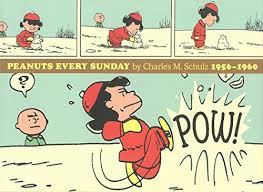
[READ: April 10, 2015] Peanuts Every Sunday 1956-1960
Fantagraphics has been releasing volumes of Peanuts daily comic strips. They are looking to do 50 years of strips in 25 books! (they are up to 1990). And now they have begun releasing the Sunday color strips in their own volumes.
This book picks up where the last one left off. And of course, Snoopy is still the star. There’s some very funny jokes with snoopy–like the one where he tries to fly—there’s something wonderful about Snoopy being insecure (and clumsy).
Linus can’t let go of his blanket (July 1956). And in an early baseball one, the blanket actually causes him trouble (instead of later ones where it is a benefit).
Pigpen gets a strip devoted to himself in July 1956 and then there’s a very funny one about sand in his shoe in 1958.
Lucy yells to make the kites fall out of the tree. And the first full acknowledgment of her pulling football away comes in December of 1956.
I also enjoy how violent the cartoons were. Like this exchange between Linus and Lucy:
Linus: Give it to me or I’ll slug ya.
Lucy: Mom, Linus says he’s gonna slug me.
Mom: Linus that’s no way to talk.
Linus: Well, that’s the way they talk on TV if they can talk that what, why can’t I?
Mom: That’s just one of those things I can’t explain.
Lucy: Listen dope. If you slug me I’ll slug you right back.
Linus: Never mind Mom, it’s just been explained to me in language that I understand.
There’s some really great one liners coming in now too. Lucy: I feel torn between the desire to create and the desire to destroy.
There almost isn’t as much Charlie Brown in this book. Although he is certainly there. In June 1957 he realizes that he won’t ever be president.
And the gang all starts to look pretty much as we know them at this point (except Snoopy still).
There’s lots of funny strips (visual mostly) of Snoopy chasing Linus to try to get his blanket (a joke that recurred for years).
And there’s a very meta joke of Lucy wearing one of CB’s shirts
Sally Brown, CB’s sister is born around August 1959 and CB gains a pencil pal. The following week Aug 16 1959 is a great sibling rivalry with Lucy and Linus. And there’s a wonderful strip where Sally and Snoopy gang up on Linus Oct 25 1959.
The Snoopy jokes are very funny with him (still) walking on all fours and wishing to be a bird or pretending to be a mountain lion.
The 1960 new years strip in which Lucy gives Linus the resolutions he should work on is hilarious.
Later Linus gets so mad at Lucy that “she hath caused me to rend my garment” is one of the funnier punch lines I’ve seen.
The great pumpkin makes its first mention on October 23 1960.
The Snoopy/Linus rivalry is really wonderful throughout with Snoopy trying to steal Linus’ blanket and then later getting into boxing matches—this is the classic Peanuts. Some of these jokes have now been around for ages (the boxing glove on the nose). And Snoopy is starting to look a lot more like his familiar self (although not exactly the same yet).
It’s a great collection, once again. And it looks amazing.
I was unfamiliar with Vijay Iyer, but I really enjoyed this Tiny Desk Concert. Iyer is a jazz improv artist and composer (although all of these pieces have titles and come from previous albums). The first four (of five) pieces are fast and eccentric, with interesting rhythms both in the drums (by Marcus Gilmore) and the piano. There’s an upright bass too (Stephan Crump) but I feel like he’s not very audible during the early medley.
I really enjoy the kinds of beats (from clicks to snares to cymbals) that Gilmore does. And even if you can’t really hear the bass, it’s really fun to see how into it Crump is, keeping time to something or other.
While the four songs have fairly distinct starting points (and are labelled in the video), they flow pretty seamlessly, which is cool. “Time, Place, Action” slows down just enough that “Questions of Agency” (a more staccato piece) is able to start fresh. And then the opening of “Hood” is quite distinct.
The four songs are
“Diptych”
“Time, Place, Action — Excerpt 1 (Libra)”
“Questions Of Agency”
“Hood”
At around 13:31 “Hood” begins, and I love the staccato playing style and practically morse code drums. It’s a dynamite piece (and you can really hear the bass too). I’m amazed at how different what his left and right hand are doing. And then the shift at 19 minutes, back to that earlier sound is very dramatic. The final minute is tense and dissonant, really building to something big.
The band pauses for applause after nearly 21 straight minutes and then they play the final piece “Time, Place, Action — Excerpt 2 (For Amiri Baraka)” which mellows things out considerably, although is still kind of dissonant.
I don’t listen to a lot of jazz, but this really hit the spot (maybe because his new album is called “Break Stuff”). And if you like this, there’s a 90 minute video of his trio playing on NPR.
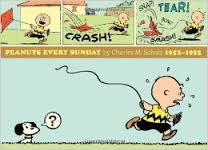
[READ: April 10, 2015] Peanuts Every Sunday 1952-1955
Fantagraphics has been releasing volumes of Peanuts daily comic strips. They are looking to do 50 years of strips in 25 books! (they are up to 1990). And now they have begun releasing the Sunday color strips in their own volumes.
The reproductions are absolutely top notch. I’m quite certain they look better here than they ever could have in the papers (the coloring alone looks phenomenal).
Schulz started doing Sunday strips for Peanuts (he hated the name Peanuts by the way, which was assigned him by the syndicate who agreed to publish him) in 1952. And he continued up through his death in 2000. Between black and white and Sunday color strips, he hand wrote, colored and lettered 17,897 comic strips. That is amazing.
And the strip really evolved over the years (for better and worse). These original cartoons are fascinating to see–especially now that the images from Peanuts are so ubiquitous that I doubt I could go an entire week without seeing an image of Snoopy somewhere. So it’s amazing to see Snoopy look so different (and so much more like a real dog) in these early strips. (more…)
After all of the Dave Grohl love I’ve been sending his way, Grohl went and fell off a stage and broke his leg. But, he is so badass (and such a thoughtful musician), that he went to the hospital, got his leg fixed up and went back on stage to finish the set! Holy cow.
This is amazing (and he must have incredible endorphins (or something else) to be able to do this (the video is long because it shows his re-arrival):
Grohl has always been very open about his love of heavy metal–and the liner notes here go into pretty good detail about he bands he grew up listening to. He wanted to create a kind of tribute/dream lineup album of metal vocalists. As far as I can tell he was sitting around and banging away riffs and every time he got one that he liked, he recorded it. He eventually added bass and drums and made demo tapes out of them. Then he contacted some of his favorite metal singers from when he was a kid and asked them to write lyrics and sing.
I assume that Grohl sent the demos that sounded most like the bands to the appropriate singer, because so many of them are spot on for the original bands. The Venom song sounds completely like Venom (Cronos’ bass certainty helps) and it’s one of the best songs here. I don’t know Sepultura that well, but the music fits perfectly with Cavalera’s style. And this song is just fantastic.
The Lemmy song sounds unmistakably Motörhead, again possibly because Lemmy plays bass, but the riff is pure Motörhead. It’s another great song and one that the Foo Fighters have played live.
The song with Mike Dean is very punk, very C.O.C. It’s followed by another punk/metal song from D.R.I. This song also matches perfectly with Brecht’s style of singing on the more metal side of D.R.I..
Lee Dorrian used to sing in a guttural cookie monster growl with Napalm Death, but in Cathedral, he turned to proper singing. I don’t know Cathedral, but the main riff coupled with the twin guitar solo notes from Thayil make a great epic song, especially that mosh section in the middle (I didn’t think Cathedral did mosh but whatever), although at 6 minutes it does go on a bit.
I also don’t know Wino, so I don’t know if this is the kind of thing he sang on, although I do hear a bit of Saint Vitus vibe from it. There’s a really long middle section which is interesting for the backwards guitar solo, and while it’s a little long, when it comes out of that, the heaviness is really great.
Tom Warrior is a fascinating guy with all kinds of tricks up his sleeve, so the weird industrial sound on top of the heavy bass is pretty interesting. There’s no way Grohl could hope to emulate Voivod’s Piggy, so he doesn’t even try. Rather than playing up to Voivod’s proggy style, he goes deeper to the heavier stuff. And, perhaps it’s Snake’s voice, the bridge sounds very Voivod. The chorus is more poppy than what Voivod might do, and yet it’s a great song. Voivod’s Away also designed the album cover.
I loved Trouble when I was in high school, although I don’t really remember them that well now. This songs sounds bit more classic rock than metal (and I recall Trouble being pretty heavy), and yet Wagner’s voice works very well with the style. I just read that Trouble went through a more psychedelic period and the middle section ties in nicely with that, so maybe this is inspired by later period Trouble.
Grohl says he was excited to get King Diamond, and who wouldn’t be. Kim Thayil is back to create a suitable Mercyful riff (although it could never live up to the classic Fate). But the mid section’s doom riffs are right on. The song showcases some of the King’s vocal acrobatics, although not quite as many as I could have used (there are some excellent high-pitched notes in there though).
There’s a bonus track at the end of the disc which features Jack Black doing a suitably funny but accurate metal tribute.
This is a really solid heavy record that lets some classic metal singers back on the scene. There won’t be a second Probot record, but there may not need to be one anyhow. I also like that he picked some slightly more obscure singers rather than the obvious Rob Halford, Bruce Dickinson type of singers, even if they would have also been interesting).
“Centuries of Sin” (feat. Cronos of Venom)
“Red War” (feat. Max Cavalera of Sepultura)
“Shake Your Blood” (feat. Lemmy of Motörhead)
“Access Babylon” (feat. Mike Dean of Corrosion of Conformity)
“Silent Spring” (feat. Kurt Brecht of Dirty Rotten Imbeciles)
“Ice Cold Man” (feat. Lee Dorrian of Cathedral and Napalm Death, and Kim Thayil of Soundgarden)
“The Emerald Law” (feat. Wino)
“Big Sky” (feat. Tom G. Warrior of Celtic Frost)
“Dictatosaurus” (feat. Snake of Voivod)
“My Tortured Soul” (feat. Eric Wagner of Trouble)
“Sweet Dreams” (feat. King Diamond of King Diamond and Mercyful Fate, and Kim Thayil of Soundgarden)
“I Am the Warlock” (feat. Jack Black of Tenacious D)
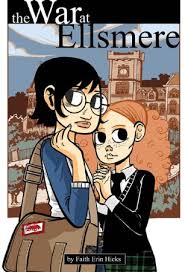
[READ: February 13, 2015] The War at Ellsmere
I’ve enjoyed Hicks’ books in the past–both the ones she’s written and the one’s she’s simply illustrated. In this book she does both which means you get big eyes and the dark hair.
As the book opens we meet Juniper, a girl who has just enrolled in Ellsmere Private School. We meet the headmistress and learn the history of this beautiful school (established in 1810). And then we find out that Juniper is there on a scholarship (merit based) and that Juniper is well aware that she will likely be there to “liven things up for the blue bloods.”
When Juniper meets her new roommate Cassie (who hears her talking to herself), Jun immediately goes on the defensive–until she sees that Cassie is actually quite a nice girl. (Nice, Jun, you just insulted Bambi).
But it’s during the orientation that we meet the real antagonist of the story–Emily, a pretty blonde girl who immediately insults Cassie and calls her “orphan.” When Jun gets involved, it suggests that it will be an interesting year for all of them. (more…)
It would seem that after recording the split acoustic and rocking In Your Honor and then touring a lot of acoustic music that the Foos were ready to make an album that combined both of these dynamics into one disc. For many of the songs it means acoustic openings and super heavy end sections. But some, particularity at the end of the album are completely acoustic.
Of course having said that, the album opens with a great heavy classic Grohl song, “The Pretender.” A fantastic opener with the great chorus of “what if I say you’re not like the others.” The next song, “Let It Die” opens with a real acoustic opening–not just mellow electric guitars but full on acoustic guitars (which Grohl has clearly become quite proficient at). The switch to the really heavy chorus (not until almost 3 minutes into the song) is pretty intense–they pack everything into one song.
“Erase/Replace” is another great song–there’s an interesting twisting riff and an awesome chorus. There’s some very nice contrasting with the smoother sections and even a cool guitar solo (there’s not too many solos in early Foos songs). “Long Road to Ruin” is one of my favorite Foo Fighters songs–the chorus pushes all my yes buttons with the way it speeds up and has and the staccato stops in the middle of the chorus. Fantastic.
“Come Alive” is another song with a slow mellow acoustic opening. It builds slowly over 5 minutes to a noisy end. “Stranger Things Have Happened” is the first fully acoustic song on the album that stays acoustic–there’s nothing heavy in it. It’s got a classic Unplugged type of feel with two acoustic guitars playing off of each other, and a soloing section that has several pause click click resume moments.
“Cheer Up, Boys (Your Make Up Is Running)” has a great riff and very poppy verses. It sounds like earlier Foo Fighters songs and reminds me of Cheap Trick with the “stop, stop” backing vocals. There’s also several different sections which hearkens back to earlier songs.
And from this point on the album mellows out but in different ways. “Summer’s End” has a folky jam band feel (even though it’s not acoustic. It’s got a such a wonderful chorus. It’s the first of three songs to feature Grohl on piano! Taylor Hawkins plays piano on it too. “Ballad of the Beaconsfield Miners” is a 2 minute instrumental written by Grohl. There’s some lovely finger picking in the song and you can hear that Grohl has really developed his guitar playing. Kaki King plays rhythm guitar on this song which is surprising as she is such a much better guitarist than he is.
“Statues” is a piano ballad (played by Grohl). It feels totally classic rock, with the sound of the opening guitar solo and the chord progression. “But, Honestly” is fast acoustic song. The melody and backing vocals remind me a lot of Bob Mould’s style of song writing. The song feels like it’s just going to stay in a mellow vein, but this song really ramps up at around 3 minutes with some simple but cool riffing and a big growling end.
The final song, Home,” is a pretty piano ballad (Grohl on piano and vocals) with strings. It’s almost cheesy but avoid that trap. It doesn’t have a big chorus, and is rather understated. It also provides the album with its title.
This is a really complex album that works to all of the band’s strengths and even lets them explore different styles a bit. Guests on the album include Rami Jaffee and Drew Hester from the live shows as well as Pat Smear (who is a sometimes member of the band, but only plays on one song here).
[READ: January 26, 2015] The Rise of Aurora West
I really enjoyed Paul Pope’s Battling Boy, but I didn’t really like the art work. So here’s the second book in the series with a different artist (and no color)–perfect!
I enjoy this David Rubin’s art a lot more because of his much cleaner page–it’s far easier to understand what’s happening here. But at the same time I don’t really like the way he renders faces. For instance, on the very first page, the bottom right image of Aurora–it’s really hard to tell what she is thinking in that image–is she angry or what (and her face seems kind of oddly misshapen). And that is fairly consistent throughout–the eyes are too big or something? I found it distracting but it didn’t really hinder my enjoyment of this story.
This story looks at the early life of Aurora West, the daughter of Acropolis superhero Haggard West (so Battling Boy does not appear in it at all). (more…)
I totally missed this album when it came out. Although since I prefer the heavier Foo Fighters songs, it’s not like I was queuing up to buy an acoustic show from them anyhow.
Nevertheless, someone had uploaded the first half of the DVD (part 2 never made it online) so that was my first exposure to this collection. Comparing the DVD to the CD, I imagine I prefer the DVD because I really enjoy the silliness and banter (I do love banter) that Grohl brings in the live show (which seems like it may have been edited out of the CD).
The songs do sound good in the acoustic format. Unlike many shows, these song are not stripped down. In fact they are build up with eight people in the band, including Petra Haden on violin and Drew Hester on percussion.
I really enjoyed Grohl’s banter with the audience. And I really enjoyed the end of “See You” (about where the first part cuts off) where everyone plays solos. Grohl laughs at his inability to solo and then encourages Hester to do a percussion solo. I really laughed how silly Grohl is (reminding me a lot of Jack Black) yelling at Hester for the various things he tries–no, I don’t like that do something else. And even asking if he paid money for one of his little blocks.
Maybe one of these days I’ll see if the edited CD version is as enjoyable.
[READ: January 15, 2015] Battling Boy
Paul Pope is a famous graphic novel artist. I’d heard of him and seen some of his work although I never knew exactly which stuff was his.
And as it turns out I really don’t care for his artistic style all that much. It is quite distinctive, but it is very dark and kind of “sloppy/ugly” and I find it very unsettling to look at. This book also has a very “superhero” look, which I have recently discovered I don’t like in general.
Which is quite a shame because this story is really interesting.
Set in the city of Acropolis, there are monsters everywhere (these monsters wander around with purple hoods on). They seem to be after young children especially, so the kids are naturally afraid to even go get their soccer ball when it rolls into dark alley. But when the monsters strike, Harggard West is there to save them. (more…)
SOUNDTRACK: FOO FIGHTERS-In Your Honor Disc Two (2005).
So disc two is an all acoustic collection (and is actually a little longer than the rocking side, bring the total time to about 85 minutes). Because of the guests, I tend to think of this as a less than exciting collection of songs. But it is actually quite solid. And even though I have always preferred Foo Fighters’ louder songs, Grohl’s voice is well suited to acoustic songs and his songwriting withstands stripping away the noise.
“Still” is a mellow acoustic opener. Grohl’s voice is gentle. It’s the kind of opening that on later records would lead to a big loud chorus, but this album is all mellow. I like the way the song unexpectedly shifts chords about half way through. The song also has keyboards done by Rami Jaffee (I believe a first for a Foo Fighters record). It’s 5 minutes long and perhaps a little samey.
But the album perks up with “What If I Do?” a brighter song with a catchy chorus. It is also 5 minutes but doesn’t feel long. It’s followed by “Miracle” a lovely ballad with a great chorus (and John Paul Jones on piano). I really like the entire composition of “Another Round,” the clear guitars and the bright chorus. And John Paul Jones plays mandolin on this one!
“Friend of a Friend” is done on just a quiet acoustic guitar. It’s a lovely, dark song. Although it is always tempting to assume Grohl’s songs are about Kurt Cobain, this one apparently was. According to Wikipedia, this was the first acoustic song Dave Grohl had ever written. “The song was written by Grohl in 1990 (and recorded in secret the same year), and it was about his first impressions of new bandmates Kurt Cobain, and Krist Novoselic.” The way it is so sparsely recorded was a really good choice.
“Over and Out” has a cool and interesting riff and a nice big chorus. “On the Mend” has some lovely acoustic guitar pairings.
Then comes “Virginia Moon.” It has a slow jazzy feel, a shuffling drum sound and really delicate vocals. The biggest surprise of course is that Norah Jones (no relation to John Paul Jones) sings a duet with him. It’s a pretty song and, while I wouldn’t want a bunch more songs like this, it works well as a one off. The next song “Cold Day in the Sun” was written by drummer Taylor Hawkins. Evidently they tried to make a rocking version but it never really came off so they made it acoustic. Hawkins sings lead vocals (and has a raspy Peter Criss type of voice–is that a drummer thing?) and Grohl plays the drums. It’s got a super catchy chorus.
“Razor” ends this disc with a neat hammering guitar line. Josh Homme plays rhythm guitar on this song. It’s a very pretty song, although I feel like Homme is underutilized.
For an 85 minute album, this is mostly really quite excellent. I tend to forget about it in the Foo’s discography but there are a number of stand out tracks here.
The band did some acoustic shows following this album, and made a CD and DVD from them.
[READ: January 20, 2015] The Wrenchies
Most of the First Second books I had been reading were either for kids or young adults. This one is squarely in the adult category–and I feel you can tell that by the rather ugly style of drawing on the cover. (First Second does an admirable job of getting books that are pretty as well as ones that are ugly).
Dalrymple has a broad spectrum of styles in this book. He has excellent realistic characters (warts and all) but he also has really nice pretty sections as well–where the characters are quite beautiful. The fact that he chooses to pick the uglier style more is likely a matter of the location–a post apocalyptic hell–than anything else.
This story is (obviously) quite dark. In fact I can see a lot of readers being turned off right from the get go with how dark and violent it is. It’s also a little confusing because the post apocalyptic world that we are introduced to is not really explained. There are also riffs on T.S. Eliot-with lines like “In the room the children a come and go.”
The story begins with Sherwood and Orson entering a cave. It all seems rather idyllic until we see just what kind of creepy thing lives in the cave–and what it does to Sherwood. (more…)
 SOUNDTRACK: MADISEN WARD AND THE MAMA BEAR-Tiny Desk Concert #444 (May 26, 2015).
 I love that Mama Bear is actually Madisen Ward’s mother, Ruth. They play some really wonderful roots music.















 I Just Read About That...