Feeds:
Posts
Comments

Archive for the ‘Funny (ha ha)’ Category

henrySOUNDTRACK: THEE SILVER MT. ZION MEMORIAL ORCHESTRA-Fuck Off Get Free We Pour Light on Everything [CST099] (2014).

99Aside from the dance remix single of “Hang on to Each Other,” this is the latest Silver Mt. Zion record to be released.  For those keeping score, GYBE has released an album more recently than SMtZ.  This album is full of punk piss and vinegar (as if the title didn’t give it away).  It’s mostly represented by a heavily fuzzed out guitar that runs underneath nearly all of the songs.

The album begins with a child saying, “We live on the island of Montreal … and we make a lot of noise … because we love each other.”

This first song is called “Fuck Off Get Free (For the Island of Montreal)” and the music starts with scratching noisy guitars and everyone else playing a simple ascending and descending riff.  The vocals kick in right away and it feels like the whole group is singing along too–everyone is involved in this noisy song.  It works great.  Even when the song shifts to a more singable part it retains the intensity of the pacing.  Around 4 minutes we get a return to the chanted vocals that lead into a kind of hurricane of a solo section.  And when they come out of that the chorus sings the chanted title.  The biggest change comes at 6 and a half minutes when the whole song shifts and a slower, heavier and deeper guitar chord (unlike any they have played before–it feels unearthly) drives the remainder of the song.  As I’ve noted in other songs, I love when the choir sings by itself (the female singers in this case singing “pull me under”), and they all sound much more “professional” than the kind of loose choir they were a few albums ago.  This choir sings to the end of the song as the instruments all drop off leaving only voices.  It’s pretty fantastic.

“Austerity Blues” is 14 minutes long and opens with a flat sounding scratched acoustic guitar and sing along vocals.  While the scratching  guitar is going on a cool bass line begins.  Things quiet down which leads to a noisy one-note distorted guitar that adds a layer of noise to the melody line.  The song shifts to a louder section with scratchy violins and big pounding drums (David Payant has really added a lot to these songs with his powerful drumming).  Around 6 minutes in, a distorted echoing guitar plays a kind of Middle Eastern-sounding guitar solo.  When the solo settles down a new faster section begins–lots of drums and group singing.  By ten minutes, the song feels like it’s fading out as the music gets quieter.  But a new set of vocals resume more quietly this time, and they sing their melodies quietly until the end.

“Take Away These Early Grave Blues” opens with a girl with a very thick British accent wondering why “people think like that” as a noisy violin kicks in with a see-saw riff and shouted vocals.  This song sounds like a pretty standard SMtZ song with the big exception being the really noisy drums that dominate the track (Payant again).  At around 2 minutes, the music drops away leaving just a buzzy bass introducing a noisy drum and guitar solo.  When the vocals resume the music becomes a fast pounding drum fill and more distorted violins and guitars.  The song is intense and while only about 7 minutes long, it really packs a lot in.  It ends with a fast riff (that’s almost an Irish jig) followed by crashing drums and chanting lyrics: “Love each other that’s all.”

“Little Ones Run” is only two and half minutes long.  That’s unusual in itself for the band.  But even more unusual is that the song is like a lullaby.  It’s a quiet piano melody and lyrics sung by the female members of the band.  It hearkens back to their first albums which were all piano, but this is a much updated version of that early sound.

“What We Loved Was Not Enough” opens with quiet violins and deep bass notes.  The relative quiet is shattered by Efrim singing (this is the first instance on this album where his polarizing voice stands out–on the rest of the album it’s pretty well mixed in with everything else.  But I think he’s won us over by this time and we can accept it, especially since the musical melody is so pretty.  There’s also a lovely violin solo that runs through the middle of the song.  In fact, the whole song would be really quite pretty except for the distortion that permeates it–a noisy guitar underpins the whole thing.  But at 6 minutes, everything drops out except for the pretty violin and the vocals,  “And the day has come when we no longer feel.”  That refrain is picked up by the beautiful choir voices (they really sound great).  As they repeat this section, Efrim sings a harsh lead vocal (he sounds a bit like Larry Kirwan from Black 47).  There’s an instrumental section that scorches with noisy guitars for about a minute and then at 9 minutes the song returns to that beautiful chorus (with male voices added) and that delicate violin.  It goes on like this until the end.  It’s really lovely.

The final song “Rains Thru the Roof at Thee Grande Ballroom (For Capital Steez)” is also rather different for the band.  It is “introduced” by an interview (in English and translated into French) from an unnamed musician who is talking about how being in a band is more than a part time gig … it’s what you devote your life to.  When the music comes in it’s floor toms and an unsettling distorted and scratchy strings or keyboards or sampled voices and keyboard which slowly growing louder.  There’s stabs of piano and vocals which are far back in the mix.  The melody is nice but mournful and it continues for all of the four minutes.  [Capital Steez was a rapper from Brooklyn who committed suicide in 2012.  I honestly can’t tell what this song has to do with him].

I’m not sure which band we can expect to hear from next, but both GYBE and SMtZ have released really strong records in the last few years.

For this album, the lineup stays the same as on the previous album (and the band name has remained the same, too).

Thierry Amar: Upright bass, electric bass, plucked piano, vocals
Efrim Menuck: Electric guitar, acoustic guitar, mellotron, vocals
Jessica Moss: Violin, plucked piano, vocals
Sophie Trudeau: Violin, plucked piano, vocals
and David Payant has taken over for Eric Craven on drums, organ, piano and vocals

[READ: March 15, 2016] “Confessions of a Humorist”

I only found out about this story from reading The Fate of the Artist.  I have always vaguely liked O. Henry, but can’t say that I’ve read much by him.  I found this story to be simple and fairly obvious, although perhaps it was obvious because he introduced this style of storytelling to the world one hundred years ago.

The narrator is a bookkeeper in a hardware firm.  We learn a bit more about him and his family.  This line delighted me for some reason, “Naturally, we lived in a vine-covered cottage.”

On the occasion of the senior partner’s 50th birthday, he was selected to give a speech.  And it was a hit.  People laughed and suddenly his reputation as humorist was established. (more…)

Read Full Post »

alieeenSOUNDTRACK: THEE SILVER MT. ZION MEMORIAL ORCHESTRA-Hang On to Each Other EP [CST105] (2014).

Hang_on_to_each_otherI try to go in sequence with a band’s records.  But this release is, inexplicably, a dance remix Ep of a song from the album Horses in the Sky.  The original is basically an a capella song with a harmonium.  Efrim sings the main melody and the chorus sings the repeated refrains.

It’s pretty cool and the spareness of it really resonates.  About four minutes (of 6 and a half), the refrain switches to “any fucking thing you love.”  Then about 5 minutes in he switches to “birds toss precious flowers from the murky skies above” while the chorus starts singing, “Any fucking thing you love.”

This EP features vocals by Ariel Engle of AroarA, and virtually nothing of the original song except the words.

The first side “Any Fucking Thing You Love” is 11 minutes long and is as promised, a dance remix.  And it is a serious, get your butt on the dance floor remix.  No irony, no winking, just butt shaking.

It opens with roars and a boat (ocean liner) whistle and then some dance drums.   Then there’s what sounds like lions roars, a middle-eastern-sounding instrument and screams.  Then the female vocals come in singing “Hang On To Each Other.”   The majority of the song is an instrumental dance section with washes of keyboards and drums.  There’s roaring noises as the beat keeps up the pace.  About 9 minutes in she starts chanting “Any fucking thing you love” and the song continues to dance on until the feedback sounds at the end.

Side two is “Birds Toss Precious Flowers” which opens with that same boat whistle.   Some skittery keyboards come in and out and then a big bass drum starts keeping the beat.  It doesn’t start getting dancey until after about 90 seconds.  That’s when the vocals come in—echoey and very cool.  About four minutes in the music cuts away and it’s just the thudding bass drum and vocals, then the song picks up again  At around 7 minutes the “birds fly” part kicks in.  The song turns really dancey with a vocal solo   The last two minutes are more or less the keyboard winding going through a very slow reverb pedal.

Of the two, I like the second one better as there’s more interesting things going on, but I have to assume that the first is a better club song.

[READ: February 15, 2016] A.L.I.E.E.E.N.

Lewis Trondheim found this book while on vacation.  It is the first collection of extraterrestrial comic strips every discovered.  And Trondheim convinced First Second to publish it [#10yearsof01].

A.L.I.E.E.E.N. stands for Archives of Lost Issues and Earthly Editions of Extraterrestrial Novelties.  (The book was originally published in France with the title A.L.I.E.E.N.)

The book is adorable, with cute and cuddly aliens creatures on a fascinating world.  There’s a blue four-legged guy and a yellow two-legged guy with a long tail and they are frolicking amidst butterfly-looking creatures.  The aliens only speak in alien tongue (I wonder if the characters can be translated or if it is just gibberish).  Then on page two, the blue guy runs into a tree and has both his eyes poked out in pools of blood.

WHAT?! (more…)

Read Full Post »

leotardSOUNDTRACK: THEE SILVER MT. ZION MEMORIAL ORCHESTRA & TRA-LA-LA BAND-Horses in the Sky [CST033] (2005).

This album is described as 330px-Horses_in_the_Sky_album_cover “6 busted ‘waltzes’ for world wars 4 thru 6” … the “first song’s about war and drug addiction, fourth song’s about kanada, and the rest of it is all love songs.”

This album proves to be their folkiest and most organic sounding album.  The songs are mostly pretty mellow, including one that was recorded at a campfire.

“God Bless Our Dead Marines” opens the disc.  It’s 12 minutes long and begins “They put angels in the electric chair, the electric chair.”  The melody is pretty catchy and the accompanying minimal strings accentuate the song nicely.  About 90 seconds into the song, the drums come in and the song takes on a rumbling field.  The vocals are repeated a lot, and Efrim’s voice is placed nicely in the mix.  The middle of song takes on a kind of shanty quality with lots of clapping and a loud electric guitar.  Around 3:30 the song stops and a new melody comes in, primarily on bowed bass.  The sound of this section is spare but very cool.  The piano returns (this is one of the first songs in a while to rely so heavily on piano) and a new melody (including the title of the song) is sung (again, a very catchy folk-song kind of melody) with occasional guitar chords.   The lyrics are also pretty straightforward and poetic.  While in no way suggesting this song could have been popular, it is certainly approachable and fairly conventional (even at 11 minutes).  At 9 minutes the song is stripped of all music except piano.  And several rounds of voices begin singing “when the world is sick, can no one be well, but I dreamt we were all beautiful and strong.”  When the third set of voices (these are bass) come in, it really sounds great.

“Mountains Made of Steam” opens with guitar harmonics and a contrasting simple guitar melody.  The vocals come in about 90 seconds in.  The song is also surprisingly stripped down.  The voices and bass grow a little louder at around 3 minutes, but not in a building and building kind of way.  After a few rounds of “Ya di da di di’s,” the instrumental section swells.  It is loud and soaring but not big the way GYBE is.   The low resounding bowed bass in this song is really fantastic–it’s very big and round and really satisfying

“Horses in the Sky” opens with acoustic guitars and Efrim singing quietly.  It sounds like a very traditional folk song.  There’s a second voice singing harmony (just about everyone is listed as doing vocals).  The lyrics sum up the tone of the song, “Schools look like prisons and our prisons look like malls / Downtown just a sick parade where no one cares at all.”  This is one of the few songs from the band that doesn’t really change over the course of the whole song (some keyboards are added, but it is otherwise pretty much just guitar and voice).

“Teddy Roosevelt’s Guns” starts with echoed guitars and strings and the vocals: “Kanada oh Kanada I ain’t never been your son.”  Strings slowly fill out the melody as more voices start singing that above refrain and Efrim’s indictments mount.  This continues with some swirling strings until about 7 minutes when the drums start pounding out three note blast.  When the vocals come back in, they are the harshest on the album, both from the lead and backing vocals.

“Hang on to Each Other” was recorded “next to a campfire by the river” … “at Garfield’s fire pit.”  You can hear the fire crackling as the song begins.  There’s some simple “ba dum da da dum” vocals before a harmonium grows louder.  Aside from that instrument, it’s otherwise almost entirely a capella with various voices singing different parts, primarily “hang on to each other,” “any fucking thing you love” and “birds toss precious flowers from the murky skies above” in various rounds and harmonies.  It’s really quite a moving song.

“Ring Them Bells (Freedom Has Come and Gone)”  is 13 minutes long.  The song opens with slow strings.  A voice, which follows  a piano melody, sings the “freedom has come and gone” part.  The song feels fuller than the rest of the album with strings and bass filing the background.   The instrumental part is the biggest and most dramatic on the record with swelling strings and occasional guitars ringing out until 4 minutes in when everything drops out except for one violin and a bass and a new vocal melody.  But soon enough a buzzy electric guitar comes in to add more drama to this song.  And then it quiets down again, with staccato guitar and strings getting softer and softer until it fades out entirely for a few seconds.  And then a new guitar line begins.  It is replaced by single piano notes and wild (but quiet) feedback.  Efrim sings over as the feedback builds louder and louder until the screeching end.

This is definitely one of my favorite overall SMtZ albums.  Even if it is quieter and less diverse than other ones, the melodies and song structures are really solid.

The band is back up to seven people for this recording with all of the former players playing but with Scott Levine Gilmore on drums.

  • Thierry Amar – contrabass, glasses, harmonica, voice
  • Becky Foon – cello, voice
  • Ian Ilavsky – guitar, harmonium, voice
  • Scott Levine Gilmore – drums, percussion, guitar, mandolin, voice
  • Efrim Menuck – guitar, piano, voice
  • Jessica Moss – violin, piano, glasses, voice
  • Sophie Trudeau – violin, trumpet, glasses, voice

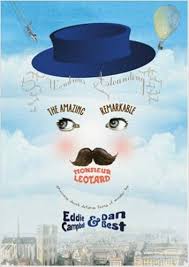
[READ: May 3, 2016] The Amazing Remarkable Monsieur Leotard

Eddie Campbell wrote The Black Diamond Detective Agency which I enjoyed, and The Fate of The Artist, which I enjoyed even more.  Both were pretty unusual–lots of different things going on.  Well, this book has even more stuff going on in it.

I genuinely didn’t know what to expect from this.  I assumed it would be a biography of Jules Léotard, the daredevil acrobat who developed the art of trapeze, popularized the one-piece item that bears his name and was the inspiration for the song “The Daring Young Man on the Flying Trapeze.”

But in this book that Jules Léotard dies on page 12.  Upon his deathbed, with no will written, his worldly possession (a fake mustache) is bequeathed to his nephew, Etienne.  So Etienne puts on the mustache and flies to Paris (in a hot air balloon, of course) to join Leotard’s troupe of circus performers.  When he finds out that they have eaten most of the animals because they were starving, his plans change somewhat.

And so this book is all about Etienne pretending to be the (possibly reincarnated) amazing Léotard and the fascinating adventures he gets up to. (more…)

Read Full Post »

earnestSOUNDTRACK: THE SILVER MT. ZION MEMORIAL ORCHESTRA & TRA-LA-LA BAND-Born into Trouble as the Sparks Fly Upward [CST018] (2001).

Born_into_Trouble_as_the_Sparks_Fly_UpwardNotice that the band’s name has gotten longer.  That could be because they have added three new members (which means they are slowly growing to be the size of GYBE anyway). In addition to Efrim, Thierry and Sophie, there is now Becky Foon on cello, Ian Ilavsky on guitar and organ and Jessica Moss on violin (all Constellation stalwarts).

The first song is the nine minute “Sisters! Brothers! Small Boats of Fire Are Falling From the Sky!”  Echoed drum sounds slowly grow louder before a slow violin plays a mournful melody.  But with the new members, there is now a cello to accompany the violin, making this album sound even more classical.  Three minutes in, the piano takes over (and the strings slowly fade).  The piano is a bit prettier and more accomplished sounding (even if it has only been a year since the last album).  Despite the addition of all of the extra instruments, the song still veers pretty far from GYBE territory.  It feels very acoustic (what with the piano), and while the song is repetitive it never feels like it is epic or building towards something–it just grows bigger and more beautiful as more instruments enter the mix.

“This Gentle Hearts Like Shot Bird’s Fallen” opens with what sounds like bird noises, but may actually be a child.  The song is primarily echoed guitars which lay a foundation over which the violins and cellos play slow mournful notes.  The song grows as more instruments  play along, including some gentle percussion, and it all seems to end too soon.

“Built Then Burnt [Hurrah! Hurrah!]” is a spoken piece.  Efrim doesn’t recite the words–it sounds like a child (but may be a young woman).  The reading is dramatic and works very well with the slowly building strings that comprise the bulk of this song.

some lines:

Why are we all so alone here
All we need is a little more hope, a little more joy
All we need is a little more light, a little less weight, a little more freedom.
….
Good words, strong words, words that could’ve moved mountains
Words that no one ever said
We were all waiting to hear those words and no one ever said them
And the tactics never hatched
And the plans were never mapped
And we all learned not to believe
And strange lonesome monsters loafed through the hills wondering why
And it is best to never ever ever ever ever ever ever ever ever ever wonder why

As that song fades, the aggressive strings of “Take These Hands and Throw Them in the River” take over. This song features Efrim singing in full voice–the recognizable voice of SMtZ.  On this song his voice is processed and echoed and so the strange timbre of his voice doesn’t quite register because it sounds so…unusual anyway.  I really enjoy the way this song sounds so much bigger than the rest.  At around 4 minutes, while the song begins to build –both instrumentally and vocally, new strings bring more intensity until the whole thing just fades away to the sounds of actual birds which chirp for about 2 minutes.

“Could’ve Moved Mountains…”is eleven minutes long and shows incredible restraint, especially in the vocals.  It opens with slow bass notes.  The whispered spoken vocals return and the song is kind of ominous..  About three minutes in quiet harmony vocals accompany him and soon after, strings are added and continue to grow louder.  The instrumental section is quite pretty although still melancholy.  Around 8 minutes in, a guitar riff begins playing a similar melody to the strings. It plays for a bit and then the strings rejoin the song, playing a more hopeful melody.  The song ends with some kids talking and singing as the song melds into….

“Tho You Are Gone I Still Often Walk W/You”  This song opens with piano and cello, a sad intro indeed.  I like that after a minute the song jumps keys unexpectedly while keeping the rhythm otherwise the same.  The song doesn’t vary much from this simple piano and strings feel although it ebbs and flows in intensity.

“C’monCOMEON (Loose An Endless Longing)” breaks the melancholy of the previous son with a big buzzy electric guitar chord.  Strings eventually come in and the song builds and builds, complete with interesting percussion.  This song is probably the closest to a GYBE song with a dramatic build and very satisfying chord progressions.  When the fast bass notes kick in around 3 minutes it seems like the song is going to grow even faster, but instead, it fades away to some ringing chimes–what sounds like a giant echo chamber (a really neat effect).  That calm is broken by a series of horns playing one note at a time, louder and louder (this whole middle section reminds me of the middle of “Atom Heart Mother” by Pink Floyd–in fact I have found a number of comparisons to some of Floyd’s trippier moments on this and other albums).  And then the drums come crashing back in.  It’s a very different song that resumes–loud bass, lots of drums and everything mixed loud enough to distort the sound.

The final song is “The Triumph of Our Tired Eyes.”  It opens with guitar harmonics and Efrim’s disatnat voice.  It’s a pretty and delicate song, joined by strings and a genuinely pretty vocal melody: “There’s beauty in this land, but I don’t often feel it.”  And as the strings swell and swell, the voices sing the refrain: “musicians are cowards” over and over.  The song and disc end on a surprisingly quiet and beautiful note.

When the songs ends, there’s a few seconds of children singing lyrics to the “Twinkle Twinkle Little Star” melody although the words don’t fit like: “when we finally cross the barricade…”

I really like the way this album plays with the new style of music the band has embraced but also admits some of the strengths from pretty much everyone else’s other band.

[READ: April 4, 2016] The Importance of Being Earnest–The Graphic Novel

This play is one of the great plays in English literature.  Oscar Wilde is at his best, writing witticism upon witticism–each line is a funny rejoinder to the previous one and the wit is infectious.

The story is fairly simple, but he adds so many twists that it’s almost easy to get lost in the story.  In fact, it’s entirely possible that reading the play is a sure way to get lost in the deceptions.  And that’s why this graphic novel is so excellent.

I’ve always maintained that it is difficult to “read” a play, especially if there are dozens of characters.  The short, one act plays that I’ve been reading over the last years are fairly easy to follow, but when you have 20 named characters in three acts, it’s not always easy to keep people straight.  And that’s why to really appreciate Shakespeare you need to see it.  Well, this graphic novel effectively performs the play for us.  The dialogue is exact and there are no changes from the original (except for any stage directions, which are left out of the text, but are presumably addressed in the art).

What’s (intentionally) confusing about this play is that the two main characters are trying to deceive other people about their identity.  Algernon Moncrieff and John Worthing are two gentlemen–well off, single, clever.  Algy talks about how he likes to go Bunburying.  Which means he has “invented an invaluable permanent invalid called Bunbury, in order that I may be able to go down unto the country whenever I choose.  …If it wasn’t for Bunbury’s extraordinarily bad health, I wouldn’t be able to dine with you.”  This comes up because John has informed Algy that he “has always pretended to have a  younger brother of the name Ernest, who lives in the [city] and who gets into the most dreadful scrapes.”

They have lies in common: each man lies to a group about a phony other person whom they use as an excuse for bad behavior. (they are old friends as well, of course). (more…)

Read Full Post »

[ATTENDED: February 27, 2016] The Wizard of Oz

wozBack in February, Tabitha and I went to the Montgomery High School’s production of The Little Mermaid.  I was pretty sure they did two performances a year, so I was surprised to see them advertising The Wizard of Oz already.

This turned out to be not the high school actors but a group of semi- and non-professional adults.  Best of all, the entire cast was made up of teachers and faculty from the Montgomery School System.

All four of us were going to go, but Clark had a sleepover the night before, which meant no sleeping, so he crashed while we went to the play.

This production was for something called Music from the Heart.  As the blurb noted:

The Montgomery Township Education Association and Montgomery High School Band Parents Association present the musical The Wizard of Oz for the fifteenth production of Music from the Heart! The fully volunteer cast and crew are assembled from an eager group of district teachers, support staff, administrators, and students. Proceeds from the production fund the graduating senior class scholarships awarded by both the MTEA and MHS Band Parents Association.

I’m all for helping out band and education associations, and since their Theater is amazing, I figured it would be a good show.

And boy was it. (more…)

Read Full Post »

succourSOUNDTRACK: MARIA VOLONTE-Tiny Desk Concert #183 (December 27, 2011).

volonteOne of my plans for this calendar year was to write about all of the Tiny Desk concerts from 2016 and from 2011 (to play some catch up).  This is the final tiny Desk from 2011!  Huzzah.

Maria Volonte is an Argentine singer who interprets tango music in her own way.  She also plays folk, Latin blues as well as more traditional music.  She plays three songs here and is accompanied by the fantastic harmonica player, Kevin Carrel Footer.

“El Beso Azul” (The Blue Kiss) is a pop-folk ballad expressing menacing sadness.  Volonte’s voice is beautiful–full of longing and desire, heartache and sorrow.  She plays a very rich and full sounding acoustic guitar and is accompanied by a wonderful bluesy harmonica which plays some amazing lines and riffs.

“Oh Viejo Tren” (Oh, Old Train) is based on a long train ride from the outskirts into the city proper of Buenos Aires.  She says, “This is about people chasing their dreams in the city and then falling into reality.”  This song is slower and sadder and her voice changes appropriately, even if there is still an air of sultriness about it.  The harmonica in addition to playing great “train” sounds, keeps a perfect bluesy accompaniment.

“SF Tango” is an ode to San Francisco and to tango.  The song is in English.  I like the way she picks her guitar at the beginning and the cool strumming rhythm that the rest of the song has.

Typically, when there’s an interesting quote from the blurb, I post it here, but Jasmine Garsd’s write up is quite lengthy, and it tells an interesting history of the tango as well as some details about Volonte.  It also says she can barely listen to “SF Tango” as she finds it so moving. I didn’t find it so, but I did enjoy what she wrote.  Read it here.

[READ: January 2, 2016] Our Ladies of Perpetual Succour

I also wanted to make sure I finished all of the posts I started in 2015.  This is the last one (although maybe I finished the book in 2016?).  So it’s nice to have that burden lifted as well!

I read Warner’s The Sopranos in 1998.  I loved it.  It was very funny, very raunchy and a delightful way to see girls having wild fun.

Of course, it’s nearly 20 years later and I have a daughter of my own and I can’t help but think that the girls’ behavior is so unsafe, so unwise, so irresponsible!

This play also seems (if memory is any guide) to take the wildness of the girls and condense it.  Since there is no narrator to slow things down they are just wild from the get go.

So this play is about six girls.  The girls are the only ones in the play–they wind up doing different characters (including men) which sounds like it would be very funny to see).  All of the girls are in the choir of Our Ladies of Perpetual Succour Catholic school.  And they are all heading to a competition in Edinburgh

The six girls are:

Fionnula (lives in a council house bought with the money from her grandad)
Manda (Mum fucked off, lives with her da, never shuts up about her sister)
Chell (lives up the complex, has had a lot of tragedy in her family)
Orla (diagnosed with cancer but recently returned from Lourdes)
Kylah (parents own their house and she sings in a band)
Kay (stuck-up goody-two shoes, off to university)

The girls are hardened and cynical–they say there have been several pregnancies this year already in their class and they call their headmistress Sister Condom.  They are excited to go  to the city for this competition not to sing but to get shitfaced and hook up with guys.

Their language is fairly shocking from the starts.  It’s one of the girls who says  Manda’s mum “fucked off.”  And this being Scotland, the word “cunt” is thrown around all over the place.

The girls plan to separate when the get to the city.  But first they get started by going to the bar (the girls are afraid to bend over to pick up their cigarettes for fear of flashing the entire bar).  They drink.  A lot.  Even though they are underage.  And they get hit on by all sorts of men.  One even has the pick up line “Do you know you have 206 bones in your body?  Would you like another one in ya?”

And then the girls separate.

Two go home with a guy who is divorced and very sad about it (which leads to a very wild scene–including a moment in which one of the girls portrays a man with an erection–wonder how they did that).

By the end of the night at least one girls has thrown up, at least one girl has hooked up and it sure looks like they have no chance of winning their competition.

Unlike a Hollywood production though, this story is not destined to end with them winning everything (this is no Pitch Perfect).  The girls are going back to their hum drum lives after this and they will also have to deal with the realities that a night of debauchery can reveal.

So despite the fact that this play is laugh out loud funny, by the end, it’s not really a comedy.  Thanks, Scotland.

For a preview of the play, check out the video

Read Full Post »

naughty SOUNDTRACK: GEM CLUB-Tiny Desk Concert #181 (December 16, 2011).

gem clubGem Club is a quiet band.  During this set there are three members:  Christopher Barnes on keyboards and lead vocals, cellist Kristen Drymala and vocalist Ieva Berberian (who is eerily silent and still for much of the performance).

The first song, “Animal” features Barnes on keyboards, playing a simple melody and Drymala, playing a low and loud cello to accompany (when her first note comes in, it’s really striking).  She also sings a wonderful harmony vocal.  Barnes’ voice is almost a whisper, but between his voice and the vibrato on the keys, it sounds really big (but still quiet).  I really enjoyed the way the only “melody” she played on cello was at the very end of the song–a brief riff to signal the end.

“Breakers” opens with some rough cello playing and then a gentle echoed keyboard.  Ieva Berberian didn’t do anything in the first song, she just hovered mysteriously in the background. But for the second song she hits occasional tambourine notes (which sound practically like explosions amid the delicate echoing keyboards).  Perhaps the most interesting part of the song is watching Drymala tap on some  colorful bells with her foot to create a lovely melody.

For the final song, “252” Barnes says it is kind of a beast, (although it doesn’t sound any more complex than the previous two to me).  The piano is echoed and Ieva Berberian finally sings backing vocals.  Her voice is a little haunting and it works very nicely with Barnes’ voice.  The melody is beautiful.

Incidentally, the blurb says that this is the first time they’ve amplified a singer’s voice (they ran his voice through a chorus pedal to give it that otherworldly echo).  I have been listening to a lot of loud music lately, and this was a perfect counterpoint.

[READ: December 20, 2015] History’s Naughty Bits

This is the kind of book that promises to be very funny.  And then it turns out to be mostly funny but also rather scholarly.  Which is not bad thing, it’s just not as raucous as one might have imagined.

Dolby begins by dismissing the idea that “naughty” things are a recent invention and then proceeds to go through the history of human culture to show examples of things that would certainly be considered naughty today (some are quite shocking).

She starts with Classical Greece where women were expected to remain chaste, except for hetairai, high-class courtesans, who were well-educated and respected.  That’s some choice.  Adultery was considered less of a sin if was committed with a prostitute. (more…)

Read Full Post »

trickSOUNDTRACK: I WAYNE-Tiny Desk Concert #180 (December 12, 2011).

Tiwaynehis Tiny Desk Concert is just 7 minutes long.  I Wayne is a reggae singer and he’s accompanied by an acoustic guitar.

“Real and Clean” is a simple song with the appropriate reggae rhythms used as background to Wayne’s lyrics, part of which go like this:

“let nature take its course / no need to rush no need to force / no need to worry about child support / abandon abused in family court”

“Can’t Satisfy Her” seems to be about a prostitute.  The song is from 2004 and the blurb says “he’s largely credited with bringing the roots and rock back to mainstream reggae.”  I’m not sure if the NPR office knew the song, but by the end they are singing along.  With a comment at the end: “thanks to the NPR chorus.”

It’s certainly catchy and a bit more interesting than the standard reggae fare.

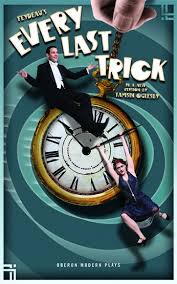
[READ: December 10, 2015] Every Last Trick

I found this book at work.  The cover was silly and the full title was “Feydeau’s Every Las Trick in a new version by Tasmin Oglesby.”  I saw that it was part of the Oberon  Modern Plays collection, which is a collection of short plays and I have read several of them (okay I just looked them up online and there are approximately 960 Oberon plays, I think I’ve read about 6).

Anyhow, this play is based on Le Système Ribadier by Georges Feydeau.  I’ve never heard of it or him.  But this version is a delightfully over the top farce.

There are four main players: Juan, Gus, Tom and Angela and a fifth one, Knowles.

As the play opens Gus, the servant of Juan and Angela is sneaking in through a window.  He steals some of the family’s booze.  Then Juan and Angela come in, arguing.  Angela is mad at Juan and accuses him of cheating on her. (more…)

Read Full Post »

silentSOUNDTRACK: HOSPITAL SHIPS-Tiny Desk Concert #177 (November 23, 2011).

hospital shipsHospital Ships is a band created by Jordan Geiger, who was in the band Shearwater, among others. In 2011 he released his second album as Hospital Ships.  The blurb describes the album as “packed with poppy folk songs and brash rockers enhanced with instrumental flourishes and bursts of guitar feedback,” but for this recording, they strip everything down to the basics: a guitar, banjo, ukulele and a drum with a towel over it to muffle the sound.

Geiger has a rather high-pitched, delicate, almost talking-singing voice and his songs are rather pretty.  The band plays 3 songs in just over ten minutes.  The first one, “Phantom Limb,” (once my lover, now my friend, you are my phantom limb) has a recurring motif of them saying/singing “ha ha” which is rather catchy.

“Carry On,” features a four-letter word (technically a seven letter word), which might be one of the first times on a Tiny Desk Concert that such a word is uttered.  It’s especially funny given how sweet the band sounds.  The sentiment of the song is nice though: “To all the women I’ve loved, When I was with you I would say I was better off….  And when I’m gone, carry on, carry on.”  There were harmonies in the first song, but they are more prominent in this one (three part) and are quite nice.  The banjo player also does a whistling solo.

“Let Me In” made me laugh because he uses the word baby a lot (which Ben Folds said in his Tiny Desk that he has never said in real life, so why would he put in it a song?).  But this song is very gentle and sweet–just Geiger on his guitar singing “baby, let me in.”

Geiger’s voice reminds me of a few different people–Ben Gibbard from Death Cab for Cutie especially on the final track; perhaps the Mountain Goats or the Weakerthans.  And his songwriting is very good.

[READ: December 26, 2015] Silent But Deadly

I really enjoyed the first Liō collection, and was pretty excited that I could find the second collection so quickly (my library doesn’t have any more collections for some reason, so I’ll have to track the rest down elsewhere).  This book collects the strips from February 25, 2007 – December 2, 2007.

Not much has changed from that book to this one, but I think Tatulli’s comic chops have gotten even better.

The strip won me over immediately with the first one in the book. Lio draws a monster and it comes to life.  He looks at the marker and it says “magic marker” and he gets a big grin and goes back to work.  So simple yet so funny.

It is that big grin–wide open-mouthed just unfettered mischievous delight that occurs in nearly every strip. (more…)

Read Full Post »

lio1 SOUNDTRACK: JOE HENRY-Tiny Desk Concert #176 (November 21, 2011).

joe henryI had never heard of Joe Henry, so imagine my surprise to find out that he was releasing his 12th album in 2011.  For this Tiny Desk, it’s just him at a stool playing his guitar.  He has a very easy vibe, telling stories between songs and playing them with very little fuss.

He opens the show by saying this is, “not exactly like Woody Guthrie playing for the union members but you are working people.”

He plays four songs, “Sticks and Stones,” After the War,” “Odetta” and “Piano Furnace.”

Between the first two songs, he says he first became aware of Tiny Desk Concerts when his friend Vic Chesnutt was on the show (amusingly, he was the second person on the show).  He says he has a song on his new record about Chesnutt (Chesnutt had recently died).  He doesn’t play it though.  At first it seems like he might not be allowed to play it, but then it seems like maybe he just doesn’t get to it.

Rather he plays “After the War” where his guitar sounds like it has an incredible echo on it.  That echo is also present on the third song.  After which Bob asks him about his guitar.

Joe says he’s had the guitar for 6 years.  But the guitar dates back to 1932.  He says that he heard things differently with this guitar.  It’s got a smaller body and was actually sold as a budget guitar by Gibson (for $19 in 1932).  He also jokes that it’s black and looks a bit like a World Wrestling Federation belt.

Then someone asks him about Sam Phillips.  Joe says he sold her husband a guitar about 20 years ago.  She and her husband have split and Sam got the guitar and has been playing only that guitar for the last 20 years.  He says that he loves that she doesn’t plug in her guitar.  She plays into a microphone where you can hear the whole guitar and which makes the other players lean in to hear her.

I love the chords he plays in the final song, “Piano Furnace,” even if I don’t know what the song is about.  Henry’s voice is familiar.  I think he sounds a bit like a number of different singers.  And overall, nothing really stands out in his performance, except that everything sounds great and hiss songwriting is really solid.  That’s not a bad thing.

[READ: December 20, 2015] Happiness is a Squishy Cephalopod

Mark Tatulli is the author of the Desmond books.  I liked the stories, but I didn’t love the drawing style so much.  Imagine my surprise to find out that Tatulli has been drawing comics featuring this little boy Liō since 2006 (going forward, I’m leaving off that line over the o, because it’s a real pain).

And even more surprising is that I like the drawing style in the comic quite a bit–it is slightly refined over the Desmond books and is all the better for it.

I am also really surprised to find out that this strip appeared in newspapers across the country.  I’ve certainly never heard of it (but then I don’t read newspapers anymore, either).

So Lio is strip about a boy named Lio.  Lio is a dark, dark kid.  He has a pet squid, he loves monsters and he’s delighted by chaos. (more…)

Read Full Post »

« Newer Posts - Older Posts »