Feeds:
Posts
Comments

Archive for the ‘Funny (ha ha)’ Category

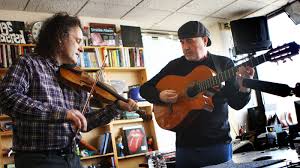
19SOUNDTRACK: MARTIN HAYES & DENNIS CAHILL-Tiny Desk Concert #269 (March 11, 2013).

hayescahillEven though I have enjoyed much Irish music over the years, I was unfamiliar with Martin Hayes and Dennis Cahill.

The blurb says:

You’re about to watch one of the best fiddlers on the planet and a subtle guitar master work their magic. For too many of us, Irish music is something that merely gets trotted out around … St. Patrick’s Day and the coming of spring — and made a cliche by commercialism.

But for a moment, stop, put aside your notion of jigs and reels, and just listen. Martin Hayes plays his fiddle with an exquisite touch and tone, as well as a magnificent sense of melody and rhythm that never ceases to astonish.

Hayes has worked with many accompanying musicians, and some are equal partners, but with Dennis Cahill you get delicate support. It’s a rhythm that keeps the tune in; that accents and colors it but never overtakes it. It’s brilliant restraint that serves the music and perfectly suits his partner. So with fresh ears, come join us in a rare treat with a familiar sound.

And indeed, this is just beautiful fiddle playing and understated guitar work.  It’s a fantastic pair.

They play three pieces (some of which are actually made up of smaller independent pieces).

“The Mountain Lark/Tom Doherty’s Reel” I’m not sure when the first part ends, but I love as they get near the end of the piece—the fast bowing is just great.   Hayes gets some really amazing sounds.

As with many great Irish players, modesty is the key.  He talks about how he learned while watching his father and how he enjoys other players.  He talks about how traditional Irish music is not slavishly about the past, but it incorporates new elements into an old tradition.  As you can tell by the name of the second half of this next pair: “P. Joe’s Reel/The Barack Obama Reel.”

He also says that it’s good to see you get music breaks.  Music breaks should be part of all work—lunch break and music break.  The final piece is in fact a traditional piece called “O’Carolan’s Farewell To Music.”  It was originally written for harp by Turlough O’Carolan and is rumored to be the final piece that O’Carolan played before he died.  The transposition to fiddle and guitar is perfect.

[READ: February 8, 2016] Bad Babysitter

Babymouse continues to delight with the funny stories and amusing spoofs.

This story opens with Babymouse dreaming about “The Old Woman Who Live in a Shoe” (which is instantly transformed into a bunny slipper).  She wakes from her daydream about comics to see an ad for a Super Scooter, only $79.  There’s no way Babymouse’s mom will pay for this, so Babymouse better save up!

The next day at school one of her friends say that there’s a babysitting job available if Babymouse would like it.  Babymouse imagines herself as Mary Poppins until the dream kitten (who looks suspiciously like Felicia Furrypaws) complains about her whiskers.

Babymouse is set to babysit for Mrs Ladybug whose child (she swears) is a sweteahrt and only cries when he is hungry.  And, he should sleep the night. Ha!  He is up all night and, just like with her goldfish, Babymouse overfeeds the baby until it throws up all over her.  This job ends with her watching a zombie movie (called Babysitting Movie) and causing serious damage to the hosts’ house. (more…)

Read Full Post »

two-worse  SOUNDTRACK: CHEICK HAMALA DIABATEN-Tiny Desk Concert #285 (July 6, 2013).

hamalaNPR Music has been the sole source of my exposure to music from Mali.  I have really grown to like its slightly unusual patterns which are all based on a fairly standard rock structure.  But unlike some of the other Mali musicians I’ve been exposed to, Diabaten does not play guitar.  He plays banjo and the ngoni (but there is plenty of guitar in the song too).

The blurb tells us

Malian tradition lies at the heart and foot-stomping soul of Cheick Hamala Diabate and his band, but their melodies and undeniable rhythms cut across age and ethnicity. Diabate primarily plays the ngoni and the banjo; think of the ngoni as a great-grandfather to the banjo and it all makes sense, because both instruments share the ability to convey melody and plucked percussive rhythm.

Diabate is from Kita in Mali and born into a family of griots, or storytellers; his first cousin is the legendary kora player Toumani Diabate. Cheick Hamala Diabate makes his home these days in a Maryland suburb a few miles over the D.C. line, and his musicians are American-born and inspired by this lively lyrical music, which often tells a tale about Mali and its people as part of the sway and shake.

“Mali De Nou” sounds fairly traditional–with all of the percussion.  And then about a minute and half in a noisy scratchy guitar solo plays over all of the music–a very Mali sound.  But it’s interesting that, for the beginning anyhow, Diabate isn’t doing all that much.  In fact, the song feels almost overwhelmed by percussion (but in a good way). There’s a shaker or two, big floor drums (congas?) and a drum held between the knees and there’s even that big round gourd drum.

There’s also a sax and a bass, the lead guitar and of course, Cheick’s banjo.  By the middle of the song,  Chieck does some lead banjo playing.  And then it sounds like he’s put some effects on the banjo making it sound almost like a kettle drum—he even plays the strings below the bridge.  He really gets a lot of cool sounds out of the instrument

After this song he chats briefly and wants to “Invite you guys to visit Mali, it’s a beautiful country, you’ll be more happy.”

For “Talcamba” he switches to the ngoni.  He explains that the original ngoni had 4 strings, but his has 7 so he can play…more.  This instrument can play reggae, salsa, everything.  This is when he says the American banjo is like the grandson of ngoni.

Tacamba is a dance from north Mali—you can move your body (he waves his arms).  There are vocals but they are mostly a chanted refrain   The solo on the ngoni isn’t a conventional solo, it’s him flicking the strings making a very interesting sound.  I could have used more close-ups of this instrument as you could barely see the strings, and I’d love to see how he fit 7 on that small neck.  Half way through the song it shifts gears and the tempo really picks up—there’s a fast guitar solo with all that percussion keeping up.  And then the percussionist puts down her shaker and starts dancing in the center of the room.  It feels inspired and impromptu and it’s a lot of fun to watch.  While she’s doing that, Cheick picks up a hand drum and starts creating a new rhythm.  It is joyful and celebratory.

For the final song, “Djire Madje,” he switches to acoustic guitar which he plays lefty upside down (so the high notes are at the top).  He plays the lead riff.  At one point the electric guitar is also playing a lead but in a very different styles and they work very well together.

[READ: October 10, 2016] The Terrible Two Get Worse

I really enjoyed The Terrible Two, and this sequel is just as enjoyable.  The pranks are bigger, but the victim has changed.  Why?

Because Niles Sparks’ and Miles Murphy’s pranks got their principal fired!

Principal Barkin was the perfect guy to play a prank on–he had no sense of humor, he was pretty jerky and his face got really purple when he was upset.  But Principal Barkin is nothing compared to his father.  We met his father in the previous book–he yelled a lot, especially at Principal Barkin.  You see, the principal’s father was the previous principal, and he was a tough guy–he took no guff from anyone.

So after a delicious opening prank, Niles and Miles set about to making a great prank on Photo Day.  One of the great things about these books is the illustrations (by Kevin Cornell).  Sometimes the text incorporates the illustrations into the story. Like with Picture Day–the hilariously bad “pictures” absolutely make the sequence.  But it’s what they do to Principal Barkin’s son (who has paid the extra $10 for a gray background) is frankly genius.

But even better is what they have done to the whole school photo– a prank many months in the making.

(more…)

Read Full Post »

two SOUNDTRACK: MOHAMMAD REZA SHAJARIAN-Tiny Desk Concert #276 (May 20, 2013).

rejaI had never heard of Mohammad Reza Shajarian, but I see that he was voted one of NPR’s 50 Great Voices.

With the visit of the incredible, honey-voiced Mohammad Reza Shajarian from Iran, we lucked out by having him sing on not just any day, but on the biggest holiday of the Persian calendar: Nowruz, the New Year.

Shajarian is accompanied by brothers Sohrab and Tahmoures Pournazeri (celebrated musicians in their own right) and French percussionist Robin Vassy.

They play one song, an improvised piece called “Az Eshgh (Love Song).”  There is an upright, bowed instrument, the Kamancheh which plays the lead melody for much of the song.  The rest of the music comes from the Tar, one of the most important musical instruments in Iran and the Caucasus.  It has a rather tinny sound.

Meanwhile, the drummer has several different gourd drums.  He hits one with his fist and scratches the notches on the side.  Around three and a half minutes in, he starts blowing into this whistle-like object that makes a wind sound.  He also has two gourds that are floating in water.  He takes one out and we can hear the dripping.  He gets almost two minutes of a solo to play all of these sounds.  Its very cool.

Interestingly, even though this Tiny Desk is all about Shajarian, he doesn’t sing all that much.  But when he does, it’s quite powerful.  As the blurb says:

In the course of this love song, titled “Az Eshgh,” Shajarian unleashed torrents of swooping, soaring, goosebump-inducing sound — still perfectly controlled at age 73.

[READ: September 20, 2016] The Terrible Two

I love Mac Barnett.  He’s one of my favorite children’s authors.  I only know Jory John a little but I’ve enjoyed what I’ve read by him.  There are also fantastic illustrations by Kevin Cornell to make this book a delightful story about pranksters.

The book opens in Yawnee Valley, a quiet place where cows are the main thing.  Literally.  They are everywhere–and you hear them mooing all day and night (and throughout the book).  Miles Murphy (the dark haired boy on the cover) is moving to Yawnee Valley.  And he is not happy.  He has already sighed 100 times that day.  He hates the thought of leaving his friends and starting a new school.

Page twelve lays out an excellent summary of what it’s like to be a new kid in a school.  What kid are you going to be?  chess kid? basketball kid?  front-row kid? kid who’s allowed to see R-rated movies?  Kid whose family doesn’t own a TV and just wants to watch your TV?  And so many more options.  But Miles knows who he is.  He’s the prankster.

But when he gets to school (this is the first day of school), someone has moved the principal’s car to the front of the stairs–blocking the front door. Looks like Yawnee Valley Science and Letters Academy already has a prankster.

The principle is Principal Barkin.  He loves being principal of the school, as his father and his father and his father and his father had been.  There was one embarrassment in the family chain of command–the principal who actually closed the school during a blizzard, but otherwise, their record was sound–no closures.  And Barkin’s own son was poised to become the principal as well. After all, he had been elected president the past two years–just as had all of his ancestors–president and then principal–that’s the plan.

But this first day of school was not a good day for Principal Barkin.  And Chapter 6 lists the 40 things that happened as soon as he found out that his car was blocking the main entrance (none of them were good for him).

Principal Barkin suspects and questions everyone for being responsible for doing this prank.  And when he sees Miles–the only child he doesn’t recognize–he automatically assumes he is guilty.  Miles assures him that he didn’t do it.  Principal Barkin says okay but he will have his eyes on him.

Barkin then gives him a book called 1,346 Interesting Things You May or May Not Know About Cows.  He also gives Miles a buddy.  The buddy is named Niles.  He is dressed in a blazer with a sash that reads “school helper.”  The introduction goes like this: “Niles is the student who first told me abut my car.  Miles is the student who I suspect moved it.”

Niles is the most cheerful, obnoxious child Miles has every seen.  And he will not let up.  Niles introduces Miles to people (like Holly the girl who sits next to him).  He states the obvious.  And he tells Miles about Josh Barkin, the Principal’ son.  And boy is Josh a jerk.  Josh intentionally hits Miles in the face with his backpack as he walks by.

Niles says “while i don’t want to call anyone the worst, Josh is pretty mean sometimes…also he really likes the word nimbus for some reason.” (Josh calls everyone a nimbus as an insult).

Another kid who makes a lot of noise and is used mostly for comic effect is Stuart, Stuart talks in all caps and really really states the obvious.  Everyone hates him.

Miles is still pretty bummed about someone else being the school prankster.  But when Josh comes over in the cafeteria to give him a hard time, Miles deliberately dumps his food all over himself and then manages to blame Josh.  Josh says he didn’t do it, but Niles supports Miles.  When Miles asks why he would lie for him, Niles says that Josh made him swallow a rock over the summer–twice.

Miles gets home an has a kind of rough night.  So doe Principal Barkin whose father calls to yell at him for the embarrassment of his school day.  But while Bakin is beaten down, Miles is inspired.  And he comes out with his greatest prank ever.

The awesome birthday party of a boy he just made up, Cody Burr-Tyler.  The plan?  Make the party secret, tell only a few people and then watch everyone show up with presents.

It’s a great plan and it works.  And just as he is about to reap his rewards, Cody Burr-Tyler shows up and steals the show.  What just happened?

I don’t want to spoil who the prankster is.  He is impressed by Miles but sees some serious flaws.

Like the birthday party–did Miles really think he could fool the entire class and walk away with a bunch of presents and have people still like him?  He had to learn to be subtle.

And so the prankster offers to let him join forces to become a great pranking team.  But there is no way Miles is going to join forces with HIM.  So instead, Miles challenges him to a prank battle.

And the rest of the book is a series of escalating pranks.  The whipped cream one is outdistancing as is the diorama double cross (everything about the plan is genius–on both sides).

Can these two join forces to torment the person who most needs some comeuppance?  (Yes).  But what can they do that will really be a spectacular prank that people will talk about for years?

I was surprised and delighted by the final prank and I love the way they pulled it off.

I’m really looking forward to book two.


Read Full Post »

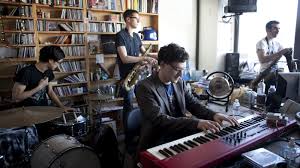
meanSOUNDTRACK: ENDANGERED BLOOD-Tiny Desk Concert #214 (May 7, 2012).

bloodThe Brooklyn jazz quartet Endangered Blood was formed so its members could play benefit concerts for their friend, saxophonist Andrew D’Angelo, who’d been diagnosed with a brain tumor. D’Angelo eventually made a full recovery, but the group — Trevor Dunn (bass), Jim Black (drums), Chris Speed (tenor saxophone) and Oscar Noriega (alto saxophone) — realized that this ensemble had potential to become a real working band. In 2011, the four released a self-titled debut album.

Endangered Blood’s music draws from the members’ diverse backgrounds and influences, combining post-bop, 20th-century chromaticism, traditional New Orleans funeral marches, avant-garde jazz and post-punk to create a sort of mad-scientist concoction. Its compositions are cerebral, but they’re also gritty and full of energy.

The band plays two songs and the description above really gives a feel for what they sound like–kind of all over the place

“Iris” is a slow song that has a real Tom Waits feel (although no vocals).  It has a slow nightclub jazz feel and I love watching the drummer do that kind of swaying lots of arms but quiet hitting drum sound.  There’s an interesting (although quiet) bowed upright bass solo in the middle of the piece.

“Uri Bird” opens with a lengthy bass and drum solo (the drummer seems to be having a ton of fun–including hitting his sticks off the walls and floor).  Then the two saxes come in playing the exact same riff.  This has a bit more bebop feel with the saxes trading off solos.  It ends with a fast wail and a solid beat.

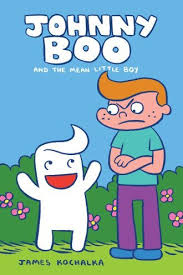
[READ: March 6, 2016] Johnny Boo and the Mean Little Boy

I love how the Johnny Boo universe is so small that characters keep returning.  Like in this one, the fourth book, Johnny Boo tells Squiggle that they can’t play today because his playing with his new friend Rocky the Rock.  This is the same rock that he threatened to make his best friend in the first book.

Johnny promises Squiggle that they will play together soon, as long as Squiggle can give him a “hooray.”  But Squiggle’s hooray is not very enthusiastic.

Squiggle says that he will go off and find other friends, too.  But it turns out to be not so easy.  And then a butterfly starts flying around him.  At first Squiggle is annoyed by it but then he thinks they can be friends. (more…)

Read Full Post »

applesSOUNDTRACK: SO PERCUSSION-Tiny Desk Concert #205 (April 2, 2012).

So Percussion is a quartet who plays nothing but percussion.  When we think percussion we often think rhythm, but these guys (Eric Beach, Josh Quillen, Adam Sliwinski and Jason Treuting) also provide great melody.

The band is inspired by John Cage.  He’s “their guy.”  They have written songs inspired by him and also perform his pieces.

Though audiences are still often puzzled or even infuriated by Cage, the composer brought essential joy and optimism to his work. Music is everywhere, Cage taught; frame sound, even the sounds of everyday life, and hear what is there. In the signature mix of serious play (or is that playful seriousness?) that So Percussion brought to this unusual Tiny Desk Concert, the group mixed a work by Cage (the first movement of his Living Room Music) with two pieces by Treuting: Life Is [ ] and 24 X 24, in which the text Quillen reads aloud comes from Cage’s own writings. Inasmuch as many of their instruments are quotidian tools, the sounds they create can be magical.

The first piece was written by the band’s Jason Treuting, called “Life Is [ ].”  It’s just under three minutes and is primarily wood blocks.  But there are also xylophones and bells (and many other things).

All four have mallets and are clacking on the wood blacks.  But each player has something else that makes a melody–tiny cymbals, the xylophone, bells that you tap with your hand–and they create a pretty melody (and the wood blocks provide interesting counterpoint rhythm).

Since John Cage is their guy they made a piece that celebrates the way he made music: “24 X 24.” Cage celebrated “time-based structures and task-based sound things.”  So this piece is flexible and malleable.  They are going to play an 8 minute version of the song which includes a spoken word of a Cage lecture [the entire lecture is reprinted at the bottom of the post].

The narrator counts down from 8, which is interesting.  Then he recites (including coughs and other noises) a piece by Cage about music and art.  While he is reciting, instruments include the melodica and harmonium, a musical saw, a coffee cup full of change (at one point instead of tapping the cup, he takes the change out and state each denomination out loud).  They also play the side of the desk, a cactus plant (that is pretty cool to see), even plucking the Emmy on the desk.

The final piece is a John Cage composition.  It is the first part of a longer piece called “Living Room Music.”  Back in the early 40s Cage wrote a piece called “Living Room Music” which was supposed to take place in a living room.  And this is our living room.  They play the first part   called “To Begin.” It’s just under a minute, but the sounds they get from a waste basket (like a bass drum), a package of paper towels, a stapler, the desk and the coffee mug is really cool.

Even people who don’t like John Cage have to appreciate what he was going for with this kind of music.

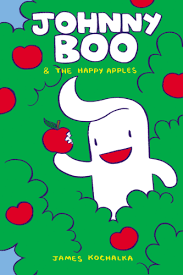
[READ: March 3, 2016] Johnny Boo & The Happy Apples

In this third book of the series, Johnny Boo, Squiggle and the Ice Cream Monster are back.

Johnny eats some ice cream and then shows off how strong it has made him. But when Squiggle accidentally “pops” Johnny’s muscle and it gets all floppy, there is much concern.  Things are even worse for Johnny when the ice cream monster (from the first book) comes and shows off his huge muscles that he got from eating apples.  If Squiggle laughs at Johnny’s floppy muscle you know there will be hurt feelings.  And there are.

Johnny runs off to find some happy apples to make his muscles strong, but he winds up eating apples from the ground, which makes his muscles super floppy (pretty hilarious looking). (more…)

Read Full Post »

  desmondSOUNDTRACK: FATHER FIGURES-Tiny Desk Concert #273 (April 29, 2013).

fatherBob Boilen describes Father Figures as “It was brash, zany, brainy, scary and danceable.”  The band formed in NYU around 2007 with Adam Schatz on sax and effects, Jas Walton on sax, Spencer Zahn on upright bass, Ian Chang on drums and Ross Edwards on keyboards.

“Doomed To Fail” is fast and rocking but very jazzy.  The two saxes play fast romping riffs while the keys play along.  Then things slow down as the bass and keyboards play a trippy, spacey-sounding melody (with occasional accents from the saxes).  The middle is noisy and skronky with some great rock bass and drums holding it down.  The song builds and builds to a shrieking climax at which point the drummer gives  few clicks on his snare before the song resumes again for a brief coda

“This Is The Way We Mean” opens with the 2 saxes playing off of each other before the bass comes in and lays a rhythm down.  Then it slows down with more cool, echoing synth sections.  One of the sax players starts playing percussion—including things all over Bob’s desk.

The first two songs are about 5 minutes each, but the last one is ten.  “Where Did You Come From?” opens slowly  and kind of trippy but it slows even further at the 3 minute mark to just some taps on the snare and bass notes.  Saxes come in around six minutes but it’s really fun to watch Chang on drums as he’s quite animated.  This song is interesting because although it keeps building and building, there is no extravagant climax, it fades quietly as it began.

[READ: July 5, 2016] Desmond Pucket and the Cloverfield Junior High Carnival of Horrors

By now, the Desmond Pucket series is in full swing (how can Tatulli write these books as well as a daily comic strip?).  Desmond is headed to 7th grade.  I like that the events of the summer (the previous book) have a huge impact on this book and that things aren’t simply stagnant in the Pucket-verse.

Like the other two books, this one is a really fast read (it’s over 200 pages but feels like it’s about 50).  And it’s chock full of fun illustrations (that are by “Desmond”) as well.

In fact even though Desmond is heading back to the same school, this year he’s a 7th grader–he’s weirded out about being in the same building but in a different hallway (and the dorky outfit he has to wear for going back to school).

When he gets to the first class–writing, their teacher tell them to write something original about what they did that summer–but they can do in whatever style they want.  And so Desmond creates a graphic novel. I love that the graphic novel recaps the previous summer in a great fashion and sets us up for this action of this book.  He gets a B+and is pretty happy about that.  But he is unhappy about the note at the end of the book: The Cloverfield Jr High Carnival of Horrors is to be cancelled this year.

In sum: the junior high principal was awesome. She was open to all kinds of things and realized that the school could make a lot of money with a good haunted house.  And the money they raised went to the library (this book loves libraries so much, I have to sing its praises even more). (more…)

Read Full Post »

johnny-twinkleSOUNDTRACK: SOWETO GOSPEL CHOIR-Tiny Desk Concert #209 (April 16, 2012).

sgcDressed all in black with pink accents the Soweto Gospel Choir certainly looks striking.  And their voices are superb.

The blurb notes that they

managed to tie the all-time record for most musicians squashed behind Bob Boilen’s desk for a single performance in the NPR Music offices. (They join the early-music a cappella ensemble Stile Antico, also with 12).

[I wonder if they keep statistics like this–I’d like to see numbers].

The Choir sings

in a number of South African languages, as well as English, Soweto Gospel Choir fuses the praise music of many Christian cultures, with nods to traditional African songs of celebration — complete with occasional clicks and bird songs.  To watch and sway along was to be blasted with some sort of ray gun that shoots beams of joy and hope.

They sing four pieces.   I don’t know what the songs area bout except for what the brief introductions tell us.

Two different women are the lead singers for the first two songs (no names are given). “Seteng Sediba” and “Emarabeni” which is a wedding song.  A man introduces the rest of the songs.  He says that “Emlanjeni/Yelele” is a traditional song and then he sings lead.  The final song “Kae le Kae” translates to Wherever I Go I Go with Jesus.

For each song the Choir sounds amazing together.  They only person not singing is the guy on the end who is playing the djembe to keep rhythm.  They sway in sync and hold hands up at the same time. They are something to watch.

As the final song ends, the Choir walks out of the room past everyone singing all the while.  It’s a great ending (and gives us a peek into the NPR offices).

[READ: March 3, 2016] Johnny Boo: Twinkle Power

This is the second Johnny Boo book and Johnny, Squiggle and the Ice Cream Monster are all back.

One thing that really cracks me up about the Johnny Boo books is how easily he and Squiggle get mad at each other.  And they always threaten to be mad forever.

In this book, Squiggle flies around Johnny’s head and makes his “hair” stand straight up.  This cracks up Squiggle and makes Johnny very angry and he threatens to never be friends with Squiggle again.

Of course this all started because Squiggle thinks that the stars have amazing Twinkle Power and he thinks it’s even better than Johnny’s Boo Power (GASP!).  Squiggle wants to go up to the stars to see if he can learn Twinkle Power. (more…)

Read Full Post »

johnny-1  SOUNDTRACK: RUDRESH MAHANTHAPPA-Tiny Desk Concert #201 (March 8, 2012).

rudreshRudresh Mahanthappa is a saxophonist whom I had not heard of but who is obviously very highly regarded (he won a Guggenheim Fellowship).

He plays jazz in very different styles, and totally wails (“a swarm of locusts rampaging through an irregular beat”), but has also experimented with different styles.  As the blurb says:

That latest album, 2011’s Samdhi, borrows a bit from … electric funk excesses … and integrates ideas from South Indian scales and modes, hip-hop and computer music programming.

The quartet here is top-notch:

Drummer Rudy Royston and Mahanthappa played in a Denver-based band together some 20-odd years ago, and have since reconnected in New York; electric bassist Rich Brown has played in just about every conceivable setting from his home base of Toronto, including the Canadian Indo-jazz group Autorickshaw; guitarist Rez Abbasi is a long-time confrere in the dual worlds of jazz and South Asian music.

They play two fairly long songs.

“Killer” starts the show.  I really loved the sound that the guitar had–a kind of electric organ/funk sound. Mahanthappa takes off right away.  One thing that was very cool was when I thought he was playing an improvised solo, but the guitarist was able to play exactly what he played both right after him and then with him (clearly it was part of the song–but it sounded great with the two of them together).  After about 4 minutes of wild noisy soloing it mellows out with a long groovy guitar solo–Rez is really impressive.  About a minute after that, the song picks up with some great drumming behind a wild guitar solo.   Around 8 minutes, the drummer gets his own impressive solo.  The ending is great and super fast.  The band sounds amazingly tight throughout.

I really love the sound of his backing band and while his sax playing is amazing and insanely fast, I actually prefer the middle section without the sax–it’s a little too frenetic for me (which is surprising, as I usually like this–I must not have been in the mood when listening).

“Playing With Stones” opens with a lengthy bass “solo” it’s a series of very quickly plucked notes that sounds almost like drums–its very cool. It lasts almost a minute and a half before the rest of the band kicks in.  There’s a great bass line throughout this track too–bouncy and a little funky.  I enjoyed the moment where Rich notices he’s on camera and gives a little smile.  As the song ends you hear them say “pretty pretty good” like Larry David.

Between songs Mahanthappa explains that all of the music on the album resulted from the Guggenheim Fellowship.  It went for research in India, looking for new ways to bridge certain areas of South Indian music and jazz with hip-hop and funk.  There’s also a funny moment when he introduces Rich and says, “He’s Canadian, don’t hold it against him.”  He mentions the CBC and then Rez says “And Tim Horton’s.”  Rich snaps “that’s not funny,” to much amusement.

[READ: February 1, 2016] Johnny Boo

Johnny Boo is a fun children’s series by James Kochalka.

Johnny Boo is a white ghost with a big swirl of “hair?” on top.  Has a pet ghost named Squiggle.  I love how simply these characters are drawn (as Kochalka tends to) and yet they are totally consistent.

As the story opens Johnny and Squiggle are playing around in the field.  Johnny is running while Squiggle is floating around   Squiggle has Squiggle Power and is able to float and swirl.  While Johnny has Boo power which is him shouting Boo very loudly and frightening Squiggle.

Squiggle is upset hat Johnny does this.  Squiggle gets mad, but Johnny says that they will get ice cream.  Which makes everything okay. (more…)

Read Full Post »

cardboardSOUNDTRACK: MARY HALVORSON QUINTET-Tiny Desk Concert #267 (February 25, 2013).

maryI had never heard of Mary Halvorson before.  And that makes sense because she is an avant-garde free-jazz guitarist, a sound I like (sometimes) but one which I do not follow.  So a little background is in order:

As a sidewoman, [Mary Halvorson] is often tapped to play in open improvising situations….  Among her sonic signatures are craggy distortions, bent strings and delay-pedaled blurts through a hollow-body guitar….  Halvorson has now recorded two albums with her quintet, one with alto saxophone (Jon Irabagon) and trumpet (Jonathan Finlayson) up top. (The rhythm section is also among New York’s finest, with John Hebert on bass and Ches Smith on drums.) From the way her songs balance order and entropy, you can hear that she’s studied how golden-era hard bop blended those voices, and how later generations morphed, rephrased and imploded those ideas.

The Quintet plays two pieces.  I would have guessed they were improvised but not only do they have titles, they have sheet music!

“Love In Eight Colors” (No. 21) starts out as a slightly dissonant mellow jazz piece.  Then about 45 seconds in, Mary throws in an unusual guitar lick—a slightly weird note.  And then a minute later things get noisy until a simple trumpet solo takes over.  When the music resumes, Mary is playing some strangely discordant chords over the solo—everyone seems to be doing their own thing.  Around 4 minutes in, it turns into something new with an interesting, mesmerizing guitar solo riff.  When the band resumes, the sax takes over and the trumpeter literally stands stock still like a statue staring forward–it’s almost creepy.  At 8 minutes, they introduce a two-minute drum solo.  It’s fun to watch all the strange things he does—elbow on the drum head, vibrato with his hands changing the sound, clicking the sides of his drum.  Then the band resumes until the end.  And it’s more dissonance.

She introduces “Hemorrhaging Smiles” (No. 25) without smiling.  There’s a lot more melody in this song–the sax and trumpet sound groovy.  Even the guitar is pretty. Then she throws in a bizarre scale which cycles throughout the song.  It’s strangely addicting and I enjoyed hearing it every time it came back–even though it wasn’t exactly pretty.  The guitar has a lot of vibrato on it, although about six minutes in she switches the sound of her guitar to a bit more conventional sound and she plays a wicked solo. The second listen through made me appreciate what was happening a lot more.  Even if the song is pretty out there.

Mary Halvorson’ Quintet is not for everyone.  It might not be for many at all, but if you like your jazz free, check her out.

[READ: June 19, 2016] Cardboard

I’ve had mixed feelings about TenNapel’s books.  I loved Ghostopolis, and didn’t love Tommysaurus Rex.  So I picked this up with some hesitation.

But I found that I really enjoyed this weird book a lot.

For a kids’ graphic novel it’s actually quite long.  And, for a kid’s graphic novels there’s a few adult themes (like unemployment and widowhood) that a kid may not get or care about all that much (or maybe they would, what do I know).

As the book opens we see Mike, a big burly carpenter, begging for work.  But he gets nothing.  And as he walks away we see a very strange-looking man (TenNapel’s book are chock full of weird-looking characters) who offers to sell him a gift for his son.  Mike has no money, so he can’t buy the cool gift.  But the man says that for 78 cents (the exact amount in his pocket) he can have this giant cardboard box.

Mike is appalled at the idea of getting his son a box (even if it can be a creative play toy–ha!), but he’s got nothing else.  So he drives home with this box muttering “worst present ever.” (more…)

Read Full Post »

squish-7SOUNDTRACK: CANTUS-Tiny Desk Concert #264 (February 4, 2013).

Cantus is an a capella cantusgroup of nine men with beautiful voices.

The blurb tells that there are many choral groups all over Minnesota (I had no idea):

Is there some kind of weird vocal vortex in Minnesota? The state turns out so many excellent choral groups — at the school, church and professional levels — that it can arguably be dubbed the choral center of the U.S.

Cantus went professional in 2000 and has cut 15 albums on its own label. Unlike some choral groups who specialize in one style of music, Cantus prides itself on diversity. Just take a look at the three songs its members chose for this concert.

“Wanting Memories” is a song steeped in African-American culture, written by Ysaye Barnwell from Sweet Honey in the Rock. “Zikr,” composed by A.R. Rahman — the same guy who scored the hit movie Slumdog Millionaire — has roots in the Sufi tradition, where deep chords and repeated phrases signal a slow burn toward religious ecstasy. And the group closes with German composer Franz Biebl’s gorgeous “Ave Maria,” a signature piece for the group that blends traditional plainsong (or chant) with delicate melody and voluptuous harmonies that ascend heavenward.

I was really impressed with this set.  “Wanting Memories”was very pretty all the way through.  From what I can tell there are two “bass’ singers who hum the melody while the others sing different parts with various harmonies.  (There’s also a shaker keeping rhythm, but that doesn’t count against the acapella in my opinion).  In the middle of the song, the basses stop the humming and sing along (in a fugue style).  The absence of those droning sounds is a dramatic change in the song. They resume the hums and end the song like it began–beautifully.

“Zikr” has incredibly low bass notes–they are genuinely impressive.   There is an occasional drum that adds some Sufi authenticity–but the sound like they have been singing in this style their whole lives.  It’s really impressive that they are doing something that seems so unlike the Minnesotans that they are.  The end of the song speeds things up a bit which is a very cool sound added to a very cool song.

In introducing “Ave Maria” they explain that they started in 1995 with four guys.  They expanded to 7 so they could perform this piece.  This turns out not to be the traditional Ave Maria.  It is very different indeed–with a traditional Latin (not Latin America, but Roman Latin) feel.  And here again there is the amazing deep voice of the bass and some amazing tenors.

It’s amazing how different they sound in each of these three songs–their range is tremendous.  There’s a comment in the blurb about the beauty of the human voice and that is really the case here–their voices are pristine and beautiful.  It’s a marvelous Tiny Desk.

[READ: July 20, 2013] Squish #7

I love the Squish books.  They’re funny and quick and often teach you a thing or two.  I also love that most of the characters are named after real microbes.  And each issue also has a Super Amoeba comic book scattered throughout.

As this book opens, we see Small Pond, where Super Amoeba lives.  Something flies out of the sky and crashes into the pond.

As with every time Squish reads this book though, he is interrupted,  This time it’s to go to school.  His friend Pod is drowsy walking down the street.  He was up late working on his top-secret project.  Squish asks is he can help, and Pod says yes–give him Squish’s Twinkie.

At school the teacher is showing them about acids and bases. The kids are bored until he pours vinegar into baking soda and they all wake up.

The next day on the way to school, sneaky Squish takes a bite out of his Twinkie.  So that when he offers it to Pod, Pod refuses.

But when Squish gets to school, his stomach starts to gurgle and he turns green (literally). (more…)

Read Full Post »

« Newer Posts - Older Posts »