Feeds:
Posts
Comments

Archive for the ‘Death’ Category

SOUNDTRACK: MERCHANDISE-“Become What You Are” (Field Recordings, April 17, 2014).

I feel like I’ve heard of Merchandise, but I can’t be sure.  Especially given their complex history:

Merchandise got its start on the Tampa punk and hardcore scene, then got weirder as artier influences like krautrock took hold. As its sound became harder to pin down, the band inspired an 18-month bidding war between record labels: This year, Merchandise finally signed with 4AD, and adventurous new material has begun to trickle out.

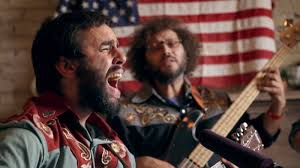
For this Field Recording [Merchandise Sprawls Out In The Sunlight] singer Carson Cox and guitarist Dave Vassalotti — a configuration Cox describes as “some component of Merchandise” — held court for an informal session at Friends & Neighbors,

Before he starts singing a bird goes squawking by, Cox says, “The bird’s on backup vocals.”

As the song starts, it’s acoustic guitar and gentle crooning.  Then Vassalotti’s  electric guitar powers in.  It’s so much louder but the acoustic is perfectly audible–great mixing!  For all that build up of punk and krautrock, this proves to be a pretty straightforward folk song with buzzy guitars.

The end builds nicely with the two of them rocking out.  With the ending guitar solo, the song wends it way to over 9 minutes long.

Though it usually keeps its songs to reasonable lengths, Merchandise also knows how to sprawl out: Its new single, “Begging for Your Life/In the City Light,” spans a whopping 14 minutes. So it’s no surprise that even a truncated version of the group would be capable of wringing an epic out of such a casual environment.

[READ: June 2018] The Misfortune of Marion Palm

Because I have been trying to empty my drafts folder of all of the New Yorker and Harper’s stories that have been cluttering it for two years, I have not read that many books this year.  I’m usually good for 100+ books a year, but this year it will be closer to about 30, if that.

I’ve also read some of these books quite a while ago, so my memory isn’t as fresh as it should be.

I’m not exactly sure why I read this book.  The title was intriguing–“misfortune” is a rather compelling noun.  Plus the chapters are almost all around 3 pages.  But I think it was the very premise that was so fascinating.

Marion Palm is a Brooklyn Heights wife and mother.  She works at her children’s (fancy, expensive) school and was a devoted, if suffering wife.  But as the book opens, she is on the lam with $40,000 cash in her pockets.  She said goodbye to her children but did not say goodbye to her husband.

This is all questionable behavior.  What is even more questionable is that she said goodbye to her two girls (aged 8 and 13) in a diner and then ran out on the bill.  It was cash only and all of her cash was in her knapsack and she didn’t want her girls to see it.  So she left them there. (more…)

Read Full Post »

SOUNDTRACK: PHOEBE BRIDGERS-Live at Newport Folk Festival (July 28, 2018).

I saw Phoebe Bridgers three days after this set at Newport Folk Festival (I had no idea).  She plays five more songs at my show than here (yay, me).

The size of the crowd does’t seem to intimate her in any way and she sounds just as great (and intimate) as she did in the small club where I saw her.

A few songs into her sun-drenched Saturday Newport Folk set, Phoebe Bridgers paused and proclaimed, “I am a puddle of sweat.” It was a one-liner that primed those huddled at the Harbor Stage for the 2018 Slingshot artist’s catalog: details delivered with specificity and a subtle sense of humor.

I will say the one thing about this recording is that I don;t think you can hear all of the percussion as clearly as I could at Asbury Lanes.

The show started much the same as mine did with a beautiful languid version of “Smoke Signals” and a try-to-hold-back-the-tears reading of “Funeral.”

For the next song, “Georgia,” she brought out songwriter Christian Lee Hutson who is “going to help me sing harmonies.”  Whether it was the song itself of Hutson’s addition, but Bridgers’ voice really soars on this song.

Even Bridgers’ stage banter reflected her striking style, mixing straightforward address and astute observation. “This song is about how every time I smoke weed, I remember why I don’t smoke weed,” she said of the plainspoken plea “Demi Moore.”

She continued: “I face plant and my brain is erased for many hours and I think I’m thinking too loud.”

There’s some gorgeous harmonies on the darkly sweet song, “Killer.”  Then she played “Steamroller” solo on the acoustic guitar.

Later, she called “Steamroller,” a devastatingly candid cut from her 2015 EP, Killer, “another dark love song, thanks.”

Introducing Gillian Welch’s song “Everything Is Free” she said. “This is my friend Marshall.  We’re going to sing my favorite song about music streaming ever written.”  I loved hearing this live and it sounds just as solid here.

Up next was a song she did not play at my show.  She welcomed Christian Lee Hutson (playing guitar with Jenny Lewis) and Sharon Silva (from The Wild Reeds) played bass with me for exactly one week and I waited for a really bassist…Emily.  Chris wrote this song for me.”  The chorus goes “”lets get the old band back together again, and there’s even a line, “with Emily on bass, it doesn’t feel the same.”

The crowd reacts strongly, as they should to her awesome song “Motion Sickness.”

Despite its venom, it’s a song that unspools with a sonic ease that feel refreshing, even for an overheated festival audience.

The songs sounds great live and she holds a 17-second note just for kicks.  The sets ends (as did ours) with “Scott Street.”  She says “This is about L.A. where we live;  where it’s hot all the time.”  It’s a quiet song, sounds and represents her music pretty perfectly–quiet, sad, with clever lyrics.

At our show, we got two encores after this, so again, yay for us.  But this is a great example of her live show.

[READ: April 22, 2016] “Playing with Dynamite”

Back in February of 2017, I posted about an essay by George Saunders from 2009 in which he remembers John Updike “Remembering Updike“.  He says that back in 1992:

 It was going to be in Tina Brown’s first issue and they marked this occasion by running two stories contrasting the new writers (Saunders) with the established.  Of course the establishment writer was going to be Updike.  Saunders said he was chagrined because he knew the contrast would go something like this:

Wonderful, established, powerful representative of the Old Guard kicks the butt of the flaky, superficial, crass poseurish New Guy.  Saunders’ story was “Offloading for Mrs. Schwartz.”

I can see why they paired the George Saunders story with this particular Updike story.  Both stories deal with grief and memory loss, although Updike’s does so in a very different way.  On the other hand, their writing styles are so very different that it’s nearly impossible to compare the two stories.

The story begins with an interesting image from childhood: “one aspect of childhood Fanshawe had not expected to return in old age was the mutability of things–the willingness of a chair, say, to become a leggy animal in the corner of his vision.”  But living now “in death’s immediate neighborhood” he allowed that things like that might happen and it wouldn’t be the end of the world.

There is then an episode in Fanshawe’s day when his wife, who was younger and more spry than he, passed him going down the stairs.  She caught her heel on her dress and fell down the stairs.  It was only after all the guests had left that she said to him, “Wasn’t I good, not to tell everybody how you pushed me me?” (more…)

Read Full Post »

SOUNDTRACK: ALYSON GREENFIELD-“Mama Said Knock You Out” (2011).

I found this song about 4 years ago and meant to post about it but never did.  I just saw it in my notes and decided to check it out again.

Alyson Greenfield is a pianist.  She sings (and plays) a bit like earlier Tori Amos.  And, like Tori, she takes an unlikley song to make an interesting cover.

The basis of this song is a wonderfully busy and complicated piano.  She doesn’t rap the verses exactly, but she does recite them quite quickly.

She is verbally dexterous, all while she’s playing a complex and beautiful arrangement on the piano.

The second chorus quiets down completely with a gentle piano melody and her singing softly but not un-menacingly.

It’s a fairly radical reinterpretation of the song.  There is no music in the original–just a sample of a simple musical motif), so everything that she plays is rather interesting and inspired.

I honestly don’t remember how I found this song.  But I have just looked her up and I see that it comes from an EP of covers of this ilk. The other songs include “Bad Boys” (a song I never had to hear again, even in her version).  “All That She Wants” which aside from being on piano instead of dance doesn’t sound all that different.  “Milkshake,” which I ‘d never heard of and “Gangsta’s Paradise” played on glockenspiel.

None of these covers is especially interesting because they lack the awesome musicality of “Mama.”

Since putting out that EP she released a one-off goof song called ‘Michael Cera C​*​ckblocked Me at SXSW,” and a song called “Uncharted Places,” which is kind of interesting–dancey but with toy instruments.  Her voice certainly sounds good in a poppy way.

But that was four years ago.  I’ve no idea what she’s up to.

[READ: January 5, 2018] “Blueprint for St. Louis”

I printed out this story from the web.  But apparently I missed the first page.  I was delighted that the story started with no introduction. I thought it was really cool that the first line was just:

What consumed them both right now was the situation in St. Louis.

What a wild opening.

It was said that in St. Louis there were thirty dead souls, but everyone knew that that number was low.  By a couple of decimal points. There had been a bombing and it was big.  It emerged that the explosives had been buried in the foundation of the building when it was being built two years earlier.

Terrorism wasn’t really the term anymore.  “Tax” seemed more like it.  This time it was levied on St Louis.  It was New Orleans the previous year.  Tuscon three years ago.  A tax on comfort and safety.  You learned not to be surprised.

It was Roy and Ida’s job to honor the site, honor the dead.  They designed large public graves where people could gather and maybe cool food trucks would park. (more…)

Read Full Post »

SOUNDTRACK: JULIA JACKLIN-Live at the Newport Folk Festival (2017).

I saw Julia Jacklin open for First Aid Kit and while I was looking for music by her I found this, her first show at Newport Folk Festival.

This show is a good representation of her live show, except that with when I saw her, she threw in a couple more upbeat songs–this set is a bit monotonous.  Or maybe that’s what an 11M crowd needs.

It’s often a sparse crowd that turns up to see an 11 a.m. set at a music festival — but not so at the Newport Folk Festival. When Julia Jacklin took the stage on Saturday morning, she seemed shocked to be faced with a tent full of attentive onlookers. (If it were any other festival, she pointed out, she’d probably be playing to an audience of four — and four hung-over people, at that.)

She played nine songs, several of which she played when I saw her.

“Hay Plain” is a slow meandering song  it takes almost 4 minutes before the full band kicks in, but when they do it really elevates the song.  ““Lead Light” she played when I saw her.  It has a kind of old school swing to it, almost 50s rock and roll.  The song build and stops several times.

“Cold Caller” is another slow-mover.  Midway through there’s a really cool–and to my mind, much needed–wicked guitar solo.  The backing vocals on “Motherland” mid way through the song perk things up.  She lets her vocals linger more on this one which shows of the power more.

“LA Dream” it is indeed dreamy and sweet and is mostly just her guitar.  “Eastwick” is a cool song that grows faster and louder in a rather slow and deliberate manner. “Coming Of Age” and “Pool Party” are slow brooding song.  “Pool Party” sounds familiar but defies what’s expected from a song with a title like that.

For the last song, “Don’t Let The Kids Win” the band left and it was just her on stage with her guitar.  The lyrics are so good and so well-delivered, it’s a real high point.

So, overall I find her songs to be pretty but a little flat.  She just not quite my thing.  But every time the rest of the band stepped up, the songs were much more fun for me (even when they werent “fun” songs).

To read some lyrics and what it was like to see her in person, check out this post.  That plaid skirt must be a trademark.

[READ: October 1, 2018] “When We Were Happy We Had Other Names”

This story is about death.

It opens in a funeral home, as the director is meeting with the protagonists Jiayu and her husband Chris.  The story is set in the States–Jiayu thinks about how much stranger living in the States would have been for her if it were fifty years earlier–but that’s doesn’t directly impact the story, exactly.

The gut punch of the story comes as we realize–it is mostly alluded to–that their son Evan has killed himself.  Their daughter Naomi is off at college and while she does come home for the funeral, she also cuts off a lot of access to her.

Jiayu and Chris spent a lot of time with grief–they asked if they had done something wrong–Evan had seemed so happy.  But things did have to move along.  Would they buy pumpkins for the holiday?  Christmas trees?  Would anyone notice or care if they didn’t?

But thinking about death was an all-consuming act for Jaiyu.  She wound up creating a spreadsheet of all of the people she knew or had met who have died.  She entered birth and death year as well as cause of death.  She wanted to test her memory, so she didn’t look up anything.  By remembering each person it would prevent them from become generically dead. (more…)

Read Full Post »

SOUNDTRACK: HOBO JOHNSON AND THE LOVEMAKERS-Tiny Desk Concert #785 (September 12, 2018).

Hobo Johnson and the Lovemakers are an incredibly fun and spontaneous-seeming band.  With lots and lots of shouting

“Romeo & Juliet” opens with some quiet piano and the band screaming: “Oh shit!  Godammit!  Fuck!  With Hobo continuing…Oh, that’s my shit right there!”

This song is a remarkably insightful look into a failing relationship.  It follows so many different avenues as Hobo John (Frank Lopes) speak/raps/sings lyrics that seem very personal.

We’re just Romeo and Juliet
But getting drunk and eating Percocets
But just to ease the stress
But soft what light, thru yonder window breaks
It is the east, but Juliet just puked off the balcony
How romantic

And if Romeo & Juliet continued to be married
Thens there’s half of a chance
That their kids would get embarrassed
When all the kids at school all talk about their parents
And Romeo Jr. has to say they’re not together
And Junior will dream of the day when he’s a man
And what he’ll do to avoid that 50% chance
Of his kids feeling the way he feels
He’ll probably just stick with Netflix and Chill

It ends with an a capella poem that details the breakup of parents–the sound of people falling out of love.

This is a band always on the verge of emotional explosions, all while Frank Lopes, aka Hobo Johnson, is quoting Shakespeare and making references to Jay-Z, The Front Bottoms song “Twin Size Mattress” and so much more.

“Sex in the City” opens with a pretty, quiet piano melody.  Hobo Johnson recites all of concerns about sex and love.  Lines like (“I got a duvet the other day – how do you wash a blanket? In a washer? That’s what I found out”)

So I’m not a babymaker-looker
But maybe I am
To a woman who really loves me
for who I am or maybe who I’m not
Either way it’s getting bothered and hot — GROSS!

If I looked like Brad Pitt mixed with a bit of Jake Gyllenhaal
in a bowl of David Hasselhoff.
I wouldn’t be here at all, I’d been in Los Angeles.
Or at your mom’s house eating all those sandwiches –DAMN I LOVE THOSE SANDWICHES.

It’s a terrific song.

Then Bob brings some peach scones our for the band–scones that he made himself.  (He got up at quarter to 7.  Hobo: That’s pretty early.  I will eat all these my self [grumbling] We’ll share them as a band).

The band

accomplished something remarkable this year with their Tiny Desk Contest entry. They made a simple backyard video – a single camera shoot – that’s now been seen almost 10 million times on YouTube. And the song they played, “Peach Scone,” has unlocked a door to a dream – to play a Tiny Desk Concert and be heard. The song is a tale of one-sided love – a tale of kindness in the face of loneliness and depression. Now, “a couple of kids – five I guess” as its lyrics go, get to bring their creative, urgent and somewhat nervous energy from Sacramento, Calif. to play “Peach Scone” and more to millions of other listeners.

They start “Scones” and Hobo messes up the words and laughs.  “How does this work when you mes at Tiny Desk?”  Bob: “Just start again.”  “Really?” “And we play the embarrassing part, too.”  “Really?  That’s awesome.”

For this song the pianist plays drums and there’s lots more shouting.  Despite the aforementioned kindness.  It’s terrific and slightly different from their video.

At times it’s as much a storytelling session or personal confession than a musical performance, and for me it conjures feelings of empathy and understanding and compassion.

The final song “Creve Coeur 1” is quieter.  It starts with a sad piano melody and although it has moments that are louder, the ending feels very personal: “Sorry Frank, You’re much too late.”

I hope I get to see them as they make the rounds touring.

[READ: September 20, 2017]  “As You Would Have Told It to Me (Sort of) If We Had Known Each Other Before You Died”

I really enjoyed this story.  Even if by the end I had no idea exactly what was happening.  And even after thinking about I’m not sure I even understand the internal logic of the title, much less the story.

It begins, “I remember that it was fall.”

Then the narrator tells the memory in past tense but with a sense of surprise as everything unfolds.

First, the police ring his doorbell.  The narrator thinks it is Katja.  He hadn’t spoken to her in three days, but things were like that between them sometimes. (more…)

Read Full Post »

SOUNDTRACK: FEDE GRAÑA Y LOS PROLIJOS-“”El Gigante” (Field Recordings, May 5, 2015).

Fede Graña Y Los Prolijos are from Uruguay and play a stomping bluegrass (which is why this is called A Bluegrass Ditty By Way Of Uruguay).

Every year SXSW hosts a night of music from Uruguay.

Nestled between Argentina and Brazil way down on the southern tip of the Americas, Uruguay spends way too much time in the shadows of its better-known neighbors.

But a closer listen reveals something for just about everyone: rockeros, sure, but also fans of hip-hop, folk-influenced downtempo music and singer-songwriters with distinct voices and stories to tell.

With an electric bass and a small hand drum laying down the thumping rhythm and an accordion adding to the flair, the fascination comes from the very American-sounding guitar solo that introduces the song.  But once you comfortably know that this is bluegrass, it’s even more surprising when they all sing in Spanish.

After a couple of verses, there’s an accordion solo followed by an acoustic guitar solo (from the other guitarist).  There’s a slow down that seems like an ending but it’s a fake out as the song takes off once more,.

There’s some great guitar fingerwork by he singer as the song races to an end

What a fun song, although I never heard the word “Gigante” once..

[READ: January 5, 2017] “Chicken Hill”

Joy Williams’ stories never do what I expect them to do–for better and worse.

This is the story of Ruth.

It begins with Ruth going to a memorial fundrasier at the Barbed Wire, a biker bar “in a somewhat alarming part of town.”  She had donated $30 to the memorial of a boy, Hector, who has been run over by a sheriff’s deputy.

Ruth was pleased that the father was suing the sheriff–then she found out it was the boy’s fault–he had run in to traffic against the light.

The transition is a strange one: “It was probably just a coincidence that a child appeared not long after that.”  This was a girl who lived in a house nearby.  She was the daughter of a doctor and rather than introducing herself she said to Ruth “I would like to draw you in plein air.” (more…)

Read Full Post »


SOUNDTRACK: THE DJANGO FESTIVAL ALL-STARS-“Them There Eyes” (Field Recordings, October 23, 2014).

This Field Recording was done under what looks like an old bridge outside of the Newport Jazz Festival.

Every year for the last decade and a half, select groups of hot swing musicians have come from Europe to tour the U.S. The exact lineups change, but they all feature masters of the “gypsy jazz” — or jazz manouche — style pioneered by guitarist Django Reinhardt. In fact, they’re billed under the banner of New York’s Django Reinhardt Festival.

After the last set of the Festival, done by the All-Stars, they asked the band, who had little time to spare, to play one last song.  Soon fingers were flying [The Fastest Fingers At The Festival, For Django Reinhardt]  The video there doesn’t work, but you can watch it on YouTube.

They chose the standard “Them There Eyes,” and to paraphrase its lyrics: They sparkled, they bubbled, and they got up to a whole lot of trouble.

Samson Schmitt, plays an amazing lead guitar–his soloing is blinding. The rhythm guitar from DouDou Cuillerier keeps up a great shuffle and Brian Torff on bass keeps the pace as everyone else gets a chance to solo wildly.

First up is Ludovic Beier, accordion and as a bystander observed: “He has the fastest fingers I’ve ever seen.”  And he does, it’s amazing.  His solo is followed by Pierre Blanchard, violin.  And Peter hits notes that seem like they might not actually exist on the violin.

There’s no vocals in the version which is just as well. No one would be able to keep up.

[READ: January 28, 2018] “Little Deaths”

Félix Fénéon was born in 1861.  In 1906 he wrote 1,220 brief items under the rubric “News in Three Lives” for the Paris newspaper Le Matin.  They were collected in a book and translated by Luc Sante

Seeing that these were written over time makes a lot more sense than having them all printed in a book–I mean, 1,220 deaths would be a lot to do all at once.  It’s still hard to believe that these would be printed in a newspaper at all.

Some examples in their entirety: (more…)

Read Full Post »

SOUNDTRACK: THE McCRARY SISTERS AND THE FAIRFIELD FOUR-“Rock My Soul” (Field Recordings, September 20, 2015).

Hearing these eight voices intertwine so beautifully is wonderful (I especially love the bass voice).  Knowing how the voices are connected is pretty cool, too.

The original Fairfield Four was founded nearly 95 years ago in Nashville, and has remained relevant into the present day; many current listeners know the group from its appearance in the Coen Brothers’ 2000 film O, Brother, Where Art Thou? The McCrary Sisters are the daughters of the now-deceased longtime Fairfield Four lead voice, Samuel McCrary; together, they’ve made a major impact as that rare thing in a mostly masculine preserve, a female gospel quartet. To hear these voices perform “Rock My Soul” together is to feel the power of living history and the timelessness of family connection.

“Rock My Soul,” powered by their persistent clapping is just wonderful.  Their voices sound amazing, their harmonies are wonderful. It’s a joyful three minutes.

[READ: August 29, 2018] “The Wind Cave”

This is a somber story from Murakami.

It concerns a boy and the death of his younger sister when she was 12.  She was born with a malfunctioning heart valve and although she was never robust, it was still a surprise that she died so young.

His parents told him to watch over her, to look after her because she was so delicate.  The fact hat he couldn’t save her from death (no one could) has hung over him.

He hated seeing her in the coffin and he grew claustrophobic even thinking about her in that tiny box.  The symptoms didn’t start right away but occurred after he had been locked in a box truck.  He was working a part time job and was accidentally locked into the back of the truck when people wanted to leave early.  (Frankly I would think that might trigger claustrophobia more than anything having to do with his sister).

But now he can no longer ride in elevators or watch movies about submarines. (more…)

Read Full Post »

SOUNDTRACK: JESSE BOYKINS III-“4 U 2 B Free” (Field Recordings, October 8, 2014).
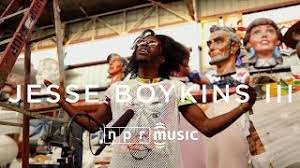
This Field Recording [Jesse Boykins III Breaks It Down] starts with a lot of ambient noise–a giant overhead fan–which I thought might be an interesting component to the song.  But once Boykins starts singing, it’s just his voice. And that’s all–it’s a lovely a capella performance.

The day after playing a set at the Superdome during the Essence Music Festival this summer, eclectic R&B singer Jesse Boykins III wandered into Mardi Gras World — an expansive, airy warehouse packed wall to wall with floats used in New Orleans’ infamous parades. The floats are built from the ground up in-house, so Boykins found himself surrounded by unfinished works and spare parts.

It’s creepy and unsettling to see these giant heads–eyeballs at eyeball height, but just a head–staring at you.  It’s also surreal with the various colors and shapes and the head of Abraham Lincoln looking on as Jesse sings.

He sang one of the most emotional tracks from his latest album a cappella. While singing “4 U 2 B Free,” Boykins pulled back the layers of his own creation, matching his performance to the exposed, oddly vulnerable characters surrounding him.

But Boykins’ performance is really powerful especially at the end as his wonderful high notes as if no no one is watching.

[READ: October 4, 2017] “Enter the Ford: Lost Chapters from A Death in the Family”

I knew nothing about this book, so I had to look it up.

The first chapter sees a young by, Rufus, waking up wearily with his dad.  The boy is very excited and the father seems pretty delighted to be awake with his son so early.  They try their best not to wake the baby girl or the mom.  Of course the mom wakes up and asks for the dad to do some things before he leaves.  The dad makes breakfast–with stern admonitions to the boy not get burnt by the coffee pot, bacon or stove–and then he helps the boy with the difficult buttons.

We don’t know too much about the dad yet, but this exchange is interesting:

“You’re getting pretty good, buttoning yourself.” he said.  Rufus said nothing.
His father thought damn fool thing to tell a child; dumb as a fish.

In the second chapter they head out to Chilhowee Park and the entire chapter is given over to the most exquisite descriptions of this amusement park through the eyes of Rufus.  Everything is amazing and wonderful and the language is of a person taking everything in–from the color of the lake to the swans on the water to the roller coaster and the fairy’s wheel.

And then came the merry-go-round.  We learn how first Rufus rode only on the bench.  And then was allowed to ride the horses that did not go up and down.  And then on the up and down horses only if his dad was holding on.  And finally, today, to ride the up and down one by himself.  The amount of detail about the merry-go round is wonderful.

The only thing more wonderful than the merry-go-round was the little train.  We hear his father’s kind words about how amazing the train is.

Then things go sour a little because there’s also the arcades–where adults play games of chance.  There’s games that one never won–like the seventeen jewel watch.  But the worst was a place where there was “a darky with his head through a hole.”  And the people were meant to, as the carny said, “hit the nigger in the head and you get a cigar.”

Rufus’ mom hated this game.  And Jay wasn’t too keen on it either.  The one time they were there, Jay conceded that the man’s got to make money some way.  Jay tried to ease his wife’s concerns by showing her that the ball wasn’t that hard.  He lifted it up but she refused to even touch it.  The carny got mad at him for touching the ball. And Jay got huffy back.  She calmed him and he walked away.

But on this visit, he did not back down. the carny did. And that made Jay’s day even better.

Chapter 3

This chapter opens with Jay and his wife, Laura, talking about something extravagant.  She wants it, he doesn’t seem to want it and he seems to twist her words against her.

It comes out that he wants to get a car so that they can visit the in-laws once in a while.  She is nervous that cars are dangerous.  He admits they are but sometimes living in a house is dangerous.  But he says that having a wife and kids means he will be even more careful than everyone else out there who has nothing to be careful about.

She agrees to the car.  But in the middle of the night she has a premonition of something bad happening to the family in the car.  He says that they won’t get one.  Then later she gets over the premonition and agrees that they should go ahead and get one.

Chapter Four.

And then daddy drove home in a gas buggy–a new ford  Rufus is thrilled.  Laura can’t believe he drove it there all by himself.  And the neighbors all come out to gawk.

“Course they got an awful name for breaking down… But where Ford’s ahead, he supplies you the parts.”

They go for a before-dinner ride.  Jay drives very well and everyone is enjoying themselves.  Laura is nervous and says so, but he is careful and considerate of them.  He pulls over when another car comes by and he is very cautious around a horse and buggy–the horse is not spooked at all.  But their joy ridge is somewhat ruined by a speed demon who comes buzzing by them scaring them all half to death.

As the excerpt ends, Jay and Rufus take the car out for a spin and Jay really lets the speed fly.  They almost have an accident but Jay is able to handle it and he confides in the boy that they must never tell their mom that they went fast.  He agrees.

I don’t actually know much else about this story.  Between the title and what kind of tension a scene like this builds I expected something bad to happen.  It never did (hooray), but i assume it does),

The writing in this story was exceptional.

Read Full Post »

SOUNDTRACK: STEVE GUNN-Plays Between the Ties of an Abandoned Railroad (Field Recordings, October 12, 2016).

I don’t know Steve Gunn and I am surprised to see that he has released fourteen albums and has worked with Kurt Vile.

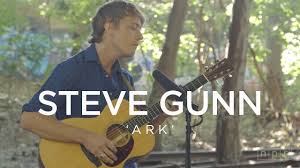
For this Field Recording, Gunn headed out to the woods to play three beautiful songs.

 In Forest Park, Queens, N.Y., an old relic suits Gunn’s sound. The Long Island Railroad’s Rockaway Beach Branch used to run through the park. It’s been abandoned for over a half-century, and trees have grown between the ties, skewing the rails and jarring the lines. Late this past summer, Gunn stood on the tracks of this worn American symbol and sang three songs off his latest album — songs about meandering, home and the crooked paths that take us wherever we’re meant to be.

Once again I am really impressed by the quality of the sound.  His guitar is absolutely clear and his voice is perfectly mic’d, but you can also hear ambient sounds–birds and such–making this recording unique.

Gunn has a pretty picking style (using thumb and fingers independently to get strums and picked notes simultaneously).  This enables him to keep the song moving forward while he plays the pretty guitar melodies.

“Full Moon Tide” has a great melody and a delightful chorus.

He walks further into the woods to play “Night Wander.”  It has a kind of circular feel in which the chorus feels like a part of the verse.  I’d say that Gunn’s voice is nothing special, but I like the deeper resonances he gets on this song.

For the final song, “Ark” he walks further down the tracks to a bridge.  Whether it is having the surface above him or just the style of his playing, this song feels warmer, and quite different from the others.

It’s a great introduction to this excellent guitarist.

[READ: January 9, 2017] “The Apartment”

This story is a fascinating look at a woman convincing herself that something must be true.

The apartment across from hers has been vacant for sometime–since the woman living there died.  But recently there was movement inside.  The person’s last name was Jahani.

Louise knew a man named Jahani when she was studying at Stockholm University.  Arman Jahani was the second man she’d slept with (her husband Martin was the first).  Martin, did not know about Arman.

While she is having lunch (sushi) with her adult son Jonas, she intersperses his conversation with memories of Arman.  The two most resonating thoughts are that he died in the early nineties and was survived by a son and a daughter.  Or so she believed.

She tells Jonas that the vacant apartment has been filled.  Jonas hasn’t lived at home for quite some time.  He wasn’t there when the woman died.  “You can;t imagine the smell” she tells him.  It was actually her husband who discovered her and was shocked that no one has mentioned the smell. (more…)

Read Full Post »

« Newer Posts - Older Posts »