
Feeds:
Posts
Comments

Archive for the ‘Babies’ Category

SOUNDTRACK: MOGWAI-Zidane: A 21st Century Portrait-An Original Soundtrack by Mogwai (2006).

It’s no secret that I love Mogwai.  I like them so much that I even track down soundtracks to obscure films that I’ll never watch.  (Of course, since Mogwai play mostly instrumentals, soundtrack work suits them quite well).

The Zidane of the film is Zinedine Zidane, a French footballer whom many consider to be the greatest ever (don’t yell at me for that, I don’t have an opinion of the man).  I had to look up exactly what the film is about and I have to say I’m intrigued: The film is a documentary focused on Zidane during the Spanish Liga Real Madrid vs. Villarreal CF game on April 23, 2005 at the Santiago Bernabéu Stadium and was filmed in real time using 17 synchronized cameras.  I watched a couple minutes on YouTube, and indeed it is a football match.   How on earth did they decide on that game (in which Zidane is ejected for fighting as the match nears its end).

The music is designed primarily for background and pacing, although there are certainly moments of great melody as well.  There are three songs that are more or less played twice (with different variations): “Terrific Speech 2″ and Terrific Speech” “Half Time and “Time and a Half” are similar piano melodies, and the opener and closer “Black Spider” and “Black Spider 2.”  “Black Spider 2” opens with the same melody as 1, but this song is thirty minutes long.  After a few moments of silence, it tuns into 17 minutes of quiet noise.  The remaining five experiment with distant feedback squalls.  Not loud and crazy, but something that creates a lot of tension, which goes with the end of the film.

Despite the titles, “Wake Up and Go Berserk” and “I Do Have Weapons” are a mellow songs.  They’re very pretty tracks.  Indeed, there’s nothing too wild at all here.  Fans of Mogwai’s wilder music will be a little disappointed.   And indeed, the overall feel is almost kind of sleepy, but it really captures another side of Mogwai, and the music is quite good.

[READ: June 20, 2012] “The Cheater’s Guide to Love”

Not bad… Junot Díaz had a story in the New Yorker just a few weeks ago, and now he’s got another one.

The familiar criticism of Díaz is that he writes the same story over and over (well, the other criticism is that he always writes in Spanish and English, but I think that’s a stupid complaint).  So here’s another story about Yunior and how he cheats on women and is basically a shit-heel.

While there is some validity to criticizing an author for retelling the same basic story, it is not unheard of in art.  Monet, for instance painted over 30 paintings of Rouen Cathedral.  And while they are all the same composition, individually they are very different.  Here’s four paintings (not prints a la Andy Warhol):
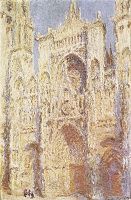
While I’m not suggesting that Díaz is on par with Monet, I am trying to say that you can work with a similar subject and create very different pieces of art.

So, yes it’s another Yunior story and yes, Yunior has cheated on his girlfriend again.  But this story is constructed differently.  And at this point I’m starting to wonder if maybe there aren’t multiple Yuniors–I’ll even think of them as in alternate realities.  Because Yunior sure has cheated on a lot of women by this time.

It makes him the perfect writer for “The Cheater’s Guide to Love.”

Unlike in the other stories, this one takes place over five years!  In Year 0 you are caught cheating by your girl (the story is set in second person).  She sticks it out with you for a time and then dumps your ass.  I liked how it was revealed just how many women he had cheated in her with over the years that they were together–he really is a shit.

In Year 1, you act like it doesn’t matter, but it does.  And you are crushed.  Your friends try to help out, but how much can they really do?  You think suicidal thoughts and imagine that that will make her forgive you.  It doesn’t.  By year 2, you have met someone.  But you find some bullshit reason (she hasn’t put out yet) and you break it off and go into another spiral.

Year 3 sees you looking after yourself–running and fitness.  In what I think of as a wholly accurate happening, you injure yourself running and are knocked back on your ass for months–momentum and caring are gone.  You look for substitutes but nothing feels as good as running.  So you stop.  And you let yourself go.

What I also liked about this story is that despite this background of the break up, there are other interesting things spiraling around Yunior.   There’s a fascinating look at racism in Boston (perceived or real?); there’s the woman who claims to be the mother of his child, the woman back in the DR who claims to be the mother of his friend Elvis’s son.  Both men act very differently to the news.  Elvis is thrilled to have a son, Yunior is freaked by this woman.  This is probably the first time that I’ve seen Díaz have a woman do behave the way they do in this story.  It’s also interesting to compare Yunior and Elvis by the end of the story.

I also got a kick out of all the women he used to cheat on his girlfriend with star getting married and they all start sending him invitations: “Revenge is living well, without you.”  Year 5 sees a completion of the spiral for all parties.  And a cool resolution to this story.

Much like with the Monet paintings, if  Díaz can keep his Yunior stories interesting (and varied enough), I will keep reading them.

For ease of searching I include: Junot Diaz, Bernabeu

Read Full Post »

SOUNDTRACK: STEREOLAB-Chemical Chords (2008).

You never really know what you’re going to get with Stereolab. Well, that’s not entirely true, you know you’re going to get some unusual sounding loungey keyboard songs with lyrics that are either in French or in highly accented English.  But beyond that each Stereolab album tends to go in its own direction.

Chemical Chords creates its own poppy bouncy bliss, making it one of their most approachable albums.  “Neon Beanbag” even features the chorus: “there’s nothing to be sad about” over a set of the bounciest keyboard riffs around.  “Three Women” has a brisk pace and some bright horns.   “One Finger Symphony” has a minor key and as lightly sinister tone (but it’s only 2 minutes long).

The title track has some cool echoed vocals and a wonderful break in the song that allows a sweet little string section to sneak through.  “The Ecstatic Static” is another pulsing song that seems alive somehow and “Valley Hi!” is a short darker piece with cool sound effects.

“Silver Sands” is a wonderfully bubbly pop song–the kind that Stereolab does so well, with vocals that seem like they might belong to another song.  “Pop Molecule” is a great minor key instrumental, which is a nice introduction to the super pop of “Self Portrait with ‘Electric Brain'” another bubbly song with a cool break in it.  “Nous Vous Demandons Pardon” opens with a martial beat before it settles down into a groovy song with French lyrics.

“Daisy Click Clack” shows off Stereolab’s totally unexpected lyrics:  “Snap snap snap snap with your fingers/Off beat on time make it linger/Enriching the rhythm/Do away with skepticism/Come and join the hymn, tap/Sensing the symbiotic force.”  From nonsense to the sublime in just a few short lines.

The final song “Vortial Phonotheque” reminds me of “I am the Walrus” in the music, but the gentle lyrics change the tone completely.  It’s a wonderful disc full of all of the bright sounds Stereolab does so well.  This would be their second to last disc before they went on a hiatus.

[READ: February 28, 2012] “How I Met My Daughter”

Two baby stories in a row!

Those following closely think that I was done with Max Barry last week.  But there was one final piece for me to read.  Technically this doesn’t make the last post wrong because although this story was on his website, it was also published in a magazine called The Bulletin.

If I thought that last week’s “Cement” story was dark, it’s nothing compared to this one!  Barry, while a somewhat violent writer (his last book was all about surgical procedures), is usually quite funny as well.  But this story eschews all humor for a walk through the dark side of man’s nature.

It opens with this incredibly dark couple of sentences:

They dragged this bloody, howling thing from my wife’s abdomen, its limbs twitching and clawing, its face like an angry pumpkin, and asked me, “Do you want to take a photo?”

Yes. I want to take a photo, so I can look back on the end of my life.

This story explores the feeling that men apparently have when their baby is born–jealousy at the lack of attention they will now receive.  I didn’t experience this at all and frankly it seems like a fictional thing to me, because I don’t know of any men who felt real jealousy of their babies.  But it makes for an interesting story. (more…)

Read Full Post »

SOUNDTRACK: NICK CAVE AND WARREN ELLIS-The Road: Original Film Score (2009).

I haven’t seen The Road, and I probably never will.  Nor have I read it.  The only reason I was listening to the soundtrack was because I like Nick Cave.  So this is a contextless review.  Of course, I know what the book is about and I rather assume that the film is equally harrowing.  I expected the soundtrack to be full of desolation and horror.

So I was quite surprised that most of the main themes are played on a piano with gentle strings or simply violins.  True there is a sense of emptiness and loss in these songs (they’re not jaunty piano pieces or anything) but they are still unexpectedly pretty.

Of course,a song like “The Cannibals” is bound to be more disconcerting, which it is.  It starts with creepy scratchy violins and then tribal drums take over–all set over a buzzing background.  This is more of what I expected the whole score to be like.   Similarly, “The House” must be a very frightening scene, as the music is threatening, loud, intense and quite scary with, again, more creepy percussion.  Unsurprisingly, a track called “The Cellar” is also spooky; it is only a minute long.

But then songs like “The Church” are so delicate and beautiful and not even all that sad–it actually makes me wonder what the scene in the film is showing.  The end of the score feels like the end of a movie, which I know it is, but it feels like a conventional movie, with closure, something I’m led to believe the book doesn’t have a lot of.

Taken away from the movie, this soundtrack is quite nice.  Aside from the three scarier tracks, this would make for some nice listening on a sad, rainy Sunday.

[READ: February 28, 2012] “The Longest Destroyed Poem”

I enjoyed Kuitenbrouwer’s “Corpse” so much that I decided to see what else she had written.  It comes to three books and four uncollected short stories.  There’s “Corpse” from The Walrus, this one here, another one called “Laikas” (which has a different title on the site where it lives) and a fourth with a broken link.  Boo.

But that’s okay because I’ll certainly investigate her books too.

Like “Corpse,” this story explores women’s sexuality, but it explores it in a very different way.  In fact, I loved the way it was introduced–especially because of the wonderfully convoluted way the sentence reveals it (and how it’s not even the main point of the sentence):

She looked fabulous. Better than back then, when she’d thought she wanted to be an artist, and Victor had made a point — she realized this as she realized many many things, that is she realized it in retrospect — of dropping into the conversation — the one she hadn’t actually been having with him, because she was instead focused almost solely on the fact his much younger roommate had a hand under the blanket her crotch also happened to be under — that he was off to bed early so he could work on a poem he’d been having trouble with.

I had to read it twice because I thought it was funny the first time, and when I fully parsed it, it was even funnier.

So yes, sex.  But as the story opens, years after the above event, Rosa sees Victor and decides to crash into him with her car.  It’s shocking and it’s shockingly well told.

I love the way Kuitenbrouwer uses language.  I could probably quote from this story six or seven times, but I love this sentence that forecasts the trouble ahead:  “Victor noticed her in that split second, too, and he knew what Rosa was up to, for his face changed, channel surfing from neutral smug — well, this was his everyday face — to impending doom.”

As she’s about to ram him (with a Prius, no less), we flash back to their spirited relationship. (more…)

Read Full Post »

SOUNDTRACK: THE FEELIES-Crazy Rhythms (bonus downloads) (2010).

The other day when I was playing Crazy Rhythms I noticed a little card that I had never noticed before.  It said that if I went to the label’s website, I could download bonus tracks.  That was pretty cool, so I did.

The are five tracks.  “Fa Cé-La” says it is a single version although it sounds even more spare and underproduced than the album version (and it’s a tad slower). “The Boy with the Perpetual Nervousness” and Moscow Nights” are demos.  “Boy” really sounds like a demo (the wood blocks are almost piercing!).  It’s interesting that the guitar solo, which sounds random on record was planned that way.  On “Moscow” the singer’s channeling Lou Reed pretty intently.

The next two tracks are live from a reunion tour in 2009.  I’m not exactly sure who was in the band, but that’s okay, the songs sound good.   “Crazy Rhythms” has a (simple) drum solo in the middle (more of a beat-keeping than a solo per se), and an extended jam towards the end song.  And the final song is a cover of Jonathan Richman’s “I Wanna Sleep in Your Arms,” at a frenetic two-minute pace.

Not bad for free downloads, eh?

[READ: December 31, 2011] “A Shade Less Perfect”

After reading all of those Max Barry blog posts, getting to read a real story is a real treat.

This is a very simple story of one-upmanship (a common trope of sitcoms–in fact just the other night Up All Night ran the “two brothers who must compete against each other at everything and never admit that they have failed at something” script).  And this story falls into the same general area, but Barry puts a surprising twist on the end.

Jonathan and Elizabeth are going to house of Jonathan’s boss, Dave.  Elizabeth likes Dave’s wife Julie.  They both had babies around the same time and met in birthing classes, so they are excited to catch up (it’s been about ten months since they’ve all seen each other).

Dave tends to lord everything over Jonathan at work.  Jonathan says he’s okay with this at work–Dave is his boss after all, but he doesn’t want to deal with it out side of work, too.  Naturally, Dave has a huge house and a convertible and every other material joy.  Even a nanny. (more…)

Read Full Post »

« Newer Posts