Feeds:
Posts
Comments

Archive for the ‘Orhan Pamuk’ Category

SOUNDTRACK: ACID MOTHERS TEMPLE & THE MELTING PARAISO U.F.O.-Pink Lady Lemonade ~ You’re From Inner Space (2011).
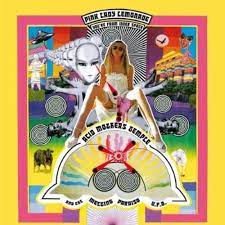
This album is something like the fortieth AMT album and somewhere in the middle of the band’s tenure with this lineup:

Tsuyama Atsushi: monster bass, voice, cosmic joker
Higashi Hiroshi: synthesizer, dancin’ king
Shimura Koji: drums, latino cool
Kawabata Makoto: guitar, guitar synthesizer, speed guru

The album consists of one song, the title track, broken into 4 parts all based around a simple, but rather lovely guitar melody

 “Part 1” is 32 minutes long.  It begins with the opening guitar melody which plays along with some trippy sounds.  Tsuyama is reciting the words (in Japanese?  English?  Gibberish?) and occasionally you hear the words “Pink lady Lemonade.”  At around 12 minutes drums and bass are added.  Once the bass starts meandering through some catchy riffs, Kawabata starts soloing.  It’s pretty far down in the mix (the main melody continues throughout).  Then around 22 minutes Tsuyama starts adding the monster bass–wild riffs that go up and down the fretboard.  With about 5 minutes left Kawabata starts playing s louder solo–louder than the rest of the music–and you can really hear him wailing away.   Part 1 fades out completely before jumping into Part 2.

“Part 2” is only 5 minutes, but it is utter chaos, with everyone making a big pile of noise–keyboard banging, sliding bass, thumping drums and wild, seemingly uncontrollable guitars.  It ends five minutes later with some warbling keys

Then comes “Part 3,” which runs just over the minutes.  It’s a faster chord version of the same guitar intro with slow bass notes and a big guitar solo.  It changes shape and adds some discoey bass lines.  About midway through the synths take over and while there is music in the background the song becomes mostly washes of sounds.

“Part 4” ends the disc at just over 18 minutes.  It picks up with the original guitar melody once more.  This time, it’s only a minute until the drums and bass kick in and the soling begins.  At five and a half minutes the guitar solo gets really loud and takes over.  The soloing is wild for over ten minutes and then around 13 minutes the song grows very quiet with only the lead guitar and the heavily echoed main riff playing.

There’s on online version here that has this entire record but adds six minutes at the end of the last part which is mostly the introductory melody and some washes of keys over the top.  i rather like this extra 6 minutes and it feels like a really nice ending.


[READ: May 1, 2021] “My First Passport”

This essay was translated from the Turkish by Maureen Feely.

Pamuk talks about people travelling from Turkey when he was young.  First it was his father, who left the country when Orhan was seven.  No one heard a word from him for several weeks when he turned up in Paris.  He was writing notebooks and regularly saw John-Paul Sartre.   He had become one of the penniless and miserable Turkish intellectuals who had been walking the streets of Paris.  Initially Orhan’s grandmother sent Orhan’s father money but eventually she stopped subsidizing her bohemian son in Paris.

When he ran out of money he got a job with I.B.M. and was transferred to Geneva.  Soon after Orhan’s mother joined his father but left Orhan and his brother with the grandparents.  They would follow when school was done.

Orhan sat for his first passport photo (included in the essay).  Thirty years later he realized that they had put the wrong eye color down–“a passport is not a document that tells us who were are but a document that shows what other people think of us.” (more…)

Read Full Post »

SOUNDTRACK: HAYKO CEPKIN-“Kabul Olur” (“Accepted”) (2018).

Hayko Cepkin is a Turkish singer of Armenian descent.  He was born on March 11, 1978 in Istanbul.

It’s hard to find out anything about him that’s not in Turkish.  So I’m including what I find interesting

In June 2005, he released his first album “a collection of compositions he recorded at home and all lyrics, music and arrangements of his own.”

He left Istanbul in 2014 and moved to Selçuk, İzmir.  He bought 9 acres of land from Şirince, and created a place where the lovers of Varil / Barrel Camping will enjoy and relax. The artist continues his music studies here.

He even had a festival there some years ago.

This song is from his latest album which is a great example of Anatolian rock–a fusion of Turkish folk and rock music.  He has taken it to some heavier levels than other bands with heavy electronics.

“Kabul Olur” starts with some electronic sounds and a flute before Cepkin starts singing in his rather lovely, powerful voice.

A minute it the drums kick in and the song starts to rock.  And then comes the power chorus at 1:20 (the second time through is even more powerful).  The post-chorus–the repeated title–is like a decompression after the intensity of the chorus.

The pounding middle section is a great combination of his growls and a traditional flute.

The denoument is him repeating “tamam” which means okay.  Its an ntense ending to a song that totally rocks.   Here’s the translated and original lyrics and the video below.

“Accepted”

My path is long, slow
Yolum uzun, ağır ağır geçer 
Life is tired I lean a little, see me
Ömür yoruldum eğilin biraz, beni görün 
The road is not this life desperation
Yol değil bu ömür biçaresizlik 
Stop, this is the final final way to death.
Durdurun, kesin final bu yol ölüm. 
Hear my voice, my voice is a little choked.
Duy duy sesim sesim biraz biraz kısık kısık buruk. 
He sees the end, walks, crazy heart.
Sonunu görür, yürür, deli gönül. Why isn’t my day in the season. 
Neden mevsim olupta günüm geçmiyor. 
Why is it born in my hands and dying? 
Ellerime doğupta neden ölüyor 
Even after all life goes by 
Bile bile sonuçta ömür geçiyor 
Heavy heavy heavy heavy heavy …
Ağır ağır ağır ağır ağır…Acceptance?
Kabul mu olur? 
Yeah, okay.
Evet, tamam.
Why isn’t my day in the season. 
Neden mevsim olupta günüm geçmiyor. 
Why is it born in my hands and dying? 
Ellerime doğupta neden ölüyor 
Even after all life goes by 
Bile bile sonuçta ömür geçiyor 
Heavy heavy heavy heavy heavy … 
Ağır ağır ağır ağır ağır… It’s okay.
Kabul olur. 
Yeah, okay.
Evet, tamam.


[READ: June 4, 2019] “Geneva, 1959”

The June 10th issue of the New Yorker features five essays by authors whom I have enjoyed.  They were gathered under the headline “Another Country.”

I do love a story which features lots of diacritics, and this one sure does.  Orhan talks about his brother Şevket and their mother Şekure and how they left Turkey because their father had gotten an good job with IBM in Switzerland.  The boys were seven and nine and their mother wanted them to learn French.  She had learned French in Istanbul and believed she could teach them at home.

But the boys were willful and she gave up, assuming the children would learn the language on the shore of Lake Geneva, in the parks, on the streets, or even at school.

But Orhan resisted the French language.  All of school was in French and Orhan seized up.  Mostly he hated being separated from his brother and he felt at sea. (more…)

Read Full Post »

SOUNDTRACK: KALBELLS-Tiny Desk Concert #783 (September 5, 2018).

The opening of the first song “Craving Art Droplets” was kind of promising, with the backing singers (Angelica Bess on keys, Sarah Pettinotti on bass) all “yeahing” at the same time and their rather strange chord progressions (and synth bass).  But once the song started, I realized it wasn’t going to get any better.  Just layer upon layer of cheesey synths.  The only thing that saved it was the live drums (Zoey Brasher), even though they don’t add a lot.

Just before the break, the song builds in an interesting way with everyone chanting louder and louder. And just when I thought there was hope, it devolved into the worst thing ever–lead singer Kalmia Travera’s long cheesey sax solo.  Oh dear.

She introduces the next piece: “The next song we’re gonna play is a medley.”  That’s a strange intro for songs no one knows.  Wordless chanting starts “123456/Bodyriders” (along with a cowbell).  The lyrics… are puzzling at best “Six was the rest, six was everything” (?)  When it segues into “Bodyriders,” the Travera singing high notes over the chanted background is promising, but those synth sounds again…. (even when she bends the notes, it’s still cheesey). .

“Droolerz” is a new song and has an amusing lyric: “We could play drums and eat lobster at the opera.”  And the way the delivery comes across is enjoyable.  The chorus also wants to be fun

Dance in the back yard, lets party
Let out all our demons, in the heat
Hang out on the lawn, in the dark
Naked in the shower, till dawn

But the way it’s sung is such a downer I can’t stand it.  Maybe its the synths–but I feel like the song is struggling and failing to be bigger than it is.  It all feels really sad to me.

[READ: April 15, 2016] “Distant Relations”

Sometimes it’s easy to tell that a piece in the New Yorker is an excerpt.  And sometimes you just hope it is.  And in this case, my hope was founded.  “Distant Relations” is a chapter from Pamuk’s book The Museum of Innocence, (like this excerpt, it was translated from the Turkish by Maureen Freely).

The main reason I assumed it was an excerpt was because of one or two lines in the early section of this story.  The ending, while ambiguous, could have been a (relatively unsatisfying) ending, but those hints that there was more really made me want there to be more.

The story begins with the narrator talking about his fiancée Sibel.  It was 1975 and she had just noticed a purse in a shop window (by Jenny Colon).  He made a note to go back and get the purse.  Although they are in Turkey, both protagonists have been abroad,  He studied in America, while Sibel studied in Paris.

The next day he decided to go to the shop and buy the purse.  It was owned by a distant relative.  She wasn’t there when he went in, but instead there was a beautiful young woman there.  Before the transaction was finished, he recognized who it was.  It was his “cousin” Füsun.  I put cousin in quotes because it turns out that she is very very distantly related. (more…)

Read Full Post »

SOUNDTRACK: THE HEAD AND THE HEART-Sasquatch Music Festival, May 28, 2011 (2011).

This is the fourth live recording from The Head and the Heart that NPR offers.  Not bad for a band with only one album out.  This set finds the band even more confident and relaxed (despite their genuine excitement at playing the festival).  The band sounds fantastic and I’ve really grown to appreciate the female harmonies on most of the songs now (I’ve not always liked them on every song).

This set has two as yet unrecorded songs in it (one of them was listed as untitled).  There’s some banter between the band and the fans (the band is nothing if not jovial) including a great story about how someone in the band went to Sasquatch the year before and swore he wouldn’t remove his backstage pass wrist band until The Head and The Heart band played Sasquatch.  I like to imagine there was ceremonial wrist band cutting ceremony on stage, but that is lost in the audio version.  Of course the story would be better if it was two or three years later, but it’s still a pretty good one. [See the Five Dials review below for a similar story!]

I found the sound quality of the show to be less than perfect.  The sounds are a bit muddied.  I don’t blame the band.  The Sasquatch venue may be beautiful (so many performers comment on it, I’d love to see the view) but I suspect that maybe the audio was less than stellar.

Nonetheless, The Head and the Heart continue to amaze in a live setting.

[READ: July 3, 3011] Five Dials Number 14

If Five Dials 13, The Festival Issue, was a double live CD, jam-packed with photos and stories and all kinds of wonderment, Five Dials Number 14 is an EP.  Even though it contains only one item, it’s more than a single, because the item is long and a lot is packed into it.  And that ends my metaphor.

One of the fun things about Five Dials is that it can be whatever length it wants to be. Many magazines offer double issues, but they never offer tiny issues afterwards.  And sometimes it’s nice to have a short issue that you can enjoy leisurely, without having to sift through filler.

So this issue consists of exactly two items: Craig Taylor’s introduction and the nobel prize acceptance speech by Orhan Pamuk. (more…)

Read Full Post »