Feeds:
Posts
Comments

Archive for the ‘Jordan Mechner’ Category

solomonSOUNDTRACK: RYAN KEBERLE & CATHARSIS-Tiny Desk Concert #393 (October 4, 2014).

keberleWhen Trombone Shorty played the Tiny Desk I said that I was surprised to see that the leader of the band was a trombone player.  Well, perhaps it’s not that unusual as Ryan Keberle is a trombonist as well.  But unlike many recent jazz performers, Keberle & Catharsis aren’t showing off. As the blurb puts it, “he’s not after any high-concept framing. He’s just targeting the sweet spot where a nifty arrangement meets a solid groove.”

This band plays pretty traditional jazz (complete with upright bass solos and everything). Although, interestingly, their first song is a cover of  Sufjan Stevens song (turns out that Keberle toured with Stevens).  “Sister” is my favorite of their three songs.  I really enjoyed when the full band kicked in after the intro riff from Keberle.  The band has a vocalist, Camila Meza, who mainly does wordless vocal sounds.  As the song nears its end she does sing lead vocals, and it’s quite pleasant.

Her vocals work pretty well for this song, but I didn’t like it is much later.  That could be because “Sister” is a catchy pop song, where the other songs are jazzy.  And I find her singing style to be a little lite-Fm for my tastes.

“Gallop” is a bit faster than the first song.  It moves along at a nice clip and then stops for a bass and drum solo–very very jazzy.  There’s a trumpet solo in the middle of song too (no trombone solos which is interesting, I guess).  The other guys in the band are Michael Rodriguez on trumpet, Jorge Roeder on bass and Eric Doob on drums.

“Zone” opens with two contradicting three note riffs on both trombone and trumpet which is pretty cool.  Then the song settles down to just bass drums and voice and Keberle playing the melodica (beloved instrument of Tiny Desk Concerts) which works but sounds odd in the mix.  It seems like the song is going to end as the music fades to just bass, but it soon picks up again with anew trumpet solo.

I don’t love mellow jazz like this, but these players are excellent.

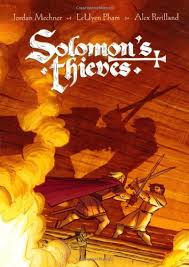
[READ: April 13, 2016] Solomon’s Thieves

I had this book on hold for quite some time.  When it finally came in, I thought, hey this art looks familiar.  And then hey, this book is about the Templar knights, what a strange thing that First Second would have two book about the Templar Knights.   And then as I flipped through it I realized the author and artists were the same.  And for a split second I though, they wrote two books about the Templar Knights?

And then it came to me that the first part of Templar was called “Solomon’s Thieves.”  And that this is indeed the First Part published long before Templar actually came out in full.

So even thought I had read the whole of Templar not too long ago, I decided to read this as well   As far as I can tell it is exactly the same as the first part of Templar.  Although it’s possible that there are some minor changes, I wasn’t sure if things that I didn’t remember were just because I can’t remember everything, you know?

Perhaps because I had read the full book not too long ago, I really enjoyed this run though again.  Since everything looked familiar, it was fun to pick up on things I missed the first time, and to see how things made a little more sense once I could tell who everyone was and what their roles were (there is something to be said for re-reading).

I’m including what I wrote about the first part of Templar here because it’s the same, but if you want more about the whole book or background about the Templar Knights check out the full post.

As the story opens we see Martin, a Knight, looking longingly at a woman, Isabelle.  We learn that he had been “dating” her (or whatever they called it back then) and then one day he found out that she left to be married to the brother of King Philip.  So he joined the Knights.  As they march through the city, we see that they are drunkards and carousers.  They get in all manner of trouble.  And one evening they were heading back to Paris when suddenly the above dictum was established–all Knights were to be arrested.  And Martin is one of them.

But through some excellent machinations (and good fighting) he escapes.  And he soon joins together with a very unlikely band of merry men, including Brother Dominic (a real priest with the tonsure and everything) and Brother Bernard, a loutish drunken man who is not above thieving from people.  Martin is offended at the thought of working with him, and they wind up at odds with each other from the start.  Before the end of the first book, we see that they have a letter revealing where all of the Templar gold and jewels are hidden.

There’s a great bit of accounting work done in which the bookkeeper shows on his ledger that rooms were empty when in fact it appears that the gold was taken out on hay carts.  The bookkeeper, even under torture, swears he knows nothing of the fortune’s whereabouts.

Mechner tells a really exciting story with humor and sadness.  The fact that it’s linked to history is just a bonus.  Another winner for First Second and their #1oyearsof01 anniversary.

Read Full Post »

flypanam templarSOUNDTRACK: FLY PAN AM-Fly Pan Am [CST008] (1999).

In the Constellation canon, there were four originators: Godspeed You Black Emperor were orchestral, Do Make Say Think were jazzy, and A Silver Mt Zion had vocals.  But Fly Pan Am was the weirdest one—the played with noise, they broke up their songs, they deconstructed their own work and, especially novel to me, everything was in French on the discs.

Roger Tellier-Craig, the main force behind FPA was in GYBE as well.  So he knows post-rock.

Their debut album is a long affair–an hour’s worth of music (in all of 5 songs) taken from two different recording sessions.  (All translated titles are taken from Wikipedia).

“L’espace au sol est redessiné par d’immenses panneaux bleus…” (“The Floorspace Is Redesigned by Huge Blue Signs…”) is a 13 minute song.   There’s ringing noises as a simple melody is plucked out.  The full instrumentation kicks in adding a repetitive guitar line that seems to fall into the background behind the opening notes that are still playing out.  The guitar lines slowly gets longer and longer, almost like a game of Simon.  By around 6 minutes the song has built up a serious head of steam with the bass and drums moving quickly and the guitar getting really complex. By 7 minutes that pretty guitar has turned into a ringing feedback skronking solo which carries on for a minute or so before fading back. At around 9 minutes the song seems to retreat on itself again. The guitars fade away and the bass seems to get a bit louder with the guitars ringing out. The last minute or so resumes a kind of noisy static sound that tells you the song is over.  That’s a heck of an introduction.

“…Et aussi l’éclairage de plastique au centre de tout ces compartiments latéraux” (“…And Also the Lighting of Plastic in the Center of All Its Lateral Compartments”) is a 9 minute song that opens with more scorching guitars and rumbling bass.  The guitar switches back and forth between a two note melody and a chord (dissonant, of course). The other guitar then plays a different three note melody.  About 2:30 in some noisy feedback and samples start taking over the song.  All the music drops away except for the bass.  By 3:15, all the music had dropped out and its just noisy effects and feedback and then outer space sounds.  After about 4 minutes of that (yes, indeed) the bass comes back in playing a kind of discoey rhythm with the guitar supplying a dancey counterpoint which runs to the end of the song.  It’s their first song where something really catchy is utterly dismantled by noise.

“Dans ses cheveux soixante circuits” (“In Her Hair Are Sixty Circuits”) is 17 minutes long (!) and is one of the most abrasive songs I can recall. The song opens with both guitars each playing a two-note melody which rotates through a round. They sound lovely together as the bass and drums play a slow rhythm. The melody changes a few times and then by around 3 and a half minutes the main guitar line grows faster (6 notes instead of 2) and the background feels a bit more tense.   And then at 5:46, the whole song seems to get stuck on repeat. The bass plays a 2 note rhythm, the drums play the same pattern and the two guitars each play one note over and over.  And over.  Evidently it’s “a half-tone interval.”  And this goes on for 12 minutes.  TWELVE!  The only differences through this whole section come from the digitalia of guest electronic musician Alexandre St-Onge, but they are the most unobtrusive electronics I’ve ever heard and just seem to bubble and prickle gently onto the repetition.  It’s maddening and then trance-like and then maddening all over again.  How can they play the same thing for twelve minutes—and their rhythm remains perfect?

“Bibi à nice, 1921” (“Bibi Nice, 1921”) opens with noises and feedback (which is a nice break from the 12 minutes of repetitiveness. But you soon realize that that’s all you’re getting (aside from some distant rumbling noise in the background). It’s a very silent song. For four minutes (out of ten) and then the full band kicks in for a really rocking section—great guitar lines and propulsive bass and drums. But after two minutes, the sound drops out entirely—pure silence (enough to make you assume the disc froze). It slowly returns after 20 seconds–they are messing with us again.  At 7 minutes a new guitar line comes in—slow and pretty with a slow drum beat.  A solo plays over the top—it is primarily electronic, and sounds pretty cool.   The guitars start playing louder and the song feels like it’s going to build up into something huge, but it soon ends and turns into….

“Nice est en feu!” (“Nice Is on Fire!”) seems like it should be connected to the previous song, but it starts off very different with big bass notes playing a very slow riff.  The guitar starts playing a nice accompanying riff. At 3 minutes in, voices come in singing Ahhs in a nice melody. The liner notes say that Kara Lacy and Norsola Johnson do vocals on “Bibi à nice, 1921” and “Nice est en feu!” but I didn’t hear any vocals on “Bibi.”  At 4:30 the guitar line turns to something else and there’s suddenly a whole bunch of noise flooding the track—sounds of water rushing, maybe—but that goes away and a new melody (slightly dissonant) resumes.  With about a minute left the voices resume—angelic and soaring over the rumbling song.  It ends this weird disc on a very pretty note.

I love the crazy stuff that Fly Pan Am creates, even if some of it is hard to listen to.

[READ: February 23, 2016] Templar

I had actually started to read this graphic novel before Prince of Persia.  But when I saw in the introduction that Mechner talks about Prince of Persia, I decided to grab that one and read it first.  The two have nothing to do with each other, but sometimes it’s nice to get things on order.

Who doesn’t love stories about the Templar knights?  The whole premise of the National Treasure is predicated on them after all.  Not to mention, The Da Vinci Code and the book that he says far surpasses all Templar stories: Foucault’s Pendulum [RIP Umberto Eco].

So Jordan Mechner has done a lot of research (there’s a sizable bibliography at the end of the book) to create the story about a couple of Knights Templar.  He says that “much nonsense has been written about the Knights Templar over the years. I’m proud to say that this book has added to that sum.”  He explains that thousands of knights were indeed killed.  Some knights did escape, but the main plot he constructed probably never happened.   One of the histories he read said that “figures of no importance” did escape, and so that was the basis for Martin, Bernard, Isabelle and their gang–inconsequential Templars and their own story.

He also says (in the preface) that all of the movies about the Knights focus on the treasure, but the Knights’ actual story–their rise and shocking downfall– is even more interesting.  He gives a brief backstory.  Formed during the crusades, the Templars gained fame as the noblest and bravest knights in Christendom.  Their legend grew which increased their numbers.   “They were the Jedi of their time.”  They peaked in the 13th century under the protection of the Catholic Church and The Pope.  Then in October 1307 the king of France ordered the mass arrest of All Templars in his kingdom (15,000 of them).  They were brought before the Inquisition and accused of witchcraft, heresy and sodomy.  Guillaume de Nogaret the king’s chef minister staged a huge show trail.  Prisoners who denied the charges were tortured until they confessed, which made everyone who refused to confess seem like a liar. Despite knowing the truth, the Pope bowed to pressure and Templars were destroyed.  Wow. (more…)

Read Full Post »

persiaSOUNDTRACK: SALTLAND-I Thought It Was Us But It Was All Of Us [CST094] (2013).

Piles of salt mined by local residents sit on the surface of the world's largest salt flats, the Salar de Uyuni, near the village of Colchani November 20, 2007. Bolivian airlines Aerosur and the Canedos family inaugurated this week the first regular flights of its renovated Douglas DC-3S, or Super DC-3, to bring tourists to the Salar, one of the world's natural wonders, in a project that the airline considers a "trip back in time." Picture taken November 20, 2007. REUTERS/David Mercado (BOLIVIA)Becky Foon, who is one of the main creators of Esmerine has another band on Constellation called Saltland.  The big difference with this band is that she sings as well.  And that this album is much more mellow–full of droning sections and a slow, deep bass that keeps the songs moving along.

This disc is very mellow, with lots of slow beats and electronica sprinkled around it.  When Foon sings, she sings in a deliciously slow voice.  So this album is a good one for chilling out.

The disc opens with “Golden Alley” which has some big slow bass notes and strings urging the song along.   When she begins singing, he voice is deep and hushed–an almost whispered sound that feels practically percussive.  There are words, but her voice also works as part of the music.  A bit of a shift in the music occurs near the end that makes it seem like it’s going to be a long song–especially when Colin Stetson starts blowing some saxophone notes–but it actually just signals the end.

“I Thought It Was Us” is an instrumental which features harmonium and cello.  It also has some interesting noises from Stetson.  About a minute and a half in, it shifts to a really catchy melody that runs through much of the rest of the song while the saxophone solo takes off.  It’s a highlight.

“Treehouse Schemes” really stands out as something familiar.  I don’t know if it sounds like something else or if Foon’s voice is so much more distinctive.  But I really like this track a lot.  It has a slow bass line and some stretched out guitars and then Foon sings a simple and lovely melody line.

“Unholy” is a bit more droney with some well used kalimba and Foon’s voice providing mostly wordless notes.  I really like the way at about a minute and a half, fast drums come in and seem to push the song faster, although the tempo never actually changes.  Theres some great tension and then a nice denouement.

“But It Was All of Us” is another slow droning instrumental, with some wordless vocals and some occasional bass notes. It feels almost like Western movie but with a Middle Eastern feel, a Middle Eastern Western?

“Colour the Night Sky” has some quiet, heavily distorted vocals that swirl with the pulsing beat of the drums and bass.   And then about midway through there’s a clean section where the vocals shine through the din, with the words “I have a fairy tale that I read when I’m feeling down.”

“ICA” has some quiet cello swirls and low voices.  And the album ends on a highlight with “Hearts Mind.”  It’s another one with a prominent bass while swirls of sounds float around Foon’s vocals.   It’s the last-minute or so Foon’s multitracked voices create some lovely ascending ooohss.

This album feel s a lot longer than its 38 minutes, possibly because most of the songs are quite long.  It’s definitely a mood creating album, although not as despairing as the album cover hints at.

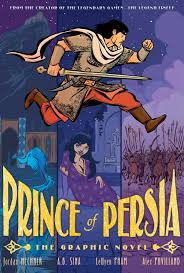
[READ:February 21, 2016] Prince of Persia

The evolution of this graphic novel is pretty fascinating.  And it is one I was completely unfamiliar with since I’m not a gamer.

Back in the 1980s Jordan Mechner created a video game called Prince of Persia.  It was popular and there was a sequel.  And then it kind of went away for a while, but people always loved it so then it came back again as a new series of games.  And a film (released in 2010).  Finally in, 2004 First Second (shoutout to #10yearsof01) contacted Mechner about making a story (not the same story as his games) into a graphic novel.  Mechner has always wanted to make a comic book (he had all the gear before he switches over to video games.  And here it is.

From what I gather, Mechner didn’t really write this story so much as inspire it (and I’m sure he had editorial control or whatever).  The book was written by A.B. Sina.  And it is a new story based on the nebulous ideas of the universe that Mechner had created.

I had actually not even heard of the video game (or the movie) so this was all lost on me. But that’s fine and is not necessary for enjoyment of the book.  Although I admit I found the story a little confusing (not because of not knowing the games), although by the end the way the stories linked up was pretty cool.

This story is set in two different eras (the 9th century and another prince in the 13th century) and has two stories paralleling each other.  The two men of the story are linked by a prophecy.  The story opens with Guiv, a (9th century) prince who had attempted to kill his brother Layth, fleeing the city of Marv after escaping death from Layth’s guards. The story then jumps to a young (13th century) woman, Shirin, who flees the city of Marv in an attempt to escape her father. She soon meets up with Ferdos,

Since Guiv was nearly killed by his brother he leaves the city.  He walks into the mountain where he is accompanied by a spirit animal (a peacock) and is able to fend off lions and boars until he encounters a door.  But inside is a pit made of human skeletons.

I was more interested in the story of Shirin.  She is a rebellious woman who would rather do gymnastic dances than hip shaking ones.  So she cuts her hair and leaves her palace behind.  Frankly her story of learning how rough things are outside of the palace was more interesting than the story of the men.   I guess it is also kind of that we follow her for many pages before she meets Ferdos and then his story takes over.  Not to mention, he seems like he’s just crazy for a while.

Ferdos is full of stories about Layth and Guiv and he imagines that he and Shirin will reprise the roles of these past rulers (Shirin will be Guian, the sister/lover–I’m a little unclear about that).

Eventually we learn that Ferdos has ties to the city of Marv, and that his story is linked to the past in unexpected ways.

The end o the story goes very fast with intense pacing and crossing of stories.  It definitely demands careful reading and maybe even a second reading, to see how the stories line up.

Th one great thing about the book is the way the two story lines are never visually confused–the color palates change depending on the century and the main characters all look different enough (especially Shrin, who looks incredibly sexy with her short hair and different colored eyes).

It’s a really clever and intricate story.   I wonder what fans of the game thought of it.

Read Full Post »