
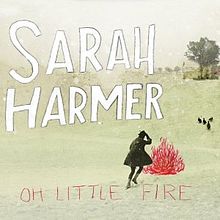
 SOUNDTRACK: SARAH HARMER-Oh Little Fire (2010).
I found Sarah Harmer when she had a left field hit (“Basement Apt”) in the states. I went back and discovered her band Weeping Tile (who are quite good and recorded a version of the song on their EP Eepee) and have been following her continued solo career.
Since that first record, she released a killer second disc, followed by a re-release of an intimate 1999 record she made for her dad which let her revel in her country roots. She followed this up with I’m a Mountain, a very country, but very catchy album. Finally, four years later, she put out Oh Little Fire.
Although she hasn’t lost her country roots, this album returns to more of the rock sound that first attracted me to her. It’s not hard or heavy by any stretch, but it’s moved beyond the country of I’m a Mountain.
Sarah and I listened to this album a lot at night when it first came out, and it slowly seeped into my system. I had kind of forgotten about it for a while, and upon rediscovering it I was delighted to hear that the melodies were fresh and still with me. The album seems like a simple indie folk or the work of an adult alternative singer songwriter, but the thing with Harmer is that she has that wonderful background with Weeping Tile, a band that was always slightly off-center. So, she writes beautiful melodies but puts little grace notes into them to keep them from being disposable. And yet they are still super catchy.
The only hard thing about this disc is wondering which song will be stuck in your head after listening to it.
[READ: January 7, 2011] L. M. Montgomery
I’ve never read any L. M. Montgomery (although I’ve seen the miniseries of Anne of Green Gables) and I’ve never read any Jane Urquhart (but I love her name!).
This biography is so radically different from the other three I’ve read so far. I wondered immediately if it was because Montgomery (and Urquhart) are women. It deals with subjects that the other books didn’t at all: lost loves, mental incapacitation, family crises. But it becomes clear through the book that these issues were THE issues that a woman at Montgomery’s time would have dealt with. Unlike the men in the other books, Montgomery did not have a professional life (outside of being an author, which she did at home). She was hardly a public figure, and since she was a woman, she was always in danger of losing what she had.
This biography is also vastly different from the others in the way it is constructed. You can tell by some of the chapter headings: Her Death (the first chapter), Orphan, Sorrow, Madness. You can also tell by these chapter titles that Montgomery did not have a happy life.
Indeed, between a husband who believed he was destined for Hell (he was a preacher!) and children whose life choices she disapproved of, not to mention terrible insomnia coupled with nightmares, her late adult life was nothing but torment. But, sadly for her, her early life was nothing but torment either. Her mother died when she was two, she was sent to live with her aunt and uncle (which was never a happy place). But the most depressing of all of these events is when she lost her dearest friend at a terribly young age, a death she never really recovered from.
So how is it possible that Montgomery wrote such charming stories?
The answer to that (and the basis for most of this biography) is in her diaries. Montgomery kept meticulous diaries (which she wrote and rewrote and then rewrote with posterity in mind). She wrote about her childhood and her life as (sort of) an orphan. She wrote about the places where she lived and the beautiful outdoors which impressed her. She wrote about the sadness and the happiness. Nothing was lost on her, and she saved it all (she also took photos of everything she loved, which are a beautiful and sometimes contradictory records of her diaries), and there are many published volumes that we can read to learn even more about her.
To me, the most fascinating (and horrible) part of the story was when she finally had Anne of Green Gables published. The publishers took complete advantage of her. They forced her to write sequels that she didn’t want to (although they are still quite good) and even compiled a final book from castoffs of the previous books (Return to Avonlea) that they published in her name. Eventually the case was settled in her favor, phew, and she was able to write new characters that inspired her.
Montgomery had a rough life, and as her diaries come to an end, she stopped writing about things. It’s hard to know exactly what she went through towards the end, but it doesn’t seem very positive. And yet for all of her disappointments in life, she left us with some engaging and memorable stories.
The last chapter is a fascinating personal account of how Montgomery’s stories impacted Urquhart’s family. It was incredibly touching and convinced me that Urquhart’s fiction would be enjoyable too. Some day, some day.
This was a really enjoyable (but major downer) biography. And, more than anything it has really inspired me to read Montgomery’s stories (and even one or two or Urquhart’s).
And, here’s a shameless plug to the folks at Penguin Canada–I will absolutely post about all of the books in this series if you want to send me the rest of them. I don’t know how much attention these titles will get outside of Canada, but I am quite interested in a number of the subjects, and will happily read all of the books if you want to send them to me. Just contact me here!

 I Just Read About That...